Historical Perspective
Like most folks, I’ve gotten hammered by the recent market declines. But yesterday —when Obama said “McCain’s capital gains tax cut won’t have any effect … not even the best investors have to worry about capital gains these days” — it got me thinking “how bad are things, and is Obama right?” Answer: “not that bad”, and “no”.
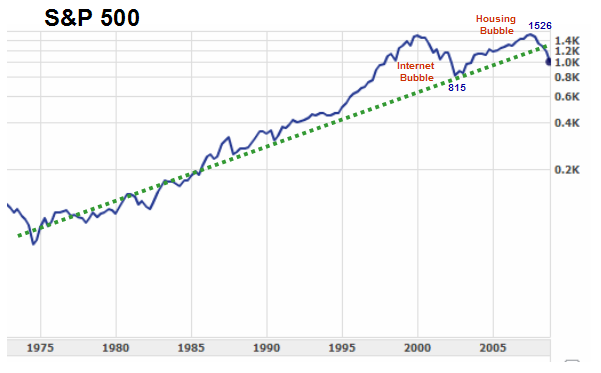
Below is historical data for the S&P 500 Index — right off Yahoo Finance. Since the plot is logarithmic, the straight line represents a constant rate of increase — across 33 years. Pretty remarkable, right ? Even considering the past couple of weeks’ battering. The chart really puts things in perspective. If you compare where we are to 2 artificially high periods — the internet -bubble and the housing bubble — things look pretty bleak. If you compare where we are to the long run historical trend — we’re only slightly below the trend line. In other words, right on track.
* * * * * *
Capital Gains
What about Obama’s assertion that not even the savviest investors will benefit from a halving of the capital gains rate?
Well, that might or might not be true. It depends on when stocks were bought. Using the S&P 500 as a proxy for an average stock, if a stock was bought near the peak of the internet or housing bubbles, it’s probably “under water” with no unrealized capital gains (i.e. capital losses). McCain’s proposal to allow deductibility of up to $15,000 of losses (up from $3,000) would offset some of the pain. The average tax benefit of the step-up would be about $2,400 [$12,000 step-up times 20% average effective tax rate equals $2,400].
But, note that a stock that’s been held for about 10 years — e.g. the portfolios of diehard “buy & hold” folks — are “in the money” and have capital gains. Or, folks who bought into the market after the internet bubble burst may have capital gains. For example, if somebody bought the S&P Index in Sept. 2002 at 815, they’d be sitting down from the housing bubble peak of 1,500 but — at 1,000 — they’d still have 185 of capital gains. After McCains 7.5% capital gains tax, that nets to 171; after Obama’s 20%, that nets to 148 — a 16% difference. Hmmm. I guess the cut in the capital gains tax rate could matter.
More important, McCain’s capital gains tax rate cut is intended to attract capital into the market now — with the prospects of favorable tax treatment when prospective gains are realized. The increased flow of capital should boost the stock market — which is good for all investors, big and small — and should provide growth capital to businesses — which should help employment. Win-win.

* * * * *
Want more from the Homa Files?
Click link => The Homa Files Blog
 The Homa Files
Leave a comment