Ken’s Take: Part of my summer research, I’m trying to learn more about the the marketing power of search engines (i.e. Google) and social networking sites (e.g. Facebook, LinkedIn). As a proponent of the Customer Lifetime Value methodologies, I’m intrigued by the “value of a (networked) friend”.
Below are highlights from a Business Week article on the subject. Short on answers, but sets up the problem …
* * * * *
Excerpted from Business Week, “Learning, and Profiting, from Online Friendships”, May 21, 2009
Friendships aren’t what they used to be. Practically every hand we shake and every business card we exchange can lead to an invitation, sometimes within minutes, for a “friendship” on LinkedIn or Facebook.
What do these relationships say about us and the people in our networks? Companies armed with rich new data and powerful computers are beginning to explore these questions. They’re finding that digital friendships speak volumes about us as consumers and workers, and decoding the data can lead to profitable insights.
Companies are working fast to figure out how to make money from the wealth of data they’re beginning to have about our online friendships.Calculating the value of these relationships has become a defining challenge for marketers. They’re finding that if our friends buy something, there’s a better-than-average chance we’ll buy it, too. It’s a simple insight but one that could lead to targeted messaging in an age of growing media clutter.
An immense new laboratory of human relations is taking shape. Millions of us are playing, working, flirting, and socializing online. —. The network behavior of 295 million e-mailers and legions of the 200 million Facebook users is producing oceans of data,
A critical finding: “The value of most information has collapsed to zero. The only scarce resource is attention.” This has created what many call the “Attention Economy.”
The easiest way is to get tips from friends. They’re our trusted sources. At least a few of them know us better than any algorithm ever could. Little surprise, then, that the companies most eager to command our attention are studying which friends we listen to.
Statistically, friends tend to behave alike. A couple of years ago researchers at Yahoo found that if someone clicked on an online ad, the people on his or her instant chat buddy list, when served the same ad, were three to four times more likely than average to click on it. It makes sense. Friends share interests.
But it raised lots of questions. Which types of friends have the most meaningful correlations with each other? People have always confided in a small circle of intimates, often only two or three. They’ve also had wider circles of experts for specific advice, whether on cars or cooking. Then there’s a broader circle of acquaintances whose opinions count far less but who can still generate buzz about a new restaurant or senatorial candidate.
By studying patterns of interactions on networks, researchers are working to predict which friends we trust and which we pay attention to in each area of our lives. A research scientist at Facebook, has perhaps the greatest lab in history for studying friendship. He can study social media communications including wall posts, shared photos, pokes, and friend requests among 200 million people.
For all its popularity, Facebook has yet to prove itself as an advertising platform. Visitors, it seems, focus on their friends and pay scant attention to ads. Few click on them, and advertisers pay pennies for page views. Consequently, Facebook, with its estimated revenue of $300 million this year, brings in scarcely a dime a month per member.
An average Facebook user with 500 friends actively follows the news on only 40 of them, communicates with 20, and keeps in close touch with about 10. Those with smaller networks follow even fewer.
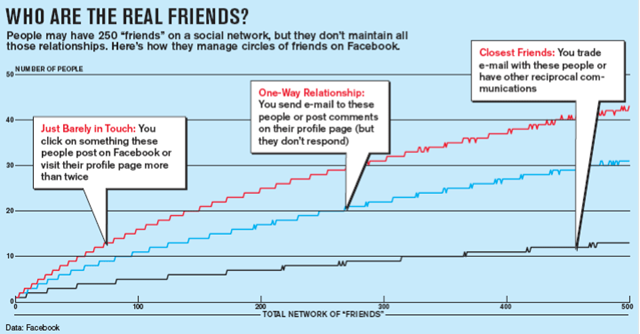
What can this teach advertisers? People don’t pay much attention to most of their online friends. By focusing campaigns on people who interact with each other, they’ll likely get better results.
In an industry where the majority of ads go unclicked, even a small boost can make a big difference. In one market test, tailoring offers based on friends’ responses helped lift the average click rate from 0.9% to 2.7%. Although 97.3% of the people surfed past the ads, the click rate still tripled.
All of networked humanity mingles in avast marketplace, trading information, creating alliances, doing favors. We may not think of our connections in such mercantile terms. But for business and individuals alike, the value in online friendship is a central focus.
Full article:
http://www.businessweek.com/magazine/content/09_22/b4133032573293.htm?chan=magazine+channel_in+depth
 The Homa Files
June 11, 2009 at 8:24 pm |
Hey just wanted to say I’ve been subscribed to your blog for a while and its really nice to see one that makes whatever it talks about really interesting and understandable while still dealing with tough issues and always teaching you something.