Archive for September 10th, 2009

Reprise: Medicare-Medicaid waste & fraud … stop yakking and fix it already.

September 10, 2009

This was originally posted July 23. 

Six weeks later, it’s still Obama’s silver bullet for covering some added healthcare costs … but nothing has been done.  If the “nut” is so juicy, go crack it already.  Comprehensive healthcare reform isn’t required to root out waste and fraud in existing programs.  We’ve wasted another $6.5 billion since my last post on the subject.  Hmmm.

* * * * *

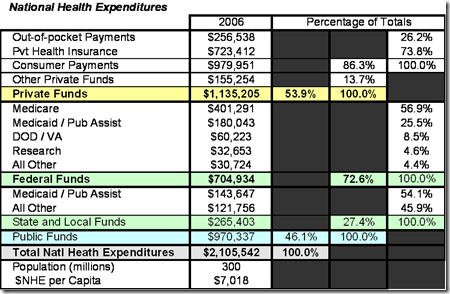
Currently, U.S. health care expenditures are about $2,1 trillion (just over $7,000 per person).

Of that, roughly half is already government administered via Medicare and Medicaid.

Would someone please explain to me:

(!) Why Obama’s crack team doesn’t fix the problem instead of just constantly whining about it ?  My hunch: finding random instances of abuse is easy, but ferreting  out fraud en masse is hard to do – and fixing it requires a massive overhaul of systems and procedures. If more people or resources are required, spell them out and get Congress to approve them post haste.

(2) If that half of the national healthcare budget is managed so badly by the government, why should we expect that the government will do any better with the other half if they take that over?

Ken’s Take: How about the government fix Medicare-Medicaid starting today, and when success is evident, come back and pitch to take over the other half.

* * * * *

Hard Facts

image

* * * * *

How To Really Fix Our Health-Care System

September 10, 2009

Washington Post,10 Things I Hate About Health-Care Reform, September 6, 2009

As a cardiologist and the administrator of a large practice that includes general internists and specialists, I spend much of my time trying to figure out how to provide care for a growing number of uninsured or underinsured patients. I also have to battle billion-dollar private insurance companies that don’t adequately cover patients with preexisting illnesses and often deny coverage for necessary treatments.

Here are 10 major reasons why I — and doctors like me — worry that the legislation on the table will leave us worse off.

1. Private insurance companies escape real regulation.

2. We urgently need tort reform, but it’s nowhere to be seen.

Without fixing these spiraling insurance costs and the legal environment that allows large payments in unjust suits, physicians will continue to practice expensive “defensive” medicine or simply leave states that do not enact tort reform.

3. “Prevention” won’t magically make costs go down.

in general, prevention adds to costs instead of reducing them. That’s because it often means medication for hypertension and elevated cholesterol, and screening and early treatment for cancer. No amount of “prevention” will put a dent in the cost of keeping Americans healthy.

4. Reform efforts don’t address our critical shortage of health-care workers.

Many people believe that the fix for our physician deficit is simple: expand class sizes at existing medical schools and create new ones. Sorry, it’s not that easy. There is a cap on the number of federally funded training positions for newly minted M.D.s. It hasn’t changed since 1996. If the number of graduates of U.S. medical schools increases but the number of post-graduate training positions remains the same, we won’t have fixed the problem — we’ll have created a different one.

5. We need more primary-care physicians — but we also need specialists.

Everyone is worried about the dwindling ranks of primary-care physicians. But we need more specialists, too. There are impending shortages in fields such as oncology, cardiology, general surgery and gastroenterology.  Few Americans will tolerate not having access to a specialist in an emergency or having care rationed because of a limited number of skilled physicians.

6. We have to streamline drug development and shake up the Food and Drug Administration.

Creating and producing new drug therapies in the United States is a nightmare. Regulatory hurdles, disorganization and a lack of leadership at the FDA, as well as burdensome conflict-of-interest policies, have made the drug-approval process grindingly slow. At the same time, development costs are close to $1 billion per drug.

7. We can’t fund health-care reform by cutting payments to doctors.

The Centers for Medicare and Medicaid Services has proposed increasing payments to primary-care physicians by approximately 6 percent while lowering payments for many specialists, including cardiologists and oncologists, by as much as 20 to 40 percent. The American College of Cardiology estimates that 40 percent of the cardiology practices in Florida will go bankrupt.

8. We can’t forget about research.

Every modern treatment for human disease is related in some way to research at U.S. academic medical centers. However, decreased federal funding for research over the past six years has threatened to decimate a generation of young scientists and the cures they could discover.

9. Cutting reimbursements could shut some hospitals down.

It is unlikely that the homeless, the mentally ill, the substance abusers or the illegal immigrants who now receive their care in “safety net” hospitals will carry any form of health insurance.

10. We need to improve the quality of care.

The Institute of Medicine has pointed out, poor quality of care can be divided into three types: underuse of care, misuse of care and overuse of care. While eliminating misuse and overuse will decrease the cost of care, correcting problems from underuse will actually increase costs.

* * * * *

I want my patients to have insurance that will pay for their care, and I want to be able to offer new medications and the most sophisticated treatment. I want to be able to give preventive care as well as to monitor patients effectively if they develop diseases. I want to be able care for my patients in their homes, and I want to offer palliative care if it becomes necessary. I want them to be able to afford all this.

In short, I want to see major reforms in health care — I just don’t want what is on the table.

Full article:
http://www.washingtonpost.com/wp-dyn/content/article/2009/09/04/AR2009090402274.html

* * * * *

The “good enough” revolution …

September 10, 2009

Wired, The Good Enough Revolution: When Cheap and Simple Is Just Fine,  08.24.09

The central premise:

The world has sped up, become more connected and a whole lot busier.

As a result, what consumers want from the products and services they buy is fundamentally changing.

We now favor flexibility over high fidelity, convenience over features, quick and dirty over slow and polished. Having it here and now is more important than having it perfect.

These changes run so deep and wide, they’re actually altering what we mean when we describe a product as “high-quality.”

Entire markets have been transformed by products that trade power or fidelity for low price, flexibility, and convenience.

Some examples …

MP3s

The music industry initially laughed off the format, because compared with the CD it sounded terrible.

What record labels and retailers failed to recognize was that although MP3 provided relatively low audio quality, it had a number of offsetting positive qualities.

By reducing the size of audio files, MP3s allowed us to get music into our computers—and, more important, onto the Internet—at a manageable size.

This in turn let us listen to, manage, and manipulate tracks on our PCs, carry thousands of songs in our pockets, purchase songs from our living rooms, and share tracks with friends and even strangers.

And as it turned out, those benefits actually mattered a lot more to music lovers than the single measure of quality we had previously applied to recorded music—fidelity.

Netbooks

On paper, netbooks might seem like crappy toys.

They have almost no storage, processing power, or graphics capability.

What they do have, though, is accessibility: Cheap, small, and light, they let you connect to the Internet from almost anywhere.

Netbook shipments were up sevenfold in the first quarter of 2009.

Kindle

Amazon’s Kindle can’t display complex graphics, and paper still has much higher resolution.

But the device does store hundreds of titles in a slim package, ensuring that you always have access to whichever Philip K. Dick tale you’re in the mood for.

The Kindle is expected to generate $310 million in revenue by the end of 2009

Kaiser Micrclinics

Instead of building a hospital in a new area, Kaiser just leases space in a strip mall, sets up a high tech office, and hires two doctors to staff it.

They cut everything they could out of the clinics: no pharmacy, no radiology. They even cut the receptionist in favor of an ATM-like kiosk where patients can check in with their Kaiser card.

Thanks to the digitization of records, patients can go to a “microclinic” for most of their needs and seamlessly transition to a hospital farther away when necessary.

What they found is that the system performs very well. Two doctors working out of a microclinic can meet 80 percent of a typical patient’s needs.

With a hi-def video conferencing add-on, members can even link to a nearby hospital for a quick consult with a specialist.

Patients would still need to travel to a full-size facility for major trauma, surgery, or access to expensive diagnostic equipment, but those are situations that arise infrequently.

* * * * *

80 percent is a magic number — the famous Pareto principle, also known as the 80/20 rule.

And it happens to be a recurring theme in Good Enough products: 20 percent of the effort, features, or investment often delivers 80 percent of the value to consumers.

That means you can drastically simplify a product or service in order to make it more accessible and still keep 80 percent of what users want—making it Good Enough

* * * * *

Full article:
http://www.wired.com/gadgets/miscellaneous/magazine/17-09/ff_goodenough?currentPage=all

Thanks to MSB MBA alum Mike Cirrito for the lead

* * * * *