Archive for March 11th, 2010

The perils of reconciliation … or the upside if you don’t like ObamaCare

March 11, 2010

Candidate Obama pledged not to use reconciliation for healthcare legislation when he was stumping.  So much for campaign promises.

There’s a greater risk to the Dems if they use the process to pass ObamaCare: if the GOP retakes a majority of the Senate, it can use the same process to repeal the legislation.  After all, an unequivocal precedent will have been set.  Oops.

* * * * *

Excerpted from WSJ: The Trouble With ‘Reconciliation’, March 11, 2010

Fear not, sayeth Speaker Pelosi, all will be fixed with the magic dust known as “reconciliation” —a  process that allows budget and spending bills to move through the Senate with 51 votes instead of 60.

But, if Democrats use reconciliation to enact health-care reform, this fight isn’t likely to end this year.

Democrats are resorting to reconciliation because that would allow them to avoid a Republican filibuster.

That leaves Republicans free to use the same process to repeal ObamaCare that Democrats are using to enact it.

It means that for the next several election cycles every GOP Senate candidate can campaign on the promise to be that 51st vote for repeal.

House Democrats would be foolish to trust a process that has deeply alienated the American public. There are lots of reasons for Democrats to worry that voters will punish them for passing this reform.

Full article:
http://online.wsj.com/article/SB10001424052748703701004575113831577327418.html

Blame the recession on low and declining business investment — and don’t expect it to get better.

March 11, 2010

Punchline: Headlines typically say that low consumer spending is at the root of the recession.  But, gov’t data indicates another cause: low and declining business investment in plant, equipment, software, and inventories. An aggregate demand problem that is certain to be exacerbated — not mitigated — by higher taxes on business and capital.

* * * * *

Excerpted from: IBD: No Recovery Until America Invests Again, 03/09/2010

The deeper story of the continuing recession can be found buried in the statistical appendix to the 2010 report of the president’s Council of Economic Advisers.

That story: a devastating decline in investment spending.

The government’s data reveal that, contrary to popular belief, consumer spending held up fairly well during the recession, falling less than 2% from the fourth quarter of 2007 to the second quarter of ’09.

A drop in private investment spending — primarily business purchases of structures, equipment, software and additions to inventories — was far more significant to the recession.

Gross private domestic investment peaked in 2006. Between the first quarter of that year and the second quarter of 2009, it fell precipitously, by nearly 34%.

This huge decline in investment spending portends an extended period of slow economic growth, lasting several years and perhaps longer. Worn-out equipment, obsolete software, ill-maintained structures and depleted inventories are not the stuff of which rapid, sustained economic growth is made.

Business firms have also fled from inventory investment, trimming their holdings by an unprecedented $125 billion in 2009 after lopping off $35 billion in 2008.

Federal government spending, meanwhile, has raced ahead. From 2007 to 2009, government purchases of newly produced final goods and services — the federal government’s “contribution” to GDP — increased by over 13% in constant dollars.

Making matters worse, the explosion of the federal government’s size, scope and power since mid-2008 has created enormous uncertainties among investors.

New taxes and higher rates of old taxes; potentially large burdens of compliance with new environmental and energy regulations and mandatory health care expenses; new, intrinsically arbitrary government oversight of systemic risks associated with virtually any type of business — all of these unsettling possibilities must give pause to anyone considering a long-term investment.

Unless Washington acts soon to resolve these uncertainties, from the cap-and-trade folly to the health care monstrosity, most investors will likely remain largely on the sidelines, consuming some of what would have been invested and protecting the remainder of their wealth in cash hoards and low-risk, low-return, short-term investments.

Full article:
http://www.investors.com/NewsAndAnalysis/ArticlePrint.aspx?id=525864

What do electricity, the EZ pass, and the 3-point line have in common ?

March 11, 2010

I often say that they make my list as the top 3 inventions ever …

You know all about the first two.  Here’s the story of the 3-pointer.

* * * * *

Excerpted from RCP Sports: Top 10 Biggest Rule Changes in Sports, 03.9.10

The three-pointer is arguably one of the most exciting parts of basketball.

It can quickly change a game’s momentum and makes the last minutes of every close game that much more exciting.

But years ago most people in power considered the three-pointer a gimmick.

The idea of the three-point field goal was first tested in a college game between Columbia and Fordham back in 1945.

The rule was used in the American Basketball League during its short lifespan starting in 1961, but became popular when it was used by the American Basketball Association (ABA), which was founded in 1967.

The three-point shot was believed to open up the game and spread the court in a league that had become dominated by big men and inside play.

The rule was not instituted in the NBA until the 1979-80 season, when it was used on a trial basis. One year later, the league adopted the rule permanently.

The NCAA didn’t officially establish the three-point field goal until 1986.

Several conferences had applied the rule in their own manner before, differing on the distance for the shot. The first to do so was the Southern Conference in the 1980-81 season.  At the time, Furman coach Eddie Holbrook summed up what most coaches thought with the inception of the rule, “It’s a coach’s nightmare and a spectator’s delight.”

Although the three-point line has changed distances over time in both the NBA and NCAA, no one would argue that it remains a spectator’s delight, and even most of the coaches have come around.

http://www.realclearsports.com/lists/biggest_rule_changes/three_point_field_goal.html?state=stop

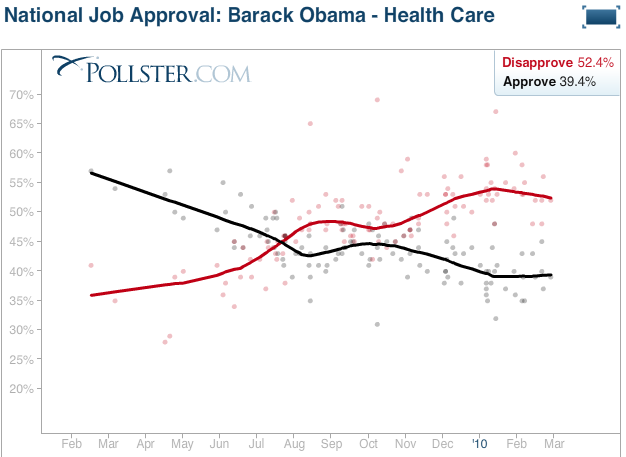
For every voter who strongly favors ObamaCare, two are strongly opposed … here’s why.

March 11, 2010

Punchline: Most voters believe the current plan will harm the economy, cost more than projected, raise the cost of care, and lead to higher middle-class taxes.

image 
http://www.pollster.com/polls/us/jobapproval-presobama-health.php?xml=http://www.pollster.com/flashcharts/content/xml/USObamaJobPresHealth.xml&choices=Disapprove,Approve&phone=&ivr=&internet=&mail=&smoothing=&from_date=&to_date=&min_pct=&max_pct=&grid=&points=1&lines=1&colors=Disapprove-BF0014,Approve-000000,Undecided-68228B

* * * * *

Here’s Why

Excerpted from WSJ: Why Obama Can’t Move the Health-Care Numbers, March 9, 2010

One of the more amazing aspects of the health-care debate is how steady public opinion has remained. Despite repeated and intense sales efforts by the president and his allies in Congress, most Americans consistently oppose the plan that has become the centerpiece of this legislative season.

In 15 consecutive Rasmussen Reports polls conducted over the past four months, for every person who strongly favors it, two are strongly opposed.

The reason President Obama can’t move the numbers and build public support is because the fundamentals are stacked against him. Most voters believe the current plan will harm the economy, cost more than projected, raise the cost of care, and lead to higher middle-class taxes.

  • 57% of voters believe that passage of the legislation would hurt the economy, while only 25% believe it would help.
  • Voters think reducing spending is more important than reducing the deficit.
  • People simply don’t trust the official projections: 81% of voters say it’s likely the plan will end up costing more than projected.
  • 66% of voters believe passage of the president’s plan will lead to higher deficits
  • 78% say it’s at least somewhat likely to mean higher middle-class taxes.
  • Fifty-nine percent of voters say that the biggest problem with the health-care system is the cost: They want reform that will bring down the cost of care.
  • Only 17% now believe it will reduce the cost of care.
  • For most voters, the notion that you need to spend an additional trillion dollars doesn’t make sense. If the program is supposed to save money, why does it cost anything at all?
  • The overwhelming majority of voters have insurance coverage, and 76% rate their own coverage as good or excellent.
  • Half of these voters say it’s likely that if the congressional health bill becomes law, they would be forced to switch insurance coverage—a prospect hardly anyone ever relishes.

Full article:
http://online.wsj.com/article/SB10001424052748704784904575111993559174212.html

Where the healthcare reform battle has left us …

March 11, 2010

Note that the article is from the Washington Post, not WSJ or IBD.

* * * * *

Excerpted from Wash Post: Obama is Choosing Liberal Divisiveness, March 10, 2010

Whatever the legislative fate of health reform, the Democratic health reformers have

  • Divided Democrats while uniting Republicans,
  • Returned American politics to well-worn ideological ruts,
  • Employed legislative tactics that smack of corruption,
  • Squandered the president’s public standing,
  • Lowered public regard for Congress,
  • Sucked the oxygen from other agenda items,
  • Re-engaged the abortion battle,
  • Produced freaks and prodigies of nature such as a Republican senator from Massachusetts,
  • Raised questions about the continued governability of America,
  • Caused the White House chief of staff to distance himself from the president’s ambitions.

Quite a list of accomplishments.

* * * * *
Early on Obama rejected the one, genuinely bipartisan health reform proposal — made by Sens. Ron Wyden, D-Ore., and Bob Bennett, R-Utah — that would have ended employer-based insurance and given individuals a deduction to buy their own coverage from a menu of private insurance options.

Wyden has turned out to be the ignored prophet of the health debate:

“If you … just pound it through on a partisan vote, you will have people practically as soon as the ink is dry looking to have it repealed.”

Full article:
http://www.realclearpolitics.com/articles/2010/03/10/obama_is_choosing_liberal_divisiveness.html