Archive for April 19th, 2010

Obama says that taxpayers should be saying thank you … huh ?

April 19, 2010

Obama mocked Tea Partiers, saying that they should be thanking him. 

President Barack Obama struck a hyperpartisan note Thursday, telling Democrats that he was “amused” by the Tax Day Tea Party rallies. 

Obama, addressing a Democratic National Committee (DNC) fundraiser in Miami, did little to endear himself to the Tea Party groups protesting around the country, saying:

 “”I’ve been a little amused over the past couple of days where people have been having these rallies about taxes …they should be saying thank you”  because of the tax cuts he has signed into law. 

‘You Would Think They’d Be Saying Thank You’, April 16, 2010
http://thehill.com/homenews/administration/92625-obama-amused-by-tea-party-rallies 

click for video:
http://tinyurl.com/y3a88zf
 

Oh really ?  

His rationale: he cut taxes for 95% of Americans. 

Give me a break, please. 

First, the tax break he was selectively talking about was a whopping dollar-a-day refundable tax credit that was part of the Stimulus package. 

Second, most of it went to the people who don’t pay income taxes anyway.  Those folks are already saying thank you … when they’re not saying “gimme, gimme, gimme” 

Third, the dollar-a-day program is more than offset by $670 Billion in enacted tax increases, about 1/2 of which hits folks reporting less than $200,000 in income … that works out to about $2,100 per citizen, and $4,200 per taxpayer collected by 16,000 additional IRS agents. 

According to a Ways and Means Committee staff analysis:

“The list of $670 billion in tax increases includes at least 14 violations of the President’s pledge not to raise taxes on Americans earning less than $200,000 for singles and $250,000 for married couples.”

This specific group of tax hikes totals $316 billion over 10 years.

http://www.house.gov/budget_republicans/press/2007/pr20100415whereisbudget.pdf

As RealClearPolitics opined:

President Obama just can’t help himself from playing the Comic-in-Chief and ridiculing his opponents.

It’s good for a laugh from the partisan crowd, sure, but it often comes across to average folks (and, of course, to the opposition) as petty and/or unpresidential.

That’s not … what the public might expect from a President who promised to rise above petty partisan politics.

http://realclearpolitics.blogs.time.com/2010/04/16/obama-may-not-be-so-amused-in-november/
Clash of the Titans: U.S. vs. G.S. … my bet’s on Goldman.

April 19, 2010

First, friends and family know that I’m no fan of investment banks.

My view: IBs are heavily populated with soulless folks who have strayed way too far the constructive role of efficiently raising capital for “producing” firms that make things and serve people … to a focus on simply making money via maneuvers that don’t advance the economy (e.g. 2nd and 3rd order derivatives).

Second, I took the bait on Friday and thought the SEC really had something on Goldman … that the crooks had gotten their come uppance.

Now, I’m not so sure. 

Admittedly, I’m heavily swayed by today’s WSJ editorial that reads in part:

The Securities and Exchange Commission’s complaint against Goldman Sachs is playing in the media as the Rosetta Stone that finally exposes the Wall Street perfidy and double-dealing behind the financial crisis. Our reaction is different: Is that all there is?

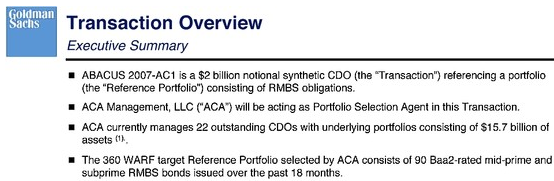
After 18 months of investigation, the best the government can come up with is an allegation that Goldman misled some of the world’s most sophisticated investors about a single 2007 “synthetic” collateralized debt obligation (CDO).

Far from being the smoking gun of the financial crisis, this case looks more like a water pistol.

WSJ, The SEC vs. Goldman, April 19, 2010
http://online.wsj.com/article/SB10001424052702303491304575188352960427106.html

Fundamentally, the “synthetic CDO” at issue did not hold mortgages, or even mortgage-backed securities.

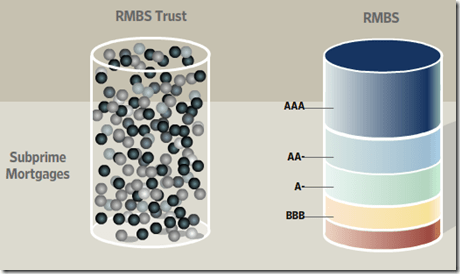
This is why it is called a “synthetic” CDO, which means it is a financial instrument that lets investors bet on the future value of certain mortgage-backed securities without actually owning them. (see pics and link below)

It was simply a mega-bet peddled to “whales” — sophisticated investors (mostly financial institutions with floors of MBAs and lawyers)    — a bet structured by an uber-bookie who took the other side of the bet.  A common practice among “players”. 

image

The main impact of the “action” was transferring a few billion dollars from the long-side housing gamblers (the financial institutions and other fat cats)  to the bookie (Paulson & Company).

Since the market crashed — i.e. the “favorite” lost the game — the whales (e.g. the Royal Bank of Scotland)  lost big — especially since they were betting with borrowed money.

My take: This wasn’t numbers being run on the city streets of Baltimore … it was big guys vs. big guys … who cares if they all lose? 

This didn’t cause the housing bubble or its bust … and Goldman will walk on the rap. 

* * * * *

Anatomy of a CDO

Wall Street Journal has an interesting depiction of how a synthetic CDO is put together.

Click either of the pics to go to WSJ’s interactive description — cool, but complicated.

image

image

Pay your taxes, fool? … Didn't you know that — according to Harry Reid — “Paying taxes is strictly voluntary”

April 19, 2010

“Paying taxes is strictly voluntary” … so says Harry Reid

Don’t you feel silly for sending in a check yesterday ?

It makes me shiver to think that this guy is the second most powerful person in the country (after Nancy Pelosi)

This is worth watching …

image
http://www.youtube.com/watch?v=R7mRSI8yWwg

Pay your taxes, fool? … Didn’t you know that — according to Harry Reid — “Paying taxes is strictly voluntary”

April 19, 2010

“Paying taxes is strictly voluntary” … so says Harry Reid

Don’t you feel silly for sending in a check yesterday ?

It makes me shiver to think that this guy is the second most powerful person in the country (after Nancy Pelosi)

This is worth watching …

image
http://www.youtube.com/watch?v=R7mRSI8yWwg

Wallet’s are opening … for consumers and advertisers.

April 19, 2010

TakeAway:  Whew.   Consumers are spending again. But this sigh of relief is not heard in the halls of the big CPGs. 

The latest recession provided private-label brands with the momentum needed to overcome consumers’ quality perceptions and induce trial. 

The result: consumers liked or were at least satisfied with the PL products. 

Now that the economy is recovering and consumers have the dough to go back to the brand-name staple goods, companies are hoping that a long-held theory – more advertising will increase market share – will ensure that consumers trade-up for their staple goods.

* * * * *

Excerpted from WSJ, “Consumer-Goods Makers Pour Out Ads,” By Ellen Byron, April 12, 2010

As wary Americans start to crack open their wallets, household-goods makers like Procter & Gamble, Colgate-Palmolive, Kimberly-Clark and Clorox are cranking up their advertising, hoping to coax consumers farther out of their shells.

Amid signs of an improving economy, recent survey data show consumers are more willing to splurge by eating out or buying new shoes, but the same doesn’t necessarily hold for everyday household goods.

“In consumer staples, you saw consumers trade down” to cheaper products due to the recession, and they were “quite satisfied,” says chief executive of Consumer Edge Research.

To lure them back to premium products—and prices—brand-name manufacturers are churning out “new and improved” goods ranging from more-absorbent diapers, to specialized toothpastes to closer-shaving razors. The strategy relies on advertising to get the word out.

That’s one reason the industry’s ad spending is expected to grow in 2010. So far such spending has been running well ahead of 2009 levels, with year-to-year increases for household products of 15% in January and 11% in February …

P&G, the world’s biggest ad spender, plans a 20% increase in “consumer impressions,” or instances when consumers see its ads … and it will introduce 30% more “significant” innovations in products this year, which its CEO describes as the most in his 30-year career at the company …

The big-name marketers face the challenge of overcoming consumers’s newfound thrift. While U.S. sales of household staples have posted middling gains overall, sales of cheaper private label, or store-branded, goods, have risen more sharply.

In the four weeks ended March 20, overall U.S. sales of household and personal products increased 0.2% from a year earlier, compared with a 5.4% gain in private-label sales …

The new spending will test a long-held theory: that boosting a brand’s share of advertising beyond its market share will raise that market share. Among major household products, market share stayed the same or rose 64% of the time over the past 16 quarters when a company’s advertising reach exceeded its market share by 50% or more …

Some experts say winning over consumers will require not just advertising, but a new approach: emphasizing value.

“For many years, any hint of price was a no-no. It was all about generating emotional connections,” says chief brand strategist at consulting firm Portnoy Group:”Now you’re going to have to work harder to convince me that I’m getting much more value by trading up.. You need to show me that I’m getting more for my money, and it’s not frivolous.”

Edit by TJS

* * * * *

Full Article
http://online.wsj.com/article/SB10001424052702304703104575174042139131092.html#mod=todays_us_marketplace

* * * * *