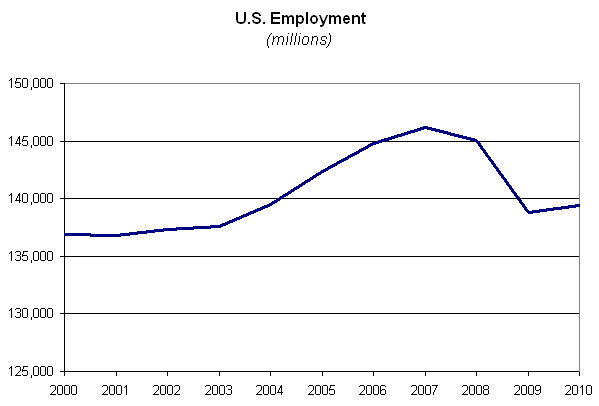
Here’s a chart of total US employment from 2000 to today.
A couple of observations;
- Employment was flat from 2000 to 2003 … remember the bursting of the dot com bubble and the 9-11 terrorist attacks ?
- There was strong employment growth between 2003 and 2007 … remember the Bush tax cuts of 2001 and 2003? … hmmm
- The financial collapse in 2008 reversed practically all of the prior 5 year gains … resulting in a net ‘no gain’ during the Bush years
So, when the Dems talk about the failed policies of the prior 10 years, exactly what are they talking about?
Hard to make a case that the Bush tax cuts creamed the economy. To the contrary, looks like they created strong job growth.
Obviously, the culprit is the financial crisis – a mix of the disastrous housing policy (think Fannie & Freddie) … and loose regulation of mortgage backed securities and derivatives.
Bush shares blame for the Fannie and Freddie fiasco … but blame for that is easily spread across the Clinton a administration and the Congress (i.e. Barney Frank, Chris Dodd).
OK, you can taint Bush with loose financial regulation and enforcement.
But, fin-reg does little to address the egregious security & derivative transgressions … and nothing has been done with Fannie & Freddie.
The main “Bush policy” being targeted by Dems are the tax cuts – of which less than 20% were “for the wealthy” – doesn’t look to me like they’re job killers. Go figure.
 The Homa Files
October 13, 2010 at 10:23 am |
Fannie and Freddie were NOT to blame for this crisis. They were priced out of the market for several years (2006 – 2008) by private lenders who were imposing virtually no credit charge to borrowers.
Employment isn’t the real issue. The real issue is that the jobs for low and middle income people could not support their lifestyle and pushed them to use credit.
Do the individuals bear some blame for this? Of course! But we must also consider the distortion caused when management salaries increase and drive “targeted” inflation. Things like college tuition and home prices explode – since the top earners can pay – but the middle class gets stuffed with debt.
Sound familiar?
October 13, 2010 at 1:57 pm |
If Fannie and Freddie are not to share any of the blame, why then did they need $145b in govt support to stay afloat?
From the NYT 8/7/10, “Housing Policy’s Third Rail” by Gretchen Morgenson:
“Outwardly, Fannie and Freddie wrapped themselves in the American flag and the dream of homeownership. But internally, they were relentless in their pursuit of profits from partners in the mortgage boom. One of their biggest and most steadfast collaborators was Countrywide, the subprime lending machine run by Angelo R. Mozilo.
Countrywide was the biggest supplier of loans to Fannie during the mania; in 2004, it sold 26 percent of the loans Fannie bought. Three years later, it was selling 28 percent. What Countrywide got out of the relationship was clear — a buyer for its dubious loans. Now the taxpayer is on the hook for those losses.”
October 14, 2010 at 9:02 am |
They absolutely SHARE the blame, but I would say they did less damage than the private lenders (who are not mentioned at all in the post).
Ironically, it was private market incentives that pushed Raines and other GSE leaders to buy subprime bonds rather than allowing the GSEs to simply shrink.
Morgenson is probably not the place you want to go for mortgage expertise. http://www.calculatedriskblog.com is much better:
http://www.calculatedriskblog.com/search/label/Fannie%20Mae
Or try 13 bankers:
http://13bankers.com/2010/05/18/calomiris-wallison-citation/