Economists warned that raising the minimum wage would result in lost jobs. It always does.
Why?
As labor gets more expensive, companies pare back the employment rolls.
Sure, the folks who hang onto their jobs make more … but folks who lose their jobs make less – zero to be precise.
Here’s a great analysis from the site Political Calculations
* * * * *
In 2006, the last full year in which the U.S. federal minimum wage was a constant value throughout the whole year, at least before 2010, approximately 6,595,383 individuals in the United States earned $7.25 per hour1 or less.
For 2010, the first full year in which the U.S. federal minimum wage was a constant value through the year since 2006, the U.S. Bureau of Labor Statistics estimates that an average of just 4,361,000 individuals in the United States earned the same equivalent of the current prevailing federal minimum wage of $7.25 or less throughout the year.
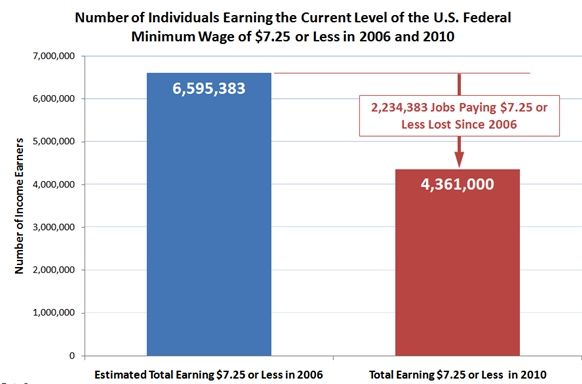
In terms of jobs lost, that means that 2,234,383 of the jobs lost in the U.S. economy since 2006 have been jobs that were directly impacted by the series of minimum wage increases that were mandated by the federal government in 2007, 2008 and 2009.
Interestingly, the average number of employed members of the civilian labor force in 2006 was 144,427,000. In 2010, the average number of employed members of the civilian labor force in the U.S. was 5,363,000 less, standing at 139,064,000.
So, in percentage terms of the change in total employment level from 2006 to 2010, jobs affected by the federal minimum wage hikes of 2007, 2008 and 2009 account for 41.8% of the total reduction in jobs seen since 2006.
Thanks to Tags for feeding the lead
 The Homa Files
March 23, 2011 at 12:12 pm |
It seems unlikely that minimum wage is the driver of 100% of these firings – especially given the financial collapse during the same period of time. It would be interesting to calculate how much of this is due to the law and how much it is a reflection of how much more severe an economic downturn is for the lowest paying jobs.
Maybe this is an argument that the least skilled need more protection, not less?