Yesterday Bernanke announced another (and apparently infinite) round of quantitative easing … that is, substantially increasing the amount of money in circulation
The stated logic: keep interest rates low so that businesses and prospective homeowners borrow.
The cynical interpretation: 56 days until election … Obama stands by Bernanke … Mitt says he’s fire him
The immediate impact: stock jumped over 200 points.
Why?
There’s a strong link between the supply of money and stock prices.
More money => lower interest rates +> higher comparative returns from stocks => higher stock prices.
That is, until inflation kicks in and borrows face higher rates …
* * * * *
Here’s an archived post that gives more detail:
Back about 40 years ago, an economist-wannabe co-authored a study in the Journal of Finance titled “The Supply of Money and Common Stock Prices”.

The article summarized an econometric study that demonstrated a tight link between the amount of money floating around and, on a slightly time-delayed basis, the price of stocks.
OK, fast forward to today.
Now, when the Feds expand the money supply, it’s called “Quantitative Easing” … or QE, for short.
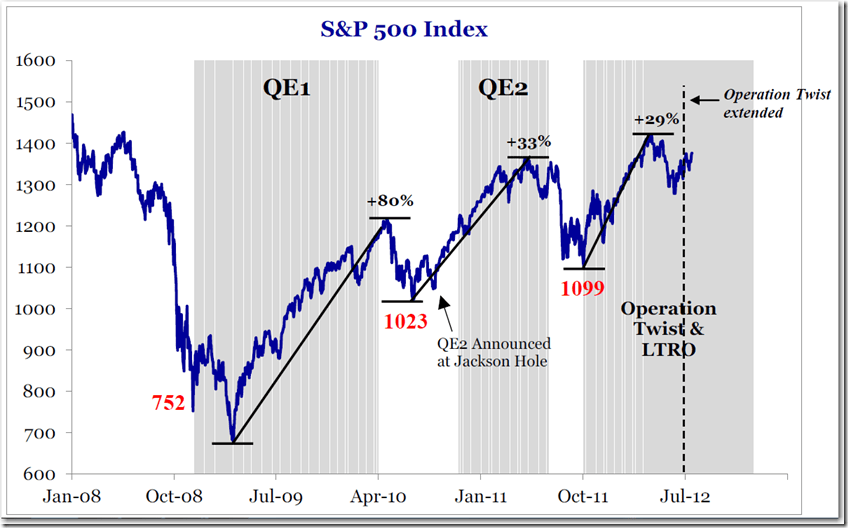
Recently, Jason Trennert of Strategas Research Partners published a revealing chart that visually relates stock prices (the S&P 500) to the recent periods of quantitative easing.
Hmmm.
Looks like the supply of money and common stock prices are still related.
Partially explains why the Dow is over 13,000 despite a sluggish and uncertain economy.
Tags: Fed, QE1, QE2, QE3, quantitative easing
 The Homa Files
Leave a comment