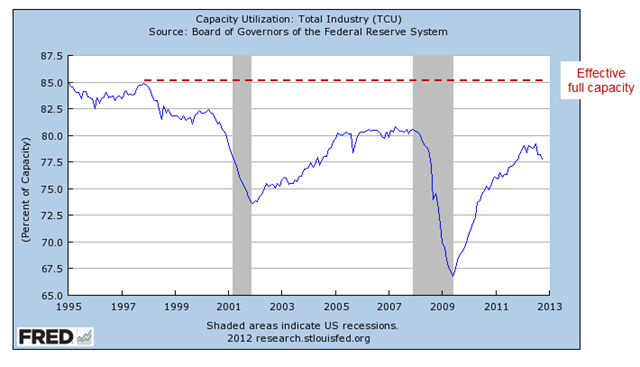
Punch line: The employment market is likely to stay in the doldrums … employers – still operating below effective full capacity – are leveraging the productive full-time employees they retained during the recession, shifting some of them to part-time status … and supplementing them with temporary workers and new part-timers. And, the labor force participation rate is dropping as workers become demotivated and disincentivized.
= = = = =
The Demand Side
Full time work is about to get scarcer.

By hiring part-time workers who put in less than 30 hours per week, employers can avoid a mandate dictated by the new health reform law: either provide expensive health insurance or pay a fine equal to $2,000 per worker.
In a July survey, 32% of retail and hospitality company respondents told [Mercer] that they were likely to reduce the number of employees working 30 hours a week or more.
Already, some companies are putting plans into action.
- Darden Restaurants [parent of Red Lobster and Olive Garden] was among the first companies to say it was changing hiring in response to the health-care law.
- Pillar Hotels & Resorts this summer began to focus more on hiring part-time workers among its 5,500 employees, after the Supreme Court upheld the health-care overhaul.
- CKE Restaurants Inc., parent of the Carl’s Jr. and Hardee’s burger chains, began two months ago to hire part-time workers to replace full-time employees who left.
- Home retailer Anna’s Linens is cutting hours for some full-time employees to avoid the insurance mandate if the healthcare law isn’t repealed.
Source: Forbes
= = = = =
The Supply Side
A new book by University of Chicago economist Casey Mulligan explains that through a major expansion of the welfare state we are paying people not to work:
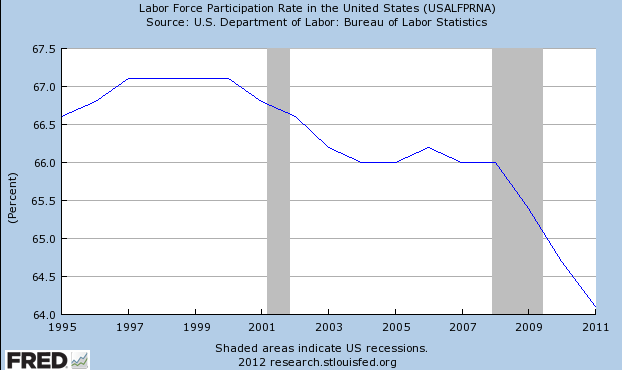
He says that public policies enacted during the Obama administration’s first four years have been affecting the supply side of the market as reflected in the labor force participation rate.
 .
.
In the matter of a few quarters of 2008 and 2009, new federal and state laws greatly enhanced the help given to the poor and unemployed — from expansion of food-stamp eligibility to enlargement of food-stamp benefits to payment of unemployment bonuses — sharply eroding (and, in some cases, fully eliminating) the incentives for workers to seek and retain jobs, and for employers to create jobs or avoid layoffs.
If a person gets laid off and is offered a new job paying $500 a week …. his take home pay would be about $250 after deducting taxes and work related expenses.
Since untaxed unemployment benefits total $289, clearly he is better off not working … [at least for 99 weeks].
All in all, Mulligan estimates that about half the precipitous 2007-2011 decline in the labor-force-participation rate and in hours worked can be blamed on easier eligibility rules for disability benefits, unemployment insurance, food stamps and housing aid.
Source: Forbes
* * * * *
 The Homa Files
Leave a comment