The Fordham Institute evaluated the power of state teacher unions along thirty-seven different variables grouped into five broad areas:
Area 1: Resources and Membership
Internal union resources (members and revenue), plus K–12 education spending in the state, including the portion of such spending devoted to teacher salaries and benefits.
Area 2: Involvement in Politics
Teacher unions’ share of financial contributions to state candidates and political parties, and their representation at the Republican and Democratic national conventions.
Area 3: Scope of Bargaining
Bargaining status (mandatory, permitted, or prohibited), scope of bargaining, right of unions to deduct agency fees from non-members, and legality of teacher strikes.
Area 4: State Policies
Degree of alignment between teacher employment rules and charter school policies with traditional union interests.
Area 5: Perceived Influence
Results of an original survey of key stakeholders within each state, including how influential the unions are in comparison to other entities in the state, whether the positions of policymakers are aligned with those of teacher unions, and how effective the unions have been in stopping policies with which they disagree.
= = = = =
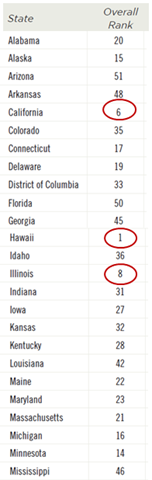
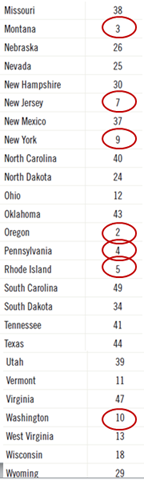
Answer: Hawaii and Oregon have the strongest teacher unions … Florida has the weakest.
See the report for details by state.
 The Homa Files
November 26, 2012 at 10:52 am |
Looks like Arizona is actually the weakest – DC is in the mix.