Lots has been written recently re: the economic value of a college degree.
Let’s boil it down to 3 key charts …
======
First, the cost side of the equation …
Sky-rocketing tuitions are loading students with an enormous amount of post-graduation debt.
While other forms of consumer debt have held relatively constant for the past 10 years, student loans have soared from “only” $200 million in 2004 to over $1 trillion today.

That’s the cost.
What about the benefits side?
======
Lower Unemployment Rate
The unemployment rate for bachelor’s degree holders is currently about 3.3% … about 1 point higher than long-run averages.
That’s about half the unemployment rate of all folks who don’t have a bachelor’s degree.
Note that the unemployment rate gap widens during tough economic times – to the disadvantage of those not holding college degrees.

=====
Higher Pay
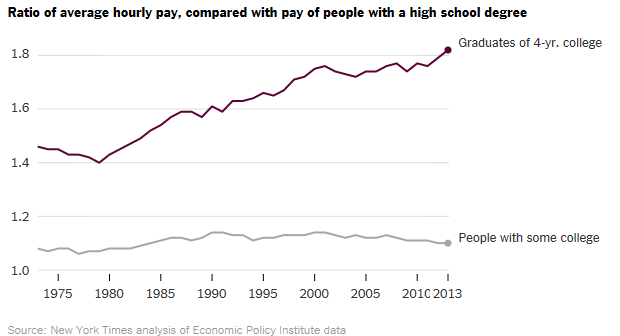
According to the N.Y. Times, he pay gap between college graduates and everyone else (chart below) reached a record high last year (based on an analysis of Labor Department statistics by the Economic Policy Institute in Washington).
Graduates with four-year college degrees earned 98 percent more an hour on average in 2013 than people without a 4-year degree.
======
Net Present Value
The lower unemployment rate and wide pay differential more than offsets the high cost of an undergraduate degree.
According to David Autor, — an M.I.T. economist,– “the true cost of a college degree is about negative $500,000.”
Said differently, the net present value – the cumulative benefit of the earnings gap less the cost to get a degree, adjusted for inflation – is about $500,000
The half-million NPV is roughly double what it was three decades ago.
The Times’ conclusion:
“For all the struggles that many young college graduates face, a four-year degree has probably never been more valuable.”
#HomaFiles
Follow on Twitter @KenHoma >> Latest Posts
 The Homa Files
Leave a comment