Archive for the ‘Employment – Jobs’ Category

Clearing out the deadwood … who will likely stay unemployed.

March 2, 2010

Well managed companies always use recessions as air cover to “restructure” their their work forces.  This recession has beenno exception.

Bottom line: with little optimism re: a bounce back in demand, expect companies to keep producing at about the same levels, and leveraging their now streamlined work forces.

* * * * *

Good point raise by Business Week:

The output per hour of nonfarm workers has increased by 6.1% since the beginning of the recession.

image

http://images.businessweek.com/mz/10/09/20100301_numbers.pdf?chan=magazine+channel_the+week+in+business

Shouldn’t a "jobs bill" create jobs ? … hmmm

February 12, 2010

Spend, spend, spend … sky is the limit !

* * * * * *
Excerpted from AP: Jobs bill won’t add many jobs, Feb 10, 2010

It’s a bipartisan jobs bill that would hand President Barack Obama a badly needed political victory and placate Republicans with tax cuts at the same time. But it has a problem: It won’t create many jobs.

Tax experts and business leaders said companies are unlikely to hire workers just to receive a tax break.

Before businesses start hiring, they need increased demand for their products, more work for their employees and more revenue to pay those workers.

“Right now, business owners just don’t have customers. Until you have work for the employee to do, there’s really less of a reason to hire a new worker.”

The bipartisan Senate plan would exempt businesses from paying a 6.2 percent Social Security tax on the wages of new employees, as long as the workers have been unemployed at least 60 days. The tax break would run through the end of the year.

A company could save a maximum of $6,621 if it hired an unemployed worker after the bill is enacted and paid that worker at least $106,800 — the maximum amount of wages subject to Social Security taxes — by the end of the year. The company could get an additional $1,000 on its 2011 tax return if it kept the new worker for at least a full year.

The nonpartisan Congressional Budget Office … estimates that such a tax break would generate only eight to 18 full-time jobs per $1 million in tax breaks.

The Senate proposal … would add 80,000 to 180,000 jobs over the course of a year. The U.S. economy, meanwhile, has lost 8.4 million jobs since the start of the recession.

In addition to a tax break for hiring workers, the Senate package would extend unemployment payments for people without jobs for more than six months as well as subsidies to help the jobless continue paying premiums for health insurance they had been getting through their former employers.

It also would extend through 2010 about $33 billion in popular tax breaks that expired at the end of 2009, including an income tax deduction for sales and property taxes and a business tax credit for research and development.

But,  lawmakers in both parties still could claim tangible accomplishments in addressing high joblessness and the inability of Republicans and Democrats to work together to solve problems, both top issues among voters early in 2010 midterm election season.

Full article:
http://news.yahoo.com/s/ap/20100210/ap_on_bi_ge/us_what_jobs_11

Why unemployment will stay high … at least until after the 2010 elections.

February 1, 2010

Quick & to the point. 

Excerpted from WSJ: Bonfire of the Populists , Jan. 28, 2010

The president’s anti-Wall Street rhetoric is not good for the economy, and may hurt his party politically.

FDR was re-elected in 1936 for many reasons, but among them was his fiery denunciations of “economic royalists,” “economic tyranny,” and “economic slavery.”

Business knew it was in the president’s crosshairs and put its capital on strike. The economy didn’t recover until the war.Team Obama is already witnessing a is already witnessing a repeat.

A venture capitalist recently remarked to me that the uncertainty the administration has created is “nothing short of paralyzing.”

Nobody will invest in an industry that might be the next to be overtaxed, overregulated, or publicly disemboweled.

Full article:
http://online.wsj.com/article/SB10001424052748704878904575031640091592622.html?mod=djemEditorialPage

* * * * *
Ken’s Take:

Real business guys tell me that they are, in fact, holding off hiring until “things settle down”. Further, they fear draconian reprisals from Team O if they show any resistance to the anti-business initiatives or rhetoric.

So how can businesses fight back?

Easy.  Just ‘recast’ each potential new hire as a vote for Obama’s policies … and refuse to pull the lever.

It’s called passive aggressive behavior.

Companies are cutting costs … that’s a good thing, right?

October 13, 2009

Ken’s Take: I think that the realization is setting in that businesses have — partially out of necessity — cut back their bloated cost structures — big time.  Short run, it’s out of necessity — just to survive.  Medium run, the skinnier cost structures will provide profit leverage when sales start to bounce back.  Long-run, companies are will be better positioned to compete.

The downside: there’s little realistic hope for a quick turnaround in unemployment.  Companies will be slow to add back to their payrolls — especially given the increased political risk from government intervention, wage controls, and health care taxes and penalties.

If 10% unemployment is the 2010 over/under, I’m taking over.

* * * * *

Excerpted from WSJ: Cost Cuts Lift Profits But Hinder Economy, Oct. 13, 2009

Corporate America is showing better-than-expected profits, but the accompanying optimism belies deep worries among company executives about the strength of the economic recovery.

In an ominous sign for the economy, much of the profit is being eked out through cost cuts. Executives say they are hesitant to reinvest such profits into their businesses. With large portions of their factories, fleets and warehouses sitting idle, some say they probably won’t see reason to do so for a year or more.

That means job growth and any significant rise in business spending could be a long time coming.

That creates a chicken-and-egg problem at a time when the unemployment rate is already nearly 10%: Without more jobs, U.S. consumers will have a hard time increasing their spending; but without that spending, businesses might see little reason to start hiring.

Already, the economy is being starved of investment it needs to spark growth. Net private investment, which includes spending on everything from machine tools to new houses, minus depreciation, fell to … the lowest level since at least 1947.

“Things have stabilized, but we’re trying to be extremely cautious and not anticipate the recovery before it occurs …we’re looking to cut back as much as possible.”

And while companies are finding the credit-market thaw is making it easier to borrow money they would need to expand, many are stashing these funds rather than spending them. Of the 100 largest bond issues globally this year, only seven listed expansion, investment, capital expenditures or research and development as the purpose of the money-raising.

In industries ranging from apparel to heavy machinery, executives say they don’t yet have enough faith in the recovery to take significant risks.

One big obstacle: Many industries have excess capacity that, even if the economy perks up, will take many months to absorb.

The cautious mood is reflected in companies’ new orders for nondefense capital goods such as computers, trucks and office furniture, which in August were down … about 20% from the same month a year earlier.

“The politicians want people to think things are getting better, because a better mood feeds a turnaround. Things are getting better, but compared to what.”

Full article:
http://online.wsj.com/article/SB125539122868481389.html?mod=WSJ_hps_LEFTWhatsNews

* * * * *

About unemployment (and accountability) … what did they know and when did they know it?

October 12, 2009

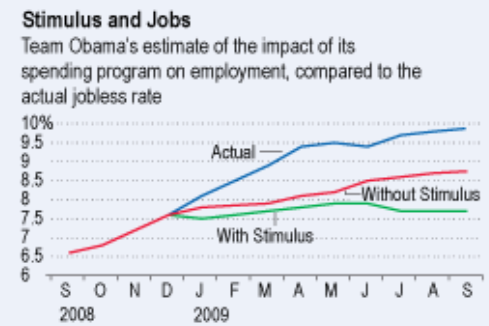
The point of February’s $780 billion stimulus plan was to “do something” to create jobs.

White House economists Christina Romer and Jared Bernstein estimated at the time that the spending blowout would keep the jobless rate below 8%, with the rate peaking in May-June and declining thereafter.

Well, everybody has picked up on the fact that 9.8% is greater than 8%.

New news (to me) is that the actual unemployment rate was 8.5% in Feb-March when the stimulus package was launched.  By my count, 8.5% is greater than 8%, too.  Hmmmm.

image

http://online.wsj.com/article/SB10001424052748703298004574459341050610398.html?mod=WSJ_hps_MIDDLESixthNews

* * * * *

More jobs lost, unemployment rate goes down … now, how can that be?

August 10, 2009

Actually, it’s quite simple.

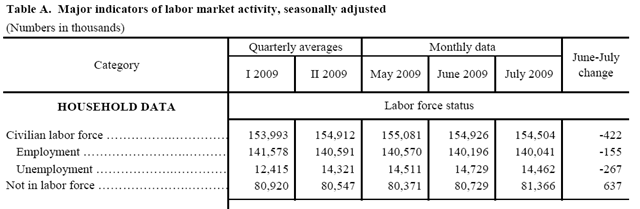
About 155,000 fewer people were employed in July.

But, according to the BLS, the labor force contracted by 422,000 people. 

The bulk of the “contraction” were unemployed people who  “got discouraged that there were no jobs available for them” and stopped looking for work … 

The discouraged “contractors” get dropped from  both the numerator and the denominator of the unemployment rate calculation. 

So, net unemployment increased by 267,000 people  … but the unemployment rate improved from 9.5% to 9.4%.

If the discouraged folks were still looking, the rate would have increased to about 9.6%

Geez.

image

* * * * *
Lowlights

The number of long-term unemployed (those jobless for 27 weeks or more) rose by 584,000 over the month to 5.0 million.

1 in 3 unemployed persons were jobless for 27 weeks or more.

There were 796,000 discouraged workers in July, up by 335,000 over the past 12 months.

Full BLS Report
http://www.bls.gov/news.release/pdf/empsit.pdf

* * * * *

Is 1/10 of 1% a little or a lot ? … According to the NY Times, it depends who’s president …

August 10, 2009

Great “catch” by Byron York of the Washington Examiner …

* * * * *
The front page of Sunday’s New York Times is filled with hope about the nation’s economic situation.  The lead story, reporting a decline in the unemployment rate from 9.5 percent in June to 9.4 percent in July, begins by declaring that, “The most heartening employment report since last summer suggested on Friday that a recovery was under way — and perhaps gathering steam.”

* * * * *

The Times hasn’t always been so optimistic when it comes to one-tenth-of-a-point declines in the unemployment rate.  On this very day in 1992, in the midst of the presidential campaign between George H.W. Bush and Bill Clinton, the government also reported that the unemployment rate ticked downward by one tenth of a point, , edging down to 7.7 percent from 7.8 percent,”and the Times’ treatment was far more restrained:

Even though the number of jobs actually went up in July 1992 (as opposed to the decline of 247,000 jobs in July 2009), the 1992 Times reported that the economic news “gave no suggestion that the economic recovery was breaking out of its painfully slow pace or, more important, that the job growth was picking up enough to push the unemployment rate down significantly … and the improvement is not enough to signal a stronger economic recovery .”

As it turned out, the one-tenth-of-a-point drop in the unemployment rate in July 1992 signaled the end of the increase in the jobless rate.

* * * * *

Source article:
Washington Examiner, “NY Times touts economic momentum, recovery; in 1992, not so much”, York, 08/08/09
http://www.washingtonexaminer.com/opinion/blogs/beltway-confidential/Times-touts-economic-momentum-recovery-in-1992-not-so-much-52781412.html

* * * * *


Boost employment by raising the minimum wage … has anybody in Washington taken Econ 101 ?

July 13, 2009

The unemployment rate is 9.5%’ including discouraged folks who have stopped looking for work, and it’s approaching 20%; for teenagers, it’s almost 25%, for black teens, it’s almost 40%

 The unemployment rate in June for American teenagers was 24%, for black teens it was 38%

With that as backdrop, Congress has scheduled an increase in the minimum wage later this month, taking the minimum wage up over 10% – from  $6.55 to $7.25 an hour.   The predictable impact: employers are certain to cut back at the low-end – laying off existing workers and not hiring new ones.  It’s simple economics.

“Studies that focus on the least-skilled groups [i.e., teens, and welfare moms] provide relatively overwhelming evidence of stronger disemployment effects.”

Proponents argue that millions of workers will benefit from the bigger paychecks, but those who lose their jobs or who never get a job in the first place get a minimum wage of $0.

Economists estimate that  the 70-cent per-hour minimum wage hike this month will kill about 300,000 jobs for those between the ages of 16-24.

“But the union economic model that now dominates Washington holds that wages only matter for those who already have jobs. The jobs that are (lost or) never created don’t count.”

Source articles:
http://online.wsj.com/article/SB124657739768489217.html
http://online.wsj.com/article/SB124743988386729701.html#mod=djemEditorialPage

* * * * *

I ask again, has anybody in Washington taken Econ 101 ?

* * * * *