Archive for the ‘MARKETING’ Category

Turn back the clock: coupon clipping brand loyaty.

October 13, 2009

TakeAway: Amid growing competition for consumer purchases, marketers are turning back the clock and resorting to increased couponing.

Now, with coupon values at all time highs, marketers are facing an should-be-expected challenge –  excessive promotion hurts brand image and trains consumers to hop from deal to deal.   

Old practices die hard.

* * * * *

Excerpted from NYTimes, “A Clip-And-Save Renaissance,” By Stephanie Roosenbloom, September 24, 2009 

… It may be the digital age, but when it comes to pinching pennies, most consumers are opting for a method that is well over a 100 years old: the paper coupon. Thanks to the miserable economy, coupons … have made a comeback.

The recession has even made coupon clippers out of some groups that once avoided them, including well-to-do shoppers and young shoppers

As the economy worsened and consumer sentiment plunged, coupon redemption ticked up 10 percent in the fourth quarter of 2008, compared with the period a year ago — the first jump in coupon redemption since the early 1990s. In the first half of this year, coupon redemption climbed 23 percent. Some 1.6 billion coupons were redeemed … it is forecast that more than three billion coupons will be redeemed this year …

Coupon redemption was also spurred on by marketers who dangled more valuable deals … there was a 9 percent increase last year in the face value of coupons …

Another way coupon clippers save is by shedding brand loyalty and buying whatever is on sale …

Edit by TJS

* * * * *

Full Article
http://www.nytimes.com/2009/09/24/business/24coupon.html?em

* * * * *

Some U.S. chocoholics tell Cadbury to “kiss” off … here’s why.

October 12, 2009

TakeAway:  Gasp! Cadbury chocolate sold in the U.S. is not actually Cadbury chocolate…it’s a variation of Hershey’s chocolate!! 

In a highly competitive industry where brand equity and loyalty is so important, it seems a risky business decision to change the formula of your most prized asset – your chocolate. 

A key pillar of consumer loyalty is based in the consistency of the product experience, no matter the time or the place. 

Given the volume of consumer traffic between the U.K. and the U.S., did Cadbury’s think that consumers would not notice the difference in the taste of its famous chocolate? 

* * * * *

Excerpted from WSJ, “What’s in a Name? Not Much for These Fans of Imported Cadbury,” By Joe Barrett and Timothy Martin, September 14, 2009

When Gayle Green has a craving for chocolate … she drives 45 minutes to … stock up on Cadbury chocolates imported from the U.K. …  Ms. Greene could buy American-made Cadbury bars at a grocery store just a few minutes from her house … she wants nothing to do with the stuff made in the U.S. … she says, “You might as well eat a Hershey bar.” …

Some U.S. fans of Cadbury are determined to snub the Americanized version of the chocolate, which is made under license by Hershey Co. … Like Coca-Cola lovers who swear the Mexican-made version of the soda tastes better, hardcore Cadbury fans spend plenty of time in hot chocolate pursuit. They scour the Internet, pester family and friends visiting Europe, and seek out specialty British and Irish stores to get their fix of imported caramel-filled Curly Wurlys … consumers say though the U.S. candy bar’s label looks virtually identical to the U.K. version, the U.K.-made bars are “silkier, smoother and they don’t leave an aftertaste.” …

A Cadbury spokesman said, “Consumer tastes and preferences differ in each market, and accordingly the products sold in different markets vary.” … Hershey has occasionally sent legal notices to stop U.S. shops from selling British-made Cadbury products. Still, the imports can be readily found in many cities. …

Edit By TJS

* * * * *

Full Article
http://online.wsj.com/article/SB125288517883707275.html

* * * * *


Finally, a Rolls-Royce for the masses … well, kinda.

October 9, 2009

TakeAway:  Owning a Rolls-Royce is an undisputed symbol of wealth…and many would argue that the brand’s exclusivity is consumers’ primary motivation for purchasing and re-purchasing its cars.  Rolls Royce has decided to test the loyalty of its existing consumer base by offering a lower-priced version of its car and thus making the car attainable by a larger portion of society. Will this strategy backfire and alienate its existing loyal consumer base?

* * * * *

Excerpted from WSJ, “Rolls-Royce Unveils its Economy Car” By  Vanessa Fuhrmans, September 17, 2009

… Rolls-Royce Motor Cars’ answer to the worst downturn in decades: Its new Ghost model, to be had for a mere $245,000 … Though the Ghost has the same hand-crafted interiors and famous grill, the sleeker and slightly shorter model costs about one-third less than the $380,000 starting price of the British car maker’s flagship Phantom.  As more people globally can afford a Rolls, though, the company faces a delicate balancing act: boosting sales while not diluting the brand’s exclusive cachet …

The Ghost’s launch comes at a critical time. Rolls-Royce sold a record 1,212 Phantoms last year. But as the economic downturn caught up with even the superrich, sales plunged 34% in the first half of this year, tarnishing what had been a bright spot for its German parent, BMW AG.  Meanwhile, Rolls faces growing competition for the lower rung of the upper crust from Bentley … Bentley sales have risen 10-fold … The success of Bentley’s Continental model (priced between $150,000 and $200,000) underscored the market to be had in the niche above Porsche and Mercedes-Benz but below Rolls-Royce …. 

The Ghost appears to be hitting the mark: Some 1,200 potential buyers have signaled “strong interest” or pledged to order one, about the same number of total Phantoms sold last year, the company said.  As the economy recovers, the car maker says it expects to sell at least 2,000 annually, boosting its total production nearly threefold.  The company has gone to great lengths to preserve the model’s Rolls-Royce quintessence, yet at a downsized price … Rolls-Royce … said 85% of the people who have expressed interest in the Ghost have never owned a Rolls, uncommon among Phantom owners. 

Edit by TJS

* * * * *

Full Article
http://online.wsj.com/article/SB125312564687516787.html#mod=todays_us_nonsub_marketplace

* * * * *

Which is your scarcest asset: time or money?

October 9, 2009

TakeAway:  In today’s economy, motivating consumers to pull the trigger and purchase (now) is job one for most marketers. 

Sometimes, the answer may be as simple as changing the brand message to emphasize time instead of money … or vice versa.

If buyers are “experiential”, focus on time; if they’re “possessive”, focus on money.

* * * * *

Excerpted Knowledge@Wharton, “Time vs. Money:  Analyzing Which One Rules Consumer Choices, ” September 16, 2009

Pick up a magazine or turn on the TV and prepare for a flood of marketing messages about how you spend your time and money … Yet with all this talk of time and money, little is known about how consumers’ attitudes and behaviors are influenced by a product’s association with these concepts …

A new paper … argues that when companies weigh whether to go for an ad campaign with a time or a money theme, they should be aware that each evokes strong reactions from consumers …

Emphasis on time … typically leads to more favorable consumer attitudes and purchasing decisions because … time is less fungible than money … and people feel less accountable for how they spend their time because it can be more difficult to measure than monetary outlays. These two characteristics — fungibility and ambiguity — are important differentiators in how consumers think about time and money …

When money matters … for the prestige possession, subjects reported greater feelings of personal connection when they were primed to recall the money spent on the product …  those who highly valued the mere possession of the product had more favorable attitudes when prompted to consider the money involved in the purchase … 

Ultimately, the researchers conclude: “Brands can cultivate consumer relationships by first considering how consumers most identify with the product (through experience or possession) and then highlighting either their time or money spent accordingly.” … 

Edit by TJS

* * * * *

Full Article
http://knowledge.wharton.upenn.edu/article.cfm?articleid=2341

* * * * *

Trenchcoat marketing … it’s not what you think.

October 8, 2009

BrandChannel, Can BurberrySpace Help Reposition A Luxury Fashion Brand?, September 17, 2009

Burberry, intent on holding onto its recently upgraded cutting-edge image, will launch its own social networking site.

The site, Art Of The Trench, will feature user-submitted pictures of people sporting the brand’s famous trench coat.

Burberry’s goal is to strengthen ties with existing customers while attracting new faces — younger consumers they hope will be inclined to spend disposable income on luxury items.

The premium site is another step in Burberry’s campaign to reclaim its brand as a classic label with a twist of cool, after years of knockoffs and thuggish associations had morphed it into “checks for chavs.”

But do the kids really want Facebook for trenchcoats?

Burberry hopes so.

If the brand’s Facebook page — currently boasting over 666,000 fans — is any indication, their updated, traditional-meets-hip brand may turn out to be a good social networker.

Full article:
http://www.brandchannel.com/home/post/2009/09/17/Can-BurberrySpace-Help-Reposition-A-Luxury-Fashion-Brand.aspx

* * * * *

MillerCoors heading into fantasyland … fantasy football, that is.

October 6, 2009

TakeAway: Beer brands want to be top-of-mind when fantasy football managers are pretending to be savvy general managers

MillerCoors has implemented an online platform that will contain a Coors Light interface while the faux manager is on his team page.

And, MillerCoors wants to be involved with all the touch points of a fantasy sports manager, and is now targeting sports blogs.

Well, at least their product will get your mind off the fact that you passed up on Drew Brees. Or it could help you cope with the fact that you aren’t a real GM.

* * * * *

Excerpted from AdAge, “Coors Light Runs Fantasy Football Advertising Blitz” By Jeremy Mullman, September 14, 2009

Coors Light is betting big on fantasy football.

MillerCoors’ flagship brand, which is the official beer sponsor of the National Football League, is rolling out a raft of new deals in and around fantasy-sports sites for the coming season.

Coors Light had previously had a presence in the sport via NFL.com, but this year it has added a series of new platforms, including deals with WaterCooler, Yardbarker and the Fantasy Sports Ventures network.

The reasons for the marketer’s enthusiasm for the category are twofold: (1) It is convinced that the brand’s core drinkers play the game in droves, and (2) the amount of user data those sites collect gives the brewer a far-greater degree of certainty that it’s ads are being seen by legal-age drinkers, so it won’t have to deal with the sort of backlash that has hounded past online ventures by brewers, such as Anheuser-Busch’s Bud.TV.

How safe? Consider that WaterCooler’s FanSection — a fantasy-football platform that’s integrated into Facebook — is able to use the social network’s user data to determine if players are 21 or older. If they are, they get a version of the game that’s literally coated in Coors, even down to the branded trash-talking modules that accompany game results that are displayed in players’ Facebook news feeds (and, as such, are viewable by all of their friends).

Edit by JMZ

* * * * *

Full Article
http://adage.com/article?article_id=139005

* * * * *

Branding in Action: The Power & Danger of Iconography

October 5, 2009

I thought that the video linked below — using the Obama campaign as an example — did a nice job of illustrating the impact of branding — including the supporting ingredients, e.g. distinctive “brand mark”, strong visual presentations, consistent (and ubiquitous) use.

image

The Video Link

WARNING: The politics lean right.  If you lean left, just pay more attention to the branding points being made than to the political points being raised.

It’s worth watching … really !

http://www.youtube.com/watch?v=GdtqtfXdR-c

* * * * *

Leading with their chin: NBC shows marketing savvy in late-night comedy timeslot switch

October 5, 2009

TakeAway: Finally Hollywood can provide us with something other than a Paris Hilton debacle or Speidi controversy.

NBC went back to the basics: giving consumers what they want.

By focusing on people, the ever-important (and often forgotten) node of the 6 P’s, NBC has drastically changed the landscape of late-night television without developing a new, innovative product. It simply realized that it’s core viewers were changing, and acted accordingly.

This demonstrates that it doesn’t always take groundbreaking innovation to create a successful product. The same result can be achieved by simply looking at your existing products and attempting to deliver greater value to the consumer.

* * * * *

Excerpted from Forbes, “Lessons from Leno: Marketers Can Learn From NBC’s Timeslot Switch” by Allen Adamson, September 22, 2009

…the producers knew exactly what they were doing when they decided to shift Leno’s show from its 11 p.m. time slot to 10 p.m. They were making a smart marketing move, one that is an interesting case study in brand management. General Electric-owned NBC, recognizing that good brand management means keeping tabs on what’s important to a core target audience, decided that airing the show an hour earlier would be a great way to hang onto this faithful group of viewers who are probably saying, “Hey, I can watch Leno and be able to get up with the kids at the crack of dawn.” There isn’t a powerful company on the planet where executives believe they no longer have to worry about what matters to their most important consumers. Consumer attitudes change, and the best brands respond. The second important branding effort made by those in charge of the Leno brand was taking a look at the competitive programming landscape and determining that there was an opportunity to offer something different, yet relevant. After considering the lineup of mediocre shows on TV, they saw something right in front of their noses. “Why can’t an already successful late-night television show be on earlier?” Here was a simple brand idea which, with a bit of repackaging, could be made ready for prime time–along with an audience delighted to have it in prime time. Taking a look at your category from a unique point of view, identifying something no one else has seen and doing your homework to determine its relevance to a particular target can give you a real competitive advantage.

Edit by JMZ

* * * * *

Full Article
http://www.forbes.com/2009/09/22/nbc-kanye-tv-cmo-network-allenadamson.html?partner=yahootix


* * * * *


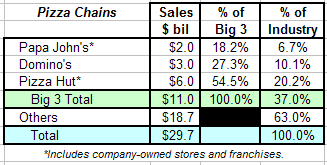
Who sells more pizza: Domino’s, Pizza Hut or Papa John’s?

October 2, 2009

According to Fortune Magazine …

image

http://money.cnn.com/2009/09/22/news/companies/papa_johns_pizza_schnatter.fortune/index.htm

* * * * *

Ken’s Note: I would have bet Domino’s … not for a minute did I think Pizza Hut sold more than Domino’s and Papa John’s combined.

* * * * *

Who sells more pizza: Domino's, Pizza Hut or Papa John's?

October 2, 2009

According to Fortune Magazine …

image

http://money.cnn.com/2009/09/22/news/companies/papa_johns_pizza_schnatter.fortune/index.htm

* * * * *

Ken’s Note: I would have bet Domino’s … not for a minute did I think Pizza Hut sold more than Domino’s and Papa John’s combined.

* * * * *

Apple set to compete with Nintendo and Sony

September 30, 2009

TakeAway: MSBers: Remember back in MarkStrat when we learned that a “Direct Hit” targeting strategy was better than a “Tweener” strategy?

Apple seems to feel the same way about the iPod touch.

Kind of caught in no man’s land (not as cheap as the iPod nano, not as awe-inspiring as the iPhone), Steve Jobs and his crew have decided to position the touch against Nintendo DS and Sony PSP as a portable video game player.

Their advantage? How about competitive prices on hardware, cheaper games with a wider selection, and, oh yeah, that delicious-looking fruit with a bite taken out of it.

* * * * *

Excerpted from Forbes, “Steve Jobs Takes Aim At Competitors” By Brian Caulfield, September 9, 2009

Steve Jobs was there . A tablet computer was not.

Jobs, however, did drag out a big bag of pain for Nintendo, Sony and Cisco from wherever he has been hiding this year.

The nastiest move: tacking a video camera onto Apple’s iPod nano.

Cisco’s Flip camera, by contrast, starts at $149 for a device with half the storage and no music player. In short: “We’re going to lower the price from $149 to free,” Jobs said.

Jobs also slashed the price of the iPod touch to $199 as he unveiled a new ad that positions the tiny touch-screen tablet as a Nintendo DS killer. The new tag line for the commercial Apple will soon be using to carpet bomb the competition: “next-level fun.”

Apple was eager to make unflattering comparisons between the Sony PSP and Nintendo DS.

Apple’s  pitch: Apple’s games are cheaper; the iPhone and iPod touch’s built-in App Store makes buying games more convenient; and Apple has more of them. Apple now offers 21,178 games, compared to 3,680 available for the Nintendo DS and 607 for Sony’s PSP.

Edit by JMZ

* * * * *

Full Article
http://www.forbes.com/2009/09/09/ipod-iphone-apple-technology-enterprise-steve-jobs_print.html

* * * * *

2009’s Best Global Brands

September 24, 2009

According to consultancy InterBrand …

 .  Top Ten Global Brands in 2009  . 
(and their estimated Brand Asset Value)

  1. Coca-Cola 68,734 ($m)
  2. IBM 60,211 ($m)
  3. Microsoft 56,647 ($m)
  4. GE 47,777 ($m)
  5. Nokia 34,864 ($m)
  6. McDonald’s 32,275 ($m)
  7. Google 31,980 ($m)
  8. Toyota 31,330 ($m)
  9. Intel 30,636 ($m)
  10. Disney 28,447 ($m)

For more, see …

Article:
http://www.interbrand.com/best_global_brands_intro.aspx?langid=1000

Full Report:
http://www.interbrand.com/images/studies/-1_BGB2009_Magazine_Final.pdf

Cool poster with Logos:
http://www.interbrand.com/BGB09/BGB2_POSTER_FRONT.pdf

* * * * *

Great moments in marketing … an old guy pitches GM’s “bring it back” guarantee … huh?

September 22, 2009

Ken’s Take: I don’t usually take positions on ads, but I can’t resist on this one.  More “Take” below…

* * * **

BrandChannel, Should GM and Citi CEOs Take To The Airwaves?, September 17, 2009

With consumer confidence low, GM plans to reform its image and resuscitate itsbrands.

Two months after declaring bankruptcy, GM has rolled out a new ad campaign featuring government-appointed chairman Ed Whitacre.

In a 60-second spot, Whitacre declares the brand revived, and goes so far as to brag, “We win.”

The ad shows Whitacre walking through what looks to be GM research and development, shiny new cars decorating the scenery. Whitacre invites consumers to test a new GM model — though none are shown — and promises them a 60-day-money-back guarantee if not fully satisfied.

GM seems to be taking a gamble by personalizing its products with the very leaders the public holds responsible for their failure. Consumers may dismiss the ads as just more lies and empty promises. On the other hand, they may find the sight of executives stepping up to the plate a refreshing act of responsibility.

GM has made a miscalculation: Consumers are looking for action, not words.

GM should spotlight their fleet of competitive vehicles in advertisements. Instead, they’re undermining the quality of their product by placing the spotlight on their 60-day-money-back guarantee.

Full article (with a link to the commercial):
http://www.brandchannel.com/home/post/2009/09/17/GM-and-Citigroup-unveil-new-ad-campaigns-to-resuscitate-brands.aspx

* * * * *

Sidenote:

“Ad agencies can do a real disservice to clients by pitching CEO ads. It’s an easy way to land a client, because it’s very flattering to the CEO. And most CEOs have big enough egos that they cannot imagine appearing in the ads might be a bad idea. They just think the agency is brilliant for recognizing their own brilliance.”

* * * * *

Ken’s Take II: (1) My wife literally asked “who’s the old guy?  He looks almost dead.”  Perhaps Whitacre thinks he reeks credibility. I bet most folks find him more creepy than credible.  (2) Re: substance: I disagree with the article.  It’s a bold move to shift product quality risk from consumers back to the company — where it belongs  (3) Re: unintended consequences: How many folks will simply take 60 day joy rides in GM cars? Hmmm

* * * * *

What’s your core value? Take your choice: fidelity or convenience.

September 17, 2009

TakeAway: In this adaptation from his new book, Trade-Off: Why Some Things Catch On, and Others Don’t author Kevin Maney explains the tension between two key qualities — fidelity and convenience — and how a great brand fell into the trap of becoming too familiar got caught in a no-man’s-land between them.

For a brand like Starbucks, familiarity and ubiquity are deadly.

* * * * *

Fortune, How Starbucks lost its ‘fidelity’, September 16, 2009

We constantly, in our everyday lives, make trade-offs between fidelity and convenience.

Those trade-offs, and how they affect business, help explain why Starbucks  hit a wall in 2007 — and why CEO Howard Schultz is still struggling to get his company’s mojo back.

Fidelity [as in high-fidelity] is the total experience of something.

At a rock concert, for example, it’s not just the quality of the sound, which often isn’t as good as listening to a CD on a home stereo, but also everything else going on, like the crowd around you and the social cache of later telling people you saw the band live.

Convenience is how easy it is to get what you want. That includes whether it’s readily available, whether it’s easy to do or use, and how much it costs. If something is less expensive, it’s naturally more convenient because it’s easier for more people to get it.

Consumers are willing to give up convenience for great fidelity, or ditch fidelity for great convenience.

But anything that offers just so-so fidelity and so-so convenience falls into a no-man’s-land of consumer apathy that I call the fidelity belly. That’s where music CDs, newspapers, and desktop Windows-based PCs find themselves today.

* * * * *

Remarkably, the most successful products and services tend to be either high in fidelity or high in convenience — one or the other, but not both. In fact, products attempting to be both typically end up with a confused brand, like if McDonald’s tried to do gourmet meals.

This impossible place of both fidelity and convenience is something I call the fidelity mirage. And Starbucks chased it big-time.

After a decade of stupendous success, Starbucks ran into trouble in 2007.

Starbucks, during its heyday, was all about fidelity.

It was all about creating a high-fidelity experience that was greater than just the coffee … “a taste of romance” and “an oasis — a small escape during a day when so many other things are beating you down.”.

And the products Starbucks served?  Once Starbucks arrived on the scene, it suddenly seemed boring to walk into a deli or a Dunkin’ Donuts and just order coffee with cream and sugar.

Starbucks had a special aura. The green label on a cardboard cup made the coffee it held seem better. Holding that Starbucks coffee cup, being seen in a Starbucks, and being enough of a regular that you knew your favorite complex beverage combination off the top of your head conferred a bit of identity. And for all of this, Starbucks charged premium prices.

As coffee goes, there was essentially nothing convenient about Starbucks. You had to travel to a store, wait in line, and pay exorbitant prices for a product you could make at home or in the office for relatively nothing.

Then. Starbucks launched aggressive expansion plans.

If you build fidelity, the temptation is to then pursue growth. But that growth can lead to the very thing that can kill a high fidelity brand: familiarity.

“Once Starbucks became ordinary, it was committing suicide.”

Starbucks carpet-bombed the world with its franchises. In 1998, the world was populated with 1,886 Starbucks stores. Ten years later, there were 16,226.

The Starbucks brand was extended to ice cream, packaged beverages, and a record label. 

Starbucks Schultz blessed it all, convinced that Starbucks could be everywhere and still be special.

Starbucks started with high fidelity — a unique, a feel-good experience that conferred upon its customers a sense of identity.  

But the expansion plans went in the opposite direction, toward high convenience — making Starbucks  available at every moment.

Convenience acts like anti-matter to fidelity. The more convenient something becomes — the easier it is to get — the more its aura dissipates.

The more convenient something becomes, the less that item identifies its owner as someone unique and special.

For Starbucks, excessive convenience dragged down the brand and made it commonplace.

On the flip side, Starbucks could not achieve genuine convenience.  

The prices of Starbucks’ products were too high, and the lines were toolong, too slow moving. Making fancy customized drinks like frappuccinos tied up the baristas, causing back-ups. Customers realized that if they were looking for a quick, good-enough cup of coffee, it was easier to go to McDonald’s or 7-Eleven, and save a few bucks.

Starbucks’ customers reacted predictably.

Despite more Starbucks around than ever before, people started veering away. 

People looking for convenience saw less reason to pay Starbucks’ prices.

People looking for aura and identity turned back to smaller chains or independent local coffee shops.

When anything — a brand, a rock band, a style of clothing — becomes popular with a huge mass market, the cool people increasingly find it uncool, and look for something new.

In February 2007, founder Howard Schultz deplored “the watering down of the Starbucks experience” and “the commoditization of our brand.”

He immediately began reaching backward, toward Starbucks’ high-fidelity core to “go back to our roots and reaffirm our leadership position as the world’s highest-quality purveyor of specialty coffee.”

First, he shut down 7,000 Starbucks stores for three hours so 135,000 baristas could learn how to correctly make a Starbucks espresso.

Second, Schultz announced that 600 Starbucks outlets in the United States would close — the first time Starbucks backed away from its drive for convenience.

This year, Starbucks got so desperate to win back its premium position, it started opening “stealth” stores — Starbucks-owned stores minus the Starbucks name, meant to mimic small, independent, high-fidelity coffee shops.

* * * * *

For a brand like Starbucks, familiarity and ubiquity are deadly.

The aura and identity Starbucks once had is gone for most Americans.

It doesn’t mean people will stop going to Starbucks. But it does mean people will be less inclined to seek out Starbucks.

Coffee purveyors that are more convenient (like McDonald’s or 7-Eleven) or are perceived as higher fidelity (independent coffee shops or smaller chains) will have an easier time competing against Starbucks than they used to.

* * * * *

Full article:
http://money.cnn.com/2009/09/16/news/companies/kevin_maney_starbucks.fortune/index.htm?postversion=2009091612

* * * * *

Fumble! Bud’s college "fan-cans" yanked from market as colleges protest.

September 15, 2009

TakeAway: Anheuser-Busch made a risky and costly marketing decision when it decided to launch a school-themed Bud Light campaign without the permission of the schools. 

AB wasted a valuable portion of its marketing budget since, due to school protest, it must stop production of and remove the existing inventory of many “themed” beers.

And, it hacked off several of the biggest (football power-house) universities, potentially damaging future relations. 

A little more due diligence or “priming” should have been done before launching this marketing campaign.

* * * * *

Excerpted from WSJ, “Team Colored Bud Cans Leave Colleges Flat” by John Hechinger, August 21 2009

Dozens of colleges are up in arms over a new Anheuser-Busch marketing campaign that features Bud Light beer cans emblazoned with local schools’ team colors …

As part of a broader marketing effort, the Bud Light school-colors campaign, also called “Team Pride” in the marketing materials, aims to use “color schemes to connect with fans of legal drinking age in fun ways in select markets across a variety of sports,” … the cans don’t bear any school’s name or logo…

Colleges fear that promotions near college campuses will not only contribute to underage and binge drinking but also will give the impression that the colleges are endorsing the brew …

Collegiate Licensing Co., which represents about 200 colleges, the National Collegiate Athletic Association and other school-sports organizations, complained to Anheuser-Busch about potential trademark violations after being notified about the campaign. 

At least 25 schools have formally asked Anheuser-Busch to drop the campaign near their campuses. In recent letters, the University of Michigan’s lawyers threatened legal action for alleged trademark infringement, demanding that Anheuser-Busch not sell the “maize and blue” cans in the “entire state.” …

Edit by TJS

* * * * *

Full Article:
http://online.wsj.com/article/SB125081310939148053.html

* * * * *

Ken’s Take: If the powerhouse schools had gotten a cut of the actions, I bet concerns re: underage drinking would have disappeared.  Call me cynical.

* * * * *

Fumble! Bud's college "fan-cans" yanked from market as colleges protest.

September 15, 2009

TakeAway: Anheuser-Busch made a risky and costly marketing decision when it decided to launch a school-themed Bud Light campaign without the permission of the schools. 

AB wasted a valuable portion of its marketing budget since, due to school protest, it must stop production of and remove the existing inventory of many “themed” beers.

And, it hacked off several of the biggest (football power-house) universities, potentially damaging future relations. 

A little more due diligence or “priming” should have been done before launching this marketing campaign.

* * * * *

Excerpted from WSJ, “Team Colored Bud Cans Leave Colleges Flat” by John Hechinger, August 21 2009

Dozens of colleges are up in arms over a new Anheuser-Busch marketing campaign that features Bud Light beer cans emblazoned with local schools’ team colors …

As part of a broader marketing effort, the Bud Light school-colors campaign, also called “Team Pride” in the marketing materials, aims to use “color schemes to connect with fans of legal drinking age in fun ways in select markets across a variety of sports,” … the cans don’t bear any school’s name or logo…

Colleges fear that promotions near college campuses will not only contribute to underage and binge drinking but also will give the impression that the colleges are endorsing the brew …

Collegiate Licensing Co., which represents about 200 colleges, the National Collegiate Athletic Association and other school-sports organizations, complained to Anheuser-Busch about potential trademark violations after being notified about the campaign. 

At least 25 schools have formally asked Anheuser-Busch to drop the campaign near their campuses. In recent letters, the University of Michigan’s lawyers threatened legal action for alleged trademark infringement, demanding that Anheuser-Busch not sell the “maize and blue” cans in the “entire state.” …

Edit by TJS

* * * * *

Full Article:
http://online.wsj.com/article/SB125081310939148053.html

* * * * *

Ken’s Take: If the powerhouse schools had gotten a cut of the actions, I bet concerns re: underage drinking would have disappeared.  Call me cynical.

* * * * *

The “good enough” revolution …

September 10, 2009

Wired, The Good Enough Revolution: When Cheap and Simple Is Just Fine,  08.24.09

The central premise:

The world has sped up, become more connected and a whole lot busier.

As a result, what consumers want from the products and services they buy is fundamentally changing.

We now favor flexibility over high fidelity, convenience over features, quick and dirty over slow and polished. Having it here and now is more important than having it perfect.

These changes run so deep and wide, they’re actually altering what we mean when we describe a product as “high-quality.”

Entire markets have been transformed by products that trade power or fidelity for low price, flexibility, and convenience.

Some examples …

MP3s

The music industry initially laughed off the format, because compared with the CD it sounded terrible.

What record labels and retailers failed to recognize was that although MP3 provided relatively low audio quality, it had a number of offsetting positive qualities.

By reducing the size of audio files, MP3s allowed us to get music into our computers—and, more important, onto the Internet—at a manageable size.

This in turn let us listen to, manage, and manipulate tracks on our PCs, carry thousands of songs in our pockets, purchase songs from our living rooms, and share tracks with friends and even strangers.

And as it turned out, those benefits actually mattered a lot more to music lovers than the single measure of quality we had previously applied to recorded music—fidelity.

Netbooks

On paper, netbooks might seem like crappy toys.

They have almost no storage, processing power, or graphics capability.

What they do have, though, is accessibility: Cheap, small, and light, they let you connect to the Internet from almost anywhere.

Netbook shipments were up sevenfold in the first quarter of 2009.

Kindle

Amazon’s Kindle can’t display complex graphics, and paper still has much higher resolution.

But the device does store hundreds of titles in a slim package, ensuring that you always have access to whichever Philip K. Dick tale you’re in the mood for.

The Kindle is expected to generate $310 million in revenue by the end of 2009

Kaiser Micrclinics

Instead of building a hospital in a new area, Kaiser just leases space in a strip mall, sets up a high tech office, and hires two doctors to staff it.

They cut everything they could out of the clinics: no pharmacy, no radiology. They even cut the receptionist in favor of an ATM-like kiosk where patients can check in with their Kaiser card.

Thanks to the digitization of records, patients can go to a “microclinic” for most of their needs and seamlessly transition to a hospital farther away when necessary.

What they found is that the system performs very well. Two doctors working out of a microclinic can meet 80 percent of a typical patient’s needs.

With a hi-def video conferencing add-on, members can even link to a nearby hospital for a quick consult with a specialist.

Patients would still need to travel to a full-size facility for major trauma, surgery, or access to expensive diagnostic equipment, but those are situations that arise infrequently.

* * * * *

80 percent is a magic number — the famous Pareto principle, also known as the 80/20 rule.

And it happens to be a recurring theme in Good Enough products: 20 percent of the effort, features, or investment often delivers 80 percent of the value to consumers.

That means you can drastically simplify a product or service in order to make it more accessible and still keep 80 percent of what users want—making it Good Enough

* * * * *

Full article:
http://www.wired.com/gadgets/miscellaneous/magazine/17-09/ff_goodenough?currentPage=all

Thanks to MSB MBA alum Mike Cirrito for the lead

* * * * *

The Power of Free (Again) … In the Air, Wi-Fi Gets a Ho-Hum Reception

September 9, 2009

Ken’s Take: A nice example of PVP concepts in action: (1) The recurring power of free – charge even a minimal amount and demand falls – a lot.  (2) Differentiated pricing – in this case, by distance.  (3) Morphing from “by the drink” to subscriptions.

* * * * *

WSJ, In the Air, Wi-Fi Gets a Ho-Hum Reception, Aug. 27, 2009

More than 500 airliners are flying around the U.S. with wireless Internet access up and running, but airlines are finding that the technology that they hope will bring new revenues may be more like in-flight meals: People gobbled up food when it was free, but they find it a lot less appetizing when they have to pay.

Airlines and in-flight Wi-Fi providers say usage has been strong and is growing as more travelers sign up for the service and find it on more flights.

But usage drops off considerably when travelers must pay for the service.

Alaska Airlines even tested charging just $1. The result: a lot fewer laptops, BlackBerrys and iPhones signed on.

Most U.S. airlines with Wi-Fi are using a service called Gogo from Aircell LLC, which built a network of cellular towers across the country.

Aircell is already testing lower prices and rolling out longer service plans. The service is priced now at $12.95 for flights longer than three hours; $9.95 for flights under three hours but more than 90 minutes, and $5.95 for flights shorter than 90 minutes.

Usage is higher on long-haul flights and has steadily increased as more travelers register for the service—making it easier to sign on during subsequent flights without entering credit-card numbers and other information.

Virgin America says about 12% to 15% of passengers across its fleet are using the service. That’s likely higher than industry averages since Virgin America has a high proportion of cross-country flights in its schedule—plus, the airline offers power ports at all seats, making it easier to use Wi-Fi.

On average, 8% to 10% of travelers need to pay for Internet access for the service providers to be profitable within five years. That may be hard to do because a large percentage of U.S. domestic flights are shorter than two hours, when travelers are least likely to pay for Web access in the air.

For many business travelers, staying online will make hours in the air more productive (and rob some road warriors of a respite from electronic leashes).

Aircell, which is adding about 100 planes a month, thinks pricing will move more toward subscriptions, with travelers buying packages of five flights or more and companies directly buying the service for their business travelers.

Full article:
http://online.wsj.com/article/SB10001424052970203706604574374571364228440.html

* * * * *

Marketing focus: “What is the bigger job this brand does in a consumer’s life?”

September 8, 2009

Many big marketers are cutting back on ad spending this year … total measured ad spending for the first six months of ’09 has dropped 14.4% compared with the first six months of 2008.

But this is not how the companies that sell basic supermarket staples the American public purchases by the palletful are going about marketing in this recession.

For example, General Mills … is spending 16% more on marketing than it did in ’08. “In an environment where you have consumers going to the grocery store more often and thinking more about meals at home,we think that is a great environment for brand building, to remind consumers about our products.”

General Mills purveys homey comforts—Cheerios, Wheaties, Progresso Soup, Hamburger Helper.  It does  intensive research that aims at wreathing a kind of grandiosity of purpose around everyday products: “What is the bigger job this brand does in a consumer’s life?”  This question is threaded through an exhaustive process—including videotaped interviews with key customers — that ultimately boils the marketing message of key brands down to simple story lines. For Hamburger Helper, it’s “One Pound. One Pan. One Happy Family.”

General Mills has long built evocative stories around simple products … believing that  “marketing is a business in which the best story that’s most aggressively deployed wins”.

excerpted from Business Week, How General Mills’ Marketing Pays Off, July 16, 2009
http://www.businessweek.com/magazine/content/09_30/b4140067532922.htm

* * * * *

Blue Nile starts chasing women …

September 4, 2009

Ken’s Take: I watched with interest as my sons and their friends shopped for engagement rings online – all from Blue Nile.  Struck me – an old-schooler — as a risky online purchase.  But, they had great experiences – nice rocks (I think), secure delivery, and fast turnaround for resizing.  Blue Nile seemed to be gaining some traction twenty-something guys, and an acceptable brand image with the ladies.

* * * * *

WSJ, Blue Nile Gets Makeover to Please Ladies,  Sept. 2, 2009

Blue Nile – an online jeweler founded in 1999 and IPO’d in 2004 — sold $295 million in jewelry last year, in a recession ravaged jewelry industry.   While data on the diamond industry is incomplete, Blue Nile estimates  its market share is roughly 4.5% to 5.5%.  

Retooling to combat slowing grow, the company is unveiling a major overhaul of its Web site to broaden its appeal, especially to women.  The changes are intended to make the experience more akin to window shopping.

But, it faces the tricky task of trying to make improvements without losing core customers.

The vast majority of those who buy rings and necklaces from Blue Nile are men, drawn to the extra information, control and discounts — they get by shopping online instead of at a high-pressure jewelry counter.

Yet most Blue Nile purchases are given to women, whom the retailer would like to have a more premium view of its brand.

Blue Nile also rebuilt a system for shoppers to create custom engagement rings — its largest business — based on criteria they can adjust with sliding scales while watching an image of the product evolve on the screen.

Shopping is now largely contained within a single page, to cut down on the confusion and tedium of clicking back and forth.

Blue Nile says that it has taken on a redesign now because of the market’s relative weakness, which has made competitors less likely to expand.

Full article:
http://online.wsj.com/article/SB125176820957074661.html

* * * * *

Hey, Southwest … what happened to free luv?

September 3, 2009

Warning: Ken is hacked !  Really hacked!

Last week, SWA got nailed for using uncertified maintenance parts on its 737s. Bad news, but I can live with that … you gotta take some risks, right?

But, this SWA policy change is personal since (a) I’m cheap and (b) I’ve gotten the “fast-trigger online check in” down to a science. 

I just may cancel my SWA Freq Flyer credit card …

* * * * *

What has Ken so upset ?

Southwest Airlines will begin charging $10 to some passengers looking to board its aircraft before others.

For the extra $10 fee each way, passengers can reserve their boarding spot while buying their ticket.

Under the Dallas-based low-fare carrier’s current policy, passengers can begin to check in 24 hours prior to their flight. Passengers who check in the earliest get to board first.

A Southwest  spokeswoman  said the new option allows passengers to not have to worry about checking themselves in.

While many airlines have been charging passengers fees for beverages and baggage, Southwest has aggressively marketed its “no frills” consumer policies to set itself apart. What sets this option apart?  Southwest’s passengers have a choice of paying the $10 fee.

“These are opportunities that customers can have the option of taking advantage of, instead of being forced to pay the additional fee,” she added.

Washington Business Journal, Southwest Airlines adds $10 fee to reserve boarding spot, September 2, 2009
http://washington.bizjournals.com/washington/stories/2009/08/31/daily56.html?ed=2009-09-02&ana=e_du_pub

* * * * *

Inside that magazine: a video clip … hmmm, interesting idea.

September 1, 2009

Ken’s Take: An interesting play.  Nice use of technology to drag print into the current century.  CBS should get nice buzz. My bet: still too expensive for it to become a common promo device … but, costs keep coming down.

* * * * *

Excerpted from WSJ: Video is invading a new medium: print. Aug 20, 2009

In a marketing stunt to promote its fall TV series, CBS is inserting thousands of tiny screens in copies of Entertainment Weekly.

The screens measure two and a quarter inches diagonally and play about 40 minutes of clips from new and old CBS shows.

The reader/viewer can push a spot on the cardboard insert that holds the screen and watch a clip of the sitcom “Two and a Half Men.” Push another to see a preview of the new crime-investigation spinoff “NCIS: Los Angeles.” Another delivers an ad for PepsiCo Inc., which is helping fund the promotion.

The player is much like the chips that play music in some greeting cards and magazine ads and is rechargeable.

This isn’t the first time magazines and technology have teamed.

In 2005, CBS embedded People magazine with singing sound chips to promote an Elvis Presley miniseries.

Last year, the cover of October’s Esquire magazine splashed blazes of electronic ink … that flashed with messages and an illusion of a car on the road.

Full article:
http://online.wsj.com/article/SB125073451546645129.html?mod=djemMM

* * * * *

Forget the cola wars … now, it’s Big Carl vs. Big Mac in “the burger wars” ..

August 25, 2009

Ken’s Take: (1) Nice example of “judo marketing” – leveraging a much bigger competitor’s strength. (2) the mobile diner shows some marketing cahones (3) never, ever say that you’re not concerned about what competitors are doing – just riles them up (4) even if you say you’re not concerned, be concerned and counter-punch

Excerpted from WSJ: Hardee’s, Carl’s Hope to Steer Angus Eaters. Aug 19, 2009 

The burger wars are heating up, with the Hardee’s and Carl’s Jr. chains taking aim at McDonald’s Corp. with a taste challenge and an attack on Big Mac.

In September, Hardee’s and Carl’s Jr. restaurants will offer mail-in refunds to customers who claim to like a McDonald’s Angus burger better than a Carl’s Jr. ‘Six Dollar Angus Burger ‘ — which actually costs $3.99 –or a $3.49 Hardee’s Angus Thickburger.

The chief executive of CKE Restaurants — the parent of both Hardee’s and Carl’s Jr. —  said that McDonald’s national rollout last month of $3.99 Angus burgers “gave us the perfect opportunity” to change a perception among consumers that burgers at Carl’s Jr. and Hardee’s cost more than those at McDonald’s.

Moreover, feeling that the McDonald’s Angus burger was a copycat of CKE’s Angus burgers, Carl’s Jr.  is introducing the Big Carl, to go up against the Big Mac.

The Big Carl contains seven ounces of beef, compared to the Big Mac’s 3.2 ounces, and costs $2.49, about 50 cents less than a Big Mac, depending on the city.

“After they so blatantly copied our burgers, we felt it was fair play.” 

The Big Carl burger will be backed by a snarky marketing campaign. One television commercial begins with a parody of the Big Mac jingle followed by a voice from Carl’s Jr. saying, “We’ve got a jingle, too. Double the meat. Double the cheese. Less money. La La La La La.”

One day next month, the company will park a Carl’s Jr. mobile diner outside McDonald’s restaurants in Los Angeles and offer to swap McDonald’s customers’ Big Macs for Big Carls.

CKE could have a hard time making a dent in its large rival. With 14,000 U.S. stores, McDonald’s dwarfs CKE, which has 1,082 Carl’s Jr. restaurants and 1,713 Hardee’s in the U.S.

Hardee’s sells different types of Thickburgers, the biggest of which is the Monster Thickburger, which tips the scales at 1,420 calories and 108 grams of fat. McDonald’s Bacon and Cheese Angus burger weighs in with 790 calories and 39 grams of fat.

McDonald’s isn’t worried about CKE’s efforts. “It’s flattering that there’s so much attention around us … our Angus third pounder is a great burger and I’m not too concerned about what other folks are doing.”

Full article:
http://online.wsj.com/article/SB125064285111841883.html?mod=djemMM

* * * * *

How (and why) consumers drive American innovation …

August 19, 2009

Excerpted from “Consumers Drive American Innovation”,  John Quelch,  Marketing KnowHow, March 31, 2009

Marketing, a distinctly American expertise, has of encouraged consumers to be venturesome and to welcome innovation.

The willingnes of American consumers to adopt new products, new processes and new services more rapidly than consumers in other countries may be the most important of all enablers of entrepreneurship and innovation in America.

Why is the American consumer more venturesome? Six factors come to mind.

Wealth. The average American consumer has more disposable income than his counterparts in most other countries. There is therefore money available, with easy credit historically fueling the fire, to risk on new things and new experiences. And the secondary market, from the flea auction to eBay, is well developed so the consumer does not necessarily lose everything if disappointed.

Mobility. American consumers relocate more than most. What they own, how they dress, what they do. In other words their consumption behavior, becomes an important signaling device to attract efficiently the right set of new friends and acquaintances. It’s not so much a matter of keeping up with the Jones’s; it’s a matter of quickly identifying the Jones’s like you.

Immigration. The prevalence of immigrants among America’s successful entrepreneurs is well-documented. But the same curiosity and openness to new things also characterizes consumer demand in the American melting pot.

Independence. The American frontier tradition and the sheer number of Americans promotes an attention to individual differentiation that is less prevalent in more conformist and homogeneous societies. Among 300 million curious consumers, it is possible for almost any innovation to find a viable niche market.

Recognition. Americans are not overly concerned or burdened by history. Many live for today or for the next new thing. Early adopters and lead users of new products are listened to and applauded. Their opinions are sought on the Internet. They can accelerate adoption of a new product or kill it. The American maverick commands more influence than the European eccentric.

Technology. Americans understand that innovation is the key to growth and wealth in a global economy where knowledge travels at lightspeed over the Internet. America’s economic strength is based on innovation. Proud parents take their children to science fairs, new electronic gizmos dominate Christmas gift sales, and senior citizens find renewed connectivity with far-flung families by going on line. Americans know technology adds value to daily life.

Bottom line: Venturesome consumers have an appetite for innovation …

Full article:
http://blogs.harvardbusiness.org/quelch/2009/03/how_consumers_drive_american_i.html

“On Sale” at Tiffany … doesn’t sound right, does it ?

August 11, 2009

The downturn has forced the likes of Tiffany, Chloé, and Chanel to quietly lower prices, a strategy that could tarnish their glitzy brands.

For example, Business Week reports that Tiffany quietly nudged down prices for engagement rings —one of its biggest sellers — by about 10%. Salespeople tell customers about the reductions, but otherwise there’s no publicity, no signs.

The dilemma that Tiffany and other purveyors of luxury goods face is how to use price cuts to woo customers without tarnishing their brands.

Executives are well aware of the need to woo today’s frugal buyers while trying to maintain tomorrow’s prestige. Some have chosen to be discreet by refusing to advertise sales or by e-mailing “exclusive” offers to select clients.

Retail experts argue that price cuts could prove to be perilous for luxury retailers. “The losers [in this recession] will be the ones who destroyed their brand by discounting them”

Excerpted from: Business Week, In Luxury Sector, Discounting Can Be Dangerous, July 23, 2009
http://www.businessweek.com/magazine/content/09_31/b4141049551979.htm

* * * * *

Stick a keg in the fridge … now, that’s innovation!

August 10, 2009

Among the Latest Innovations From Major Brewers Fighting for Business in a Jammed, Sluggish Market

MillerCoors  has begun testing the sale of $20 draft-beer systems for consumers to drink at home, part of a string of new products and package innovation from beer giants grappling for market share in a crowded, slow-growing industry.

The 1.5-gallon boxed product, which is designed to fit into refrigerators for drinkers to consume periodically, rather than for one-time party use.

Sales of major U.S. beer brands are struggling as some recession-weary consumers drink less or switch to cheaper brews.

Despite a new ad campaign this year aimed at revitalizing the brand, Miller Lite’s retail sales fell 7.5% by volume.

Sister brew Coors Light, on the other hand, continues to post sales gains. Analysts attribute its long-running success in part to innovations in packaging, such as “cold-activated bottles,” whose labels turn blue when the beer inside cools to a certain temperature.

MillerCoors’s new Home Draft systems are meant to be placed upright in a refrigerator, which will keep the beer fresh for about 30 days. The price per ounce is roughly 15% higher than for an 18-pack of the same beer.

The product, which is recyclable, is aimed at the 30% of beer drinkers who say they prefer draft beer to the bottled or canned variety.

“We’re really trying to meet that occasion when you just got back from work and want to reward yourself,” rather than “the party occasion,” he said.

Excerpted from WSJ, MillerCoors Tests a Draft-Beer Box for the Fridge, July 29, 2009
http://online.wsj.com/article/SB124882355717088341.html

* * * *

Name a government agency that works … here’s one if you’re stumped.

August 7, 2009

DARPA – the Defense Advanced Research Projects Agency — is the Defense Dept.’s famous research branch.

Created at the height of the Cold War to bolster U.S. military technology following the Soviet Union’s Sputnik satellite launch, the agency has a long history of innovation.

Most famously, DARPA’s researchers first linked together computers at four locations in the early 1960s to form the ARPANET, a computer network for researchers that was the core of what eventually grew into the Internet.

Other breakthroughs have fueled big advances in commercial areas , including:

  • GPS
    DARPA co-funded the original satellites used for GPS in 1960. By the 1980s its research helped miniaturize GPS receivers, making them portable and inexpensive enough for use in everything from automobiles to cell phones.
  • COMPUTER MOUSE
    An agency-sponsored researcher named Douglas Engelbart invented the now ubiquitous device in 1964. The original model was made of wood and had a single button.
  • INTERNET
    DARPA developed the military network, the ARPANET, from which the Internet later emerged. Launched with four connected sites in 1969, it eventually linked universities and think tanks before an international network was commercialized in the mid-1990s.
  • UNIX
    In the 1960s, the agency funded the further development of the computer operating system known as UNIX, which remains in widespread use today by Hewlett-Packard, IBM, Sun Microsystems, and others.
  • PARALLEL COMPUTING
    In the 1990s, DARPA funded research into a technology that breaks apart highly complex problems into pieces and solves them in parallel. It is now commonly employed in high-performance computing.

Excerpted from Business Week, Can the Military Find the Answer to Alternative Energy?, July 23, 2009
http://www.businessweek.com/magazine/content/09_31/b4141032537895.htm

How do you know a successful new car when you see it ?

August 6, 2009

 Ken’s Take: This article is specific to the auto industry but the general principles are applicable to most businesses.

* * * * *

Excerpted from: WSJ, The Auto Industry’s Comeback, July 29, 2009

The future of any car company is built on the relative success of its new cars.

Between now and 2014 there will be approximately 250 launches of either all-new or significantly redesigned new cars in the U.S.

* * * * *

What constitutes a successful launch?

First,  focus on the true indicators of how well a launch is going. Sales reports are not enough. What are the cars actually selling for at retail? Do the vehicles require incentives? Are dealers earning a profit? How are the residual values holding?

Second, the company must deliver a high-quality product if sales are to be sustained. Getting things right from the start has become the price of admission. Even the most subtle mistakes—like user-unfriendly technology—can kill off an otherwise promising product.

Third, the vehicle must have appeal. Owner delight with the design, content, layout and performance can be objectively measured. Attributes such as drivability, instrument panel layout can make the buyer an advocate and give the launch momentum.

Fourth, the products must have durability and reliability. It takes about three years to get a good reading on how the consumer feels about these two qualities. But we do know there is a direct relationship between a brand’s reputation for reliability and durability and its performance. So part of the assessment should include a look at the reputation of the brand. Where the reputation is strong, the launch gets a boost.

Fifth, while manufacturers launch cars, dealers sell them. The dealer’s willingness to put his best sales people on the new product, advertise vigorously, finance, carry and merchandise (a fancy word for trick out) the requisite inventory is all a reflection of the dealer’s confidence in the franchise. Brands that enjoy a high level of dealer confidence and exclusive dealership facilities have a more effective channel for launching a new vehicle.

 Full article:
http://online.wsj.com/article/SB10001424052970204886304574308202570479912.html

* * * * *

Looking for ideas in all the right places … different right places

July 31, 2009

Ken’s Take: Lots is written on how to be innovative. This is a nice checklist of frequently used methods …

* * * * *

Extracted from WSJ, “In Search of Innovation”, Bessant, June  23, 2009

When companies try to come up with new ideas, they too often look only where they always look. That won’t get them anywhere.

If you want to understand why some companies lack innovative ideas, think about the man who can’t find his car keys.

His friend asks him why he’s looking for the keys under the lamppost when he dropped them over on the lawn. “Because there’s more light over here,” the man explains.

Innovative ideas, however, don’t really come from nowhere. Instead, they are typically at the edge of a company’s radar screen, and sometimes a bit beyond: trends in peripheral industries, unserved needs in foreign markets, activities that aren’t part of the company’s core business.

In other words, they have to look away from the lamppost.

None of this is easy to do. But companies that succeed may just recognize the next great opportunity, or looming threat, before their competitors do.

Here are nine examples of practices with the potential to produce a company’s eureka moment.

BUILD SCENARIOS
Many companies use teams of writers with diverse perspectives to create complex scenarios of what future markets may look like. The writers try to imagine detailed opportunities and threats for their companies, partners and collaborators. An oil company that wants to explore energy opportunities in cities of the future, for example, might want to work on scenarios with writers from construction, water and utility-management companies.

SPIN THE WEB
A few companies have created Web sites that act as literal marketplaces of ideas. InnoCentive.com is a site where people and companies look for help in solving scientific and business challenges. Posters of challenges sometimes offer cash rewards for solutions: Amounts have ranged from $5,000 to $1 million. Problem solvers can be professionals, retired scientists, students or anyone who can answer a problem that has stumped a company’s own researchers.

ENLIST LEAD USERS
Ideas and insights from so-called lead users can be the starting point for new markets, products and services.

Lead users are innovators themselves. They tend to be people working in or using products in a specific market who are frustrated by the tools, goods or services currently available and yearn for something better. Many medical devices, for example, originate from sketches drawn by surgeons, surgical nurses and other medical staff who feel driven to experiment with new ideas because current products aren’t meeting their needs. They are often supportive, and tend to tolerate product failures as part of a process that helps bring about improvements.

DEEP DIVE
Interest has surged in market research that uses detailed, firsthand observation to learn more about consumers’ needs or wants. Deep diving is one of many terms used to describe the approach, which resembles an anthropological study in the way researchers immerse themselves in the lives of the target consumers.

Such approaches can help uncover underserved or unserved markets and give clues to new directions and new frames in which to search for innovative ideas.

PROBE AND LEARN
Some companies design probe-and-learn strategies that study opportunities in segments of markets the company isn’t active or strong in. This strategy goes further than deep diving by actively experimenting with new ideas in a new context. The experiments might not always work, but they will give valuable insight about future directions of markets.

MOBILIZE THE STAFF
By engaging more of its own workers in the search for innovation, a company can broaden its vision. For example, the duties of procurement, sales or finance groups can be expanded to include learning about trends they encounter that ordinarily might be considered not of primary interest to the company.

CATER TO ENTREPRENEURS
Innovation can bubble up inside a company as well—when the organization follows practices that favor it.

Clear policies that reserve blocks of time for scientists or engineers to explore their own ideas have worked well at some companies. At 3M Co., based in St. Paul, Minn., scientists can spend 15% of their time on projects they dream up themselves, and the company has set procedures to take bright ideas forward, including grants and venture funding. Google Inc. takes a similar approach, allowing researchers to devote 20% of their schedules to play time, pursuing their own ideas and projects.

It helps to have an established pathway to make sure the best new ideas get taken forward. In some cases, informal networking has pushed innovations to the forefront—below the radar screen of formal corporate systems.

START A CONVERSATION
Sometimes innovations arise when different departments talk to each other. But what’s the best way to start the conversation?

Many companies set up so-called communities of practice, which are typically internal Web sites where employees are encouraged to share knowledge and skills important to the company.

BREED DIVERSITY
Close, long-term relationships—depending too much on the same customers, partners or suppliers for innovation ideas—can reinforce old ways of doing things and make changing a frame of reference difficult.

Some companies seek innovation partners with whom they wouldn’t normally work, and who might bring a fresh perspective. Some companies are also recruiting staff with very different perspectives to spice up their knowledge mix e.g.  experienced entrepreneurs. Such characters aren’t afraid to challenge corporate perspectives and to make waves. As one manager put it, they create a little grit to stimulate the oyster to produce pearls.

full article:
http://online.wsj.com/article/SB10001424052970204830304574133562888635626.html

* * * * *

Outback’s $9.99 menu lures budget-strapped boomers …

July 30, 2009

Disclaimer: I’m not unbiased.  Outback is the Homa family restaurant of choice for fancy family meals.

Ken’s Take:  It’s always risky to move away from your traditional value proposition.  Outback is known for a quantity not quality.  Reducing the quantity – even with a commensurate cut in prices – could alienate core customers (like me).

Note that customers get lured in by the lower prices, but end up spending about the same amount as before.  Another marketing triumph, right ?

* * * * *

Business Week, The Leaner Baby Boomer Economy, July 23, 2009

[Hit by the recession], Outback Steakhouse  … reduced menu prices and offered smaller cuts of beef at Outback to maintain margins … and has gone on an ad blitz pushing the more modest portions for $9.99. This is obviously a tricky balancing act at Outback, where a big slab of meat was the chain’s main attraction.

The good news, says Chief Branding Officer Jody Bilney, is that people who order the less expensive entrées typically end up buying dessert or more alcohol, so the average ticket is still about $19 per person.

Full article – includes vignettes on BMW, Starwood Hotels and others:
http://www.businessweek.com/magazine/content/09_31/b4141026524433.htm

* * * * *

Tough times all over: The days of the $330 Coach purse could be over…

July 27, 2009

Summary: Adapting to a more frugal consumer, Coach has created the less pricey Poppy line, revamping its product mix to lower its average bag price to $290

* * * * *

Excerpted from Business Week, “Coach’s Poppy Line Is Luxury for Recessionary Times”,June 18, 2009

The Coach brand  brand had emerged from its modest origins in the 1940s to become an emblem of the working woman and then, remarkably, a favorite among the fashion-conscious. It had created the very conceit of affordable luxury.

But, even before the recession Coach had become too expensive. “We have a long history of being a very grounded $200 handbag business,” he says. “Beginning around 2001 we started moving up and became a $300 handbag business. Then we reached $330. And the customer came right with us.  Until we reached our natural limits,” .

So began a nearly yearlong quest to design a line of purses and accessories that could be priced to fit the times without cheapening, or otherwise damaging, Coach’s image.

The resulting collection, which will be introduced in late June, is called Poppy. It’s more youthful, eclectic and spontaneous. The average price will be $260, about 20% less than the usual Coach purse.

The main pieces in the Poppy collection were tested in nine Coach stores and 23 department stores in April and May. And for the first time, Coach let people make online purchases through Facebook. Two $198 bags, the Groovy and the Glam, did better than Coach expected. But one didn’t do quite as well: That was the Spotlight, which sells for $298.

* * * *

Factoids

Coach spends about $5 million annually on that customer research.  It frequently surveys customers about their outlook and tastes; it carefully tests new designs; it measures almost everything.   Every three months it surveys some 20,000 women online about the Coach brand as well as about their economic expectations and spending habits.

Coach’s gross margins had been above 75% for the past five years. But during the recession, as the company has lowered prices at its factory stores, its margins have fallen to 72.4%. By comparison, brands such as Polo Ralph Lauren and Tiffany have margins of less than 60%.

Full article:
http://www.businessweek.com/magazine/content/09_26/b4137040272361.htm

* * * * *

Microsoft tries again … with Windows 7 @ intro prices

July 10, 2009

Ken’s Take: It’s almost incomprehensible that a company with Microsoft’s tech savvy and  heft could have blown it as badly as they did with Vista.  For their sake, Windows 7 had better be an acclaimed product. You can only shoot and miss so many times.

The intro pricing expense makes sense except the $10 discount is simply leaving money on the table.  Do they really think that it will motivate any incremental purchases?

* * * * *

Excerpted from WSJ, Microsoft Plans Lure for Windows 7, June 26, 2009

The product

Windows 7 is a critical test of whether Microsoft can polish the reputation of its operating system after Windows Vista suffered early technical problems.

While Windows remains by far the most dominant software for running PCs, Vista’s problems were exploited relentlessly by Apple  in marketing campaigns for Macintosh computers. Macs have gained market share steadily over the past few years.

So far, early reviews of test versions of Windows 7 have been favorable.

* * * * *

The pricing

Microsoft announced a plan to encourage pc users to move to a much anticipated new version of its operating system, Windows 7 …  scheduled for release in late October.

Until July 11, consumers can preorder an upgrade copy of Windows 7 Home Premium through retailers for $49.99.

Most new PCs coming out starting in October will have Windows 7 preinstalled.

Any consumers who buy new PCs running its current Windows Vista operating system from now until Jan. 31 will receive free upgrades to Windows 7. 

For consumers who bought PCs prior to the free upgrade program, Microsoft said it will charge $119.99 for Windows 7 Home Premium — expected to be the most popular version for consumers — instead of the $129.99 upgrade price for the comparable version of Windows Vista.

Full article:
http://online.wsj.com/article/SB124593802040653741.html#mod=testMod

* * * * *

The 10 Commandments of Innovation & Entrepreneurship …

June 25, 2009

Ken’s Take: Kawasaki has a track record, so worth listening to. Note especially #1 re: mission statements and #5 re: rolling the DICEE

* * * * *

Knowledge@Wharton, “Ten Commandments from Entrepreneurial ‘Evangelist’ Guy Kawasaki”, June 10, 2009

Guy Kawasaki  became the second software “evangelist” at Apple Computer, where his job from 1983 to 1987 was to convince people to create software for the Macintosh. Kawasaki fondly recalls his colleagues at Apple as visionary, driven and “arguably the greatest collection of egomaniacs in the history of California — though the record has subsequently been broken by Google.”

Here are Kawasaki’s “Ten Commandments” for innovation and entrepreneurship:

1. Make meaning, not money. “Most companies founded on the concept of making money pretty much fail …  focus on making their product or service mean something beyond the sum of its components “.  Nike “turned $2.50 of raw materials into something that stands for efficacy and power and liberation.  Apple has done it with the Mac and the iPhone.

2. Make a mantra, not a mission statement. Bland, generic company mission statements — about “delivering superior-quality products and services for our customers and communities through leadership innovation and partnerships” — serve no one  …  keep it short and define yourself by what you want to mean to consumers. FedEx is about “peace of mind.” To get everyone internally and externally on the same page, explain why your organization exists and how it meets customers’ needs and desires.

3. Jump curves. Innovating is harder than just staying a little bit ahead of competitors on the same curve. “If you’re a daisy-wheel printer company, the goal is not to introduce Helvetica in another point size. The goal is to jump to laser printer”.

4. In product design, “roll the DICEE.” That’s an acronym. “D” is for deep, which to Kawasaki means thinking about features that go beyond the norm. One of his favorite “deep” ideas: Fanning Reef sandals, which have a bottle opener built into the sole. “I” is for intelligence, as seen in the design of Panasonic’s BF-104 flashlight, which uses batteries of three different sizes to accommodate the random mix of extra batteries many people have around the house. “C” is for complete — or being not just a product, but including support and service. The first “E” is for elegance: Beauty matters, according to Kawasaki. The second “E” is for emotive. “Great products generate strong emotions: Think Harley Davidson, Macintosh.”

5. Don’t worry, be “crappy.” This doesn’t mean ship a bad product, but “your innovation can have elements of crappiness to it,” Kawasaki said. Twitter has a litany of flaws, but it is changing people’s habits.

6. Polarize people. Try to be all things to all people and you often ship mediocrity. The boxy Toyota Scion xB looks ugly to some people but very cool to its devotees.

7. Let 100 flowers blossom. You never know where the flowers will emerge, so let them grow. Innovations may attract unexpected and unintended customers. Think of Avon Products’ Skin-so-Soft cream, which became popular as a mosquito repellent.  Learn who’s buying your product, ask them why and give them more reasons. “That’s a lot easier than asking people who aren’t interested ‘why not,’ and trying to change their minds.”

8. Churn, baby, churn. Always improve. Listen to customers for ideas. Once the product reaches the hands of customers, it’s time to start listening to their feedback.

9. Niche yourself. Find your place. A product or service does not need to be unique if it delivers extraordinary value to a select group.

10. Follow the 10-20-30 rule when pitching to venture capitalists. That means no more than 10 PowerPoint slides, a limit of 20 minutes for the pitch, and using a 30-point font size in the presentation (to keep it simple). The goal of such pitches isn’t to walk home with a check,  it’s to “not be eliminated” from consideration.

Full article:
http://knowledge.wharton.upenn.edu/article.cfm?articleid=2258

ESPN to sports fanatics: Get out your wallet … ESPN to advertisers: Get out your wallet, too.

June 24, 2009

Ken’s Take: It’s no secret that click through response rates to online ads) is miniscule.  A current hot topic is whether “engaged” or “attentive” site visitors are more ad responsive.  Conventional wisdom says ‘yes’.  If true, sites with engaged visitors should be able to command higher ad rates.

Couple that with longstanding wisdom that people take stuff more seriously when they pay for it. and you have a new formula for online profits: generate revenue by charging a subscription fee for site access, and sell advertisers on the notion that they should pay more for an engaged base of exposures.

Might work … if the content is powerful and the base of subscribers is big enough.

* * * * *

Excerpted from Business Week, “ESPN Bets Sports Fanatics Will Pay for Online”, June 4, 2009

ESPN The Magazine, the decade-old print offshoot of Walt Disney (DIS)’s wildly successful cable sports network, is about to begin charging $6.95 a month for access to its Web site.

At a time when many media companies are merely jawboning about demanding fees from online users, this magazine is doubling down on it.

More broadly, such a move by a well-known name will plumb whether a paying customer equals a more enthralled customer—the term in the trade is “engaged”—and a more valuable target for advertisers as well.

ESPN The Magazine is well placed to test these waters. Rabid sports fans have bottomless appetites for sports info and the universe of data, jargon, and inside jokes surrounding it. 

“There is an audience that just loves games” and flits on and off sports sites only to grab scores, says ESPN.com Editor-in-Chief Rob King. But others “love the in-between stuff—the predictive stuff that helps them be smarter fans.” They’re the people the company is banking on. It also helps that many like to wager on sports, though ESPN doesn’t say so: When information can be translated into currency, people pay for it. Insider’s most popular features include data, tools, and deep-dig analyses geared to fantasy-league players and other stat geeks, and “Rumor Central,” which gathers and comments on sports tidbits from other media, such as newspapers and local call-in radio shows.

“Why is it, in this business, we are apologetic when asking [consumers] to pay for what we give them online?”

There is a a case that a subscribing customer is more “engaged” and thus more valuable to marketers than one who hops from one free site to another.

But, industry observers warn that it’s not a sure thing that an obsessive fan’s focus on ESPN Insider also means “there is more engagement with advertising.” That’s a debate that ESPN will presumably take up later, should it persuade more readers to pay up online.

Full article:
http://www.businessweek.com/magazine/content/09_24/b4135072008154.htm?chan=magazine+channel_business+views

Marketing Budget Cuts At the Box Office

May 20, 2009

Excerpted from LA Times, “Studios struggle to rein in movie marketing costs” By Claudia Eller, Apr 20, 2009

* * * * *

You know times are getting tough in the movie business when an entourage of studio executives, instead of flying by private jet to Sacramento to attend a screening, is forced to ride-share … Along with hosting fewer lavish premiere parties, curtailing newspaper advertisements and restricting the number of agencies that produce trailers, the Hollywood studios are struggling to get a grip on the movie industry’s equivalent of the pork barrel earmark: marketing budgets.

And like an entitlement program that can’t be axed, Hollywood isn’t having much success … Studio executives contend that if they want to get out the word to the public about their movies, they have to pony up … “Every film launch is a new-product release …we can’t jeopardize successfully opening these pictures” …

One bit of good news is that the depressed economy has apparently not stopped people from going to movie theaters. Ticket sales are up 17.3% this year from a year earlier, and attendance is up 15.6%.

As the studios have flooded theaters in recent years with an increased number of releases, they have been forced to spend more on marketing as they jostle for the attention of moviegoers. Although studios have begun to reduce the numbers of films they make and squeeze the fees they pay talent, marketing costs have largely escaped the scythe.

After falling from a peak of $40 million in 2003, the average marketing cost for a studio picture popped back up again to $36 million in 2007

But executives say it’s hard to know exactly where to trim marketing costs because they fear spending too little could hurt a movie’s chances at the box office. A picture basically gets one shot to make a mark on opening weekend; if it doesn’t gain traction with audiences, it will be knocked out of the way on subsequent weekends by the next films opening up behind it … As a result, when it comes to cutting marketing costs, the studios have been largely confined to trimming the edges …

Buying commercial time to advertise a movie on network and cable TV remains the biggest marketing expense for the studios … Despite the recession, studios still spent as much as $3 million for each 30-second spot for 10 movies … that aired on the Super Bowl telecast in February.

For the same reason, companies defend their multimillion-dollar Super Bowl ads because of the huge audience the game delivers — about 100 million viewers — and argue that they can’t afford to cut back on network TV ads, even though viewership is declining …

One major contributor to rising marketing costs is the fragmentation of media, which makes it harder to reach an audience. The long-ago three TV network era has given way to an abundance of broadcast and cable channels and Internet sites …

With no end in sight for the recession or the economic pressure that the studios are under to shore up their bottom lines, marketing costs may finally get the same scrutiny as movie production budgets.

“Marketing is really an integral part of this business and always has been as far back as the barkers who used to stand out in front of the nickelodeon theaters and try to get people to come in … we just have to be smarter about it and try to get as much bang for our buck as we can.”

Edit by SAC

* * * * *

Full Article:
http://www.latimes.com/business/la-fi-ct-movies20-2009apr20,0,4008012.story?track=rss

* * * * *

Want more from the Homa Files?
Click link =>
The Homa Files Blog

From marketing ROI to AMP: the free ride is over …

May 19, 2009

Excerpted from Brandchannel, “Achieving Accountable Marketing: Six Critical Value Levers Must Be Pulled” by Michael Dunn, April 13, 2009

* * * * *

Senior management continues to push marketers to demonstrate a strong return on investment, demanding more accountability and evidence that marketing investment is driving business growth.

It requires marketers to demonstrate disciplined planning, rigorous tracking and evaluation and, above all, continuous improvement in performance. They must also show cause and effect, quickly diagnose the root causes of any spending performance issues and make timely, fact-driven decisions to improve returns.

Call it accountable marketing performance (AMP), a goal that requires six “value levers” to be pulled effectively.

1. Strategy
This critical lever sets up a series of choices that inform most of the subsequent activities across the other levers. It encompasses a series of decisions about strategic marketing choices:

  • With which set or sets of customers does your company have the best business opportunities?
  • What are the most achievable behavioral responses from these target groups?
  • What unique benefits, attributes and ideas are most likely to elicit the desired behavioral response?
  • What specific brand or business challenges are standing in the way?

Getting smart and shared answers to these questions requires a fact-based foundation involving customer segmentation and targeting, customer-driven analysis, pathway modeling, brand equity modeling and purchase funnel analysis. When combined with equally valid qualitative insights and intuitive thinking, you create a strategic value proposition that is worth its weight in gold.

2. Content
The strategic foundation must be translated into compelling, engaging and medium-appropriate messaging ideas. The best content platforms originate from a magical combination of strategic insight and creative expression and connect in authentic yet emotionally compelling ways.

Most companies rely heavily on external agency partners at this lever. But it’s the best collaborative partnerships that inspire great work, and great content ideas can come from anywhere—agencies, similarly briefed internal teams pursuing independent and somewhat competitive paths, or single contributors who find inspiration on a walk or in the shower. Whatever the source, smart companies validate multiple messaging ideas with robust testing before deploying them across a full-scale creative campaign.

3. Marketing Vehicles
Effective vehicle choices should enable your messages to reach and connect with audiences in a timely, relevant, cost-effective and multi-platform way. But you must understand where your audiences interact with media or media-enabled experiences as well as their openness to receiving messages in that setting. You must understand the optimal strategic applications of each vehicle, their trade-offs and the underlying economics.

The wrong choices can endanger accountable marketing. You risk failure by mismatching vehicles with marketing objectives or audiences, or by having inadequate coverage across the mix. It’s equally dangerous to fail to weigh the underlying economics and potential revenue response dynamics. Finally, balance between new and traditional media is a must.

4. Investment Levels
This value lever should diagnose whether the overall marketing investment amount is too high or too low vis-à-vis the intrinsic financial return characteristics of the proposed marketing activities in relation to strategic marketing objectives. It also helps determine whether the amount invested in particular vehicles, programs or activities is too high, too low or just appropriate relative to intrinsic return characteristics and those of alternative investment options.

But it’s complicated. Marketing program returns are not static. Changes in brand maturity levels or competitive intensity can impact program-level returns. Changing media habits and changing cost dynamics of various vehicles can affect their returns. Nor are returns always linear. Despite such challenges, there’s considerable upside potential to this lever.

5. In-Market Execution
Great content still needs a great delivery mechanism; execution diligence ensures that your marketing content and your delivery mechanisms work together harmoniously.

Many tactical decisions underpin a successful and cost-effective campaign. Planning requires choices about reach and frequency, geographic coverage, and scheduling in light of insights around seasonality, purchase frequency and key decision points in the purchase cycle across all types of programs. Be warned: if poor in-market execution prevails, your failures may well be amplified in an embarrassingly public way through Web-based channels.

6. Fixed Cost Management
This lever aims for improved cost efficiency and effectiveness through both cost cutting and cost containment. Your fixed cost base depends on your mix of marketing programs and can account for 20 percent to 60 percent of the overall marketing budget. And savings can be redeployed into programs that may improve overall effectiveness.

This value lever requires applying a purchasing or procurement manager mindset. One way to start is by understanding the ratio of “working” to “non-working” spend on the fixed costs of marketing program production. If this ratio is off, try selectively applying strategic sourcing principles to pay a little less for what you buy, redefine some core programs so they can be executed more cost-effectively or re-engineer overall processes to reduce costs without compromising quality.

Accountable marketing performance is an achievable goal. By focusing on and unlocking the power of the six critical value levers, the marketing organization will prove its value to the business as a whole as the creative yet rational source of future growth.

Edit by NRV

Full article:
http://www.brandchannel.com/brand_speak.asp?bs_id=216

* * * * *

Want more from the Homa Files?
Click link => The Homa Files Blog

Maryland Throws Out Minimum Pricing

May 18, 2009

Excerpted from WSJ, “State Law Targets ‘Minimum Pricing'” By Joseph Pereira, Apr 28, 2009

* * * * *

In a move that could lead to lower prices for consumers across the country, Maryland has passed a law that prohibits manufacturers from requiring retailers to charge minimum prices for their goods.

The law, which takes effect Oct. 1, takes aim at agreements that many manufacturers have been forcing on retailers, requiring them to charge minimum prices on certain products. The practice has surged since a controversial 2007 U.S. Supreme Court ruling that no longer makes such agreements automatically illegal under federal antitrust law.

Under the new state law, retailers doing business in Maryland — as well as state officials — can sue manufacturers that impose minimum-pricing agreements. The law also covers transactions in which consumers in Maryland buy goods on the Internet, even when the retailer is based out of state. That could potentially affect manufacturers throughout the country.

Minimum-pricing agreements keep retail profit margins higher, which in turn keeps retailers from pressuring manufacturers to lower the wholesale prices they pay for those goods. Suppliers also think that eliminating pricing competition can help retailers spend more money promoting their products to consumers. But certain retailers — particularly online ones — that attract customers because of low prices say the agreements stifle competition and gouge consumers.

Maryland’s legislation is one of a series of recent initiatives aimed at circumventing the Supreme Court decision … “Today there are an estimated 5,000 companies that have implemented minimum-pricing policies, much of it happening in the wake of the Supreme Court decision.”

One company with a minimum-pricing policy is Kolcraft Enterprises Inc., a supplier of bassinets and strollers sold by Wal-Mart Stores Inc … Kolcraft requires retailers to charge a minimum price of $159.99 for its Contours Classique 3-in-1 Bassinet. Wal-Mart’s price is $169.88. The price dictated by Kolcraft for its Options Tandem Stroller is $219.99; Wal-Mart charges $219.98.

The agreement states that the policy is intended, among other things, “to protect all Kolcraft and Kolcraft-licensed brands from diminution.”

Without such legislation, retailers had little hope of prevailing against a manufacturer who requires minimum pricing. “One must show that a manufacturer basically has greater than a 30% market share … and few manufacturers wield such market power in the U.S.


Edit by SAC

* * * * *

Full Article:
http://online.wsj.com/article/SB124087840110661643.html

* * * * *

Want more from the Homa Files?
Click link =>
The Homa Files Blog

Ad agency: "We think you should put the CEO in the commercial" … CEO to ad agency: "You’re hired"

May 15, 2009

Excerpted from Brandchannel, “Risky Business: When Personalities Promote Brands” by Mya Frazier, April 20, 2009

* * * * *

Including marketers—or any other employee for that matter—as brand representatives in marketing campaigns raises a bevy of questions, especially considering the propensity for real people to get into trouble.

Think Kate Moss snorting cocaine in a British tabloid and the immediate scrubbing out by H&M, Chanel and Burberry of the supermodel’s image in ads. Or consider Kobe Bryant. Or Michael Vick. Or Michael Phelps. The list of brand representatives falling prey to their own humanity goes on and on. It’s why fictional brand icons, from the Pillsbury Doughboy to Tony the Tiger, remain so popular in the history of advertising.

By branding around execs and other employees, brands might save money… however, CEOs and marketers are not the most trusted people these days.

It’s certainly arguable that the inclusion of employees is an inherently risky venture, though perhaps not in the trainwreck style of Moss.

The popularity of celebrity spokesmen (think William Shatner for Priceline.com or Dennis Haysbert for Allstate) remains relatively steady, perhaps for the degree of separation from the company. After all, if a scandal erupts, most consumers understand that despite being held up as the personification of the brand, the celebrity isn’t the brand.

However, using a marketer or other employee is an entirely different beast. It’s the ultimate merger of person and brand. They embody the company more completely simply by being an employee. He or she also bears a level of responsibility and accountability for corporate actions, especially a brand’s environmental impact, particularly if the campaign carries a green message.

That’s perhaps why when employees such as marketers are held up publicly as the stewards of a brand, critics are even more emboldened to attack.

The inclusion of “real” people—such as Apple’s Steve Jobs, Sprint’s Gary Foresee or the Body Shop’s late Anita Roddick—arguably brings a level of authenticity to ad campaigns in a way the no-name commercial actor can’t. But striking the right tone is not easy.

“Consumers demand more authentic connections with brands. Authenticity is one of the six drivers of brand credibility in my book. Transparency is another one, and in a transparent environment consumers can quickly vet out what the CEO believes and stands for anyway, so the executive might as well be proactive.” 

Building trust, of course, is key. And when claims of going green are made, consumers can sense when brand representatives are coloring the truth.

Edit by NRV

Full article:http://www.brandchannel.com/start1.asp?fa_id=474

* * * * *

Want more from the Homa Files?
Click link => The Homa Files Blog

Innovators’ success formula … don’t listen to users

May 12, 2009

Excerpted from HBS Working Knowledge, “Radical Design, Radical Results” by Julia Hanna, February 19, 2009

* * * * *

When furniture designer Herman Miller presented a prototype of its sleek, mesh Aeron chair to a consumer focus group, many asked if they could see a finished, upholstered version.

Innovative product design can be a risky proposition. Yet as consumer purchases become increasingly driven by emotion, the competitive advantage gained by how a product “speaks” to a customer is clear. Just think about how Apple began its resurrection in 1998 with the unthinkable design of computers made of translucent blue, orange, and pink plastic, the original iMac.

Despite the importance of industrial design, little theory exists on how companies might go about creating a successful design strategy.

“Researchers have been investigating technological innovation for decades, but we know almost nothing about how companies manage design innovation.” .

For a study, Profs. Verganti and Dell’Era focused on the Italian furniture industry… they also divided the corresponding sample of 100 manufacturers into innovators and imitators.

Verganti says that design innovation often involves a high degree of uncertainty in terms of market success. “It’s very hard to understand what people want,” he says. “If I make a car that can brake in 10 yards instead of 50, that’s a quantifiable advantage that is easy to understand. But if I decide to create a computer out of translucent, colored plastic, it’s much more subjective. People will love it, or they won’t.”

Focus groups and market research can help to define a product, of course, but Verganti has found that design-driven innovation is not user-centered. Instead, it comes from within the organization. “Rather than being pulled by user requirements,” he wrote recently, “design-driven innovation is pushed by a firm’s vision about possible new product meanings … that could diffuse in society.”

“Apple is a company that is pushed by a vision,” Verganti says. “Steve Jobs has said that the market doesn’t always know what it wants. Companies that do radical innovation do not listen to users; they eventually value market feedback, but first they propose things to the users.”

In the face of this market uncertainty, Verganti has found that companies adopt one of three different strategies:

  1. Launch and see. The company launches a variety of products, and then measures market reaction to each, relying on the selective capability of consumers to determine which products to focus on.
  2. See and launch. The company employs some sort of research process and then launches products based on its findings.
  3. Wait and see. The company allows others to experiment with various products, observes what is most successful, and reacts accordingly.

In Verganti’s study of the Italian furniture industry, one would expect those who wait and see to have the least amount of variety in their product line. After all, if the imitators decide to stand back and observe what is most successful, wouldn’t they choose to copy just a few, choice products? Conversely, it would seem that the innovative companies would probably have higher levels of variety in their products because of the experiments they conduct.

Instead, the results showed just the opposite.

While the cost of experimentation in the furniture industry is relatively low, Verganti and his colleague found that the innovator companies actually used a see and launch strategy, conducting research in order to understand what sort of product language might be most successful. (This research is less of the focus-group variety and more of a broad-based assessment of cultural trends and scenario building.)

“Innovators avoid proposing a wide range of product signs and languages as a way to protect brand identity,” says Verganti. “They tend to adopt strategies that allow customers to easily reconnect specific product signs to their brands.”

In contrast, imitators show a greater variety in their product portfolio. They observe what innovators do and how the market reacts. But the feedback they receive is initially so ambiguous, with several languages coexisting, that they eventually imitate everything.

“The confusion that this creates in the market is called semiotic pollution,” Verganti says. “Imitators can be successful if they wait four or five years to determine what they should produce. But in the beginning it’s not clear which product is the winner. So when it comes to product languages, imitation is a very expensive strategy.”

Do these findings have implications beyond the design-heavy world of the Italian furniture industry? Regardless of the product in question, Verganti believes that companies need to consider the importance of design.

“In every industry, sooner or later, there is a radical change in the language of its products,” he says. “So the point for companies is, do they want to lead the change, or do they want to suffer the change?”

Edit by NRV

Full article:http://hbswk.hbs.edu/item/5850.html

* * * * *

Want more from the Homa Files?
Click link => The Homa Files Blog

Price Only One Part of the Value Proposition …So Say Companies Trying to Raise Prices

May 8, 2009

Excerpted from New York Times, “With Shoppers Pinching Pennies, Some Big Retailers Get the Message”, by Stuart Elliott, April 13, 2009

* * * * *

As shoppers remain reluctant to open their wallets, stores are still scrambling to adjust advertising and marketing strategies to play up the value aspects of what they sell. Even as retail sales data for March suggested improving results at some chains, consumers are hesitating to buy much beyond groceries, gasoline, vitamins and candy.

Much of the focus on value defines the term in a way that will resonate with choosy shoppers. Value can mean more than low prices, but with unemployment high — and consumer confidence low — many are fixating on cost.

* * * * *

That is reflected by a change in approach at Home Depot, which introduced a campaign that carries the theme “More saving. More doing.” The theme replaced one used since 2003, “You can do it. We can help.”

J. C. Penney, whose campaign carries the theme “Every day matters,” recently added phrases to its ads like “Style, quality and price matter.”

Whole Foods Market is promoting the lower prices of its private-label brand, 365 Everyday Value, in regional ads with headlines like “Sticker shock, but in a good way” and “No wallets were harmed in the buying of our 365 Everyday Value products.”

* * * * *

Target, the discount retailer, began running a value campaign on April 5 in newspapers in 19 major markets. The headlines asked, “Why pay more for more?” The campaign seeks to explain the value proposition within the longtime ad theme, “Expect more. Pay less.”

In May, Target plans to advertise with “a whole new articulation” of the promise inherent in the “Expect more. Pay less” theme.

Before the recession, Target “fell into a trap,” and was “not doing as much as we should have been doing” with the “Pay less” part of the theme.

As the principal Target rival, Wal-Mart Stores, made hay with ads carrying the theme “Save money. Live better,” ads for Target played up the stylishness of merchandise or featured the designers behind its apparel and home furnishings.

“‘Expect more’ is the true differentiating play for Target if Wal-Mart owns price. The right price is only the beginning of the conversation.

Edit by DAF

* * * * *

Full article:
http://www.nytimes.com/2009/04/13/business/media/13adcol.html?ref=media&pagewanted=print

* * * * *

Want more from the Homa Files?
Click link => 
The Homa Files Blog

* * * * *

Employees Are Becoming the Newest TV Stars

May 8, 2009

Excerpted from Forbes, “Forget Celebrities. Employees Make Compelling Ad Stars In Tough Times” By Helen Coster, Apr 17, 2009

* * * * *

A few employees who haven’t lost their jobs suddenly have a new one: advertising.

At a time when consumers are distrustful of big companies and their leaders, marketers are putting employees in ads in an effort to make their brands seem more transparent and trustworthy. These ads, from companies like Ford Motor, ExxonMobil, and Alabama Power, among others, are geared to make customers and employees feel better about these companies. Honda Motor Co. features at least 30 employees, including Chief Executive Takeo Fukui, and a few luminaries, including race car driver Danica Patrick, in three seven-and-a-half minute online films dubbed “Dream the Impossible” …

Nationwide Insurance is taking a similar approach with its new TV, print and radio campaign called “I Am On Your Side.” The TV ads feature Nationwide claims adjusters and customer service representatives talking about their experiences on the job. In one spot, property claims representative Terry Medley talks about how people prepare for a “prize fight” before they talk to an insurance adjuster. “We wanted to come across as authentic and genuine,” says Nationwide spokesman Michael Switzer …

[T]he TV spots … mark a sharp departure from the company’s previous ad effort. Themed “Life Comes at You Fast,” it featured celebrities such as Kevin Federline and Fabio showing the bad things that can happen to people when they aren’t prepared.

In some cases, marketers hope to demonstrate that by treating employees well, they will do good things for customers too. A current print ad from Verizon Wireless talks up innovation by touting its training programs for employees, including Philip Morisky, who is pictured teaching his son how to ride a bike. The tagline: “Our people. Our network.”

Companies tend to trot out employees as spokespeople when the economy or the company is in trouble. “Because of the financial crisis, there’s a growing anger about big companies in particular … People think that CEOs are overpaid, that big companies don’t respect the environment. … This is the natural reaction of some companies to say: “We’re on the consumers’ side. We’re not the enemy.”

Will people really buy more cars if they relate to the Average Joe in a Honda ad? “I think in the long term [they will],” says Honda’s Center. “It’s always controversial when you do institutional advertising but, as a marketer, you have to be able to juggle a couple of balls. One of them is to sell products and generate revenue in near term while continuing to build the foundation your house is standing on. That’s why we’re doing these things, even in these tough times.”

Edit by SAC

* * * * *

Full Article:
http://www.forbes.com/2009/04/17/honda-nationwide-ads-cmo-network-employee-ads.html?feed=rss_leadership_cmonetwork

* * * * *

Want more from the Homa Files?
Click link =>
The Homa Files Blog

The Next Big Thing … Ping Pong?

May 7, 2009

Excerpted from WSJ, “Anheiser Gets Set to Play a Whole New Game,” By Matthew Futterman, Apr 27, 2009

* * * * *

A group of sports and entertainment marketers is betting ping pong will be the next game to sweep the nation, and Anheuser-Busch InBev’s U.S. unit is getting into the action.

Anheuser-Busch … has signed on as the lead sponsor of the Bud Light Hard Bat Ping Pong Tournament, which started last month.

The big brewer is backing Robert Friedman, president of media and entertainment for New York commercial-production company @Radical Media, and several major partners, who think ping pong could be the next Texas Hold ‘Em, the card game featured in the highly successful World Series of Poker.

The nostalgia factor, made keener by the recession, is one reason they are confident of ping pong’s appeal. “This is about the residual goodwill we all feel for the better times we grew up with,” says Mr. Friedman. “This conjures up family.”

As the idea for the new tourney began to jell, Anheuser-Busch was re-evaluating, and even shedding, several longtime deals with athletes and major sports teams … In came ping pong. With exclusive sponsorships for mainstream teams and sports becoming ever more expensive, Anheuser-Busch needed to strike a balance …

The organizers know they have to come up with an innovative approach to televising a game that in the past has been hard to follow because of the speed and the size of the ball. Even if they can, could this really be the next poker?

Poker already had a long-established mystique, built on images of high rollers in deluxe Las Vegas hotel suites, before Internet gambling and the World Series of Poker inspired a wider appreciation of the mental calculations taking place around the table behind low-brimmed caps and sunglasses.

Ping pong, by contrast, is more closely associated with suburban basements and harsh fluorescent lights. Even so, the International Olympic Committee says table tennis is the world’s leading participation sport, with 40 million competitive players world-wide and tens of millions more playing for fun …

Competition started in March, with local Anheuser-Busch distributors supplying Bud Light-branded ping pong tables to some 4,600 bars where regional competitions are under way. Winners can land an invitation to the tournament finals and play for the $100,000 prize in Las Vegas in late June …

That event, which will also include professionals, will be the focus of a two-hour television special that the organizers plan to air on Walt Disney’s ESPN in September.

Mr. Friedman and Jordan Wynn, executive of Mark Gordon Co., say they noticed ping pong re-emerging in popular culture over the past year. The posse on the HBO series “Entourage” played during an episode, for example, and hip-hop star 50 Cent had a ping-pong theme at his birthday party.

“The question was could we take this game out of the basement and the cluttered garages,” says Mr. Friedman. “We think the timing is just right.”

Mr. Wynn goes so far as to suggest ping pong has sex appeal. “It’s taking on this cool cultural space of short-shorts and retro headbands, and it’s kind of goofy, but it’s also got people who take it very seriously,” Mr. Wynn says. “It’s poker eight years ago.”

Edit by SAC

* * * * *

Full Article:
http://online.wsj.com/article/SB124078190514657141.html

* * * * *

Want more from the Homa Files?
Click link =>
The Homa Files Blog

Twitter Loses Touch … Fritters Away SUbscribers

May 7, 2009

Excerpted from Ad Age, “Why Twitter’s Reach Is Limited” By Abbey Klaassen, April 28, 2009

* * * * *

Over the past few weeks we’ve seen countless stories about the “Oprah effect” on Twitter — TechCrunch suggested more than one million people signed up and many a blog linked to Hitwise data that suggested the talk-show doyenne’s endorsement of the service led to a 43% spike in Twitter traffic.

While those numbers are important, the breathless reports have not accounted for what people do after they sign up for a Twitter account. Creating a Twitter account doesn’t equal becoming an uber-user, or even a casual user, of the micro-blogging site. Nielsen Online data suggest more than 60% of people who sign up for Twitter abandon the service.

David Martin, VP-primary research at Nielsen Online, posted the data on the company’s blog, noting that Twitter’s retention rate — the percentage of a given month’s audience that comes back the following month — hovers around 40%. So that means only 40% of the people who visited Twitter last month will come back this month. However, that number is slightly higher than the 30% retention rate Twitter saw before Oprah Winfrey’s endorsement

One problem, Mr. Martin noted, is that it’s very hard to grow reach when that much of your audience fails to return month after month. He plotted the reach and retention rates of the major websites Nielsen follows and came up with an audience curve that suggests that at Twitter’s current retention rate, it will only reach about 10% of online consumers …

“Twitter has really big hype — it’s the hype that much bigger sites like MySpace or Facebook had when they were coming up … But it’s just not going to live up to that hype in the long run, audience-wise, if it can’t get retention up.”

He also looked at MySpace and Facebook’s retention in their first few years, when their reach looked more like Twitter’s current reach. Even then, the two larger social networks had steadily growing retention rates of more than 40%, which moved closer to 60% as time went on. Twitter’s retention rates, on the other hand, have fluctuated without passing 40%.

Twitter’s user interface can be confusing to people who aren’t familiar with the service, from the hard-to-follow conversation threads to the codes for direct messaging, “retweeting” and “hashtags.” … On the flip side, said Mr. Martin, to “keep people engaged there has to be interesting content. And Oprah, to a large number of Americans, is interesting content. If people continue to stay engaged and are compelled to stay on the site, there’s no reason that engagement shouldn’t go up. But it’s yet to be seen.”

Edit by SAC

* * * * *

Full Article:
http://adage.com/digital/article?article_id=136318

* * * * *

Want more from the Homa Files?
Click link =>
The Homa Files Blog

Some Brands Never Die: Liquidators License Bankrupt Brand Names

May 6, 2009

Excerpted from New York Times, “Brand Names Live After Stores Close”, by Amy Zipkin, April 14, 2009

* * * * *

In the last year, a string of retailers have gone into bankruptcy — Sharper Image, Linens ’n Things, Circuit City and Fortunoff among them. But while the stores have disappeared, their names live on.

And the companies that have breathed new life into these brand names are, paradoxically, some of the same ones that had led the stores through their dying days — the liquidators.

Liquidators have bought the rights to use the names of Sharper Image, Linens ’n Things and Bombay, the onetime furniture retailer. The liquidators — who prefer to be known as asset recovery specialists — have also expressed an interest in buying the Circuit City and Fortunoff names.

Already, new merchandise with the Sharper Image name is available at retailers like Macy’s, J. C. Penney and Bed, Bath & Beyond. A new Web site for the Linens ’n Things brand, lnt.com, is up and running. In addition to the bedding and bath products the chain was known for, the site also carries toys, pet products and baby accouterments.

Liquidators spent about $175 million to acquire the Sharper Image, Linens ’n Things and Bombay names and predict a billion dollars a year in sales for Sharper Image and Linens ’n Things in each of the next five years.

* * * * *

The value of brand names is being redefined, as “the liquidators are taking the definition of assets and extending them to the brands themselves.” 

The liquidators say they see themselves as brand licensing experts who will receive royalties for the products without the need to pay rent or a sales staff. “It’s not a capital-intensive business. It’s a royalty-driven business. It’s like an annuity.”

Those familiar with intellectual property rights say there is no guarantee that a revived brand will be successful after a retailer has gone under. The brands will compete with others that do not have troubled histories.  Still, with the recession continuing, merchandise with a familiar name may prove attractive to consumers.

Edit by DAF

* * * * *

Full article:
http://www.nytimes.com/2009/04/14/business/14liquidate.html?ref=business&pagewanted=print

* * * * *

Want more from the Homa Files?
Click link => 
The Homa Files Blog

* * * * *

Making Money in Magazines: Is It Time for a New Pricing Model?

May 6, 2009

Excerpted from New York Times, “In Switch, Magazines Think About Raising Prices”, by Stephanie Clifford, April 13, 2009

* * * * *

Most big magazines’ subscriptions cost on average little more than a dollar an issue. But now, as they consider the decline in advertising and the success of magazines that have increased prices recently, some publishers are wondering whether they can raise their prices without losing subscribers.

“We’re realizing that the product is undervalued,” said the chief marketing officer of Hearst Magazines, which raised cover prices on more than half of its magazines last year and plans to raise subscription prices this year.

Publishers have long set low subscription prices and have even lost money doing so, assuming that the real money came from ads. Subscription revenue was gravy.

It is a “model where magazines essentially try to gain as many subscribers as they can and allow advertising to pay the bills.”

* * * * *

“Think about the cost of a movie ticket. Think about the cost of your subscription for cable television. Think about the cost of going to a sporting event,” Mr. Clinton, the Hearst marketing chief, said. Those industries, he said, “have kept pace in passing on more of the cost to the consumer, and the consumer’s willing to pay for it.”

The Economist is leading the charge on expensive subscriptions, and its success is one reason publishers are rethinking their approaches. It is a news magazine with an extraordinarily high cover price — raised to $6.99 late last year — and subscription price, about $100 a year on average.

Even though The Economist is relatively expensive, its circulation has increased sharply in the last four years. Subscriptions are up 60 percent since 2004, and newsstand sales have risen 50 percent, according to the audit bureau.

“We get more money out of our readers than advertisers, and that’s a very different model,” said senior vice president for marketing in the Americas at the Economist Group. “We’ll never discount the kind of content we have.”

* * * * *

The Economist’s readers, it could be argued, are professionals who can afford price increases. But one of the most popular and expensive mass magazines, People, has also been raising its prices without losing readers.

The subscription price for People has risen about 5 percent, to $104 a year, in the last four years. The cover price has risen 21 percent, to an average of $4.09 . In that time, People’s subscription and newsstand sales have both increased slightly.

“Our strategy right now is to maintain a premium price on both sides of the equation,” said the president and group publisher of Time Inc.’s (People’s) style and entertainment group.

* * * * *

Interestingly, whether consumers pay $5 or $50 for a subscription does not affect their perception of the magazine, according to a study conducted four years ago by the media consultant Rebecca McPheters.

Given those findings, the price a consumer pays should not matter to advertisers, since it does not affect the reader’s attitude toward the magazine–“the fact is, the pricing comes as a result of what the consumer is willing to pay.”

Given the economy, it may not be “a propitious moment to launch this,” said Victor S. Navasky, chairman of The Columbia Journalism Review, but “to the extent that the publication is aimed at a segment of the population that can afford it, why not?”

Edit by DAF

* * * * *

Full article:
http://www.nytimes.com/2009/04/13/business/media/13circ.html?ref=media&pagewanted=print

* * * * *

Want more from the Homa Files?
Click link => 
The Homa Files Blog

* * * * *

Is it too soon to think about marketing AFTER the recession?

May 4, 2009

Excerpted from HBS Working Knowledge, “Marketing After the Recession”, John Quelch March 18, 2009

* * * * *

Congratulations. Your business is surviving the recession. You made the necessary adjustments, weeded out under-performing distributors, shed unprofitable or unreliable customers, deleted poor-selling products from your portfolio, and concentrated your marketing dollars on media and channels that you could prove delivered a strong return on investment. You may have downsized, voluntarily or involuntarily, since the recession began; but at least you’re still in business.

Now, you are waiting for the recovery, the chance to again have some fun and make some money. Here are my seven top recommendations for marketers looking to plan ahead:

Focus on high-potential customers. Make sure you focus on building relationships with ambitious customers in growth industries where pent-up demand is going to be unleashed once the economy turns the corner. If you’re running a B2C business, focus on cash-rich or long-term-oriented consumers to lead you into recovery. But don’t forget to stock up to take advantage of the pent-up demand that will be unleashed once other consumers get their confidence back.

Don’t assume a return to normal. The longer and deeper the recession, the more likely consumers will adjust their attitudes and behaviors permanently. Their coping mechanisms may become ingrained and define a new normal. In addition, the competitive landscape will have changed. A competitive shakeout along with new product launches may mean consumers are looking at your products and services through new lenses. Listen closely to your customers and revise your market segmentation assumptions.

Assess your target customers’ trust in your brand. Clearly, trust in financial services brands has taken a beating. Many well-known brands like Merrill Lynch will simply never win back consumer confidence; if you are working for such a brand, dust off your CV and move on. But bad behavior in the financial services sector has bruised trust in all corporate brands. Confirm that your target customers still trust you but plan to add service support and hold their hand more firmly in the short term, even though your service quality, measured objectively, has remained constant.

Stay focused on costs. Many manufacturing industries (as opposed to services industries) are plagued by global overcapacity, relative even to pre-recession demand. Combined with excess inventories in the supply chain, especially in consumer durables, the result will be continuing downward pressure on prices. Economic recovery will not allow producers to let up on tightening cost controls and improving productivity.

Know your lead indicators. Every good marketer knows the specific indicators, macro or micro, that predict demand for his or her product in the next period. Use common sense. If the Wal-Mart parking lot looks less crowded, some consumers are probably migrating back to Target and vice versa.

Develop scenarios. How long the current recession will last is widely debated. And whether the eventual economic recovery will be gradual or dramatic is equally unknown. Marketers planning for 2009 and 2010 should bear in mind Peter Drucker’s wise advice: “A strategy is a sense of direction around which to improvise.” Know how you can source supplies and expand distribution in a hurry if demand suddenly spikes. Don’t wait for permission. Most companies will not begin reinvesting until the Wall Street Journal or Ben Bernanke officially declare the recovery underway. Get ahead of the crowd. Craft your recovery plan now, and pull the trigger when your lead indicators say go.

Smart hedging has outweighed smart marketing. The current recession has not been kind to marketers. In many multinationals, the positive financial impacts of recession-busting marketing plans have been obliterated by commodity price volatility and weaker-than-expected overseas earnings due to the unexpected strengthening of the dollar. Economic recovery will bring greater commodity price and exchange rate predictability. Marketing will again come to the fore as a differentiator between successful businesses and also-rans.

Edit by NRV
Full article:
http://hbswk.hbs.edu/item/6139.html

* * * * *

Want more from the Homa Files?
Click link => The Homa Files Blog

Is the honeymoon over for FREE user-generated content?

May 4, 2009

Excerpted from Slate, “Do You Think Bandwidth Grows on Trees” by Farhad Manjoo, April 14, 2009

* * * * *

The darlings of the the Internet…websites built on user-generated content, might seem like an extension of the “Long Tail” concept (all you need are a website and users, right?), but this article points out that these ventures aren’t as profitable as you may think.  The large amount of storage and bandwidth needed for content means that companies need to find a way to cover this high storage and distribution cost if they plan to make a profit (or at least break-even).   Since services are typically free, they rely on advertising to cover these costs, but it doesn’t seem like that is enough.

* * * * *

Everyone knows that print newspapers are our generation’s horse-and-buggy; in the most wired cities, they’ve been pummeled by competition from the Web. But it might surprise you to learn that one of the largest and most-celebrated new-media ventures is burning through cash at a rate that makes newspapers look like wise investments. It’s called YouTube: According a recent report by analysts at the financial-services company Credit Suisse, Google will lose $470 million on the video-sharing site this year alone. To put it another way, the Boston Globe, which is on track to lose $85 million in 2009, is five times more profitable—or, rather, less unprofitable—than YouTube. All so you can watch this helium-voiced oddball whenever you want.

YouTube’s troubles are surprisingly similar to those faced by newspapers. Just like your local daily, the company is struggling to sell enough in advertising to cover the enormous costs of storing and distributing its content. Newspapers have to pay to publish and deliver dead trees; YouTube has to pay for a gargantuan Internet connection to send videos to your computer and the millions of others who are demanding the most recent Dramatic Chipmunk mash-up. Google doesn’t break out YouTube’s profits and losses on its earnings statements, and of course it’s possible that Credit Suisse’s estimates are off. But if the analysts are at all close, YouTube, which Google bought in 2006, is in big trouble.

There’s a simple reason for this: Advertisers don’t like paying very much to support homemade photos and videos. As a result, the economics of user-generated sites are even more crushing than those of the newspaper business. At least newspapers see a proportional relationship between circulation and revenues—when the paper publishes great stories, it attracts more readers, and, in time, more advertisers. At YouTube, the relationship can be backward: The videos that get the most clicks—and are thus most expensive for YouTube to carry—trend toward the sort of lewd or random flavor that doesn’t sit well with advertisers. 

…YouTube sells ads on fewer than 10 percent of its videos. Credit Suisse estimates that 375 million people around the world will play about 75 billion YouTube videos this year. To serve up all these streams, the company has to pay for a broadband connection capable of hurtling data at the equivalent of 30 million megabits-per-second—about 6 million times as fast as your home Internet connection. All this bandwidth costs Google $360 million a year, the analysts estimate. Then there’s the cost of the videos themselves: Even though many of the site’s most popular content is uploaded for free from users, Credit Suisse says YouTube spends about $250 million a year to acquire licenses to broadcast professionally produced videos. Add in all other expenses, and the cost of running YouTube for one year exceeds $700 million. But the company makes only a fraction of that back in advertising—about $240 million in revenues for 2009, according to the report.

YouTube isn’t alone in Poor House 2.0. Yahoo bought the popular photo-sharing site Flickr in 2005, and though the service might be marginally profitable, it certainly hasn’t added appreciably to Yahoo’s bottom line. (Yahoo similarly doesn’t break out Flickr’s financials.) Facebook provides an even better example. The social network is running up a huge tab to store and serve up all the photos, videos, and other junk you stuff into your profile. Last year, TechCrunch reported that Facebook spends $1 million a month on electricity, $500,000 a month on bandwidth, and up to $2 million per week on new servers to keep up with its users’ insatiable photo-uploading needs. (Members post nearly a billion photos every month.) But Facebook gets relatively little in return for storing all your memories. Ad rates on its network are terribly low, the company doesn’t make a profit, and it hasn’t shed any light on how it will make good on investments that valued the company at $15 billion.

For all the frenzy surrounding citizen-produced media, the content that seems to do best online is the same stuff that did well offline—content produced by professionals. My colleague Jack Shafer recently listed the many services that people are willing to pay for online. They include music from iTunes, game videos from MLB.TV, reviews from Consumer Reports, and articles from the Wall Street Journal—and nothing made on some dude’s cell phone. Or look at Hulu, the video site that shows TV shows and movies. It attracts far less traffic than YouTube does (and thus pays far less for bandwidth). But because advertisers are willing to pay much more to be featured on its videos, Hulu is on track to match YouTube’s revenues and with much lower overhead.

YouTube has been trying to catch up to Hulu in the non-user-generated video business. It has signed content-licensing deals with several Hollywood studios and recording companies in the hopes that it can attract an audience—and advertisers—for the kind of quality programming we now run to Hulu for. But as Benjamin Wayne points out, those deals won’t solve YouTube’s fundamental problem; even if it does begin to make respectable profits from, say, showing old feature films, it’ll still have to keep paying huge infrastructure costs to host the world’s home videos. It’s possible that over the next few years, Google’s engineers could find a way to reduce dramatically the costs of hosting such a service. (They’re capable of amazing things.) But that proposition is iffy. As Wayne argues, there’s a very real possibility that YouTube as we know it is doomed. The company may have to institute restrictions to keep its bandwidth in check, or it could unveil any number of pay-per-use schemes (as some other video sites have done). Then the video free-for-all that we’ve grown to love will come to an end.

That would be unfortunate. Time wasn’t wrong: YouTube and its fellow user-contributed sites really did change the world. Too bad nobody could find a way to pay for it.

Edit by NRV
Full article
:http://www.slate.com/id/2216162/pagenum/all/#p2

* * * * *

Want more from the Homa Files?
Click link => The Homa Files Blog

iTunes Price Strategy Shifts … Oh no, please don’t make me pay for the (bleep) tracks on the album.

May 1, 2009

Excerpted from WSJ, “Music Labels Push Extras with iTunes Pass” By Ethan Smith, Apr 15, 2009

* * * * *

Record companies, weary of scraping by on 99-cent song downloads and dwindling CD sales, are trying to dress up and reimagine their most profitable product — the album — to woo music fans on Apple Inc.’s iTunes Store.

On Tuesday, Sony Corp.’s Epic Records plans to release a $17 iTunes “pass” for pop band the Fray. The pass delivers songs, video footage and photos, but spaces out the offering over several weeks in the hope of holding consumers’ attention and justifying the premium price …

Apple plans several more subscription-style passes in the coming weeks.The offer is part of a broader strategy among record labels as they try to adapt to a retail landscape now dominated by the iTunes Store, which has become the world’s largest music retailer.

While iTunes has thrown the music industry a lifeline by getting listeners to pay for a product that many had been getting free via illegal file-sharing, it also has created a new set of problems for record labels. The vast majority of iTunes sales are for single-song downloads, while higher-priced album sales have dwindled. Record companies are desperate to find ways, including re-pricing songs, to hook consumers on bigger-ticket products that deliver higher margins.

The release of the Fray’s iTunes pass comes the same day that song prices on the iTunes Store are set for an overhaul. Instead of the longstanding across-the-board price of 99 cents, songs will be priced on a three-tiered system, with new releases or hits costing $1.29, and older tunes at 69 cents. Those occupying the middle ground will still cost 99 cents.

The four major-label groups have been calling for such a shift so they can make more money on their most sought-after releases. But even so, many in the recorded-music industry view consumers’ gravitation to song-by-song downloads as a major economic problem. Among other things, major labels can’t sustain their global marketing and physical distribution infrastructures with transactions that net them pennies apiece …

Though CD sales still account for around 80% of retail music sales in the U.S., they have fallen 20.3% this year alone … Adding in digitally downloaded albums, sales are down 13.5%, compounding a 45% decline in album sales since 2000 …

One downside to the pass idea: It’s something of a grab bag. Fans don’t know exactly what they’ll get. Still, the price isn’t that much more than the cost of many full albums …

Apple has begun offering fans other incentives to trade up from individual songs to full albums. A feature introduced in 2007 called “complete my album” allows a buyer to apply money spent on individual songs toward the cost of the full album it came from …

Eddy Cue, the Apple VP who oversees iTunes, says that “once [an album] gets out the door, you can’t update it, you can’t refresh it, you can’t do anything to it.” But the add-ons allow music companies to keep it new for a longer period.

Edit by SAC

* * * * *

Full Article:
http://online.wsj.com/article/SB123906011712694965.html

* * * * *

Want more from the Homa Files?
Click link =>
The Homa Files Blog

Worked then, so it should work now. Right? … Big Brands Go for “Nostalgia Marketing”

April 29, 2009

Excerpted from New York Times, “Warm and Fuzzy Makes a Comeback”, by Stuart Elliott, April 7, 2009

* * * * *

As the recession continues taking its toll, marketers are trying to tap into fond memories to help sell what few products shoppers are still buying. The time-machine tactics are primarily evoking four decades — the 1950s through the 1980s.

For instance, on April 20 a beverage unit of PepsiCo will begin an eight-week campaign for “throwback” versions of two soft drinks, Pepsi-Cola and Mountain Dew. The packages and formulas, along with advertising and promotions, will evoke the ’60s and ’70s.

The hope is that warm, fuzzy feelings about the past will help make people feel better about the present and future.

“In a time of anxiety, people are seeking out brands they’re comfortable with and they can trust.”

Those taking part in the trend acknowledge a potential pitfall of nostalgic pitches: They could lead consumers to believe a brand or product is outdated and therefore not for them.

* * * * *

Hard times have frequently inspired fond looks in the rear-view mirror. There was a nostalgia boom during World War II, as evidenced by movies like “Meet Me in St. Louis” and songs like “Long Ago and Far Away.”

In the ’60s, the American Tobacco Company, now part of Reynolds American, introduced a filtered version of one of its first national cigarette brands, Sweet Caporal.

In the economic turbulence of the ’70s, there was a fad for nostalgia for the ’50s. The ’60s made a comeback in the ’80s and the ’70s were revived in the ’90s.

Edit by DAF

* * * * *

Full article:
http://www.nytimes.com/2009/04/07/business/media/07adco.html?ref=media&pagewanted=print

* * * * *

Want more from the Homa Files?
Click link => 
The Homa Files Blog

* * * * *

The Law of Small Numbers … Measuring your MySpace ROI

April 27, 2009

Excerpted from Ad Age, “Study: ROI May Be Measurable in Facebook, MySpace After All” By Jack Neff, Apr 13, 2009

* * * * *

Package-goods brands are still cautious about social media, figuring that the return on investment can’t be accurately measured. After all, marketing on Facebook or MySpace might generate a conversation but not necessarily a sale. Now, however, a method is emerging to relate one to the other, potentially eliminating a major impediment.

Recent research from ComScore, MySpace and Dunnhumby … suggests that even relatively small outlays on social networks by package-goods brands can result in offline sales impact and deliver positive return on investment.

Generally, the ROI tool of choice for consumer package goods — marketing-mix models that rely on econometric analysis of changes in retail scanner data — can’t pick up the impact of the relatively small five- and six-figure outlays package-goods brands make on digital media.

To overcome that, MySpace teamed with ComScore, which uses a panel of more than 1 million people in the U.S. to track internet usage, and Dunnhumby, which runs loyalty programs for supermarket retailers and has access to loyalty-card purchase data from 59 million people in the U.S. …

One of the first studies was for an unnamed personal-care brand that ran a $1 million campaign on MySpace last year, including a contest in which members submitted videos of themselves and friends for others in the network to vote on … The program also included online couponing.

By the standards marketers sometimes use to measure digital-ad effectiveness, the MySpace effort wasn’t overwhelming. Of 76.9 million people exposed to the campaign … fewer than 1%, visited an advertiser page on MySpace, though roughly half who did (358,000) visited the advertiser’s website.

But by the measure that matters most, sales, the campaign appeared to pay off nicely. It produced $1.28 million in offline sales, as measured by Dunnhumby, which compared purchases among shoppers not exposed to the campaign with purchases among those who were. That amounted to a 28% return on investment, not counting returns from repeat sales among consumers the brand won via the campaign …

Particularly by package-goods standards, that $1 million digital outlay with one site was large … While a campaign that reaches nearly 77 million people is certainly large enough to generate a read in marketing-mix models, the combination of the ComScore and Dunnhumby panels into a single-source database … holds promise for more-accurately measuring many smaller efforts …

The bigger question is whether the ROI will hold up for bigger efforts, he said, justifying budgets similar to what consumer-package-goods brands spend on TV and magazines.

Digital is “incredibly efficient, because the cost per thousand is low … But it’s just not moving a lot of volume yet. And, of course, what you always grapple with is if they suddenly went [from $1 million] to $10 million in digital, would the return stay where it is? … I think the answer is no.” But it’s also a question he said no CPG brand appears to have tried to answer yet.

Edit by SAC

* * * * *

Full Article:
http://adage.com/digital/article?article_id=135940

* * * * *

Want more from the Homa Files?
Click link =>
The Homa Files Blog