Archive for the ‘Taxes’ Category

When GE really does file its tax return …

April 5, 2011

A week or two ago, the NY Time’s dropped a bombshell of a story.

The headline,  “GE’s Strategies Let It Avoid Taxes Altogether”:

The reported “facts”: GE reported worldwide profits of $14.2 billion, and said $5.1 billion of the total came from its operations in the United States. Its American tax bill? None. In fact, G.E. claimed a tax benefit of $3.2 billion.

Hmmm.

According to Reuters, it turns out that GE hasn’t actually filed its tax return for 2010 yet, and when it does it will pay some unknown amount in US income taxes.

The ultimate conclusion is likely to be the same, but it looks like the Times got some of facts wrong.

Oh my.

NY Times & O’Reilly come together … rant over GE’s tax loopholes.

March 30, 2011

Disclaimer: I own GE stock and want the share price to go up … a lot.

The NY Time excoriated GE last week because the company paid federal income taxes in 2010.

According to the Times:

“As the company expanded abroad, the portion of its profits booked in low-tax countries such as Ireland and Singapore grew far faster … Since 2002, the company has eliminated a fifth of its work force in the United States while increasing overseas employment.

In that time, G.E.’s accumulated offshore profits have risen to $92 billion from $15 billion.”

Let’s frame the issue: GE paid no federal income taxes for 2 main reasons:

1) The company lost a boatload of money on GE Credit during the financial meltdown, and have carried over the losses.  The ultimate tax dodge: lose money.

2) GE makes a ton of money outside the U.S., pays taxes to local countries and doesn’t “repatriate” the profits back to the US.  That way, the company funds its international developments and keeps the $$$ away from the IRS.

Put succinctly by Seeking Alpha:

Why should GE, or any other company, have to pay U.S. tax on money earned outside the U.S.?

It makes perfect sense, from the perspective of the company and its shareholders, to keep the money outside America until the American politicians wake up and lower American tax rates to the point at which they are competitive with those in Singapore or Ireland.

GE choosing not to pay tax now by choosing to keep the money offshore isn’t really that different from a homeowner deciding not to sell his house now because he doesn’t want to pay the capital gains tax this year.

Up to a point, the decision on when to realize income is up to the taxpayer, not up to the New York Times reporter.

And whatever you might think about how influential GE or its tax department is, it’s not GE that sets the tax rate in Singapore or Ireland.

Seeking Alpha, Why G.E.’s Tax Reducing Strategies Are Legit,  March 27, 2011 

Note: O’Reilly hates GE … mostly because of his feud with Olberman and because he thinks that MSNBC operates as a White House press office.

See Bill and Lou Dobbs rant on GE

Raise taxes … unionize gov’t employees … and say bye-bye to your taxpayer base.

March 29, 2011

Some preliminary census results have been released.

Here’s a shocker: folks (and companies) are moving from high tax states to low tax states.

* * * * *

Excerpted from RCP: The Eyes of Texas Are Sparkling in the 2010 Census, March 28, 2011

The fastest growth rates in the 2000-10 decade have been in Texas, the Rocky Mountain states and the South Atlantic states.

Public policy plays an important role that’s especially relevant as state governments seek to cut spending and reduce the power of the public employee unions that seek to raise spending and prevent accountability.

  • The eight states with no state income tax grew 18 percent in the last decade. The other states (including the District of Columbia) grew just 8 percent.
  • The 22 states with right-to-work laws grew 15 percent in the last decade. The other states grew just 6 percent.
  • The 16 states where collective bargaining with public employees is not required grew 15 percent in the last decade. The other states grew 7 percent.

The lesson is that high taxes and strong public employee unions tend to stifle growth and produce a two-tier society.

The fall and rise of unions …

March 2, 2011

Great chart in yesterday’s WSJ.

The point of the article was the power of public unions.

My take: the steady decline in private sector unionization.

Why?

Not because company workforces have de-unionized, but because union companies have either (1) moved to non-union regions of the U.S., or (2) have off-shored operations, or (3) have gone out of business – collapsing under the weight of union wage & benefit scales.

Interesting analysis: I’d like to see a mapping of state tax rates against the presence of public employee unions.

My hypothesis: a very high correlation …  in part, indicating a vicious cycle: public unions drive up gov’t expenses – which drive up tax rates –  which drive companies & industries out of the states – which narrows the tax base – which drives up tax rates – which …

Surprised no pundits have jumped on that yet.

image

http://online.wsj.com/article/SB10001424052748704615504576172701898769040.html?mod=djemEditorialPage_h

How high are your property taxes?

February 16, 2011

If you want to know how your county stacks up against others in the US, here’s a very cool interactive tool from the Tax Foundation … reports data for every county in the US

image

http://interactive.taxfoundation.org/propertytax/

Joe Wilson was right … “you lie”

February 10, 2011

On Monday, President Obama told the Chamber of Commerce that he’s pro-business and would cut both regulations and taxes.

That was Monday.

On Tuesday, the White House proposed to allow cash-strapped states to raise unemployment-insurance taxes.

Last year, Obama’s stimulus law expanded eligibility for unemployment … and the duration of its payments.

Now, the White House is moving to impose tax hikes on employers to pay for it.

Let me get this one straight.

Extend unemployment benefits … then add an employment tax that makes workers more costly … then act surprised when some of the more costly workers are canned – adding to the unemployment rolls and costs … and then raise taxes on employed workers … and so on.

Not exactly a virtuous cycle …

Every time I start thinking these guys can’t be THAT stupid … they prove me wrong.

Want to protest big government? … Then give to charities.

January 12, 2011

Punch line: Charitable gifts are a cheerful protest vote against the growing state.

Translation: since charitable donations are tax deductible, folks can divert money from the Fed coffers to causes of their choosing.

It’s a win-win-win.  Charities get money to operate, the Feds get less money to waste, and the contributors can feel that they did  good in two ways – by supporting worthwhile causes and constraining our free-spending Congress.

Explains why Buffett pledges his dough to Gates’ Foundation and why, generally, conservatives give way more to charity than liberals.

From the WSJ …

Your intuition might tell you that people who favor government redistribution of wealth care most about the less fortunate and would give more to charity.

But the data tell a different story.

A large, nonpartisan survey asked people about both redistributive beliefs and charitable giving. It found that those who were against higher levels of government redistribution of wealth privately gave four times as much money, on average, as people who were in favor of redistribution. This is not all church-related giving; they also gave about 3.5 times as much to nonreligious causes. Anti-redistributionists gave more even after correcting for differences in income, age, religion and education.

Obviously, not all charity has ideological connotations — nor should it.

But for many, especially at this time of year, giving is a cheerful, productive protest vote against the growing state.

WSJ, Tea Partiers and the Spirit of Giving, Dec. 24, 2010
 
http://online.wsj.com/article/SB10001424052748704774604576036010174911064.html?mod=WSJ_newsreel_opinion

Perspective on Federal revenues (aka “taxes) …

January 3, 2011

Interesting chart from Heritage, referenced in a Forbes article …

Couple of takeaways:

As the headline says, Fed revenues have tripled since 1965 … that’s about 3% per annum … pretty much in line with GDP growth.

No big news there.

I added the line connecting 1965 and 2010 … note the 2 recent bulges above the long-term trend line … the first courtesy of the Clinton tax hikes and the dot-com bubble …  the 2nd courtesy of the Bush tax cuts and the housing bubble.

What’s common?

Fed revs jumped during the bubbles … but, rather than the Feds treating the inflows as “found money”, they treated it as a permanent change in the revenue stream and poured it into spending programs … all of which are now apparently untouchable.

Hmmm.

image

>> Latest Posts

About the rich … and the impact of taxes

December 24, 2010

Great analysis presented in the WSJ.

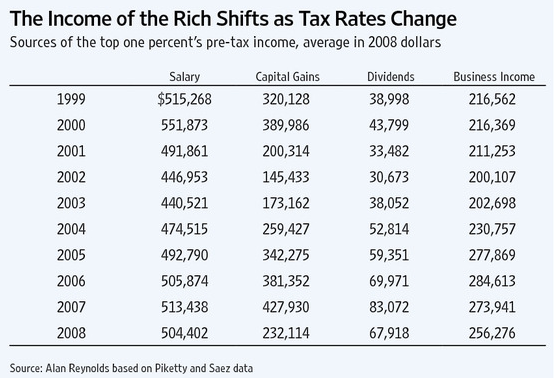
Key is the chart below which takes official IRS data for the top 1% of pre-tax-earners, adjusts for inflation (by stating all years in constant 2008 dollars), and breaks income into it’s components

image

The key points:

1) Business income is roughly 25% of reported income

2) Average inflation-adjusted salary has stayed pretty flat.

3) Until the crash in 2008, capital gains grew … note: cap gains tax rates were reduced in 2003 .. coincidence?

4) Similarly, dividends increased after the dividend tax rate was cut to 15% … another coincidence?

The mega-point of the analysis is that behavioral economics is alive and well … dink with marginal rates and folks will simply shift income … causing an inverse relationship between marginal tax rates and tax receipts.

Just do the the math.

* * * * *

Full article is a worthwhile read:
WSJ,Taxes and the Top Percentile Myth, Dec.  23, 2010
http://online.wsj.com/article/SB10001424052748703581204576033861522959234.html?mod=djemEditorialPage_h

Oregon hikes tax rates … and tax receipts (predictably) go down.

December 22, 2010

Remember when Charlie Gibson stunned Candidate Obama by pointing out that when capital gains tax rates go up,capital gains tax receipts go down? It was obviously new news to Obama who countered: “But, it should be done for fairness”.

Continues to amaze me that our crack legislators confuse “tax rates” with “tax revenue” … and refuse to accept the repeated empirical evidence that they are inversely related.

Excerpted from WSJ, Ducking Higher Taxes, Dec 21, 2010…

Oregon raised its income tax on the richest 2% of its residents last year to fix its budget hole, but now the state treasury admits it collected nearly one-third less revenue than the bean counters projected.

Oregon’s liberal voters ratified a tax increase on individuals making more than $250,000 and another on businesses … no doubt feeling good about their “shared sacrifice.”

Congratulations. After the tax was raised “income tax and other revenue collections began plunging steeply.  Instead of $180 million collected last year from the new tax, the state received $130 million.

One reason revenues are so low is that about one-quarter of the rich tax filers seem to have gone missing. The state expected 38,000 Oregonians to pay the higher tax, but only 28,000 did. Funny how that always happens.

All of this is an instant replay of what happened in Maryland in 2008 when the legislature in Annapolis instituted a millionaire tax. There roughly one-third of the state’s millionaire households vanished from the tax rolls after rates went up.

http://online.wsj.com/article/SB10001424052748704034804576026233823935442.html?mod=WSJ_Opinion_AboveLEFTTop

Bumps ahead for gov’t gravy train …

December 21, 2010

Honestly, excluding the military and first-responders, what’s your view of government employees? 

How many fulfilling experiences have you had with the IRS,  the DMV, the tax assessor’s office, the planning board, etc. ?  My bet: not many.

In the old days, most folks got annoyed but gave passes because they thought the inefficient bureaucrats weren’t getting paid very much.

Recent news reports have burst those myths: revealing high pay relative to private sector employees and outrageous benefits packages.

For sure, the next couple of years will have spotlights shining on government employees and their candidate-contributing unions.

Blue states (think NY, CA, IL) will get hit particularly hard now that fiscally responsible red states are refusing to bail them out.

Since the unions won’t budge, expect higher state taxes and cuts in services …   

Compared with many sectors that have suffered grievously from the slump — housing, automobiles, finance — state and local governments have been relatively sheltered.

One reason is President Obama’s  “stimulus” packages … have provided about $158 billion to states.

As these transfers dwindle … local governments may be less lucky. They rely on property taxes for about a third of their revenues, and because property appraisals are done every few years, “the decline in house prices implies that collections will probably fall in the coming years.”

The truly bad news lies in the future with massive retiree pension and health benefits that haven’t been prefunded. How big are the shortfalls? All estimates are huge … the gaps are about $3 trillion for states and almost $600 billion for localities.

Whatever the ultimate costs, they threaten future levels of public services.

The generous benefits encourage workers to retire in their late 50s or early 60s after 25 years of service. The health benefits typically provide coverage until retirees qualify for Medicare at 65.

To pay for unfunded benefits, either government services must either be cut or taxes raised.

So support for schools, police, roads and other state and local activities is undermined by careless — or corrupt — bargains between politicians and their public-worker unions.

Promises of generous future retirement benefits were expedient contract sweeteners, with most costs conveniently deferred. Even when pension contributions were supposed to be made, they were often reduced or postponed when budgets were tight.

If these arrangements look familiar, they should. The U.S. auto industry adopted the same model; the costs helped bankrupt General Motors and Chrysler.

RCP,Cheating Our Children (Again), December 20, 2010
http://www.realclearpolitics.com/articles/2010/12/20/cheating_our_children_again_108288.html

Billionaires pledge charitable deductions … to do good and duck taxes.

December 20, 2010

Last week, 17 more billionaires signed on to the Giving Pledge and declared their intention to give away to charitable organizations at least 50 percent of their wealth. The initiative is being spearheaded by Buffett and Gates.

To call me cynical about the pledge would be an understatement.

I see it as a clever way for them to dodge estate taxes taxes (while whining about how they are undertaxed) and maintain their power … even from the grave.

I’d like to see how much money they’d throw in the pot if they had to do it with after-tax dollars.  That would be a nice sincerity test.

I was surprised to see the Huffington Post raise some issues about the billionaires’ pledge …

Huff Post, Why We Should Dial Down Our Enthusiasm for the Giving Pledge, December 15, 2010

Last week, 17 more billionaires signed on to the Giving Pledge and declared their intention to give away to charitable organizations at least 50 percent of their wealth. The initiative is being spearheaded by Warren Buffett and Bill and Melinda Gates.

I applaud the Gates family and Mr. Buffett for being willing to challenge their peers and to lead by example. Their effort will surely lead to an increase in giving among billionaires and others. I do, however, have some concerns.

There are three important reasons to keep our enthusiasm for the Giving Pledge in check.

First, the pledge is likely to have an extremely small impact on total giving, especially in the first few years. The problem is, the money is going to trickle out over a very long period of time, and it will represent only a very small upward tick in total charitable giving. Billionaires who take the pledge commit to giving half their wealth to charity at some point during their lifetimes, or at their deaths. Some people on the list are quite elderly, but others are likely to spread their giving out over the next 50 years.

My guess is that most of the money will wind up in university or foundation endowments, with only about 5 percent of the asset base getting spent on charitable purposes each year in perpetuity. Clearly, the Giving Pledge will not be a major factor in sparking a much hoped-for rebound from the drop in giving that has decimated many nonprofits these last two years.

Second, little of the money is likely to benefit the most under-served populations. And third, giving by billionaires has typically been limited in its effectiveness and has dangerous implications for democratic decision-making.

Wealthy donors don’t tend to prioritize lower-income communities, communities of color or other marginalized groups as beneficiaries of their giving. Instead, they tend to give to nonprofits that they patronize, such as cultural institutions and their alma maters.

Wealthy donors give to places “where they spend their leisure time” and that only 10 percent of charitable contributions actually benefit the poor. 

Third, giving by billionaireshas dangerous implications for democratic decision-making.

http://www.huffingtonpost.com/aaron-dorfman/the-giving-pledge_b_796159.html

English translation of “dangerous implications for democratic decision-making”: if people start making personal decisions about where their money should be directed -– partially subsidized by tax advantages—then the Feds have less money at their disposal to direct as they (the Feds) see fit.

Oh my …

Memo to GOP: Watch out for the old reconciliation play.

December 15, 2010

As Yogi would say, “It’s not over until it’s over”.

Why do I think that the proposed tax scheme (oops, I meant “compromise”) may offer a Christmas surprise.

OK, the Senate passed a bill with all of the compromise provisions included.

What if the lame duck, Dem-controlled House passes a variant that, say for the sake of illustration, resets the death tax to 55% with a relatively low exclusion (say, $1 million)?

Won’t happen, right?

The modified law will get blocked in the Senate, right?

Not so fast.

Remember the devious reconciliation play that was used to ram ObamaCare through? Allowed a modified bill to be passed by a simple majority of Senators (all Dems).

What if the House passes a slightly modified tax bill, and the Dem majority in the Senate decides that a simple majority reconciliation process is appropriate?

Bingo.  The GOP “wins” vanish from the bill.

Check ! and Mate !

Remember, it happened on ObamaCare … one of the biggest pieces if legislation in the country’s history …. which was opposed – then and now – by a majority of voters.

The difference this time? A bunch of lame-duckers will be punching in their votes.

Don’t put it past them.

What do these taxes have in common ?

December 15, 2010

OK, here’s the list:

Sales Tax
School Tax
Liquor Tax
Luxury Tax
Excise Taxes
Property Tax
Cigarette Tax
Medicare Tax
Inventory Tax
Real Estate Tax
Well Permit Tax
Fuel Permit Tax
Inheritance Tax
Road Usage Tax
CDL license Tax
Dog License Tax
State Income Tax
Food License Tax
Vehicle Sales Tax
Gross Receipts Tax
Social Security Tax
Service Charge Tax
Fishing License Tax
Federal Income Tax
Building Permit Tax
IRS Interest Charges
Hunting License Tax
Marriage License Tax
Corporate Income Tax
Personal Property Tax
Accounts Receivable Tax
Recreational Vehicle Tax
Workers Compensation Tax
Watercraft Registration Tax
Telephone Usage Charge Tax
Telephone Federal Excise Tax
Telephone State and Local Tax
IRS Penalties (tax on top of tax)
State Unemployment Tax (SUTA)
Federal Unemployment Tax (FUTA)
Telephone Minimum Usage Surcharge Tax
Telephone Federal Universal Service Fee Tax
Gasoline Tax (currently 44.75 cents per gallon)
Utility Taxes Vehicle License Registration Tax
Telephone Federal, State and Local Surcharge Taxes
Telephone Recurring and Nonrecurring Charges Tax

Answer: Not one of these taxes existed 100 years ago.

At the time, our nation was the most prosperous in the world, we had no national debt, and we had the largest middle class in the
world.

Hmmmm

Good News: Corps accumulating cash and increasing dividends

December 14, 2010

OK, the headline has the gist of the story. Here’s the meat.

  1. The WSJ reported that companies are sitting on almost $2 trillion in cash reserves … the largest cash share of corp assets since 1959.
    http://online.wsj.com/article/SB10001424052748703766704576009501161973480.html?mod=WSJ_hp_LEFTWhatsNewsCollection
  2. GE – a corporate bell cow, raised its dividend for the second time this year … reported a healthy balance sheet, cited an optimistic near tern sentiment, and declared an intention to distribute 45% of profits as dividends.  Analysts expect many companies to follow suit.

    ”A senior analyst at S&P, said the big factor for investors this year is that companies largely have stopped cutting their dividends. Next year, he expects over half the S&P 500 to raise their payouts.”
    http://online.wsj.com/article/SB10001424052748704457604576011561050926064.html?ru=yahoo&mod=yahoo_hs

    Disclaimer: I hold a bunch of GE stock and I am totally biased re: the company.

  3. As part of the extension of the Bush tax cuts, the tax rate on dividends stays at 15% for high-earners and zero for low earners.  So, dividends will continue to be welcome on an after-tax basis.

    Technical note: The double-taxation of dividends – at the corp level and at the individual level — is stupid.  The tax rate should be zero.

  4. As dividends go up, so do stock prices … which increases individuals’ net worth … in their Schwab accounts, in IRAs, in 401Ks, in pension accounts, etc. … some pundits are predicting the S&P will go to 1,450.

    ”The Fed’s data, known as the “flow of funds” report, show that the net worth of U.S. households increased to $54.9 trillion in the third quarter, up from $53.7 trillion in the second quarter, as rising stock-market wealth more than offset declining home values.”
    http://online.wsj.com/article/SB10001424052748703766704576009501161973480.html?mod=WSJ_hp_LEFTWhatsNewsCollection

  5. As net worth goes up, consumer confidence goes up … consumers can use the “new found money” to finish cleaning up their balance sheets … and eventually, will start spending again.  That’s good.

There’s reason to be optimistic …

How much $$$ makes a millionaire ?

December 10, 2010

I find that the rhetoric about extension of the Bush tax cuts demonstrates the economic ignorance of most of our elected officials..

Sen. Chuck Schumer and Sen. Barbara “Don’t call me M’am” Boxer are running around screaming that how extending the high bracket tax breaks is “simply giving undeserved tax breaks to millionaires and billionaires”.

Yes indeed, the high bracket includes some millionaires and billionaires.

Here’s the rub: it includes way more people who aren’t millionaires or billionaires.

The high end brackets start at $250,000.

In 2008, according to the IRS, about 138 million people filed tax returns.

Of the 138 million, approximately 2.8 million (2% of total returns) reported AGI greater than $250,000.

354,093 tax payers  — 12.8% of the 2.8 million high bracketers – reported AGI greater than $1 million.

In other words, almost 9 out of 10 tax payers in the vilified high brackets earn less than $1 million.

Hmmm.

Now, anybody who has taken a business or economics course knows that there is a difference between wealth and earnings.  (Note – this group doesn’t include many Congressmen, Senators, or members of the Administration).

Earnings are a “flow” and wealth is a “stock”.

Think water flowing into a pool. The accumulated water in the pool is liquid wealth.

Now, some people who earn more than $1 million spend it all  They accumulate no meaningful wealth. They’re not really millionaires.  They’re wasteful  idiots.

And, some people who earn less than $1 million annually, practice thrift and savings … and accumulate more than $1 million.

Obviously, these people are evil millionaires and should be penalized for not spending like a drunken Congressman.  They should be taxed high every year and then have their wealth confiscated when they die.

Huh?

My take: Schumer and Boxer wouldn’t know a millionaire if they saw one – unless they were just looking around the Senate. Then, the odds would be in their favor.

IRS Data:
http://www.irs.gov/pub/irs-soi/06in23ar.xls

The potentially fatal flaw in the tax compromise … for the GOP, that is.

December 7, 2010

This morning, the GOP is crowing and the mass media headlines are reading: “Republicans achieve top goal in Obama tax-cut plan”.
http://news.yahoo.com/s/ap/20101207/ap_on_bi_ge/us_tax_cuts

My take – which I haven’t heard from any pundit yet – is that the GOP fell for a trap.

Interestingly, I don’t think that Team Obama even realizes what it got in the deal.

First, because of the layered tax breaks to low earners, high earners will be paying an even higher proportion of the country’s total income tax tax take.

More important, Obama is one step closer to institutionalizing a tax scheme that has a majority of voters paying zero income taxes (or less).

Think about it: the majority gets to demand more government programs that they don’t pay a cent towards.  I think that’s scary.  Very scary..

* * * * *

See the analysis that I originally posted on July 31, 2008 during the run-up to the election.

It proves the point (ahead of its time)  that less than half of all voters pay any income taxes if / when Obama’s tax scheme is adopted.

It’s the Homa Files post that continues to get the most hits, and the topic is ‘hot’ this week because of the plan to continue the Bush tax cuts.  So, here’s a flashback .

HomaFiles: “My #1 tax beef: Under the Team Obama tax plan, a majority of voters will be paying zero income taxes (or less)”
https://kenhoma.wordpress.com/2009/04/16/my-1-tax-beef-under-the-team-obama-tax-plan-a-majority-of-voters-will-be-paying-zero-income-taxes-or-less/

More whining from Warren Buffett … and I’ve got the remedy.

November 29, 2010

Warren Buffett is back on the talk shows sanctimoniously asserting that the wealthy don’t get taxed enough.

ABC, Warren Buffett: “There’s No Sacrifice Among The Rich”
http://www.realclearpolitics.com/video/2010/11/28/warren_buffett_theres_no_sacrifice_among_the_rich.html

Since he won’t shut up, I suggest that the extension of the Bush tax cuts come with the following modifications:

  • For anyone with wealth (not income) totaling more than $1 billion, all current income – whether ordinary income or capital gains — shall be taxed 95%.  Call it the Gates / Buffet tax.
  • For anyone with wealth totaling more than $1 billion, no deductions shall be allowed against adjusted gross incomes.  Specifically, charitable deductions shall be made after-tax.  Sorry, Bill, but I want to see more of Buffet’s money going to the Feds instead of Gates Foundation … just like mine.
  • For all citizens, an estate can be sheltered by a maximum of $1 million of charitable gifts. Ditto the prior point. Confiscate Buffet’s estate and throw it into the gov’t grinder.

And, while we’re at it:

  • For all members of Congress (House & Senate) and all members of the Administration who report directly to the President, no income tax deductions shall be allowed and all income – regardless of source, type or amount – shall be taxed in its entirety at the highest marginal rate paid by any taxpayer. Let’s make the Congressional tax discussions a bit more personal.
  • For all retired members of Congress and any retired members of any Administration who reported directly to the President, all government pension and retirements benefits (including gov’t paid healthcare premiums) shall be taxed in its entirety – with no allowable deductions —  at the highest current marginal rate paid by any taxpayer. Let them ‘feel our pain’ everyday when they wake up

The above plans kill many birds with relatively few stones:

  1. Raises some dough for deficit reduction
  2. ‘Sensitizes’ our lawmakers.
  3. Potentially, gets Buffett to shut the blank up.

Win, win, win.

Maybe, just maybe, the answer is $5 million

November 16, 2010

Since the Bush tax cuts are in the news again, I’m taking the opportunity to reprise one of my favorite posts from the archives.  The original was posted on Sept. 11, 2008 …

The punch line: “wealthy” starts at a number higher than $250,000 and higher marginal tax rates for the real high earners might be a good idea.

* *  * * *

Maybe, just maybe, the answer is $5 million

Background: At the Obama-McCain Saddleback debate, the candidates were asked: “What’s rich?” Both gave glib answers.  Obama got a pass, McCain didn’t.  Thinking about it, McCain may have been right.

* * * * *

After Saddleback, Senator McCain was repeatedly hammered for his $5 million dollar answer to Rick Warren’s “what’s rich?” question.

Interestingly, but not surprisingly, Senator Obama got a free pass for his parallel laugh line — even though the annual royalties on 25 million books probably exceed $5 million.  Perhaps. the conversion from books to dollars is sufficiently nuanced that folks didn’t notice.

Even liberal columnist Paul Krugman, acknowledges that McCain was just joking when he flipped the $5 million dollar figure at Pastor Rick.

In a recent  New York Times op-ed titled “Now, that’s rich”,  Krugman concedes the point and puts it into context.  Specifically, he references the book Richistan by Robert Frank of The Wall Street Journal. According to Krugman, Frank “declares … that country is divided into levels, and only the inhabitants of upper Richistan live like aristocrats; the inhabitants of middle Richistan lead ample but not gilded lives; and lower Richistanis live in McMansions, drive around in S.U.V.’s, and are likely to think of themselves as “affluent” rather than rich.”

Perhaps, the stage-pensive Obama should take pause and reflect on Prof. Krugman’s observations.  Senator McCain gave Senator Obama a huge gift.  No, not the new applause line that Obama keeps repeating in his stump speech. It’s bigger than that.  It’s a clue to attracting — or, at least, to avoid alienating — about 5 million voters who, in a close election, may be what the pollsters call “statistically significant”.

* * * * *

Let me explain.

Boiled down to its essence, Senator Obama’s complicated tax plan reduces to taking an average of about $20,000 in additional annual income taxes from about 5 million people, and redistributing the loot to 200 million others — $500 (or more) per person in annual tax credits.

Some of the 5 million targeted “givers” earn as low as $200,000; some are in  Warren Buffett’s category, earning $40 million or $50 million or more.  Obama’s plan doesn’t differentiate among them. The freshly minted MBA working 80 high stress hours in a high cost, high tax locale (think, New York or San Francisco) – paying off a hundred grand or more in student loans — just gets lumped in with Bill Gates.

Now, what if Senator Obama were to adopt Senator McCain’s perspective and define “rich” as starting at $5 million ?  What would it take to raise a redistributable $100 billion from them ?

Well, according to recently released IRS data, there were about 41,000 tax returns filed in 2006 with adjustable gross income greater than $5 million.  Those returns averaged over $15 million in AGI and $13.5 million in taxable income.  As a group, the over $5 million crowd accounted for almost $600 billion in annual taxable income.

So, if he wanted to, Obama could leave the folks earning $200,000 to $5 million alone, and raise the $100 billion by introducing an uber-high income tax bracket for everybody reporting more than $5 million — upping their effective tax rates to about to about 37% (from their current 20% effective income tax rate).  To get there would require a 50% top bracket marginal income tax rate (up from 35%).  And, since about 75% of the uber-high-earners income comes from capital gains and dividends, which are insulated from the Alternative Minimum Tax calculations  — the capital gains and dividends rate would have to upped to about 30%, and rolled into the AMT.

* * * * *

Before dismissing the notion out-of-hand, consider that a $5 million top bracket fits in a historical context, and has some well-aged precedents. 

Since 1913, the top bracket income threshold has averaged about $650,000 (unadjusted for inflation), ranging from $29,750 in 1988 (Reagan’s last year)  to, yes,  $5 million (from 1932 to 1941).  In order to fund WWII, the top bracket income threshold was cut in 1941 to $200,000 — which, coincidentally, inflates to about $5 million in 2008 dollars.

Besides generating a $100 billion redistribution pool, a top bracket with a high rate and high income threshold addresses a few of Senator Obama’s other oft-repeated concerns.  On the campaign trail, Obama often showcases Warren Buffett’s lament that his secretary’s 30% tax rate is higher than his 18%.  That gap only narrows a bit under Senator Obama’s current plan (her’s drops to 29%; his goes to 22%).

Under an uber-income rate bracket structure, the Buffett injustice would remedied, and along with it, private equity and hedge fund loopholes would be closed, and the fattest cats would start paying their fair share despite the holes in the AMT.  Sure, these uber-earners will be tempted to search harder for tax shelters — in the U.S. and offshore — but that’s a risk that Obama says he’s willing to take.

* * * * *

If Senator Obama wanted to moderate the risk somewhat, he could scheme between the extremes by creating multiple new brackets.  Maybe a bracket starting at $500,000 with a 40% marginal rate, a 42.5% bracket starting at $1 million, a 45% bracket starting at $2.5 million, a 47.5% bracket starting at $5 million, and a 50% bracket starting at $10 million.  By my math, this multiple bracket structure would give Senator Obama his $100 billion, too. The point: there are many ways to skin the (fat) cats.

Comedians say that, at their core, many jokes have a ring of truth.  Senator McCain’s $5 million jest may have provided Senator Obama with an out-of-the box idea for rebalancing incomes: deep-drilling the super-rich. The introduction of an uber-income bracket would make Obama’s tax plan more palatable to about 3% of the voting population. And, Mr. Buffett would get his wish come true. In military parlance, I think that’s called friendly-fire. 

* * * * *

Must Read: Home Depot founder says "Stop Bashing Business, Mr. President"

October 15, 2010

This will the the buzz on the talk shows today.

Ken Langone was one of the 3 founders of Home Depot.

His Punch Line: “If we tried to start The Home Depot today, it’s a stone cold certainty that it would never have gotten off the ground.”

Highlights are below.  Worth reading the whole piece.

* * * * *

Excerpted from WSJ: Stop Bashing Business, Mr. President, Ken Langone, Oct.15, 2010 

Your insistence that your policies are necessary and beneficial to business is utterly at odds with what you and your administration are saying elsewhere. You pick a fight with the U.S. Chamber of Commerce, accusing it of using foreign money to influence congressional elections, something the chamber adamantly denies.

Your U.S. attorney in New York, Preet Bahrara, compares investment firms to Mexican drug cartels and says he wants the power to wiretap Wall Street when he sees fit.

And you drew guffaws of approving laughter with your car-wreck metaphor, recently telling a crowd that those who differ with your approach are “standing up on the road, sipping a Slurpee” while you are “shoving” and “sweating” to fix the broken-down jalopy of state.

Your short-sighted wavering—between condescending encouragement one day and hostile disparagement the next — creates uncertainty that, as any investor could tell you, causes economic paralysis. That’s because no one can tell what to expect next.

          * * * * *

If we tried to start Home Depot today, under the kind of onerous regulatory controls that you have advocated, it’s a stone cold certainty that our business would never get off the ground, much less thrive.

Rules against providing stock options would have prevented us from incentivizing worthy employees in the start-up phase—never mind the incredibly high cost of regulatory compliance overall and mandatory health insurance.

Still worse are the ever-rapacious trial lawyers.

          * * * * * 

Meantime, you seem obsessed with repealing tax cuts for “millionaires and billionaires.”

I stand behind no one in my enthusiasm and dedication to improving our society and especially our health care.

[I’m willing to pay higher taxes.] Just make sure that money actually reduces federal spending and isn’t simply shifted elsewhere.

I guarantee you that many millionaires and billionaires will gladly forego government benefits — as my wife and I already do when we forward those checks each month to charity.

Full article:
http://online.wsj.com/article/SB10001424052748704361504575552080488297188.html

About those folks whose taxes Obama wants to raise …

October 14, 2010

An interesting factoid from the Tax Foundation …

The scorned “wealthy” taxpayers — those earning more than $200 – $250k — work an average of 48.1 hours per week … those earning less than that amount dodge Obama’s tax arrow — they work an average of 38.8 hours per week.

In other words, on average, the wealthy tax targets work about 20% more hours than the Obama-classified non-wealthy.

Makes sense to punish them for working harder, right ?

* * * * *

Tax Foundation Fiscal Fact, No. 247,  September 22, 2010
http://www.taxfoundation.org/files/ff247.pdf

A perspective on job growth and failed policies

October 13, 2010

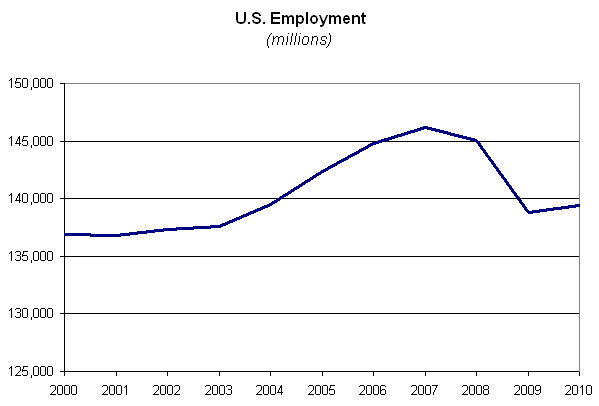
Here’s a chart of total US employment from 2000 to today.

image

A couple of observations;

  • Employment was flat from 2000 to 2003 … remember the bursting of the dot com bubble and the 9-11 terrorist attacks ?
  • There was strong employment growth between 2003 and 2007 …  remember the Bush tax cuts of 2001 and 2003? … hmmm
  • The financial collapse in 2008 reversed practically all of the prior 5 year gains … resulting in a net ‘no gain’ during the Bush years

So, when the Dems talk about the failed policies of the prior 10 years, exactly what are they talking about?

Hard to make a case that the Bush tax cuts creamed the economy.  To the contrary, looks like they created strong job growth.

Obviously, the culprit is the financial crisis – a mix of the disastrous housing policy (think Fannie & Freddie) …  and loose regulation of mortgage backed securities and derivatives.

Bush shares blame for the Fannie and Freddie fiasco … but blame for that is easily spread across the Clinton a administration and the Congress (i.e. Barney Frank, Chris Dodd).

OK, you can taint Bush with loose financial regulation and enforcement.

But, fin-reg does little to address the egregious security & derivative transgressions … and nothing has been done with Fannie & Freddie.

The main “Bush policy” being targeted by Dems are the tax cuts – of which less than 20% were “for the wealthy” – doesn’t look to me like they’re job killers.  Go figure.

Either they don’t know how business works, or they just don’t care … here’s more evidence

October 8, 2010

According to the WSJ …

The issue: 2011 tax-withholding tables.

Treasury officials must release the tables, which determine the take-home pay of millions of wage-earners, by mid-November because it takes payroll processors weeks to adjust their systems before Jan. 1.

But congressional leaders recently postponed voting on taxes until after the election and lawmakers don’t reconvene until Nov. 15.

The Senate is scheduled to take up several nontax issues when it returns and is expected to leave for Thanksgiving soon after, possibly pushing a vote on taxes into December.

Treasury officials’ most obvious option is the least attractive. If they publish tables based on expiration of the Bush tax cuts, which occurs Jan. 1, millions of low- and middle-income taxpayers who have paid little or no income taxes for a decade would likely see increases in January.

It’s estimated that higher withholding could take up to $10 billion a month out workers’ pockets due to higher tax rates alone.

Excerpted from WSJ: Delays to Tax Tables May Dent Paychecks, Oct. 7, 2010
http://online.wsj.com/article/SB10001424052748704689804575535861229293800.html?mod=WSJ_hps_LEFTWhatsNews

What if the rich leave the building ?

October 7, 2010

I think this is the fatal flaw in Obama’s class-warfare tax plan.

Initially, high earners will push their tax deductions to the absolute limit (no, I don’t think they’re doing that now).

…  then they’ll just re-create tax shelter devices reminiscent of the pre-Reagan days (e.g. rental properties; gas, oil, timber partnerships)

…  and finally, they’ll take their bank accounts to safe havens.

A couple of vignettes bring the dynamics to life.

* * * * *

According to FBN’s John Stossel …

New York billionaire Tom Golisano isn’t stupid.

With $3,000 and one employee, he started a business that processes paychecks for companies. He created 13,000 jobs.

Then New York state hiked the income tax on millionaires.

“It was the straw that broke the camel’s back,” he says.

“Not that I like to throw the number around, but my personal income tax last year would’ve been $13,800 a day. Would you like to write a check for $13,800 a day to a state government, as opposed to moving to another state where there’s no state income tax or very low state income tax?

He established residence in Florida, which has no personal income tax.

* * * * *

Maryland created a special tax on rich people that was supposed to bring in $106 million. Instead, the state lost $257 million.

Former Gov. Robert Ehrlich, who is running again for his old job, says: “It reminds me of Charlie Brown. Charlie Brown was always surprised when Lucy pulled the football away. And they’re always surprised in Washington and state capitals when the dollars never come in.”

Some of Maryland’s rich left the state.

“They’re out of here. These people aren’t stupid,” Ehrlich says.

* * * * *

Donald Trump, who knows something about making money, says of course the rich will leave when hit with higher taxes.

“I know these people,” he told me.

They’re international people. Whether they live here or live in a place like Switzerland doesn’t really matter to them.”

You haven’t left, I told him.

“I haven’t left yet. … Look, the rich people are going to leave. And other people are going to leave. You’re going to end up with lots of people that don’t produce. And then that’s the spiral. That’s the end.”

* * * * *

Excerted from John Stossel, Taxing the Rich, September 29, 2010
http://www.realclearpolitics.com/articles/2010/09/29/taxing_the_rich_107350.html

The uber-rich speak: Gates (the father) says rich should pay more taxes …

October 6, 2010

I’ve often expressed my chagrin over Warren Buffet’s pontificating that his taxes are too low and so all high earners should pay more taxes.

Now Bill Gates’s father has jumped on the bandwagon and is helping fund support for a new millionaire’s tax in Washington state.

He riles me more than Buffet.  At least Buffet created his pile of gold.  This guy’s major claim to fame is providing young Bill with some DNA.  Now, he lives a lavish life as part of young Bill’s live-in posse. 

Give me a break …

And, oh yeah, before you tell me how philanthropic Buffet and Gates are, remember (1) most of their gifts are forthcoming when they die — allowing to retain the the power of their wealth until they’re long gone, and (2) all of their giving is specifically directed to causes they care about, and managed by members of their posse. 

Why don’t they just turn over their accumulated wealth to the the government right now?

Answer: they’d lose their power as super-rich guys … and even they know that most of the money would be wasted on wacky, ineffective programs.

* * * * *

According to Art Laffer in the WSJ …

It’s one thing to believe in bad policy. It’s quite another to push it on others.

But Mr. Gates Sr.— a retired lawyer— is now trying to have his way with the people of the state of Washington.

Mr. Gates Sr. has personally contributed $500,000 to promote a statewide proposition on Washington’s November ballot that would impose a brand new 5% tax on individuals earning over $200,000 per year and couples earning over $400,000 per year. An additional 4% surcharge would be levied on individuals and couples earning more than $500,000 and $1 million, respectively.

If Mr. Gates Sr. and his son feel so strongly about taxing the rich, they should simply give the state a chunk of their own money and be done with it. Leave the rest of Washington’s taxpayers alone.

The 11 states where income taxes were adopted over the past 50 years are: Connecticut (1991), New Jersey (1976), Ohio (1971), Rhode Island (1971), Pennsylvania (1971), Maine (1969), Illinois (1969), Nebraska (1967), Michigan (1967), Indiana (1963) and West Virginia (1961).

Each and every state that introduced an income tax saw its share of total U.S. output decline. Some of the states, like Michigan, Pennsylvania and Ohio, have become fiscal basket cases. As the nearby chart shows, even West Virginia, which was poor to begin with, got relatively poorer after adopting a state income tax.

WSJ, The Bill Gates Income Tax,  OCTOBER 5, 2010
http://online.wsj.com/article/SB10001424052748703882404575520241519315372.html?mod=WSJ_Opinion_LEADTop

High taxes? … At least you don’t live in New York or Hawaii …

October 4, 2010

 According to Bloomberg …

High-income residents of New York City and President Barack Obama’s home state of Hawaii would have the highest marginal tax rates in the U.S. if Congress adopts the president’s proposal to increase taxes for top earners, a study found.

State, local and federal levies would result in a top 50.8 percent rate on high-income New York City residents. Affluent Hawaiians would pay 49.7 percent. Residents of California, Vermont, Maryland and New York round out the five states with the heaviest burdens, with top federal- state rates of 49.4 percent, 48.8 percent, 48.6 percent and 48.4 percent, respectively.

States rounding out the top 10 are Maine, Minnesota, Idaho, North Carolina and Ohio.

* * * * * 

Separately, IRS data shows 80 percent of those facing higher taxes under Obama earn between $200,000 and $500,000. An analysis by the congressional Joint Committee on Taxation in August concluded their taxes would increase on average by $532 a year.

* * * * *

Source:
http://www.bloomberg.com/news/2010-09-22/new-york-hawaii-top-earners-face-highest-tax-under-obama-plan-study-says.html

Playing chicken with the economy …

October 4, 2010

According to the WSJ …

If he Bush Tax Cuts are allowed to expire at year-end per current law, after-tax income for every working American would be reduced.

According to the Tax Policy Center, the average reduction in after-tax income would be 3.3% .

Do the math:

94% of income goes to consumption, and consumption is 70% of gross domestic product.

All else being equal, if the Bush tax cuts don’t get extended, that’s a 2.3% hit to 2011 GDP.

In other words, a certain double dip.

The Trade and Tax Doomsday Clocks, Oct. 4, 2010 
http://online.wsj.com/article/SB10001424052748704116004575521822940983434.html?mod=djemEditorialPage_h

The problem is that there aren’t enough rich people to soak …

September 28, 2010

According to the WSJ …

Claiming to tax only the rich has always been more political strategy than fiscal realism.

IRS tax data show that you could have taken 100% of the taxable income of every American who earned more than $500,000 in the boom year of 2006 and still only have raised $1.3 trillion in revenue.

That amount would not have closed the budget deficit in either of the last two fiscal years.

Liberals know that the only way to pay for their spending plans is by soaking the middle class—because that’s where the real money is.

But, they pretend they can finance a European-style entitlement state by taxing only the rich because they know that soaking the middle class is unpopular.

* * * * *

WSJ, The Democratic Tax Retreat, Sept. 25, 2010
http://online.wsj.com/article/SB10001424052748704523604575511863393295260.html?mod=WSJ_Opinion_LEADTop

The downside risk of raising taxes on the rich … by the numbers

September 27, 2010

The President sound bites that extending the Bush Tax Cuts “to the wealth” will “cost” $700 billion.

Let’s take his number at face value, but put it in context …

The $700 billion — based on conventional, but odd gov’t accounting — is a 10 year projection. 

The annual impact is $70 billionand that’s making the unlikely assumption that folks won’t employ strategies to mitigate the tax hit.

The $70 billion equates to about less than 1/2% of GNP … which is sluggishly running at about $14.5 trillion. 

Generally, economists expect that raising taxes on the rich will hurt the recovery since — according to the Tax Policy Center — about $400 billion of small business income in hit and since the rich account for almost a quarter of all consumer spending.

If GNP drops by 2.5%, the apparent tax revenue increase would disappear … tax revenues would be the same as prior to the tax increase.

So, the pivotal question is: will the decline in consumption by the rich (again, 1/4 of consumer spending) be substantial enough to drive a reduction  in GDP ? 

I’m betting “yes”.

Taking another perspective … what about the impact on unemployment ?

Mark Zandi — one of the Dems’ poster-child economists — says that raising taxes on the rich would cost 770,000 jobs

The current unemployment rate of 9.6% equates to about 15 million people unemployed.

In other words, bumping the tax rate on the rich is likely to increase the unemployment rate by about .5% — to over 10% if all other things are held constant.

Is $70 million of best case tax revenue worth bumping the unemployment rate by .5% ? 

Keep in mind that the $70 billion is against a national debt that’s running over $13 trillion

So, the decision reduces to increasing the unemployment rate by .5% to over 10%  in order to (maybe) cut the national debt by about .5% per year .  The latter is a big ‘maybe’ since politicos would have to avoid the temptation to just spend the windfall on more goofy programs  …  and since ‘the rich’ would have to avoid the natural tendency to  change their behavior to duck taxes or to cut spending  — which would utltimately cut tax revenues.

Doesn’t sound like a good bet to me …

* * * * *

Sources:

Washington Post, The Problem With Sound-Bite Economics, September 20, 2010
http://www.realclearpolitics.com/articles/2010/09/20/the_economic_blame_game_107220.html

US Debt Clock
http://www.usdebtclock.org/

Even if Obama gets his way, Buffett will still have a lower tax rate than his secretary …

September 27, 2010

Whine, whine whine.

Warren Buffett says raise taxes on folks making more than $200,000 because he pays a lower tax rate than his secretary and he wants to pay more.

Music to Obama’s ears … and an anecdotal rationale for allowing all of Bush’s high-end tax cuts to expire.

Problem: Even if the Bush tax cuts are allowed to expire, Warren will still be paying a lower rate than his secretary.

Consider the generic uber-wealthy case …

Obama’s proposal would allow the top marginal tax rates of 33 percent and 35 percent to revert to 36 percent and 39.6 percent next year. Phase-outs for deductions and exemptions would also be reinstated, pushing the rate higher.

Tax rates on dividends and capital gains would increase to 20 percent from 15 percent.

The top marginal rates also don’t reflect the overall tax the highest earners pay, especially when most of the income comes from capital gains or dividends.

The 400 highest-earning U.S. households reported an average of $345 million of income in 2007, while their average tax rate fell to 16.6 percent, the lowest in almost 20 years.

Almost three-quarters of the highest earners’ income was in capital gains and dividends taxed at a 15 percent rate.

Of the 400 earners, 289 paid a total effective federal tax rate of 20 percent or less in 2007.

http://www.bloomberg.com/news/2010-09-22/new-york-hawaii-top-earners-face-highest-tax-under-obama-plan-study-says.html

Buffett’s income is practically all capital gains.

So, Obama’s plan will nick him an additional 5% … but since his rate will be the 20% capital gains tax rate, it’ll still probably be below his secretary’s rate.

I propose a super-uber tax bracket: for folks with huge  portfolios —  say, in excess of $5 billion — every dollar of earnings over $250,000 — ordinary income, cap gains, and dividends — gets turned over to the government each year with no recourse.

Bingo.  Problem solved.

Ending the Bush Tax Cuts will hurt small businesses … so, outboard them.

September 23, 2010

This week, a series of ‘angles’ on the debate to kill or keep the Bush Tax Cuts …

Again, I’m for extending all of the Bush Tax Cuts, and I don’t like helping the Dems with their messaging.  But …

The GOP’s constant sound bite is that that letting any of the Bush Tax Cuts expire would hurt investors and small businesses.

The Dems say that only 3% of all small businesses report Schedule C business income on their 1040s.

The GOP counters that the 3% accounts for 43% all small business income.

 The Tax Policy Center estimates that higher business taxes would affect 725,000 returns with about $400 billion of business income. Some of these are partnerships of doctors, lawyers and accountants. Others are contractors, restaurant owners, florists and plumbers.

http://www.realclearpolitics.com/articles/2010/09/20/the_economic_blame_game_107220.html

Score the point for the GOP.

So, why don’t the Obamatrons just cap Schedule C  income at, say, 25%.

That would take that issue off the table.

And, before you say ‘would be too complicated’ … remember that typical 1040s treat ordinary income, dividends, and capital gains at different rates already.

What's the hurt if from Obama's tax hikes if you make more than $250,000 but less than $500,000

September 22, 2010

This week, a series of ‘angles’ on the debate to kill or keep the Bush Tax Cuts …

First, a couple of context points: I think all of the Bush Tax Cuts should be extended and, I’m not in the business of hepling the Dems with their messaging.  But …

According to the nonpartisan Tax Policy Center, the average taxpayer earning $200,000 to $500,000, will be socked an additional $988 if Obama jacks tax rates on “the wealthiest” Americans.

True, it’s more than pocket change, but it’s not going to threaten anybody’s lifestyle.

I wonder why Obamatrons aren’t highlighting the under $1,000 number to settle down the ‘almost rich’ who are collateral damage in his class attack?

* * * * *

Data source: L,A, Times, The tax cut debate, September 15, 2010
http://www.latimes.com/news/opinion/editorials/la-ed-taxes-20100915,0,6983741.story

"Giving millionaires $100,000 more each year" … oh, really ?

September 20, 2010

This week, a series of ‘angles’ on the debate to kill or keep the Bush Tax Cuts …

The President’s constant sound bite the past week was that extending the Bush Tax Cuts to ‘the wealthiest Americans’ would be “giving $100,000 to each  millionaire”.

Not so fast.

According to the Tax Policy Center:

  • Folks with precisely $1 million in taxable income would pay about $11,000 more under Obama’s scheme than they would if the Bush tax cuts were extended. 
  • The top 0.1% — those with average incomes of $8.4 million — would pay $310,000 more under Obama’s proposal.

Bottom line: the average is obviously skewed by a relatively few uber-earners.

So, instead of going after garden variety fat cats, why not go after the obese cats ?

I say, add a few uber-high-end brackets … say,

  • Over $500,000 gets nicked, 37.5%;
  • Over $1,000,000 gets dinged 40%
  • Over $5 million pays 45%, etc.
  • Warren Buffett pays 99.6% and stops whining about how he’s undertaxed

Such a scheme would potentially get the dollars (empasis on ‘potentially’ — more on that in a later post) … while impacting the fewest taxpayers.

Seems like a democratic thing to do, doesn’t it ?

* * * * *

Data source:L,A, Times, The tax cut debate, September 15, 2010
http://www.latimes.com/news/opinion/editorials/la-ed-taxes-20100915,0,6983741.story

Larry Summers: “Better uses for the $700 billion”

September 17, 2010

Obama econ advicer was asked by CNBC about the tax hike on the so-called wealthy taxpayers.

Keep in mind that Obama’s rap is that “we can’t afford to keep tax rates for the weathy where they are now” … implying that the money would go towards deficit reduction.

Well, Summers blew it.

His answer: “There are better uses for the money”

He clarified: maybe more targeted tax breaks or stimulative spending.

Deficit reduction didn’t make his list.

Oops …

The CNBC shills didn’t follow-up on the obvious slip.

What happens when you raise capital gains tax rates?

September 16, 2010

Answer: Based on history, aggregate tax revenues go down.

If you run into President Obama, whisper in his ear, please.

* * * * *

Remember this exchange, from a 2008 primary debate, between Obama and ABC News’s Charlie Gibson:

Gibson: You have . . . said you would favor an increase in the capital gains tax. As a matter of fact, you said on CNBC, and I quote, “I certainly would not go above what existed under Bill Clinton,” which was 28%. It’s now 15%. That’s almost a doubling, if you went to 28%. But actually, Bill Clinton, in 1997, signed legislation that dropped the capital gains tax to 20%.

Obama: Right.

Gibson: And George Bush has taken it down to 15%.

Obama: Right.

Gibson: And in each instance, when the rate dropped, revenues from the tax increased; the government took in more money. And in the 1980s, when the tax was increased to 28%, the revenues went down.

So why raise it at all, especially given the fact that 100 million people in this country own stock and would be affected?

Obama: Well, Charlie, what I’ve said is that I would look at raising the capital gains tax for purposes of fairness.

WSJ : Best of the Web,  ‘The Bush Tax Increase’ , August 31,2010
http://online.wsj.com/article/SB10001424052748703467004575463772860827634.html?mod=WSJ_Opinion_MIDDLETopOpinion

Encore – Those %#@! Bush Tax Cuts

September 14, 2010

This Homa FIles brief was originally posted July 23, 2008. It’s long, … loaded with with pivotal facts.

Since expiration of the Bush tax cuts is looming soon, I thought they’re worth another look — just as background 

On the campaign trail, candidate Obama broad-brushed all of the Bush tax cuts as “for the wealthy”.

Now, OMB estimates that extending the Bush tax cuts in their entirety would cost $3.7 trillion over 10 years … of that amount over 80% goes to folks making less than $200,000 – $250,000 annually.

In other words, over 80% of the Bush tax cuts for the wealthy went to Obama-defined “non-wealthy” folks — some of whom pay income taxes, and some of whom don’t. 

* * * * *

Summary: We’ve all heard the  rants about the cuts in the top bracket rate, capital gains rate, dividend taxes, and estate taxes.

But, when was the last time that your heard a candidate (on either side) or a pundit (O’Reilly included) mention the new 10% bracket, larger and refundable child and earned income credits, negative income taxes, elimination of the marriage tax penalty, or expanded college benefits?

* * * * *

The income tax cuts of 2001 and 2003 are shorthanded by the press and political candidates as “Bush’s tax breaks for the wealthy — who didn’t even want them”, and are blamed for an accelerating polarization of wealth distribution (i.e. rich get richer, poor stay poor).

Warren Buffet says his secretary pays more taxes than he does (really?). McCain says he’ll stay the course. Obama says that he’ll roll back the tax cuts if he’s elected and redistribute them to the “folks who need them the most”.

All of the rhetoric got me thinking.  Somewhat embarrassed, I realized that I didn’t know exactly what was in the Bush tax plan.  (Quick Test: take out a sheet of paper and jot down the tax breaks enacted as part of the Bush plan)

Prompted by curiosity (and a modicum of selfish interest) I did some digging.  Here’s what I found, along with my “take”:

The top marginal income tax rate  was cut from 39.5% to 35% (applied to Taxable Income >$350,000)
– the 36% marginal rate was cut to 33%  (TI > $161,000)
– the 31% marginal rate was cut to 28%  (TI> $77,000)
– the 28% marginal rate was cut to 25%  (TI > $32,000)
…  a clear benefit to the top half of income earners; with the biggest benefit to the highest earners

Capital gains and dividend tax rates were reduced to 15% for high-earners, zero for low earners … more of a benefit to high-earners, but 1/3 of households own stock and more than 1/4 of returns (including many retirees) report dividend income … turned out to be a windfall for hedge funds and private equity via the “carried interest” loophole (more on that in a subsequent post)

A low-income 10% tax rate bracket was introduced … benefit to many low-earners previously in the 15% bracket

Child Care Credit and Earned Income Tax Credit were increased and made refundable … resulting in zero or negative tax due balances for millions of people (note: “refundable” means that any negative tax due is paid to the citizen — a very important policy shift)

Income limits were eliminated on personal exemptions and itemized deductions … the former helps low earners most — since it’s a higher proportion of income; the latter benefits higher earners most — since they are the ones who itemize deductions. (Note: roughly 2/3′s of tax filers take the standard deduction)

Marriage penalty was neutralized … benefits middle-earning couples most

College education benefits were liberalized, e.g. 529 plans, student loan interest deduction, tax-free employer paid tuition … benefits mid- and high-earners most (since their family members disproportionately attend college)

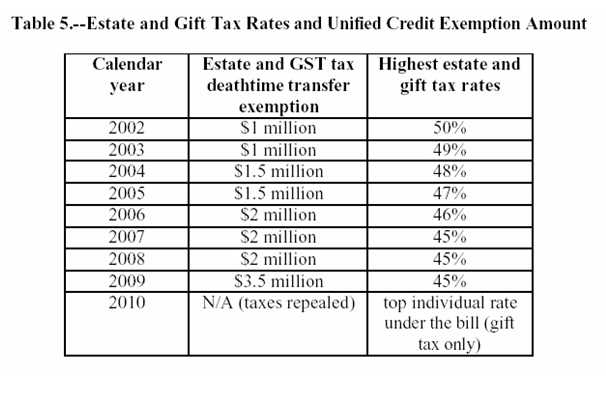
Estate taxes were reduced and to be phased out… only impacts wealthy folks with estates that are big enough to be subject to “death taxes”


* * * * *

Details re: “Bush Tax Plan” – 2001 and 2003

Officially, the first round of Bush tax cuts were codified in the “Economic Growth and Tax Relief Reconciliation Act of 2001″ which was approved by the Congressional conference committee on May 25, 2001; signed into law shortly thereafter; but phased in over a several year period.  The key provisions of the law (as reported in the conference committee’s report):
Introduce a 10-percent rate bracket… reducing the rate from 15% to 10% for the first $6,000 of taxable income for single individuals ($7,000 for 2008 and thereafter), $10,000 of taxable income for heads of households, and $12,000 for married couples filing joint returns ($14,000 for 2008 and thereafter).

Reduce individual income tax rates  … from 28 percent, 31percent, 36 percent, and 39.6 percent are phased-down over six years to 25 percent, 28 percent, 33 percent, and 35 percent, effective after June 30, 2001.

click table to make it bigger

Phase-out of Itemized Deductions and Restrictions on Personal Exemptions … by eliminating all limitation on itemized deductions and any restrictions on personal exemptions for all taxpayers by one-third in taxable years beginning in 2006 and 2007, and by two-thirds in taxable years beginning in 2008 and 2009, and by 100% for taxable years beginning after December 31, 2009.

Increase and Expand the Child Tax Credit… Increasing the child tax credit to $1,000, phased-in over ten years. and by making the child credit — subject to certain income limitations — non-taxable and refundable (i.e. payable to the person if the net tax liability is zero),

Provide relief from the “marriage penalty” … by increasing the basic standard deduction for a married couple filing a joint return; by increasing the size of the 15-percent regular income tax rate bracket for a married couple filing a joint return to twice the size of the corresponding rate bracket for an unmarried individual filing a single return.; and by increasing limits on the Earned Income Tax Credit.

Provide Education Benefits… by increasing the annual limit on contributions to education IRAs to $2,000; by expanding the reach of 529 tuition programs; by extending the non-taxibility of employer paid tuition; and by raising income phase out levels for deductability of student loan interest.

Phase-out and Repeal of Estate and Generation-Skipping Transfer Taxes:
* * * * *

In 2003, a second round of tax changes was enacted in the “JOBS AND GROWTH TAX RELIEF RECONCILIATION ACT OF 2003” which:

Accelerated the phase in of the 10% bracket, the reduction in other bracket rates, the child care tax credit, and marriage penalty relief.

Provide reductions in taxes on capital gains and dividends … reducing the 10- and 20-percent rates on capital gains on assets held more than one year to five ( zero, in 2008 ) and 15 percent, respectively. and providing that dividends received by an individual shareholder from domestic and qualified foreign corporations generally are taxed at the same rates that apply to capital gains.

* * * * *

Source Reports
http://www.jct.gov/x-50-01.pdf
http://www.house.gov/jct//x-54-03.pdf

About half of small business income to be hit with higher taxes …

September 14, 2010

Punch line: Obama’s plan to raise top marginal rates is holding back the very people who should be leading the economic recovery.

Ken’s Q: Why doesn’t Obama just declare that a separate rate will apply to business income reported on 1040s?  That would neutralize this issue.

* * * * *

According to the WSJ …

The President has called for the permanent extension of the Bush tax cuts for singles with incomes below $200,000 and married couples with incomes below $250,000, but has proposed that most of the tax cuts for households with higher incomes be allowed to expire.

To buttress this position, the president and his supporters have repeatedly asserted that the expiration of these cuts will have little impact, because they affect only about 3% of the wealthiest Americans, people who “can afford it.”

House Speaker Nancy Pelosi repeatedly flips the number around and says that the planned tax increases would exempt “98% of American families and about 97% of small businesses.”

The 3% figure, which is computed from IRS data, is based on simply counting the number of returns with any pass-through business income. 

But, according to IRS data, fully 48% of the net income of sole proprietorships, partnerships, and S corporations reported on tax returns went to households with incomes above $200,000 in 2007.

That’s the number to look at, not the 3%.

And, the evidence is clear that lifting the top rates will hamper the business investment upon which our nation’s prosperity depends.

Research studies have consistently found that increasing progressivity of the tax code discourages entrepreneurs from starting new businesses.

Excerpted from WSJ: The Small Business The 97% Fallacy, Sept. 3, 2010
http://online.wsj.com/article/SB10001424052748703959704575454061524326290.html?mod=WSJ_Opinion_LEADTop

Boehner blinks … or doe he ?

September 13, 2010

 Obama says he only wants to extend 80% of the Bush cuts — only for families earning less than $250,000.

Speaking at a White House press conference, Obama accused Republicans of “holding middle-class tax relief hostage” by insisting that all of the tax cuts passed under President Bush be extended. He called out Congressman John Boehner as the main culprit.

On Sunday talk shows, GOP Leader Boehner — fresh off his Obama-induced rise to national attention — seemed to sell out the 3% of folks who pay almost half of all income taxes: 

WSJ, Boehner Opens Door in Tax Talks SEPTEMBER 12, 2010

The top House Republican said Sunday that he would support legislation that extended tax cuts for the middle class but not the wealthy if that was the only option, an apparent concession to Democrats that was met with skepticism from the White House.
http://online.wsj.com/article/SB10001424052748703897204575487904204238046.html?mod=WSJ_WSJ_US_News_5

What’s up?

Here’s my take …

Now, 80% of the Bush tax breaks — which candidate Obama said were all “for the wealthy” — get renewed — probably permanently, without any sunset provisioning.  And, GOP is off the hook for “holding the middle class hostage”. My bet: Obama wanted them to stop the middle class tax breaks — so he could say that he was keeping a campaign pledge and have an addition $3 trillion to throw against his spending spree.

Then, GOP wins the House and immediately passes a bill to extend the Bush tax cuts for investors and business owners — i.e. “the wealthy”.

Either Obama OKs the extension — selling out his base — or, more likely, he vetoes the bill and owns the results if the economy continues to stagger. Neither are good options for the President.

Biggest question is how they sort out the capital gains, dividends and estate tax rates.

We’ll see …

Orzag says “extend the Bush tax cuts” …

September 8, 2010

Yesterday we posted that the looming decision on the Bush tax cuts put the Dems in a political pickle: let some or all or them expire and jeopardize the prospects of an economic recovery … extend them and implicitly concede that Bush’s tax plan was right.  Oh, what a dilemma.

Peter Orzag – Obama’s budget director who jumped ship last month – fueled the debate with an op-ed in the NY Times (link below).

Orzag opined:

What to do about the Bush-era tax cuts scheduled to expire at the end of the year?

,,, the best approach is a compromise: extend the (Bush) tax cuts for two years and then end them altogether.

Ideally only the middle-class tax cuts would be continued for now. Getting a deal in Congress, though, may require keeping the high-income tax cuts, too. And that would still be worth it.

Higher taxes now would crimp consumer spending, further depressing the already inadequate demand for what firms are capable of producing at full tilt.

And since financial markets don’t seem at the moment to view the budget deficit as a problem — take a look at the remarkably low 10-year Treasury bond yield — there is little reason not to extend the tax cuts temporarily.

Hmmmm …. wonder why the guy decided to leave the Obama economic team ?

* * * * *

The op-ed made me smile until Orzag pushed one of my hot-buttons:

Many conservatives (would) make the tax cuts permanent for the likes of Warren Buffett, even though he’d prefer they didn’t.

First, Billionaire Buffet doesn’t speak for everybody making more than $200,000.

Second, if Warren wants to pay more taxes, then why doesn’t he just write a fat check to the Feds and shut the (expletive deleted) up already ?

* * * * *

Full Op-ed: New York Times, One Nation, Two Deficits, PETER ORSZAG, September 6, 2010
http://www.nytimes.com/2010/09/07/opinion/07orszag.html?_r=1&ref=opinion

Expiration of Bush tax cuts puts Dems in a pickle…

September 7, 2010

Everybody knows that the so-called Bush Tax Cuts are due to expire at the end on 2010.

Here’s the rub …

While Dems like to refer to them with the modifier “for the wealthy”, they touched all income brackets and, the bulk of the tax savings (in dollars) go to the middle and lower income earners.

So, letting the whole tax plan expire is a non-starter … violates Obama’s campaign pledges and delivers a staggering blow to the slow economy.

Conventional wisdom is that the so-called middle class cuts would be extended, but that the upper bracket cuts would be allowed to expire.

The problem: Would be more an act of politics than economics … would only dent the deficit (since most dollars are going to the lower and middle brackets) … and the dent assumes that upper bracket folks don’t change their behavior (i.e. by shifting income and assets).

For sure, the impact on the economy would be negative – since high earners consume disproportionately, and since some small businesses are lumped in the tax bracket. May not be a losing hand, but it sure isn’t a winner.

The other option is is renew the Bush Tax Cuts in their entirety for a year or two.

Hmmm.

That would say that Bush was right all along … not good politics.

As Woody Allen would say:

More than any other time in history, mankind faces a crossroads.

One path leads to despair and utter hopelessness.

The other, to total extinction.

Let us pray we have the wisdom to choose correctly.

Woody Allen, Speech to Graduates, circa 1979
http://www.quotedb.com/quotes/1761

* * * * *

Post inspired by: WSJ,  ‘The Bush Tax Increase’, August 31, 2010
http://online.wsj.com/article/SB10001424052748703467004575463772860827634.html?mod=WSJ_Opinion_MIDDLETopOpinion

Obama’s Economic Remarks in Ohio … say what ???

August 25, 2010

I’d bet the ranch that Obama took no courses in economics, business, or taxes in college. (Of course, we’ll never know since he refused to release his transcripts.)

Here’s one of his frequent refrains that makes me cringe:

“And so a couple of things that we’re focused on right now is, number one, making sure that small businesses are getting help, because small businesses like Joe’s architectural firm are really the key to our economy.

They create two out of every three jobs.

And so we want to make sure that they’re getting financing.

We want to make sure that we are cutting their taxes in certain key areas.

One of the things that we’ve done, for example, is propose that we eliminate capital gains taxes on small businesses so that when they’re starting up and they don’t have a lot of cash flow, that’s exactly the time when they should get a break and they should get some help.”

Obama’s Economic Remarks in Ohio, August 18, 2010
http://www.realclearpolitics.com/articles/2010/08/18/obamas_economic_remarks_in_ohio_106807.html

Perhaps somebody can explain to me what capital gains an upstart small business has?

Sure, there are capital gains when a small business goes public or gets bought.

But – except for small companies that buy and sell assets, e.g. financials, real estate – there are no capital gains from normal operations.

So, cutting the cap gains tax rates does nothing to increase cash flow … save for being an incentive to get others to throw dough into the business.

So, what the heck is he talking about ?

“Make no mistake, we’re headed in the right direction” … oh, yeah ?

August 2, 2010

Ken’s Take: Q2 GDP growth was 2.4% … 3% is required to hold the unemployment rate constant … that means that next week’s unemployment rate will tick up … unless more unemployeds get discouraged, stop looking for work and don’t get counted in the denominator.

Doesn’t sound like the right direction to me …

* * * * *

Highlights from WSJ: The 2.4% Recovery, July 31, 2010

Savings by households also increased again, to above 6%, which is back to the range of the early 1990s and is a healthy sign.

The great deleveraging that began with business last year is now continuing with consumers.

While some economists fret that this is bad for consumer “demand,” savings don’t vanish from the economy. They are recycled into lending and investment that can drive future growth if businesses see the right opportunities and have enough confidence.

Ken’s Note: the savings do “vanish” if repaid lenders are also shoring up their balance sheets, i.e. holding the capital in reserve – by law or by desire.

* * * * *

The Obama Administration, in its Keynesian confusion, is simultaneously saying the economy is so weak it needs more spending “stimulus” but also strong enough to absorb a huge tax increase.

The message of 2.4% second quarter growth is closer to the opposite: The epic government stimulus has failed to produce the robust expansion the White House promised, and the prospect of higher taxes and more regulation is inhibiting the private animal spirits needed for growth to accelerate.

Ken’s Note: the fight over the Bush tax cuts will be fun to watch … my bet: it’ll be another GITMO … lots of rhetoric, but Bush had it right.

* * * * *

Full article:
http://online.wsj.com/article/SB10001424052748703999304575399490468359832.html?mod=WSJ_Opinion_LEADTop

German idea: Don’t tax the rich … tax the fat.

July 30, 2010

Excerpted from AOL News: Germany Weighs Tax on the Obese, July 23, 2010

Germany, famed for its beer, pork and chocolates, is one of the fattest countries in Europe. Twenty-one percent of German adults were obese in 2007, and the  cost of treating obesity-related illnesses is about $21.7 billion, a year.

Germany’s health system is paid for by a series of mandatory health insurance funds, all of which are reporting serious deficits as the system is overused.

A conservative member of parliament said it is unfair and unsustainable for the taxpayer to carry the entire cost of treating obesity-related illnesses in the public health system.

“I think that it would be sensible if those who deliberately lead unhealthy lives would be held financially accountable for that.”

A health economist called for Germany to tackle the problem of fattening snacks in order to raise money and reduce obesity.

“One should, as with tobacco, tax the purchase of unhealthy consumer goods at a higher rate  … that applies to alcohol, chocolate or risky sporting equipment such as hang-gliders.”

The German teachers association recently called for school kids to be weighed each day,

The fat kids could then be reported to social services, who could send them to health clinics.

A professor of nutrition at the Harvard School of Public Health, described the idea of a fat tax as “not humane … since lifestyle is not the only factor in obesity, with both genetics and urban environments playing major roles … Most people who are obese would prefer not to be so.”

Full article:
http://www.aolnews.com/world/article/germany-considers-tax-on-the-obese/19566425

Most Americans want the Bush tax cuts made permanent …

July 27, 2010

According to IBD /TIPP …

  • 51% percent of Americans favor making the Bush cuts permanent vs. 28% who didn’t.
  • Republicans were more than 4 to 1 and Independents more than 2 to 1 in favor.
  • Only Democrats were opposed, but only by 40% to 38%.

The cuts also proved popular among all income groups — despite the Democrats’ oft-heard assertion that Bush merely provided “tax breaks for the wealthy.”

image

* * * * *

As of midnight Dec. 31 , if the Bush tax cuts aren’t extended …

  • The death tax returns — at a rate of 55% on estates of $1 million or more.
  • The lowest bracket for the personal income tax moves up 50% — to 15% from 10%.
  • The next lowest bracket — 25% — will rise to 28%, and the old 28% bracket will be 31%.
  • At the higher end, the 33% bracket is pushed to 36% and the 35% bracket becomes 39.6%.
  • The marriage penalty makes a comeback … e.g. the standard deduction for couples is fixed at the same level as it is for single filers.
  • The capital gains tax will jump 33% — to 20% from 15%.
  • The tax on dividends will go all the way from 15% to 39.6% — a 164% increase.
  • Other tax hikes include: halving the child tax credit to $500 from $1,000

Source IBD: The Tax Tsunami On The Horizon, 07/21/2010
http://www.investors.com/NewsAndAnalysis/Article.aspx?id=541131

Economy’s weak, so let’s spend and tax … huh ?

July 26, 2010

I continue to be dismayed by the Administration’s lack of business savvy, economic unorthodoxy (despite lack of success), and steaming contradictions …

* * * * *

Excerpted from WSJ: Liberal Tax Revolt, July 23, 2010

Only in the age of Obama have Democrats convinced themselves that the best “stimulus” is higher spending and higher taxes.

There’s nothing like the prospect of an electoral rout to concentrate the incumbent mind, and so all of a sudden rank-and-file Democrats in Congress are saying maybe they shouldn’t let the 2003 tax rates expire after all.

The revelation that “as a general rule, you don’t want to be  raising taxes in the midst of a downturn.” tax increases has recently been heard from Senators Evan Bayh of Indiana, Ben Nelson of Nebraska, and, most surprising, even from Kent Conrad of North Dakota. On a scale of unlikely events, this is like the Pope coming out against celibacy.

These are hardly supply-side conversions, but they’re a start.

As for  Pelosi,  Geithner and Obama, they remain prisoners of their spend-and-tax dogma.

Geithner declared that the tax increases will arrive as scheduled.

So the same Mr. Geithner who says the economy is weak enough that we must have new spending “stimulus” says it is strong enough to endure a huge tax increase.

Go figure.

* * * * *

New data from, of all places, the Democratic-run Joint Committee on Taxation show that in 2011 roughly 750,000 taxpayers with net business income will pay the highest marginal rate of 39.6% or the next highest bracket of 36% (up from 33%) – that’s a higher rate than Goldman Sachs will be paying.

About half of the roughly $1 trillion of total net business income will also be reported on those returns.

In a stroke, that will make tens of billions of dollars unavailable to invest or to hire new workers.

* * * * *

Full article:
http://online.wsj.com/article/SB10001424052748703467304575383233009284878.html?mod=WSJ_newsreel_opinion

Timing is everything: Steinbrenner’s biggest coup …

July 16, 2010

… was, of course, dying in 2010.

Why ?

No estate taxes.

Steinbrenner’s estate is estimated to be north of $1 billion.

By dying this year, his heirs will pay no Federal estate taxes.

If he had hung on until next, the Feds take would have been about $500 million – assuming that Obama ditches the Bush tax program

Timing is everything.

Full article:
http://dealbook.blogs.nytimes.com/2010/07/14/steinbrenner-heirs-may-save-millions-on-estate-tax/

LeBronomics: Which is better, paying no state income taxes in Florida or $12.5 million to NY ?

July 12, 2010

Talk about having your cake and eating it.

LeBron gets Miami in the winter instead of Ohio, gets a sure-shot at a title and, oh yeah, saves $12.5 in state income taxes … almost enough to cover the first wave of Obama’s tax hikes.

That’s win-win-win.

* * * * *

In a July 1 blog post, the New York Post warned that “dysfunctional lawmakers in Albany” could cost the state a chance to bring the coveted athlete to New York.

“If LeBron James goes to the Miami Heat instead of the [New York] Knicks, blame our dysfunctional lawmakers in Albany, who have saddled top-earning New Yorkers with the highest state and city income taxes in the nation, soon to be 12.85 percent on top of the IRS bite.”

On a five-year contract worth $96 million, LeBron would pay

  • $12.34 million in New York taxes.
  • $10.32 million in NJ state taxes
  • $5.69 million in Ohio state taxes
  • No state income taxes in Florida 

Note: Professional athletes do have to pay other state taxes for the dates they play in visiting team arenas, but most of Mr. James’s considerable endorsement income would be taxed at Florida rates.

Business & Media Institute,  LeBronomics: Could High Taxes Influence James’ Team Decision?, 7/8/2010 http://www.businessandmedia.org/articles/2010/20100708120415.aspx

* * * * *

From the WSJ:

We feel for Cleveland fans, but maybe they should allocate some of their wrath to the state politicians who keep driving high-income individuals and their businesses to financially sunnier climes.  

While LeBron’s departure got extraordinary media attention, it is hardly unique.

  • In the early 1990s, Ohio was the home of 43 Fortune 500 companies. Twenty years later the number is 24.
  • Census Bureau data show that from 2004-2008 Ohio saw a net outmigration of $6 billion of income and some 97,000 taxpayers.
  • Even Ohio’s famously liberal Senator, the late Howard Metzenbaum, moved to Florida late in his life to reduce his estate taxes.

WSJ: LeBron’s Tax Holiday, July 10, 2010
http://online.wsj.com/article/SB10001424052748704075604575357232023445918.html?mod=WSJ_Opinion_LEADTop

Surprise, surprise: It’s the wealthy that drive retail sales … so, tax ‘em to improve the economy … huh ?

June 16, 2010

A new poll from Gallup (chart below) confirms that consumers who make more than $90,000 account for practically all of the periodic variation in consumer spending.

Upper-income Americans’ self-reported spending averages about $120 per day – about twice the spending level of those making less than $90,000.

Note that lower income spending is practically flatlined at $60 per day. Makes sense since most of the spending is on necessities (or at least I hope so).

But, upper income spending ranges plus or minus 20% – from about $100 per day when times are perceived to be tougher, to $145 per day when optimism reigns.

Couple of implications …

These days, gov’t programs (e,g, via Obama’s dollar-a-day “make work pay” tax rebate) don’t move the needle on lower income spending … not even the dollar-a-day seems to flow through.

Higher taxes on the wealthy drive them to the lower limit of their spending ($100 per day) … from their higher limit ($145 per day). 

Impact on the recovery?  Draw your own conclusion …

image

Source article: WSJ, Wealthy Are the Only Ones Spending, June 11, 2010
http://blogs.wsj.com/economics/2010/06/10/wealthy-are-the-only-ones-spending/

Congress yells “fire” … then starts dousing with dollars.

May 26, 2010

Earlier this week, the President is unveiled a new line-item veto proposal to “rein in wasteful spending and hold Congress accountable.”

Concurrently Congress was putting the finishing touches on another $200 bullion faux-stimulus bill … that contains some of the hidden costs of ObamaCare and emergency relief to bond traders and racetrack operators.

This mega-spending is exempt from pay-as-you-go because it’s all emergency spending (huh?) and exempt from the line item veto since it hasn’t been enacted (and wouldn’t be applied to this junk any way).

I’m not sure if this stuff should be classified under “hope” or “change” …

* * * * *

Excerpted from WSJ: American Jobbery Act,  May 25, 2010

The House plans to vote this week on $190 billion in new spending, $134 billion of which it won’t even pretend to pay for.

  • Note: “pay as you go” doesn’t apply to anything that is considered an emergency

The biggest item is $65 billion to prevent a 21% cut in Medicare physician reimbursements … complemented with $24 billion to help states pay the exploding tab for Medicaid

  • Note: remember how ObamaCare was going to cut healthcare costs ?  Oops … just kidding.

There’s  $47 billion to extend unemployment insurance to nearly two full years.

  • Note: economic studies consistently find that extending unemployment benefits tends to, well extend unemployment.

The rest is a grab bag of political payoffs, corporate welfare and transfer payments: including subsidies for municipal bond traders, cotton farmers, yarn producers, sheep growers, Hawaiian sugar cane cooperatives, motor sports businesses, renewable energy firms, the steel lobby, and so on.

  • WSJ Note: Any industry that doesn’t get a tax credit or other handout in this bill should fire its lobbyist.

image

Of course, taxes will  increase to partially fund this new spending.

  • There’s a new 24 cent a barrel tax on oil companies because Congress says the industry’s profits are excessive.
  • U.S. multinational companies would pay a higher tax rate on their overseas income.
  • Managers of private equity and venture capital firms will see their tax rate on carried interest rise to as high as 35% from 15% today.

Full article:
http://online.wsj.com/article/SB10001424052748704113504575264532051783298.html?mod=djemEditorialPage_h

Prying eyes: gov’t hones in on your financial transactions …

May 25, 2010

The was (and is) broadscale opposition to the Patriot Act provisions that let Feds listen in to phone chats.  But, not much whining about the Feds getting their  hands on all of our health and financial records. 

ObamaCare gives the Feds access to individual health records (though they promise they won’t do anything ontoward with them) ,,,  and the new Financial Reform ductates more detailed accounting of financial transactions.

And, oh yeah, there’ll be 15,000 more IRS agents …

* * * * *

Excerpted from cnnMoney.com: Stealth IRS changes mean millions of new tax forms, May 21, 2010

The 1099 is a catch-all series of IRS documents used to report non-wage income from a variety of sources like contract work, dividends, earned interest and pension distributions.

There’s  massive expansion of requirements for businesses to file 1099 tax forms that was hidden in the 2,409-page health reform bill, but it’s just one piece of a years-long legislative stealth campaign to create ways for the federal government to track down unreported income and close the so-called “tax gap”.

The federal government loses an estimated $300 billion each year from the “tax gap” between what individuals and businesses owe and what they actually pay.

A new 1099-K aims to shine a light on a currently hard-to-track payment stream: credit cards.

Starting in 2011, financial firms that process credit or debit card payments will be required to send their clients, and the IRS, an annual form documenting the year’s transactions. It applies to all payment processors, including Paypal, Amazon.com, and others that service very small businesses.

The 1099 changes attached to the health care reform bill massively expand the requirements for filing the “1099-Misc” form, which companies use for recording payments to freelance workers and other individual service providers.

Until now, payments to corporations have been exempt from 1099 rules, as have payments for the purchase of goods.

Starting in 2012, all business payments or purchases that exceed $600 in a calendar year will need to be accompanied by a 1099 filing.

In essence, the 1099-Misc is having its role changed from a form for tracking off-payroll employment to one that must accompany virtually any sizeable business transaction.

Full article:
http://money.cnn.com/2010/05/21/smallbusiness/1099_deluge/index.htm