It’s a popular refrain: oil companies are making too much money and they’re failing to develop alternative energy sources.
McCain says: “I am very angry, frankly, at the oil companies not only because of the obscene profits they’ve made but at their failure to invest in alternate energy to help us eliminate our dependence on foreign oil.”
Memo to Sen. McCain: There’s a reason they’re called “oil companies” — that’s their business — that’s what they do.
Obama says:“I’ll make oil companies like Exxon pay a tax on their windfall profits, and we’ll use the money to help families pay for their skyrocketing energy costs and other bills.”
Memo to Obama: putting more money into the hands of the buyers of relatively scarce commodities will simply bid up prices faster. It’s fundamental economics: called the “budget effect”. Any “relief.” is briefly transitional.
Even O’Reilly piles on, saying that the oil companies are reaping unconscionable profits by price gouging “the folks”.
What about the obscene, unconscionable windfall profits? What do the numbers say?
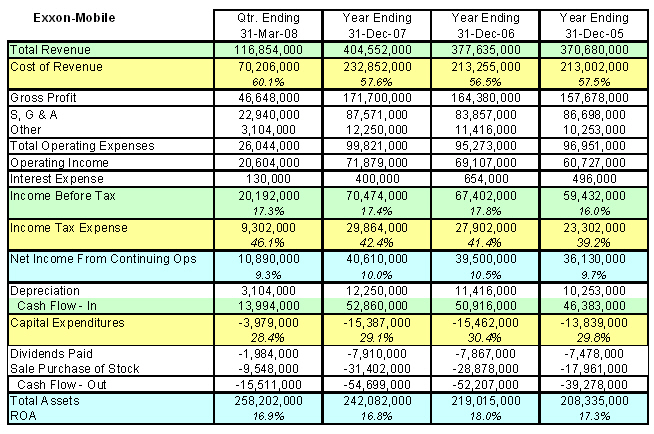
First, on a comparative basis, it’s tough to make the case (chart below).
Comparing Exxon Mobil to fan favorites Coke and Microsoft is revealing:
- Exxon’s 17.4% EBIT (earnings before interest and taxes — a measure of their profit margins — the difference between their operating costs and the prices they charge) is lower — much lower — than either Microsoft’s (39.3%) and Coke’s (28.9%)
- Exxon already has a higher effective tax rate (42.4%) than either Microsoft (30%) or Coke (22.7%).
- So, Exxon’s net income after taxes (10%) is about half of Coke’s (20.7%) and about 1/3 of Micosoft’s (27.5%)
Of course, applying 10% to Exxon’s gigantic revenue base ($404 billion) gives a very big number — $40 billion. But, it takes a correspondingly enormous level of capital investment (think rigs and refineries) to generate that level of sales. Exxon has almost $250 billion in assets — one measure of a business’ capital intensity. Exxon earns a 16.8% return on its assets — 5 percentage points less than Microsoft, and roughly the same as Coke (depending on whether or not Coke’s “intangible assets” are counted).
Bottom line: For sure, Exxon’s profits are high. But, they’re not “obscene” or “unconscionable” … unless Coke and Microsoft’s are, too.
That leaves the question of “windfall” for a follow-up post.

 The Homa Files
Leave a comment