Archive for October 10th, 2008

Bad news: Tax-payers on the hook for the bailout … Good news (?): that’s not many people

October 10, 2008

Ken’s Take:  I’ve been railing for awhile on the trend to have a minority of voters incur the full burden of taxes. I think everybody should have some skin in the game.

So, who is paying for the bailout?  Read on …

* * * * *

Excerpted from RealClearPolitics.com: “The Bailout and the Vanishing Taxpayer”, October 08, 2008

* * * * *
We have heard much in the press lately about the American taxpayer being forced to rescue the sharpies on Wall Street from their own greed and irresponsibility. Anti-bailout sentiment cuts “across class lines” on Main Street because “the taxpayers are on the hook for the bad judgment of others,” as the Washington Post put it.

Now for a reality check. Many Americans probably won’t pay a cent of the cost of this bailout.

That’s because a rapidly increasing percentage of U.S. households legally pay no income taxes, and many others pay so little in taxes that they already get back more from the federal government in services than they send to Washington. The number of taxpayers  … is small and shrinking, which is why the only way that the folks on Main Street will pay for this bailout will be if Main Street is where the mansions are in your town.

* * * * *

The declining portion of households who pay taxes is a direct result of policies pursued by both Republicans and Democrats over the last 15 years or so. While deductions and credits have always served to eliminate the tax bill for some low and lower-middle income workers, from 1950 through roughly 1990, the percentage of households with no income tax burden stood constant at slightly more than one-fifth of all filers, according to the Tax Foundation. But since 1990, Washington has added all sorts of tax credits��”subsidizing everything from “lifetime learning” to adoption expenses–that have further reduced the tax tab, and in the process raised the proportion of households with no federal tax liability to 33 percent.

A big culprit in this evolution is the current Bush administration and its tax packages. Although the 2001 and 2003 tax cuts are often criticized as having favored the rich, in fact they were also laden with tax credits benefiting low and middle income families, and as a result, under Bush, the percent of families not paying taxes increased more than under any other president during the last 50 years.

Both presidential candidates would vastly accelerate the trend (from 33% to the mid 40%s).

* * * * *

In the end, how we actually pay for the bailout is just part of the issue. The larger point is that if McCain or Obama follow through with their tax plans, we’ll continue a trend that makes us look more and more like some European social welfare state, where many people have a stake in growing government entitlements, which fewer and fewer taxpayers finance. At some point along that road, change becomes impossible because too many citizens benefit from the system in place, while those who pay the freight for this system try whatever they can, including starting businesses elsewhere, or reducing their output, to avoid the disproportionate tax bite.

* * * * *

Full article:
http://www.realclearmarkets.com/articles/2008/10/the_bailout_and_the_vanishing.html

* * * * *

Want more from the Homa Files?
Click link =>
  The Homa Files Blog
Worth reading: Playing Frisbee on a Precipice

October 10, 2008

Ken’s Take: Peggy Noonan a gifted writer who plays pretty much down the middle and always seems to cut to the core of political issues.   I think this sober analysis is worth reading and pondering.  Here are some highlights.  Full rticle is well worth the time.

* * * * *

Excerpted from WSJ:”Playing Frisbee on a Precipice”, Peggy Noonan, Oct. 10, 2008 

* * * * *

Punch Line: “America’s political class lacks the seriousness this moment demands.”

* * * * *

In parts and pockets of the middle, we have Americans who aren’t thinking about politics because they’re busy trying to imagine what a modern depression would look like and wondering, for the first time ever, if it is possible that they may wind up living in their cars.

Quoting an old comic: “I have enough to live comfortably for the rest of my life, as long as I’m hit by a bus tomorrow.”

* * * * *

In a time of crisis, do you really want one party to control the entire government? Don’t you want one party controlling one power center, and one in charge of the other, with each side tempering the other’s worst impulses?

* * * * *

Both campaigns, in the closing stretch, seem not fully worthy of the moment. We are in crisis—a once-in-a-century event, as we now say. And what we got from the candidates, in this week’s presidential debate, was a bunch of gummy meanderings—smooth, rounded sentences so full of focus-grouped inanities that six minutes in viewers entered a kind of trance in which we almost immediately gave up on trying to wrest meaning from what was being said and instead focused on mere impressions. The look of things. The men on the plane, the pseudo-tough political operatives who surround both candidates, sometimes grouse, in private, that it’s all symbols now, all mood, all about the visual.

But they have some real responsibility here. They send their candidates out to speak such thin gruel, such spat-out porridge, that we are struck dumb, and left daydreaming about the fact that Mr. Obama’s suits are always slate gray and never seem to wrinkle, and Mr. McCain tonight seems like a rabbity forest creature darting amid the hedgerows.

* * * * *

As to what they will do about the crisis, Mr. Obama will raise taxes on the rich and help us weatherize our homes, while Mr. McCain favors “energy independence” and buying up mortgages. On the causes of the crisis they spoke of insufficient regulation, or high spending.

But these were not the great causes. Neither party has clean hands. Or rather, both parties have dirty hands. Here is the truth, spoken by the increasingly impressive Sen. Tom Coburn: “The root of the problem is political greed in Congress. Members . . . from both parties wanted short-term political credit for promoting homeownership even though they were putting our entire economy at risk by encouraging people to buy homes they couldn’t afford. Then, instead of conducting thorough oversight and correcting obvious problems with unstable entities like Fannie Mae and Freddie Mac, members of Congress chose to . . . distract themselves with unprecedented amounts of pork-barrel spending.” That is the truth.

* * * * *

And yet at the debate, when one citizen-questioner invited both candidates to think aloud about the responsibility of our representatives in Washington, they both gently suggested she was cynical.

She was not cynical. She was informed.

Why would anyone trust either candidate to help dig us out of this if they can’t speak frankly about what got us into it?

* * * * *

One had the sense this week that our entire political class is playing Frisbee on the edge of a precipice, that no one is being serious enough, honest enough, that it’s all too revved, too intense, and yet too shallow. I have grown impatient with the strategists from the campaigns, the little blond monsters who go on cable TV to give us their bouncy, aggressive, tendentious talking points. They are like the men on the plane, the gargoyles with BlackBerrys who think the race is about them and their personal win/loss ratio, who think history is their plaything, who stay up with the press in the bar sipping Perrier and calling it seltzer, and who advise their candidates, in essence, to talk down to the voters, to the American people. They treat every crisis as if it is a political fact to be used for gain or loss, and not as a real crisis, something that deserves a response of gravity and seriousness.

It is asking a lot to ask a political animal to be thoughtful, because they find meaning in action. They are propelled through life by the force of their hunger. But now and then you want to see them think. You want to see them speak the truth. This is one of those times.

* * * * *
Full article:
http://online.wsj.com/article/SB122359863551021415.html#articleTabs%3Darticle

* * * * *

Want more from the Homa Files?
Click link =>
  The Homa Files Blog

Brooks Brothers or Big Brother?

October 10, 2008

Excerpted from Strategy & Business, “Web Sales with a Human Touch”, by Edward H. Baker, August 28, 2008

* * * * *

Many e-tailers endeavor to gather as much knowledge as possible about customer behavior and buying habits by aggregating and crunching massive amounts of data on users’ online buying habits. But those are just dry numbers and statistics. The plain truth is that even the most successful, tech-savvy retail Web sites still convert only 1 to 3 percent of visitors into buyers, largely because Web-based salesmanship is such a blunt instrument.

Suppose, however, that you could use the very technological virtues that make e-commerce so potent a sales channel, and bring in the human touch at exactly the moment it would be most effective. How much would that be worth? According to 24/7 Customer, a business process outsourcing firm based in Campbell, CA,  the human touch used in this way can increase online consumer conversion rates by 15 percent or more.

To prove this, 24/7 has developed predictive software called SalesNext that sorts online visitors into hot and cold leads and then makes personalized contact through online chat with the most promising prospects to close the deal.

* * * * *

The flow of consumers from the category of mere visitors to that of actual buyers, in any sales channel, is like liquid passing through a funnel. At a real-world retail outlet, the marketing portion of the funnel at the top is poorly targeted because companies have limited control over who visits a store. The power of the funnel lies at the bottom, where seasoned salespeople convert store visitors into buyers.

However, the top part of the typical e-commerce funnel is potentially very efficient. Advanced Web marketing techniques can target prospects entering the online retail site on the basis of prior Web behavior and other historical data and drive them to items that match their past preferences. But the bottom part of the funnel narrows to a trickle, because most Web sites’ one-size-fits-all consumer experience makes conversion of those visitors into buyers much more difficult.

However, by separating the tire kickers from the hot leads, then chatting with those leads in a way that personalizes their experience and drives them toward a transaction, Web retailers can open up the bottom of the funnel significantly.

* * * * *

Plenty of retail Web sites offer live human-to-human chat with consumers; what distinguishes 24/7 Customer’s approach is its ability to offer chat only to those who might not otherwise buy. Getting to the stage at which a visitor is invited to chat involves a series of filters de­signed to predict which individuals are most likely to buy as a result of a chat, rather than through self- service. After all, there’s no point in needlessly cannibalizing the lower-cost automated channel.

As a visitor browses the Web site, she is evalu­ated on a variety of criteria, including how she was referred to the site, whether she’s visited or bought anything there before, the time of day, the day of the week, her geographical location, and the product category. Equally important is the path a consumer takes through the Web site. If she heads immediately to the spec sheet for a particular digital camera, it’s unlikely that chatting with her will influence her buying decision. But if she appears to be wavering among three different models, a chat just might help her make up her mind.

The goal at this stage is to match likely consumers with likely product choices.

* * * * *

Once a visitor is identified as a hot lead, another filter determines whether to invite him to chat — that is, the program analyzes whether talking to him is virtually the only way to convince him to make a purchase. On one level, deciding who to invite for a chat is a simple scheduling problem: Are there enough agents available to handle the chat? Increasing the number of agents means increasing the number of invitations to chat, which in turn means approaching colder leads who are less likely to end up making a purchase. The colder the lead, the lower the potential profitability.

On a more strategic level, the software must determine the number of agents that will maximize profitability. Further statistical modeling is needed to select the right agent for each consumer, depending on such criteria as the best-performing agent for the product category that individual is looking at.

* * * * *

Now, it’s time to chat. The 24/7 chat format, of course, does not allow for all the nuances any decent salesperson picks up in a face-to-face conversation. It does, however, perform analyses of thousands of chat transcripts, through text mining and data mining, to perfect the techniques that human customer service representatives use to close the sale.

* * * * *

Adobe, the software giant, rolled out SalesNext in July 2007 with excellent results. Since then, the company has seen a 15 percent jump in conversion among consum­ers who chat, says Dawn Monet, senior manager of Adobe’s worldwide call centers. And, she notes, the satisfaction of consumers who use chat is higher than that of both consumers who shop online without chat and those who shop by phone.

Edit by DAF

* * * * *
Full article:
http://www.strategy-business.com/press/article/08313?pg=all&tid=230

* * * * *

Want more from the Homa Files?
Click link => 
The Homa Files Blog

* * * * *

Packaging’s Impact On Waistlines

October 10, 2008

Excerpted from INSEAD Knowledge “Supersizing and downsizing: the impact of changing packaging and portion sizes on food consumption

* * * * *

When it comes to packaging, size matters.

In a research paper, INSEAD Associate Professor of Marketing Pierre Chandon and co-author Nailya Ordabayeva, an INSEAD PhD student, found that changes in the shape of packaging or portions can have a big impact on our consumption patterns.

As consumers, we tend to buy bigger packages or order bigger portions because we believe we’re getting better value. However, this phenomenon leads to overeating and obesity because we fail to notice just how big these portions and packages are and hence underestimate how much we consume. The size and the shape of packaging play a key role in these misperceptions…

For marketers, this means that if a company increases the size of its packaging in one dimension, consumers perceive it to be much larger and so assume they’re getting a better deal and are more likely to buy it. If a company increases the product size by the same volume but the package is expanded in three dimensions – not just one – consumers don’t perceive as big of a change.

This has important consequences for purchase and consumption decisions…“If you want people to order a larger portion, then you should just increase the height because people will notice. If you want to reduce the quantity of your portions, for example if you had higher raw material costs, you should reduce the height, the width and the length because people won’t notice,” Chandon says.

The research is timely because the phenomenon of ‘supersizing’ has swept the US and is now moving to the rest of the world…This trend has had a big impact on how much consumers eat. The supersizing trend is one of the main drivers of the obesity epidemic and packaging is adding to the problem, the study states.

“It’s very easy to be influenced by marketers,” Chandon says. “For example, the size of the package, the size of the meals, even the size of the plates and of the spoons; we know these things have a very strong impact on how much we eat.”

When it comes to eating healthy, people sabotage themselves as well…Chandon’s research shows that, in addition to underestimating how much we eat, when we eat ‘healthier’ meals, we tend to reward ourselves with treats or bigger portions…

One of the other conclusions of the research: downsizing packaging and portions is one of the most effective ways of reducing overeating. Chandon believes there’s a growing market for low calorie, smaller portion products. But manufacturers need to be very clear in their labelling and careful about pricing, because many consumers think smaller portions are less economical. 

Edit by SAC

* * * * * 
Full article:
http://knowledge.insead.edu/SupersizingDownsizing080901.cfm

* * * * *

Want more from the Homa Files?
Click link =>
The Homa Files Blog

Got $85 billion ? Go get a massage …

October 10, 2008

This one speaks for itself.  Only question: arrogance or stupidity ?

* * * * *

After Bailout, AIG Executives Head to Resort

Less than a week after the federal government offered an $85 billion bailout to insurance giant AIG, the company held a week-long retreat for its executives at the luxury St. Regis Resort in Monarch Beach, Calif., running up a tab of $440,000.  The executives spent $200,000 for rooms, $150,000 for meals and $23,000 for the spa.

“They were getting their manicures, their pedicures, massages, their facials while the American people were paying their bills,” thundered Rep. Elijah E. Cummings (D-Md.), of the executive retreat at the Monarch Resort.

* * * * *

In March 2008, when the company’s compensation committee met to award bonuses, Chief Executive Martin Sullivan urged the committee to ignore those losses, which should have slashed bonuses. But the board agreed to ignore the losses from the financial products division and gave Sullivan a cash bonus of over $5 million. The board also approved a new compensation contract for Sullivan that gave him a golden parachute of $15 million.

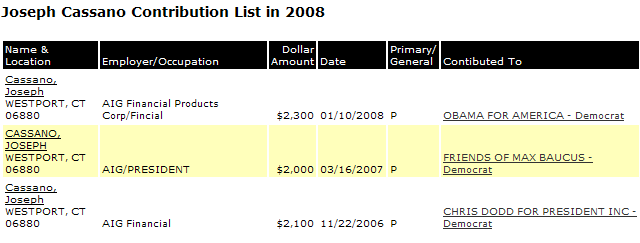
Joseph Cassano, the executive in charge of the company’s troubled financial products division, received more than $280 million over the last eight years. Even after he was terminated in February as his investments turned sour, the company allowed him to keep up to $34 million in unvested bonuses and put him on a $1 million-a-month retainer. He continues to receive $1 million a month.

image

http://www.campaignmoney.com/political/contributions/joseph-cassano.asp?cycle=08

* * * * *

In Dec. 2007, PricewaterhouseCoopers, AIG’s auditor, told the company in March 2008 that the “root cause” of AIG’s problems was that people assessing risk did not have enough access to the financial products division, where the risky investments originated. PWC warned Sullivan that the company “could have a material weakness relating to these area.”  Still, Sullivan expressed confidence to investors.

* * * * *

Thanks to SMH & JMH for the feed.

* * * * *

Want more from the Homa Files?
Click link =>
  The Homa Files Blog