Archive for November 13th, 2008

Citi mulls replacing Chairman … what's wrong with this picture?

November 13, 2008

Excerpted from WSJ, “Citi Directors Mull Replacing Chairman”, Nov. 13, 2008

* * * * *

“The board of Citigroup  is growing increasingly dissatisfied with the financial giant’s performance, and some directors are considering replacing Sir Win Bischoff as chairman, according to people familiar with the matter.

One leading candidate is Richard Parsons, Time Warner’s chairman and a member of Citigroup’s board.

Mr. Parsons ran a New York thrift in the early 1990s and is one of the few Citigroup directors with experience in financial services.

He also is part of President-elect Barack Obama’s transition economic-advisory board.

While Mr. Parsons is a leading candidate for the chairmanship, no choice has yet been made. One potential wild card is whether Mr. Obama will ask Mr. Parsons to take a prominent role in his cabinet.”

Full article:
http://online.wsj.com/article/SB122652480535921911.html?mod=testMod

* * * * *

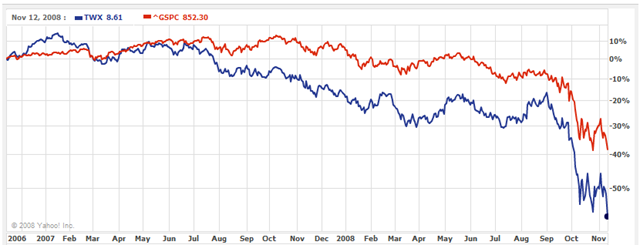
Time Warner financial performance.  (Note: NI down 33% from 2006 to 2007; 2008 is worse !)

 image

* * * * *

Time Warner stock is the blue line; S&P 500 is the red line

image

* * * * *

Ken’s Take: Both Citi and Barack seem to have quite an eye for talent. Isn’t it time to stop rewarding under-performance (and abject failure?)

* * * * *

Want more from the Homa Files?
Click link =>
  The Homa Files Blog

The government should save General Motors … why?

November 13, 2008

Excerpted from IBD, “Pulling Plug On GM Would Help Both Auto Industry And Michigan”,  John Tamny,  November 11, 2008

* * * * *

Ludwig Von Mises once wrote that the entrepreneur who fails to use his capital to the “best possible satisfaction of consumers” is “relegated to a place in which his ineptitude no longer hurts people’s well-being.”

General Motors … is the living embodiment of managerial ineptitude, and to ensure that it no longer fails its customers while harming the well-being of Americans more broadly, it’s essential to let the firm die.

GM’s continued existence under weak management has served as a capital repellant such that capital and jobs will continue to flee the state if GM is saved with the money of others.

* * * * *

Businesses rarely fail due to a lack of money. Instead, poorly run businesses find it hard to raise money in the capital markets. Government money allows the architects of bad decisions to continue making mistakes that cause a company to be capital-deficient to begin with. Capital is correctly searching for better opportunities.

Paradoxical as it sounds, GM’s bankruptcy would be a boost for Michigan’s economy and the U.S. auto sector generally.

Far from vanishing, many of GM’s assets would be quickly purchased by competent foreign automakers eager to expand their capacity in what is the world’s largest auto market. The list of well-run car companies, from Toyota to Nissan to Porsche, is long.

So while the cries of certain Armageddon would be ear splitting in the event of a GM failure, the U.S. auto sector would actually emerge much healthier thanks to a change in ownership that would be the certain result of GM going under.

* * * * *

In the end, the state of Michigan and the U.S. automobile sector are struggling not due to back luck, but precisely because they cling to a company that investors no longer value.

So rather than waste precious capital in the naive hope of propping up that which investors don’t value, it’s essential to let GM fail.

* * * * *
Full article:
http://www.ibdeditorials.com/IBDArticles.aspx?id=311297941730996

* * * * *

Want more from the Homa Files?
Click link =>
  The Homa Files Blog

Forging Ahead at Ford Motors … what a difference a week or two makes

November 13, 2008

Excerpted from New York Times, “Ford Says It Can Make It Without a Merger”, by Bill Vlasic, October 30, 2008

* * * * *

Ken’s Take: Everything is fine in October.  Then, in the first week of November, Ford’s CEO shows up in Washington with a big tin cup.  Huh ?

* * * * *

With United States vehicle sales down nearly 13 percent this year, most car companies have been cutting production rather than increasing it.

But with 1,200 hourly workers cheering them on, top executives of the Ford Motor Company said Thursday that they would call back 1,000 laid-off workers to help build more trucks.

While its Detroit rivals General Motors and Chrysler wrestle over terms of a possible merger and seek help from Washington to survive the steepest downturn in the industry in decades, Ford says it can survive, and thrive, on its own.

Ford is gearing up for a new-product blitz that will replace 40 percent of its production with fresh models by next year. And the company — sandwiched between the bigger G.M. and the smaller Chrysler in Detroit’s traditional Big Three — hopes to take advantage of the potential merger of its rivals and the distractions that come with it.

“I don’t know what they’re going to be spending their time on if they’re merging,” said James Farley, Ford’s vice president for sales and communications. “But I know we’re spending our time on launching products.”

* * * * *

Ford is counting on a wave of product introductions to increase its revenue during the market downturn.

In addition to the F-150, Ford is bringing out new versions of its Taurus and Mustang passenger cars next year and accelerating development of a series of new smaller, more fuel-efficient vehicles.

Analysts say they believe Ford has some opportunity to take market share from G.M. and Chrysler if the two companies merge and go through a prolonged restructuring.

“Ford could definitely make some hay while all the turmoil is going on at G.M. and Chrysler and they try to put those two companies together,” said Joseph Phillippi, principal in the consulting firm AutoTrends in Short Hills, N.J.

Ford is moving faster than its rivals to replace its big, gas-guzzling S.U.V.’s with small cars. But any hope Ford has for a revival depends largely on strong sales of its new F-150 pickup.

Through the first nine months of the year, the F-series was still the top-selling vehicle in America. The new version, Ford executives said, is aimed directly at buyers who need trucks for work and other practical purposes, rather than because of their macho image.

Edit by DAF

* * * * *

Full article:
http://www.nytimes.com/2008/10/31/business/31ford.html?ref=business

* * * * *

Want more from the Homa Files?
Click link => 
The Homa Files Blog

* * * * *

The Election … some numbers

November 13, 2008

Excerpted from  TheHill.com , Dick Morris, November 11, 2008

* * * * *

Turnout did not increase substantially. Despite predictions  of a vastly greater voter turnout, it didn’t happen. Turnout rose by about 5 million (4%) between 2004 (122 million) and 2008 (127 million).  In contrast, turnout increase almost 20% between 2000 and 2004.

As expected, Obama generated a big increase in African-American voter turnout. Exit polls estimate that blacks constituted 13 percent of the turnout in 2008, compared with 11 percent in 2004 and 10 percent in 2000.

But voters under 30 years of age were still the same 11 percent of the vote that they were in 2004. The surge of young voters failed to happen.

Full article:
http://www.vote.com/mmp_printerfriendly.php?id=1210

* * * * *

Want more from the Homa Files?
Click link =>
  The Homa Files Blog