Archive for December 16th, 2008

Feds in "stand off" over foreclosures … is that bad news or good news ?

December 16, 2008

Excerpted from Business Week, “A Standoff Over How to Rescue the Housing Market”, December 11, 2008

* * * * *

image 
        http://images.businessweek.com/ss/08/12/1211_numbers/2.htm

Without reducing foreclosures and ending the slide in home prices, it will be nearly impossible to stabilize banks and lessen the depth of the recession. And sharply rising unemployment has added new urgency: Last spring, Rod Dubitsky, Credit Suisse’s (CS) head of research for asset-backed securities, projected 6.5 million foreclosures. With unemployment set to top 8% in 2009, he says up to 10 million families may lose their homes.

What’s the best way to stabilize plunging home prices?

Treasury Secretary Hank Paulson and his staff are considering plans to push mortgage rates down to 4.5% in hopes of bringing buyers back into the moribund market.

Democrats—in Congress and on President-elect Barack Obama’s team—seem more set on pressing lenders to renegotiate troubled mortgages. That tack, championed by FDIC head Sheila Bair, is aimed at trimming foreclosures and ending fire sales.

Bair’s plan offers a guarantee to lenders that modify a mortgage so payments are trimmed to 31% of a homeowner’s gross income. If they cut interest rates or stretch out the life of a loan, Washington would cover part of the lender’s losses should a homeowner redefault. Bair says the plan would save 1.5 million homeowners at a cost of $24.4 billion. [Note; lenders would get subsidies only on loans that redefault.]

But conflicting investor interests make it legally tough to modify securitized loans. And new statistics suggest that more than half of loans modified early this year are already at least 30 days past due.

Treasury says it’s studying several options, including the plan to subsidize low rates. Proponents say that by bringing new buyers to the market, the move could help end the pricing slide.   Problem is, low rates would do little for those now facing foreclosure or trapped in homes worth less than their mortgages.

Full article:
http://www.businessweek.com/magazine/content/08_51/b4113030318539.htm?chan=top+news_top+news+index+-+temp_news+%2B+analysis

* * * * *

Ken’s Take:

In rough numbers …

  1. 2/3’s of roughly 125 million households are owner-occupied
  2. 1/3 of owner-occupied households are owned free and clear of any mortgage
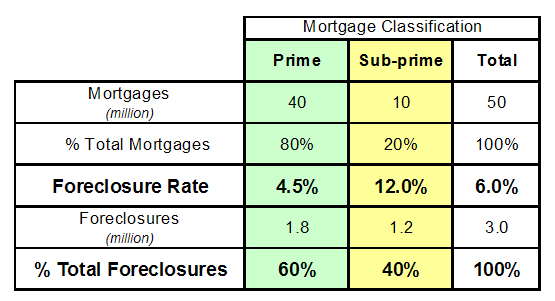
  3. 20% of mortgages are sub-prime; most with no down payment; many “under water”
  4. Vast majority  of sub-primes were “unqualified” at fair market (vs. “teaser”) interest rates
  5. 12% of sub-primes are in foreclosure, accounting for 40% of total foreclosures
  6. 50% of foreclosed sub-primes don’t qualify at modified terms (e.g. writing loan down to house’s FMV)
  7. 50% of modified sub-prime loans re-default within 6 months
image

Bottom line: Many of the people being foreclosed on are “occupants” not “owners”.  Help legitimate owners who are going through some tough times; stop delaying the inevitable for the sub-primes — and certainly don’t reward them with deals better than the people who played by rules have.  That’s not fair !

* * * * *

Want more from the Homa Files?
Click link =>
  The Homa Files Blog

The automaker’s specious bankruptcy argument …

December 16, 2008

Excerpted from WSJ, How Destructive Would Bankruptcy Be for Big Three?, December 12, 2008

* * * * *
One of the Big Three’s main arguments for a bailout is that American consumers won’t buy General Motors and Chrysler cars if they are forced into bankruptcy. They would be tainted by a stigma and by worries that warranties and parts wouldn’t be available years down the road if the firms ran the risk of liquidation.

Consumer surveys support this view. One survey of 6000 consumers by CNW Research this summer found that 80% said they would abandon an auto maker if it were to file for bankruptcy.

Does the argument hold up? One way to test it is to look at consumers’ actual behavior. The risk of bankruptcy has obviously risen in the past few months. If bankruptcy is likely to drive consumers away, one might expect to see the market share of GM and Chrysler fall more precipitously as bankruptcy risks rise.

The U.S. market share of the Big Three has been dropping consistently for years, from 74% in the mid-1990s to less than 50% today. But there’s little evidence in the data so far that this longer term pattern has been dramatically amplified by the rising risk of bankruptcy.  

With the whiff of bankruptcy in the air …

Chrysler’s U.S. sales market share has actually risen from 8.7% in July to 11.5% in November, according to  Moody’s Economy.com.

GM’s market share has bounced around but hasn’t dropped below levels hit earlier this year. 

Ford, which isn’t facing an immediate cash crunch, has picked up market share too, rising from 14.2% in July to 16.5% in November.

Of course, sales have been propped up by  fire-sale deals and aggressive fleet sales.  But, that’s not new news.

http://blogs.wsj.com/economics/2008/12/12/how-destructive-would-bankruptcy-be-for-big-three/

* * * * *

Ken’s Take:

1. Is there anyone who doesn’t recognize that the Detroit automakers are hanging by financial threads?  The companies are bankrupt, they’re just not in legal bankruptcy proceedings. If they were, they’d at least stand some chance of restructuring themselves into healthy positions. The current government thinking stands no chance of doing that. 

2. As I’ve said before, they survey results are misleading.  Would somebody be more likely to buy a car from a financially healthy car maker?  Of course.  Would somebody prefer to by from one that is on the brink of financial collapse or one that is in bankruptcy proceedings?  I bet that would be a statistical tie.

* * * * *

Want more from the Homa Files?
Click link =>
  The Homa Files Blog

Feeling pinched these days? Here’s why …

December 16, 2008

Economists estimate households will have lost more than $5 trillion in net worth since the summer of 2007 because of falling home equity and stock prices.

In recent years, households have used their big multiyear wealth gains as a means to afford more debt and as a surrogate form of savings, instead of socking away more of their pay. But by the end of 2008,  They are now more dependent on income growth to finance their spending and saving and less so on credit and wealth.

Source: Business Week
http://www.businessweek.com/magazine/content/08_51/b4113010266237.htm

* * * * *

Ken’s Take: On average, that works out to be about $40,000 per household — or about 80% of median annual household income — i.e. the rough equivalent of an average person being laid of for about a year.  Ouch.

Want more from the Homa Files
Click link =>  The Homa Files Blog