Archive for January 16th, 2009

To stem foreclosures, you have to “cram down” loan balances … NOT !!!

January 16, 2009

If you’re up to speed on the proposals to modify mortgages to stop foreclosures, scroll down to  Loan Modification Math …

Background:

There seems to be momentum to “keeping people in their homes” by modifying the bulk of the 4.6 million mortgages that are currently in foreclosure or payment delinquent for longer than 90 days.

There have already been some voluntary lender efforts to modify distressed mortgages by lowering interest rates or extending the term of the mortgages (say, from 30 to 40 years).  Generally, the programs haven’t generated many modified loans … and for the loans that have been modified, about 40% become delinquent again within 6 months. (Note: I’ve seen ranges on this number from 35% to over 50%).

So, the Feds are pushing lenders to sweeten the mortgage modification packages.  Specifically, there’s talk of a broadscale government program that would pare mortgage interest rates to 4.5%.  And, there seems to be support for “cram downs” — having lenders reduce the principal loan balances to the current fair market value of the homes collateralizing the loans.  That is, if a defaulting loan is on a home that is “below water” — i.e. loan balance is greater than the home’s market value — the lender writes off the difference and issues a revised mortgage at the home’s market value.

These proposals strike me as both naive and very problematic.  In this and subsequent posts, I’ll summarize why I think cram downs are a bad idea.

* * * * *

Loan Modification Math

A frequent pundit refrain is that “you can’t get there with just rate and term adjustments — you have to reduce the loan balance to keep these loans out of foreclosure.”  Not surprisingly, there’s a lot of hand-waving but few numbers.

For the record, here’s how the math works.

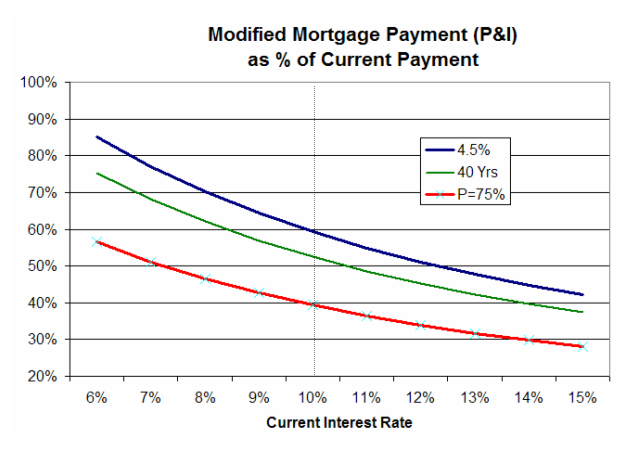
Say, a person buys a home for $150,000 with no downpayment (as is typical with sub-primes), a 10% mortgage interest rate (maybe a bit low for sub-prime loans), and a 30 year term.  The monthly mortgage payment — for principal and interest — would be $1,269.

If the interest rate on the loan is cut to 4.5%, the monthly payment would drop by over 40% to $752.

If the interest rate is cut to 4.5% and the loan’s payback period is extended from 30 to 40 years, then the  monthly payment would drop to $666.  That’s about half of the original monthly payment! {Note: If the starting interest were more than 10%, the new payment would be more than half off).

Apparently, some politicos think that cutting the payment in half isn’t enough to make a difference.  So, they propose that lenders accept “cram downs” and reduce loan balances.

Let’s assume that the home’s fair market value fell by 25% since the time of purchase.  That would mean writing off $37,500 of the loan balance and reissuing it with a $112,500 balance.

If the interest rate is cut to 4.5%, the loan’s payback period is extended from 30 to 40 years, and the principal balance is reduced to $112,500, then the monthly payment drops to $499.  That’s less than 40% of the original monthly mortgage payment — a discount of more than 60%.

Are these folks serious ???

Cutting the mortgage rate in half for a defaulter — while keeping the hardworking, creditworthy folks next door at the full rate — is morally bankrupt.  Especially when the defaulter didn’t legitimately qualify for the loan by any reasonable underwriting standards … and is equally likely to default again.

What about the hardworking guy who has made payments for years but but just got got laid off in the tough economy?  Well, the half-payment may even be too much for him to handle.  Unfortunate, but true.  I say the bank (and Feds) should give that guy plenty of breathing space (e.g. suspend payments for 6 months).

In a subsequent post, I’ll show how government largesse might even give a defaulter free housing under the proposed plan.  This stuff gets nuttier by the day …

* * * * *

Technical Stuff

Below is a graphical display of the above math.  The top line is reducing the interest rate to 4.5%; the middle line reduces the interest rate to 4.5% and extends the term to 40 years; the bottom line reduces the interest rate to 4.5%, extends the term to 40 years, and writes off 25% of the loan balance.

The takeaway: within a representative range of original interest rates, modified mortgage payments can be roughly halved by simply cutting the interest rate to 4.5% and extending the loan term to 40 years.
image

* * * * *

Want more from the Homa Files?
Click link =>
  The Homa Files Blog

Maybe some taxes really are regressive …

January 16, 2009

In several prior posts, I demonstrated that the core of the US tax system — income taxes and payroll taxes (i.e. Social Security and Medicare) — are progressive.  That is, when all pay-ins and pay-outs are considered, high earners pay a higher proportion of their earnings in taxes.  Apparently I did overlook one very regressive tax …

* * * * *

Excerpted from IBD, “Will The Poor Feel Tax Pinch From Stimulus?”, Malkinn, Jan 14, 2009

Congress is rushing this week to impose massive tax hikes of at least 61 cents on every cigarette pack sold in America, in addition to new increases on other tobacco products … a  punitive tax increases on the poor.

How so? Health surveys show that smokers are more likely to be blue-collar workers, minorities and have less than a high school education.

Tobacco taxes take a 50 times larger share of income from those earning less than $20,000 than those earning more than $200,000.

Put another way: Families making less than $30,000 per year pay more than half of all taxes paid on cigarettes, while families making more than $60,000 pay only 14%.

That’s the dictionary definition of regressive, not progressive.

Full article:
http://www.ibdeditorials.com/IBDArticles.aspx?id=316826618344159 

* * * * *

Want more from the Homa Files?
Click link =>
  The Homa Files Blog

Riviving the auto industry by smashing gas guzzlers into a tiny cubes …. hmmm, might work

January 16, 2009

Ken’s Take: some good  ideas that I haven’t seen other places … the notion of Feds buying gas guzzlers and smashing them to into cubes certainly qualifies as ‘out of the box’ thinking

* * * * *

Excerpted from IBD, “Revival Of U.S. Automaking Awaits If UAW Will Follow Toyota Model”, Morici, January 13, 2009

General Motors and Chrysler are on the anvil of history. United Auto Workers President Ron Gettelfinger holds the hammer and will determine whether they emerge more competitive or shattered in pieces and sold to foreign investors.  Eventually, Washington will tire of their begging, they will march through bankruptcy, and their factories will be sold off to Japanese, Korean, European and Chinese automakers.

* * * * *

At U.S.-based Toyota factories, workers receive about $25 dollars an hour and good health care benefits. But they don’t retire at 50 after 30 years or get as much time off and huge severance packages. Toyota does not endure the medieval work rules and job classifications imposed by UAW contracts.

Most other Americans would be happy to get Toyota pay, benefits and working conditions. 

* * * * *

Over the last two decades, Japan has kept the yen at least 30% undervalued against the dollar, and this provided Toyota with an average subsidy of at least $2,000 on every car it sold in the United States.

The Federal Reserve has dramatically reduced U.S. interest rates, and the yen has risen closer to its true market value against the dollar. Japanese officials appear poised to again intervene directly in currency markets to restore Toyota’s unfair advantage, and Washington should take whatever steps are necessary to head off such Japanese protectionism.

* * * * *

In addition, Washington should take assertive steps to encourage production of fuel-efficient vehicles in the U.S. and create a strong export industry.

Washington could offer incentives to car buyers to trade in gas guzzlers for more fuel-efficient vehicles — the newer and the bigger the clunker and the more fuel-efficient the replacement, the more dollars the car buyer would receive if the guzzler is destroyed.

Washington could provide substantial product development assistance to U.S.-based … battery makers and other suppliers to accelerate the production of innovative, high-mileage cars.

The condition for assistance would be that beneficiaries do their R&D and first large production runs in the United States, and share their patents at a reasonable cost with other companies manufacturing in the United States.

Finally, individual Americans should open their minds. Many are considering trading in trucks and SUVs for sedans and are naturally attracted to the Toyota Camry and similar import brands. Visit a Ford or Chevy showroom and test drive a Fusion or Malibu and be pleasantly surprised. Those are high-quality, affordable and reliable vehicles.

Washington is giving Detroit a second chance, and Americans should give its cars a second look.

Full article:
http://www.ibdeditorials.com/IBDArticles.aspx?id=316741420675724 

* * * * *

Want more from the Homa Files?
Click link =>
  The Homa Files Blog

Online ads … customized on the fly

January 16, 2009

Excerpted from the New York Times, “Web Marketing That Hopes to Learn What Attracts a Click”, by Stephanie Clifford, December 3, 2008

* * * * 
Online advertisers are not lacking in choices: They can display their ads in any color, on any site, with any message, to any audience, with any image.

Now, a new breed of companies is trying to tackle all of those options and determine what ad works for a specific audience. They are creating hundreds of versions of clients’ online ads, changing elements like color, type font, message, and image to see what combination draws clicks on a particular site or from a specific audience.

It is technology that could cause a shift in the advertising world. The creators and designers of ads have long believed that a clever idea or emotional resonance drives an ad’s success. But that argument may be difficult to make when analysis suggests that it is not an ad’s brilliant tagline but its pale-yellow background and sans serif font that attracts customers.

Adisn, based in Long Beach, and Tumri, based in Mountain View, are working both sides of the ad equation. On one, they are trying to figure out who is looking at a page by using a mix of behavioral targeting and content analysis. On the other side, they are assembling an ad on the fly that is meant to appeal to that person.

* * * * *

Adisn’s approach has been to build a database of related words so it can assess the content of a Web site or blog based on the words on its pages.

Adisn then buys space on Web sites, and uses its information to find an appropriate ad to show visitors to those sites. If a visitor views pages about beaches, weather and Hawaii, it might suggest that the visitor is interested in Hawaiian travel.

Based on that analysis, Adisn’s system pulls different components — actors, fonts, background images — to make an ad. For example, it might show an ad with a blue background, an image of a beach, and a text about tickets to Hawaii.

Simple Green, the cleaning brand, began working with Adisn this year to advertise a new line of products called Simple Green Naturals.

“If it’s a woman looking at a kitchen with a stainless steel refrigerator, they can show a stainless steel product.”

* * * * *

Tumri’s approach is slightly different. It creates a template for ads, including slots for the message, the color, the image and other elements.

Unlike Adisn, it does not buy ad space, but lets clients choose and buy space on sites themselves. And rather than building a contextual database, Tumri uses whatever targeting approach advertisers are already using, whether it is behavioral or contextual or demographic, and assembles an ad on the fly based on that information.

“It’s reporting back to the advertiser and agency saying, ‘Guess what? The soccer mom in Indiana likes background three, which was pink, likes image four, which was the S.U.V., and likes marketing message 12, about room, safety and comfort.”

Edit by DAF

* * * * *

Full article:
http://www.nytimes.com/2008/12/03/business/media/03adco.html?_r=1&ref=media&pagewanted=print

* * * * *

Want more from the Homa Files?
Click link => 
The Homa Files Blog

So, what happens when a luxury brand drops its prices ?

January 16, 2009

Excerpted from the WSJ, “In Rare Move, Luxury Goods Makers Trim Their Prices in the US”, by R. Dodes and C. Passariello, November 14, 2008

* * * * *

For the first time in recent memory, luxury-goods makers are cutting prices on designer apparel, shoes and handbags in the U.S. market.

With even the biggest spenders starting to scrimp, luxury companies are reversing the industry’s maxim that luxury prices only move up. The cuts range from 8% to 10% on most products sold in the U.S.

But the move isn’t likely to dent the profit margins…because the value of the dollar has increased 28% against the euro since April. Luxury-goods companies don’t disclose margins, but Louis Vuitton is estimated to have a margin of 45 cents on every dollar…The strengthening of the dollar means luxury-goods companies are earning more than they had budgeted on every handbag or piece of clothing sold in dollars.

Luxury-goods executives must walk a fine line when cutting prices… if prices drop precipitously, the perception of a label’s value may also drop… During the recent years, luxury companies often assumed that money was no object for their fans…But luxury makers have acknowledged that a ceiling exists even for exclusive goods…

Edit by SAC

* * * * *

This article is a follow-up to a previous post on marketing luxury brands in lean times. It confirms that even high-end consumers are cutting back spending and likely avoiding conspicuous consumption. As a result, marketers are faced with the challenge of maintaining their premiums and exclusivity while also making sure their brands are accessible and acceptable to purchase in the eyes of the high-end consumer.

* * * * *

Full Article:
http://online.wsj.com/article/SB122662444379126865.html

* * * * *

Want more from the Homa Files?
Click link =>
The Homa Files Blog