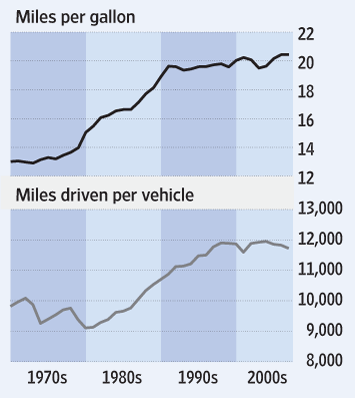
Ken’s Take: A couple analyses I did last summer suggested that people drive more when they get higher MPG from their vehicles … largely (or completely) offsetting the efficiency gain.
http://online.wsj.com/article/SB124338431100556717.html?mod=djemalert
Here are a couple of articles citing studies going back to the 19th century that draw the same conclusion.
* * * * *
Excerpted from Heritage Foundation, “Why the Government’s CAFE Standards for Fuel Efficiency Should Be Repealed, not Increased”, July 11, 2001
Clearly, the CAFE program has failed to accomplish its purposes. Consumption has not decreased.
As fuel efficiency improves, consumers have generally increased their driving, offsetting nearly all the gains in fuel efficiency.
Advocates of higher CAFE standards argue that increasing miles per gallon will reduce gas consumption. What they fail to mention is the well-known “rebound effect”–greater energy efficiency leads to greater energy consumption.
As more fuel-efficient vehicle costs less to drive per mile, so vehicle mileage increases.
Since 1970, the United States has made cars almost 50% more efficient; in that period of time, the average number of miles a person drives has doubled.
http://www.heritage.org/Research/EnergyandEnvironment/BG1458.cfm
* * * * *
Interesting Historical Perspective
Excerpted from WSJ: “The rebound effect: Conservation Wastes Energy,” May 17, 2001
Way back in the 19th century, English economist Stanley Jevons embarked on a study of coal and its consumption. He was intrigued by the introduction of James Watt’s new, efficient steam engine, which began replacing older, more energy-hungry engines.
Jevons found that in Scotland (Watt’s native land), coal consumption was initially reduced by one-third. But in the ensuing years of 1830 to 1863, there was a tenfold increase in consumption. Why? The engines were so much cheaper to run that people used them far more than they ever would have before. Greater efficiency had produced more energy use, not less.
The same arguments apply to government-mandated energy efficiencies today.
Since 1970, the U.S. has made cars almost 50% more efficient; in that period of time, the average number of miles a person drives has doubled. Studies show that when consumers buy more energy-efficient air conditioners, they run them longer because it still costs the same amount.
Consumers, in short, spend to the size of their billfolds.
And that is the failing of government-led demand reduction.
There is only one thing that convinces Americans that they should conserve — market prices. Only when gas prices start to pinch will Americans drive less or hunt for smaller cars.
http://www.opinionjournal.com/columnists/kstrassel/?id=95000484
* * * * *
Want more from the Homa Files?
Click link => The Homa Files Blog


 The Homa Files