Archive for June 22nd, 2009

Goin’ negative … Obama’s PAI drops to minus 2.

June 22, 2009

 TakeAway: All major polls show that Obama’s approval rating is still over 50%, but showing significant recent slippage. 

For the first time, Obama’s Presidential Approval Index has gone negative.  Keep reading …

* * * * *

Rasmussen

Overall, 53% of voters say they at least somewhat approve of the President’s performance so far … 46% at least somewhat disapprove.

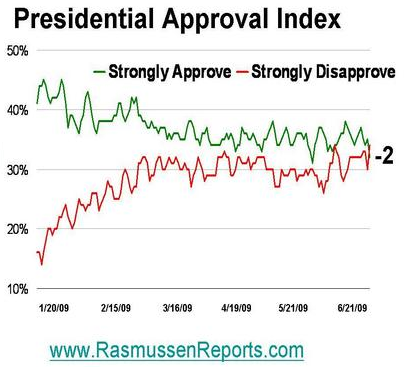
But, the Rasmussen Reports daily Presidential Tracking Poll for Sunday showed that 32% of the nation’s voters now Strongly Approve of the way that Barack Obama is performing his role as President … 34% Strongly Disapprove giving Obama a Presidential Approval Index rating of -2.

That’s the President’s lowest rating to date and the first time the Presidential Approval Index has fallen below zero for Obama.

Sorted by self-identified race, Obama’s PAI is plus 80 among blacks, minus 6 among whites, and minus 7 among all others.

By party affiliation, Obama is plus 56 among Dems, minus 50 among GOPs, and minus 6 among independents.

38% say we’re on the right track, 56% say we’re on the wrong track.

These results are consistent with recent Gallup and WSJ polls summarized below.
 

image 
http://www.rasmussenreports.com/public_content/politics/obama_administration/daily_presidential_tracking_poll


Gallup

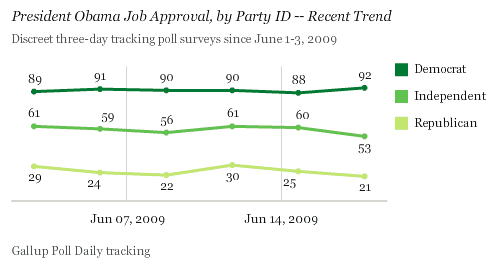
President Barack Obama’s job approval rating fell to 58% in Gallup Poll Daily tracking from June 16-18 — a new low for Obama in Gallup tracking.  In the past couple of weeks, Dem approval has remained unshakable; GOP has fallen by 8 points; Independent support has fallen by a whopping 11 points.
image

http://www.gallup.com/poll/121028/Obama-Job-Approval-Slips-58-First-Time.aspx

* * * * *

WSJ / NBC

Since Feb., approval is down 4 or 5 points – disapproval is up 8 points – as some “not sure” have become negatively “sure”

image

The simple math of healthcare “reform” …

June 22, 2009

There was sticker shock when the CBO estimated the cost of the proposed healthcare reform package at about $1.6 trillion (over 10 years).

My question: why the shock?  In fact, why any surprise at all?

Think about it …

Total healthcare costs are generally reported to be about $2.1 trillion annually.

The U.S. population is just a bit over 300 million …  so, per capita healthcare costs are about $7,000 per person (which is consistent with most reports).

It’s generally reported that there are approximately 45 million people in the U.S. without health insurance.

So, it follows arithmetically that it costs about $315 billion annually to cover those folks (45 million times $7,000 per person).

Assuming a quick ramp up of the coverage, that’s $3.15 trillion over 10 years (for simplicity, call it $3 billion).

It’s generally reported that about 1/3 of the 45 million uninsureds are not citizens. At the national average, their healthcare expenses would be 1/3 of the $3 trillion, or $1 trillion. 

Policy question:  Who’s in favor of paying higher taxes or boosting the national debt to cover this $1 trillion ?

Also, it’s generally reported that about 1/3 of the 45 million uninsureds are healthy young adults who have access to health insurance and earn enough to pay for it, but opt to self-insure.  Simple economics –  they expect that the insurance will cost them more than their out-of-pocket expenses if they pay their own way.  Of course, they’re gambling that they won’t have any catastrophic medical bills – but, that’s their choice.

Policy question: Should other taxpayers have to foot the bill the bill for these opt-outters?  I don’t think so. 

Policy question: Should the government make them buy insurance? I don’t care – that’s not my problem.

Policy question: Should the opt-otters get health insurance subsidized by other taxpayers?  I don’t think so – they can afford to pay the freight – they just choose not to.

So, what’s left is about 15 million uninsureds … with an associated annual cost of about $105 billion … or a little over $1 trillion for 10 years.

Policy question: Should these ininsureds be covered by other taxpayers?  Even with a hard heart, it’s easy to say yes.

Note: Many of these uninsureds are simply between jobs.  when they find a new job, they’ll have insutance again.

* * * * *

The CBO took a couple of weeks to get 17 million new insureds at a cost of about $1.6 trillion.  The above analysis took all of 10 minutes.  Hmmmm