Archive for September 18th, 2009

Ouch: 45% Of Doctors Would Consider Quitting If Congress Passes Health Care Overhaul

September 18, 2009

Ken’s Take: If you think it’s hard to get in to see a doctor now, just wait …

* * * * *

IBD, 45% Of Doctors Would Consider Quitting If Congress Passes Health Care Overhaul, September 15, 2009

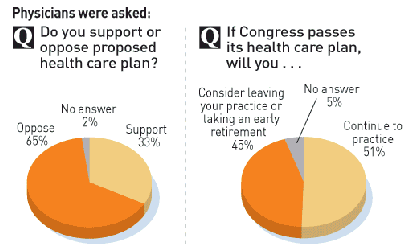
Two of every three practicing physicians oppose the medical overhaul plan under consideration in Washington, and hundreds of thousands would think about shutting down their practices or retiring early if it were adopted, a new IBD/TIPP Poll has found.

The poll contradicts the White House claims that the medical profession is behind the proposed overhaul.

* * * * *

Major findings included:

• Two-thirds, or 65%, of doctors say they oppose the proposed government expansion plan. This contradicts the administration’s claims that doctors are part of an “unprecedented coalition” supporting a medical overhaul.

• 45%, said they “would consider leaving their practice or taking an early retirement” if Congress passes the plan the Democratic majority and White House have in mind.
image

* * * **

More than 800,000 doctors were practicing in 2006, the government says. Projecting the poll’s finding onto that population, 360,000 doctors would consider quitting. The number of doctors is already lagging population growth. From 2003 to 2006, the number of active physicians in the U.S. grew by just 0.8% a year, adding a total of 25,700 doctors.

The U.S. today has just 2.4 physicians per 1,000 population — below the median of 3.1 for members of the Organization for Economic Cooperation and Development, the official club of wealthy nations.

A recent study from the Association of American Medical Colleges found steadily declining enrollment in medical schools since 1980. The study found that, just with current patient demand, the U.S. will have 159,000 fewer doctors than it needs by 2025.

Full article:
http://www.ibdeditorials.com/IBDArticles.aspx?id=337909690110379

* * * * *

Marketers' challenge: making shopping easy for cranky old folks.

September 18, 2009

Excerpted from WSJ, Seeing Store Shelves Through Senior Eyes, Sep 14, 2009

The number of adults aged 65 and older will reach 71.5 million people by 2030, twice their number in 2000 and representing nearly 20% of the total U.S. population. As baby boomers turn 65 years old beginning in 2011, they are expected to spend an additional $50 billion over the next decade on consumer products in the U.S.,

Current store layouts present challenges for elderly shoppers, experts say. Worsening eyesight makes finding items more frustrating, arthritis complicates browsing and reduced balance intensifies the strain of stooping or reaching for products.

So, some marketers are donning glasses that blur their vision, slip un-popped popcorn into their shoes, wear gloves and adjust tape that binds their thumbs to their palms …  an exercise designed to help them better understand the physical challenges facing elderly shoppers.

Some of the ways marketers are helping seniors cope:

Morgan Stanley, recommends that financial advisers ensure report colors and office lighting are friendly to elderly eyes.

Drug-store chain Rite Aid is revising its private-label goods with bigger typefaces on packaging.

Family Dollar is weighing new lighting and shelf labels.

Walgreen plans to install call buttons near heavy merchandise like bottled water and laundry detergent in some stores. It also will put magnifying glasses on store shelves.

Many retailers offer nearby parking spaces  and manageable carts.

Full article:
http://online.wsj.com/article/SB125288402995807243.html

* * * * *

Marketers’ challenge: making shopping easy for cranky old folks.

September 18, 2009

Excerpted from WSJ, Seeing Store Shelves Through Senior Eyes, Sep 14, 2009

The number of adults aged 65 and older will reach 71.5 million people by 2030, twice their number in 2000 and representing nearly 20% of the total U.S. population. As baby boomers turn 65 years old beginning in 2011, they are expected to spend an additional $50 billion over the next decade on consumer products in the U.S.,

Current store layouts present challenges for elderly shoppers, experts say. Worsening eyesight makes finding items more frustrating, arthritis complicates browsing and reduced balance intensifies the strain of stooping or reaching for products.

So, some marketers are donning glasses that blur their vision, slip un-popped popcorn into their shoes, wear gloves and adjust tape that binds their thumbs to their palms …  an exercise designed to help them better understand the physical challenges facing elderly shoppers.

Some of the ways marketers are helping seniors cope:

Morgan Stanley, recommends that financial advisers ensure report colors and office lighting are friendly to elderly eyes.

Drug-store chain Rite Aid is revising its private-label goods with bigger typefaces on packaging.

Family Dollar is weighing new lighting and shelf labels.

Walgreen plans to install call buttons near heavy merchandise like bottled water and laundry detergent in some stores. It also will put magnifying glasses on store shelves.

Many retailers offer nearby parking spaces  and manageable carts.

Full article:
http://online.wsj.com/article/SB125288402995807243.html

* * * * *