Archive for September, 2009

Hey, Southwest … what happened to free luv?

September 3, 2009

Warning: Ken is hacked !  Really hacked!

Last week, SWA got nailed for using uncertified maintenance parts on its 737s. Bad news, but I can live with that … you gotta take some risks, right?

But, this SWA policy change is personal since (a) I’m cheap and (b) I’ve gotten the “fast-trigger online check in” down to a science. 

I just may cancel my SWA Freq Flyer credit card …

* * * * *

What has Ken so upset ?

Southwest Airlines will begin charging $10 to some passengers looking to board its aircraft before others.

For the extra $10 fee each way, passengers can reserve their boarding spot while buying their ticket.

Under the Dallas-based low-fare carrier’s current policy, passengers can begin to check in 24 hours prior to their flight. Passengers who check in the earliest get to board first.

A Southwest  spokeswoman  said the new option allows passengers to not have to worry about checking themselves in.

While many airlines have been charging passengers fees for beverages and baggage, Southwest has aggressively marketed its “no frills” consumer policies to set itself apart. What sets this option apart?  Southwest’s passengers have a choice of paying the $10 fee.

“These are opportunities that customers can have the option of taking advantage of, instead of being forced to pay the additional fee,” she added.

Washington Business Journal, Southwest Airlines adds $10 fee to reserve boarding spot, September 2, 2009
http://washington.bizjournals.com/washington/stories/2009/08/31/daily56.html?ed=2009-09-02&ana=e_du_pub

* * * * *

Cash-for-Clunkers: The “Re-Leveraging Effect”

September 3, 2009

Bottom line: the C4C program jacked $3 billion from about 100 million tax payers, redistributed it to 750,000 clinker owners (some tax payers, some not), and leveraged the rebates dollar-for-dollar into $3 billion in new consumer debt.

* * * * *

Talk with friends over the weekend turned to the C4C program … specifically, how many rebate-takers were driving clunkers because they couldn’t afford a fancy new ride.  Consider the implications if that’s true.

Running some back-of-the-envelope numbers, it’s likely that C4C buyers took on debt (auto loans) equal or greater than the tax payer provided rebates.

Here’s the logic, using rough, top-of-mind assumptions:

Assume that a clunker qualifies for a $4,000 rebate, that the clinker owner applies the rebate to a new $24,000 car, and that $20,000 balance is rolled into a shiny new auto loan. (Note: no money down – just like the home deals that got us into this mess).

Assume the $20,000 is financed at 6% over a 4 year term.  The monthly payment is just a bit under $500.

So, the clunker-trader walked into the showroom with a clunker and no auto loan payments. 

He rides out with a cool new ride and a new $500 monthly payment.  Hmmm.

Assume that 1 in 4 clunker-traders are rich folks who pay cash, and that the other 3 take out auto loans.

Project the numbers to the whole program (calcs below) … and PRESTO – the C4C program jacked $3 billion from about 100 million tax payers, redistributed it to 750,000 clinker owners (some tax payers, some not), and leveraged the rebates dollar-for-dollar into $3 billion in new consumer debt.

Frankly, I’m not sure if that’s good or bad.  Maybe the stimulative effects are worth it.

But, it begs the question: isn’t this how we got into this mess in the first place?

* * * * *

image

copyright K.E. Homa 2009, All Rights Reserved

* * * * *

Throw the bums out … 57% say “get rid of the entire Congress”

September 2, 2009

A recent Rasmussen survey asked likely voters:

“Suppose you could vote this fall on whether to get rid of the entire Congress and start over again.
Would you vote to keep the entire Congress or get rid of the entire Congress? “

The survey said:

25% Keep the entire Congress
57% Get rid of the entire Congress
18% Not sure

70% of independents said they would vote to replace all of the elected politicians in the House and Senate.

* * * * *

Some drill down diagnostics:

74% trust their own economic judgment more than Congress’.

67% are NOT Confident that Congress knows what its doing on economy

59% think that members of Congress are overpaid

54% do NOT think that members of Congress understand legislation that they vote on

42% think that a group selected from the phone book would do a better job

* * * * *

Interesting background:

More than 90% of Congress routinely gets reelected every two years.

When the Constitution was written, the nation’s founders expected that there would be a 50% turnover in the House of Representatives every election cycle since that was the experience they witnessed in state legislatures at the time.

For well over 100 years after the Constitution was adopted, the turnover averaged in the 50% range as expected.

In the 20th century, starting with the New Deal era, turnover began to decline.

In 1968, congressional turnover fell to single digits for the first time ever, and it has remained very low ever since.

* * * * *

Source: Rasmussen, “57% Would Like to Replace Entire Congress”,  August 30, 2009:
http://www.rasmussenreports.com/public_content/politics/general_politics/august_2009/57_would_like_to_replace_entire_congress

* * * * *

No one should have to move from NJ to Kentucky …

September 2, 2009

We lived in Kentucky for 2 years and enjoyed our time there, but …

* * * * *

Excerpted from WSJ:The Competition Cure, Aug 23, 2009

In places like New Jersey, the annual cost of an individual plan for a 25-year-old male in 2006 was $5,880.

A similar plan in Kentucky,  cost less than $1,000 in 2006.

The higher cost of medical services in the Garden State only explains a small part of the difference.

The main reason: New Jersey is highly regulated, with costly mandated benefits and guaranteed access to insurance.

Affordability would improve if consumers could escape states where each policy is loaded with mandates.

“If consumers do not want expensive ‘Cadillac’ health plans that pay for acupuncture, fertility treatments or hairpieces, they could buy from insurers in a state that does not mandate such benefits”

If consumers can’t escape heavily mandated states,  “risk selection” is a problem.

As more healthy people opt out of health insurance because it is too expensive relative to what they consume, the pool transforms into a group of older, sicker people. Prices go higher still and more healthy people flee.

High-mandate states are in what experts call an “adverse selection death spiral.”

http://online.wsj.com/article/SB10001424052970203550604574360923109310680.html?mod=djemEditorialPage

* * * * *

The Rx: let health insurance policies be sold across state lines … in effect, working around state mandates and letting folks buy only the coverage they want.

Note: Like tort reform, ObamaCare doesn’t include the selling of policies across state lines.

* * * * *

Mr. Dow and President Obama … hmmmm

September 1, 2009

Earlier in the month, I posted that:

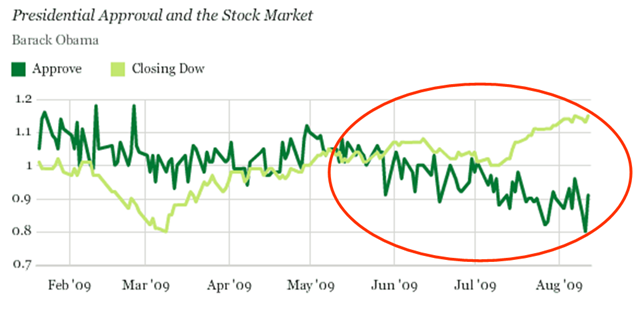
I think the recent stock market run-up is largely attributable to Pres. Obama’s declining approval ratings … and the numbers seem to corroborate the conclusion.

https://kenhoma.wordpress.com/2009/08/05/whats-driving-the-stock-market-higher-heres-an-analysis-you-wont-see-on-cnbc/

A team of of crack Gallup analysts has concluded that Presidential Approval shows no clear relationship to the Dow Jones Industrial Index.

Glancing at Gallup’s own chart, I ask: “Say what ?”

image

http://www.gallup.com/poll/122567/Presidential-Approval-Dow-No-Clear-Relationship.aspx

* * * * *

Health reform without malpractice tort reform … get serious.

September 1, 2009

Excerpted from IBD: Tort Reform Is Key To Health Reform, August 24, 2009

Many lawmakers and analysts still stubbornly insist that medical liability lawsuits do not contribute significantly to rising health care costs.

A 2006 Harvard School of Public Health study found that 40% of medical malpractice lawsuits filed in America each year were “without merit.”

Nonetheless, defending against such lawsuits imposes costs on doctors, hospitals and insurers that invariably are passed on to health care consumers.

Beyond the obvious costs of litigation, more subtle costs related to the practice of “defensive medicine” are contributing to runaway health care inflation.

How much? In a Massachusetts Medical Society survey published last November, 83% of physicians cited the fear of being sued in their decisions to practice defensive medicine.

On average, 18% to 28% of tests, procedures, referrals and consultations and 13% of hospitalizations were ordered to avoid lawsuits. All of this adds at least $200 billion to annual health care costs.

* * * * *

President Obama should reconsider his stated opposition to limiting non-economic damages in medical liability litigation.

The president and Congress should also consider additional liability reforms, such as medical courts, administrative compensation programs, “early offers” and “safe harbors” for physicians who practice in compliance with evidenced-based clinical guidelines.

If comprehensive health care reforms are to succeed, they must include liability reform.

Certainly real victims of negligence must be fairly compensated, but public policy must discourage litigation that abuses our civil justice system and makes health care less accessible and more expensive.

Full article:
http://www.ibdeditorials.com/IBDArticles.aspx?id=336004677519666

* * * * *

Inside that magazine: a video clip … hmmm, interesting idea.

September 1, 2009

Ken’s Take: An interesting play.  Nice use of technology to drag print into the current century.  CBS should get nice buzz. My bet: still too expensive for it to become a common promo device … but, costs keep coming down.

* * * * *

Excerpted from WSJ: Video is invading a new medium: print. Aug 20, 2009

In a marketing stunt to promote its fall TV series, CBS is inserting thousands of tiny screens in copies of Entertainment Weekly.

The screens measure two and a quarter inches diagonally and play about 40 minutes of clips from new and old CBS shows.

The reader/viewer can push a spot on the cardboard insert that holds the screen and watch a clip of the sitcom “Two and a Half Men.” Push another to see a preview of the new crime-investigation spinoff “NCIS: Los Angeles.” Another delivers an ad for PepsiCo Inc., which is helping fund the promotion.

The player is much like the chips that play music in some greeting cards and magazine ads and is rechargeable.

This isn’t the first time magazines and technology have teamed.

In 2005, CBS embedded People magazine with singing sound chips to promote an Elvis Presley miniseries.

Last year, the cover of October’s Esquire magazine splashed blazes of electronic ink … that flashed with messages and an illusion of a car on the road.

Full article:
http://online.wsj.com/article/SB125073451546645129.html?mod=djemMM

* * * * *