Archive for January 7th, 2010

Of the 5 types of Americans … which are you?

January 7, 2010

Dr. Frank Luntz has used dozens of attitudinal, behavioral, and demographic questions to segment Americans into five statistically distinct psychographic categories that explain not just who they are, but also how they are likely to behave and their view of life around them.

* * * * *

Excerpted from: WHAT AMERICANS REALLY WANT by Dr. Frank I. Luntz

* * * * *

According to Dr. Luntz’s surveys, there are five segments of American consumers:

1. Thirty percent of Americans are Relationship People.

The largest segment of the American population, it’s also the youngest.

To them, relationships can mean friends, family, or spouse. Their whole idea of the good life is to be with someone all the time.

They get their satisfaction out of interacting with other people. They don’t care as much about jobs or careers. They are generally satisfied with their life today, but very nervous about tomorrow.

They don’t save; they spend, and they enjoy spending on other people as much, if not more than, on themselves.

2. Twenty-five percent of Americans are Spiritual People.

This is the oldest and most female-oriented of the five segments.

What unites them, in addition to the importance of religion and prayer, are the principles of simplicity and efficiency.

They don’t need or want to spend money to be happy.

They have older cars and TV sets; they don’t have TiVo or satellite radio.

They’re not just late adopters, they’re non-adopters because stuff doesn’t matter to them.

If Relationship People are the loudest group, Spiritual People are the quietest.

They tend to do things in their spare time that don’t require other people, such as reading and listening to music.

They appreciate the outdoors (they are environmentalists) and they have a respect for natural beauty.

3. Eighteen percent of Americans are Health People.

They’re younger than average, more male than female, and they’re the segment most likely to participate than to observe.

You won’t just meet this segment at the gym or on the basketball or tennis court — you’ll find them shopping at Whole Foods and having a snack at Jamba Juice.

They’re similar to the Spiritual segment in their desire to be outdoors, but they’re parallel to the Relationship segment in their desire to be with others.

They are the most physically active of all the groups and put a lesser emphasis on career and financial success.

4. Twelve percent of Americans are Control People.

These people can be very unpleasant to be around.

For them, it’s not about money; it’s about more time and less hassle.

They have everything planned out.

Their intensity is similar to the Health segment, but while the Healthy are engaged in physical activity, Control People are engaged in mental or intellectual activity.

Control People want to be doing something other than what they’re doing; they think today is awful, but tomorrow is going to be great.

This is the flip side, demographically, of the Spiritual segment in that these people are almost exclusively under 50 and more male than female.

They’re the mirror image in another way: Stuff matters. Their stereo is high-end, and their TV screen is huge. In fact, everything is bigger; they want the newest and the best of everything.

They’re willing to spend money, and they work longer hours than the other segments to be able to afford it.

5. Eleven percent of Americans are Financial Security People.

The fastest-growing segment, these people are always unhappy and dissatisfied, and in the current economic mess, they’re downright miserable.

They judge themselves by how other people judge them.

Their reputations mean more to them than they do for any other segment.

They’re the opposite of self-satisfied; they’re almost self-loathing.

They have a ton of material goods, but they buy things to make a status statement rather than to enjoy them.

They tend to be older and wealthier than average, although you’ll find plenty of people in their 30s in this segment.

They own; they don’t rent or lease because they want whatever it is to belong to them — and they’re dissatisfied when they can’t have everything they want when they want it.


* * * * *

From: WHAT AMERICANS REALLY WANT. . . REALLY – The Truth About Our Hopes, Dreams, and Fears
by Dr. Frank I. Luntz
Fed Economist: A Home is a Lousy Investment

January 7, 2010

Punch line: Before the housing bust, Americans tended to think their homes were their best and most important investments –- a view promoted by Washington policy makers who made home ownership a top priority.

Karen Pence, who runs the Federal Reserve’s household and real estate finance research group, argues that homes are actually a terrible investment.

* * * * *

Excerpted from WSJ: Fed Economist: Housing Is a Lousy Investment, January 5, 2010

Putting aside the fact that home prices have fallen dramatically, Pence says several factors make homes a lousy investments:

  1. An indivisible asset.
    If you own stocks and bonds and suddenly need a little cash, you can sell some of your stocks or bonds but not all. With a home, on the other hand, “you can’t just slice off your bathroom and sell it on the market.”
  2. Undiversified.
    You can buy stocks or bonds in industries or countries all over the world. A home is a bet on one single neighborhood.
  3. High transaction costs
    When you buy or sell a home, you pay real estate agent fees, mortgage fees and moving costs.
  4. Asymmetrically liquid
    That means it’s easy to get money out when home prices are going up. (You just take out a bigger mortgage.) But it’s hard to take money out when prices are going down because refinancing becomes more difficult.Put another way, the leverage that you have in your house with a large mortgage means your investment does well in good times but could be lousy in bad times.
  5. Highly correlated to the job market.
    Home prices in a neighborhood tend to rise when the job market is improving in the area and fall when the job market is worsening. This means that your main financial asset provides the smallest cushion to you when you might need it most.

Ms. Pence has been a Washington renter for many years. Ironically, though, she says she’s considering buying a house herself. The reason: Her husband wants a dog and wants to start gardening. That means moving out of the apartment.

Full article:
http://blogs.wsj.com/economics/2010/01/05/fed-economist-housing-is-a-lousy-investment/

Heath care prescription: more doctors, enabled RNs and PAs, way less paperwork

January 7, 2010

Punch line: According to honchos from Johns Hopkins and Emory Med Schools, health insurance doesn’t guarantee health care — we need initiatives to boost the ranks of physicians and make all physicians more productive.

* * * * *

Excerpted from Baltimore Sun Times: Prescription: more doctors, January 1, 2010

That 30 million Americans may soon be able to obtain health care insurance is at the core of the Senate and House health care bills.

But let’s be clear: “insurance” doesn’t guarantee “care.”Indeed, the legislation is giving “bus tickets” – that is, health insurance – to uninsured Americans. But there are no buses running on those routes.

Without important changes in how many doctors we produce and how we pay to train them, millions of newly insured Americans will simply not have access to a physician.

In fact, we don’t have enough doctors for the 256 million Americans who are insured right now.

The U.S. Department of Health and Human Services notes that the United States has a current shortage, at minimum, of 16,000 primary care physicians.

Some facts:

The U.S. medical schools train about 27,000 new doctors a year.

Today, the overall number of physicians in the U.S. is lower than the average per capita number of doctors in other nations such as Sweden, Denmark, Spain and France, and we now “import” some 25% of our physicians from other countries.

According to HHS, overall demand for physician services will increase an estimated 22% between 2005 and 2020, and the United States will face a shortage of more than 125,000 physicians in the next 15 years.

http://online.wsj.com/article/SB10001424052748703483604574630321885059520.html?mod=djemEditorialPage

* * * * *

The solution is to increase the supply of physicians, especially those in primary care and general surgery … and to increase Medicare-funded residency slots for physicians.

Already, the nation’s medical schools have pledged to increase enrollment by 30 percent by 2015.

Training slots for residents have been capped at present levels for more than a decade.

An increase of 15,000 positions would produce an additional 40,000 physicians over the next 10 years, helping the nation manage the projected shortage by 2025 of 125,000 physicians. And unless we significantly expand training positions, the number of physicians per capita will begin to decrease in the next 10 years.Moreover, there are other steps we can take:

Double the number of National Health Service Corps awards.

Under this program, medical school tuition is paid off by physicians agreeing to practice for several years in underserved areas.

This would not only help with the supply issue, but the more persistent problem of how doctors are distributed around the country. There are plenty of physicians in high-income ZIP codes in the United States. The shortage is most acute in rural areas where access is difficult and where the poverty level is high.

Changing doctors’ traditional practice model.

Nurse practitioners and physician assistants should be more fully integrated into clinical practice, handling the simple, uncomplicated cases. This would allow the physician to spend more time managing patients with chronic and complex conditions.

The new best-practice model should include designing a “medical home” for all patients, utilizing – and paying – all health professionals as part of team that coordinates care, enhances efficiency and increases patient satisfaction.

Cutting through the “hassle factor” of medical administrative costs.

An in-depth survey published in the journal Health Affairs in May showed physicians spend an average of three hours a week on the phone or corresponding with insurance claims adjusters.

Nowhere addressed seriously in House and Senate legislation are the paperwork and multiple insurance claim forms that many physicians name – along with other administrative issues – as their No. 1 complaint.The cumulative cost of the time physicians spend interacting with insurers is $23 billion to $31 billion annually – money and time that could be better spent on direct patient care.

* * * * *

As the House and Senate conferees refine legislation promising new benefits to 30 million Americans, we trust that, unlike the bus tickets to nowhere, attention is focused on funding and training a health care workforce that guarantees access to all.

Dr. Michael M.E. Johns is university chancellor and professor in the schools of Medicine and Public Health at Emory University. Dr. Edward D. Miller is dean and CEO of Johns Hopkins Medicine.

Full article:
http://www.baltimoresun.com/news/opinion/oped/bal-op.doctors01jan01,0,7827816.story

Raise your hand if you want to add some sales taxes onto that Internet order …

January 7, 2010

Ken’s Take: You had to know that this one was coming.

While I’m a beneficiary of the Internet sales tax rules … I agree with the guy that the sales should be taxed — whether bought in local stores or over the net.

In fact, I’d be a fan of upping sales taxes  … concurrent with blowing up the income and estate taxes, of course. 

* * * * *

Excerpted from NY Times: Sorry, Shoppers, but Why Can’t Amazon Collect More Tax?, December 26, 2009

Today, Amazon collects sales tax in only five states, which gives it a continuing advantage over companies who do collect them in all or most states. Competitors aren’t the only ones hurt by Amazon’s stance on sales taxes: it also means the loss of considerable revenue to states and localities that badly need it.

In addition to its home in Washington State, Amazon has facilities in North Dakota, Kentucky and Kansas, and collects sales taxes in these states. The company also collects sales tax in New York, but not cheerfully: Amazon has gone to court to overturn a law passed last year that compels it to collect from New York residents.

Yet these five do not exhaust the roll call of states in which Amazon has additional corporate offices, fulfillment and warehouse operations, customer service and other facilities. Fourteen more (among states with sales taxes) are listed in the company’s last annual report: Arizona, California, Delaware, Florida, Indiana, Michigan, Nevada, New Jersey, Pennsylvania, South Carolina, Texas, Virginia, West Virginia and Wisconsin. But Amazon.com does not collect for any state on that list.

Amazon uses “tax entity isolation” to put large portions of its business into tax-havens … by creating wholly owned subsidiaries for the parts that are treated separately for tax matters, so that Amazon is under no obligation to collect sales tax.

For example, Amazon has offices in four cities in California, for example, including those that are home to the subsidiary that developed the Kindle. Because the subsidiary isn’t selling the Kindle directly to consumers, Amazon is under no obligation to collect sales taxes in those locales. 

Amazon is deliberately maximizing “the significant competitive advantage it gains over its rivals when they must add the typical 5 percent to 10 percent tax to their prices, but Amazon does not.”

Amazon argues that it shouldn’t be compelled to collect sales taxes for purchases made by customers other than those who live in Washington.  “In Washington State, where we have a presence, we get police protection, we get fire protection. We send our kids to local schools … since we get no services from North Carolina and many other states, they shouldn’t be able to force us to collect taxes for them.”

And this may be a good time to point out that states and localities are having a bit of a tough time paying bills.

The Center on Budget and Policy Priorities estimates that state budget gaps for this year and next year combined will be more than $350 billion.

Wider collection of the sales tax is not going to plug a hole of that size, but every billion or two would help.

Some 147 million people, or half the nation’s population, live in sales-tax-levying states where Amazon has facilities but does not collect tax on residents’ purchases.

An Amazon spokesman described today’s sales taxes as “very complex,” but said the company would welcome a “simplified system, fairly applied to all business models.”

Full article:
http://www.nytimes.com/2009/12/27/business/27digi.html?adxnnl=1&ref=business&adxnnlx=1261944246-BDKnjFI47UhFShH1ZYYq1w

Nouveau rides may leave drivers up the creek without a paddle

January 7, 2010

Takeaway: Green enthusiasts applaud electric cars as a breakthrough innovation to control emissions.

However, these cars’ limited range along with an absence of charging stations may leave consumers stranded.

The product’s success is unlikely unless automakers find an effective way to fill these voids by identifying and serving a niche market better than do legacy products.

Only highly satisfied customers will tout the product’s benefits to others and thereby help the manufacturers cross the chasm to broad-based product adoption.

* * * * *

Excerpt from Washington Post, “Where can I juice up my ride?”, by Pete Whoriskey, November 17, 2009.

Electric cars entering U.S. showrooms as early as next year will be engineering marvels: stylish, battery-operated, zero-emission wonders.   While most electric cars are expected to be recharged at home, the predicament of a driver who runs out of battery power on the road has yet to be settled. 

A Nissan chief executive said in an interview that he believes that range anxiety will afflict only a portion of the potential market. For plenty of people, trips of 100 miles or less will be fine.

General Motors, meanwhile, has studied range anxiety and seems to have arrived at a different conclusion.  Accordingly, its forthcoming electric car runs on a battery for the first 40 miles, but when the charge runs low, a gasoline engine kicks in. With or without public charging stations, a Volt driver can motor on as long as there is a gas station nearby.

“For a long time, cars have represented a way to move around — freedom,” a GM executive said. “Some people are unwilling to accept restrictions to that.”

Nissan said that by forgoing the gas engine at the expense of a more limited range, Nissan will be better able to make its electric cars cheaply.

Nissan and other companies exploring the market for electric cars say it would be very difficult to win over consumers without the benefit of the $7,500 tax credit for people who purchase electric cars.

Edit by BHC

* * * * *

Full Article
http://www.washingtonpost.com/wp-dyn/content/article/2009/11/16/AR2009111603706.html?wpisrc=newsletter&wpisrc=newsletter&wpisrc=newsletter

* * * * *

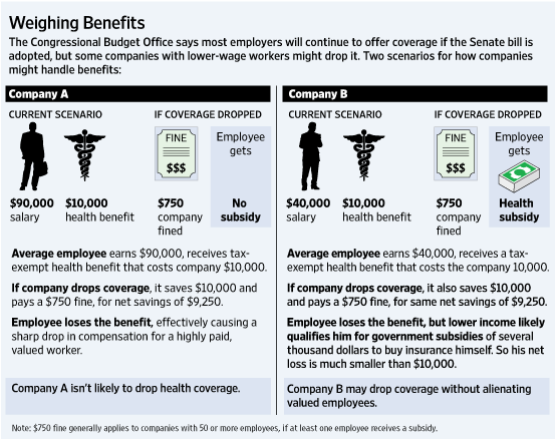
Behavioral Economics: Why companies will drop their health insurance plans …

January 7, 2010

Nice examples that cut to the chase …

click to enlarge

image
From WSJ, Businesses Brace for Health Bill’s Costs, Dec. 23, 2009 
http://online.wsj.com/article/SB126153353820802365.html?mod=WSJ_hpp_LEFTTopStories

How much to pay for an Apple?

January 7, 2010

Teaching point: It’s always easier to lower a product’s price than to raise it.  That’s called the “ratchet effect”.  So, it often makes sense try launch at a high price to ‘skim’ the market.  If the market resists, cut the price until you hit the sweet spot.

A blizzard of speculation is building over Apple’s as-yet-unconfirmed release of a tablet computer.

Among other things, the tablet is expected to offer e-books and TV programs. Apple has been trying to get TV networks to license their programming for a subscription service planned as part of a revamp of iTunes, presumably with the tablet in mind.

Assuming the talk is correct, it is hard to see the device proving immediately attractive to the mass market given a price expected somewhere between $500 and $900.

The iPhone wasn’t a big seller when it first released at $499 and $599. Apple quickly lowered that to $399.

But it was only when Apple renegotiated its deal with AT&T, cutting the price for the cheapest model to $199, that sales really took off.

The iPhone will remain Apple’s growth engine for the company for a while yet.

WSJ: Apple’s Hard-to-Swallow Tablet, Dec. 30, 2009
http://online.wsj.com/article/SB10001424052748703510304574626213985068436.html?mod=djemMM