Archive for March 5th, 2010

Liar, liar … pants on fire !

March 5, 2010

OK, all politicians lie.  That’s not new news. But …

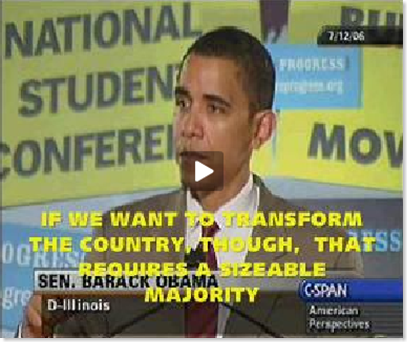
If you haven’t seen these clips, watch them now. 

Two separate clips … definitely “must see TV”.

In his words: “Reconciliation is  a majoritarian abuse of power” and “Democrats Should Not Pass Healthcare With a 50-Plus-1 Strategy.”

Makes Tiger Woods seem like a pillar of trustworthiness …

image 
http://www.breitbart.tv/obama-american-agenda-flashback-dems-should-not-pass-healthcare-with-a-50-plus-1-strategy/

image
http://www.powerlineblog.com/archives/2010/02/025673.php

A colossal waste of time — if we’re lucky.

March 5, 2010

Punch line: ObamaCare’s essential mistake is to choose health-care expansion over health-care reform.

Another insightful column from Peggy Noonan.

* * * * *

Excerpted from WSJ: What a Disaster Looks Like , Mar 5, 2010

ObamaCare will have been a colossal waste of time—if we’re lucky.

It is now exactly a year since President Obama unveiled his health care push and his decision to devote his inaugural year to it—his branding year, his first, vivid year.

What a disaster it has been.

At best it was a waste of history’s time, a struggle that will not in the end yield something big and helpful but will in fact make future progress more difficult. At worst it may prove to have fatally undermined a new presidency at a time when America desperately needs a successful one.

In terms of policy, his essential mistake was to choose health-care expansion over health-care reform. This at the exact moment voters were growing more anxious about the cost and reach of government.

The practical mistake was handing the bill’s creation over to a Democratic Congress that was becoming a runaway train. This at the exact moment Americans were coming to be concerned that Washington was broken, incapable of progress, frozen in partisanship.

New presidents should never, ever, court any problem that isn’t already banging at the door. They should never summon trouble.

Mr. Obama did, boldly, perhaps even madly. And this is perhaps the oddest thing about No Drama Obama: In his first year as president he created unneeded political drama, and wound up seen by many Americans not as the hero but the villain.

And now here are two growing problems for Mr. Obama.

The first hasn’t become apparent yet, but I suspect will be presenting itself, and soon. In order to sharpen the air of crisis he seems to think he needed to get his health-care legislation passed, in order to continue the air of crisis that might justify expanding government and sustaining its costs, and in order, always, to remind voters of George W. Bush, Mr. Obama has harped on what a horror the economy is. How great our challenges, how wicked our businessmen, how dim our future.

The president can’t be a hope purveyor while he’s a doom merchant, and he appears to believe he has to be a doom merchant to justify ramming through his legislation. This particular legislation is not worth that particular price.

All this contributes to a second problem, which is a growing credibility gap. In his speech Wednesday, demanding an “up or down” vote, the president seemed convinced and committed — but nothing he said sounded true. His bill will “bring down the cost of health care for millions,” it is “fully paid for,” it will lower the long term deficit by a trillion dollars.

Does anyone believe this?

Does anyone who knows the ways of government, the compulsions of Congress, and how history has played out in the past, believe this? Even a little?

It would be a relief to have a president who could weigh in believably and make clear what his own bill says. But he seems to devote more words to obscuring than clarifying.

The only thing that might make his assertions sound believable now is if a group of congressional Republicans were standing next to him on the podium and putting forward a bill right along with him. 

GOP support won’t happen, for three reasons. First, they enjoy Obama’s discomfort. Second, they believe the bill is not worth saving, that at this point no matter what it contains —a nd at this point most people can no longer retain in their heads what it contains — it has been fatally tainted by the past year of mistakes and inadequacies.

And the third reason is that the past decade has taught them what a disaster looks like, and they’ve lost their taste for standing next to one.

Full article:
http://online.wsj.com/article/SB10001424052748704187204575101742162779612.html?mod=djemEditorialPage_h

The fundamental economic problem of our age … and the impotency of policy makers.

March 5, 2010

Punch line: Commentary from Bill Gross — one of the premier bond traders in the world:  

“The impotency of policymakers … has consequences for credit and asset markets worldwide.”

* * * * *

Excerpted from PIMCO investment outlook, March 2010

Let’s get reacquainted with the fundamental economic problem of our age – lack of global aggregate demand – and how we got to where we are today:

(1) Twenty years of accelerated globalization incrementally undermined the real incomes of most developed countries’ workers/citizens …

forcing governments to promote leverage and asset price appreciation in order to fill in what is known as an “aggregate demand” gap – making sure that consumers keep buying things.

When the private sector assumed too much debt and asset prices bubbled (think subprimes and houses, or dotcoms/NASDAQ 5000), American-style capitalism with its leverage, deregulation, and religious belief in lower and lower taxes reached a dead end.

There was a willingness to keep on consuming, there just wasn’t the wallet. Vigilantes – bond market or otherwise – took away the credit card like parents do with a mall-crazed teenager.

(2) The cancellation of credit cards led to the Great Recession and private sector deleveraging, the beginning of government policy reregulation, and gradual deglobalization – a reversal of over 20 years of trade policies and free market orthodoxy.

In order to get us out of the sinkhole and avoid another Great Depression, the visible fist of government stepped in to replace the invisible hand of Adam Smith.

Short-term interest rates headed to 0% and monetary policies of central banks incorporated new measures labeled “quantitative easing,” which essentially involved the writing of trillions of dollars of checks to replace the trillions of dollars of credit that disappeared after Lehman Brothers.

In addition, government fiscal policies, in combination with declining revenues, led to double-digit deficits as a percentage of GDP in many countries, a condition unheard of since the Great Depression.

(3) Financial crises led to sovereign defaults or at least uncomfortable economic growth environments where real GDP was subpar based on onerous debt levels – sovereign and private market alike.

Dubai, Iceland, Ireland and recently Greece pointed to a potential flaw in the model.

Now, markets are raising interest rates on sovereign debt issuance either in anticipation of higher future inflation, increased levels of credit risk, or both. This places a potential “cap” on the “debt” that supposedly can be created to get out of the “debt crisis.”

* * * * *

An investor’s motto should be, “Don’t trust any government and verify before you invest.”

The potential impotency of policymakers to close the gap are evolving into a life or death outcome for the weakest sovereigns, with consequences for credit and asset markets worldwide.
 
Full article:
http://www.pimco.com/LeftNav/Featured+Market+Commentary/IO/2010/Investment+Outlook+March+2010+Bill+Gross+Dont+Care.htm

The "empathy decay rate" … and cocktail party acceleration.

March 5, 2010

Bill Gross is the one of the world’s premier bon traders.

His view on bonds – I don’t care.

His views on cocktail parties — now, you’re talking.

* * * * *
Excerpted from PIMCO.com: I Don’t Care, March 2010

Cocktail parties wouldn’t be so bad if there was something original to be said, or if “you” had a genuine interest in “me” as opposed to “you,” but let’s face it folks, no one does.

The only reason any of us really cares about cocktail conversations is to quickly redirect someone else’s stories into autobiographies that we assume to be instant bestsellers if only in print.

You can bet that unless there’s a requested personal favor coming, 90 seconds into a typical conversation, no one gives a damn about you and your problems.

image

During that unbearable minute-and-a-half, however, you’re likely to have covered some of the following topics:

  • Where are you from? (If it’s not a place where I’ve been or have a distant second cousin – don’t care.)
  • How’s the family? (If Johnnie is in advanced placement courses and my kids aren’t – don’t care. Don’t care about your kids’ soccer games either or that upcoming wedding.)
  • Medical problems? (Unless you’re dying from cancer – people don’t really care. Your artificial hip and kidney stone stories are important only to let them tell you about their’s.)
  • How’s work? (Forgot where you work, but it’s a good lead in. Don’t really care though unless you can direct some business my way.)
  • Can you believe Tiger? (Now there’s something I care about, but the wife is only five feet away.)

Thank god for the, the “afterparty” — driving home with your partner and dissing all of the guests.

Full article:
http://www.pimco.com/LeftNav/Featured+Market+Commentary/IO/2010/Investment+Outlook+March+2010+Bill+Gross+Dont+Care.htm