Archive for March 9th, 2010

Heads up: The capital gains hurt on the horizon … and the giant sucking sound from the stock market.

March 9, 2010

The unions cut a special behind-closed-doors deal with the President to delay the tax on Cadillac heath insurance plans until 2018.  Though Obama proposes eliminating the Cornhusker kickback, he plans to keep his word to the SEIU on this break.

To compensate for the lost tax revenue, Obama proposes extending Medicare “payroll taxes” to unearned income — i.e. interest, dividends and capital gains. 

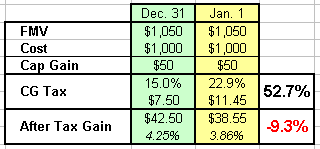
That’s a 2.9% increase in capital gains taxes.

Keeping in mind that the Bush tax rates expire on Dec 31, the capital gains tax rate will go from 15% to 22.9% — a 52.7% increase !

As the simple example below shows, after-tax gains get crushed — overnight — when the new rates take effect.

Note: Potentially making matters worse, I expect the Medicare tax on unearned income to become effective on the date Obama signs the bill … or worse, I wouldn’t be surprised if Team Obama made the tax hike retroactive to Jan. 1, 2010. The sucking sound you’ll hear is the stock market losing steam …

image

Paul Krugman: "Don’t believe what’s in my textbook" … huh ?

March 9, 2010

OK Krugman didn’t actually say those words, but he did deliver the message.

Great ‘catch’ by WSJ writer James Taranto who hoists economist Paul Krugman  by his own pitards …

* * * * *

Excerpted from WSJ: Mirror, Mirror, By JAMES TARANTO, March 5, 2010

Former Enron adviser Paul Krugman takes note in his New York Times column of what the calls “the incredible gap that has opened up between the parties”:

Today, Democrats and Republicans live in different universes, both intellectually and morally.
“What Democrats believe,” he says “is what textbook economics says”

But that’s not how Republicans see it.

GOPers say unemployment relief “doesn’t create new jobs. In fact, if anything, continuing to pay people unemployment compensation is a disincentive for them to seek new work.”

Krugman scoffs: “To me, that’s a bizarre point of view — but then, I don’t live in their universe.”

What does textbook economics have to say about this question? Here is a passage from a textbook called “Macroeconomics”:

Public policy designed to help workers who lose their jobs can lead to structural unemployment as an unintended side effect. . . . In other countries, particularly in Europe, benefits are more generous and last longer. The drawback to this generosity is that it reduces a worker’s incentive to quickly find a new job. Generous unemployment benefits in some European countries are widely believed to be one of the main causes of “Eurosclerosis,” the persistent high unemployment that affects a number of European countries.

So it turns out that what Krugman calls Republicans “bizarre point of view” is, in fact, textbook economics.

By the way, the authors of that textbook are Paul Krugman and Robin Wells. Miss Wells is also known as Mrs. Paul Krugman.

It seems Krugman himself lives in two different universes — the universe of the academic economist and the universe of the bitter partisan columnist.

OK, so he was off by $1 trillion (twice) … don’t get bogged down in the (flakey) numbers..

March 9, 2010

Liberal pundits tout President Obama’s intellect and grasp of “the details”. 

May be true, but a couple of recent trillion dollar “gaps” gotta make objective observers scratch their heads.

Either he doesn’t know, he’s sloppy, or he’s fibbing.  Pick one.

* * * * *

First, the CBO says that the national debt will rise by at least $1.2 trillion more than Obama’s White House projects.  Oops.

Excerpted from 247WallSt.com: Mr. Obama’s Missing $1 Trillion,  March 8, 2010 at 5:22 am

The Congressional Budget Office said the national debt will be rise by $9.8 trillion by 2020. The figure is $1.2 trillion higher than White House estimates.

The CBO estimates are lower than the President’s on both the receipt and expense sides of the ledger.

The differences between the White House estimates and those of the CBO are profound when the ten years are added up.

US debt held by the public is 67% of GDP under the President’s forecast, but 90% when the CBO estimates are used as the basis of calculations.

The President’s projections are obviously optimistic. If he is wrong, the price will be high enough that America may not be able to meet its debt obligations with any ease by the end of the decade. That could mean default on US sovereign debt, or austerity  greater than the American public has seen in decades.

http://247wallst.com/2010/03/08/mr-obamas-missing-1-trillion/

* * * * *

Then yesterday, the President pitched his health care plan to nodding supporters as “reducing most people’s premiums and bringing down our deficit by up to $1 trillion dollars over the next decade”.  Oops, again.  Off by about $1 trillion … 

Excerpted from White House Blog: Obama Overstates Health Care Savings by $868 Billion, March 8, 2010

In what the White House calls the final push for health care reform, President Obama said: “Our cost-cutting measures mirror most of the proposals in the current Senate bill, which reduces most people’s premiums and brings down our deficit by up to $1 trillion dollars over the next decade because we’re spending our health care dollars more wisely,”

The President was so proud of these cost-saving numbers in the latest version of health care reform, he delved into a bit of Washington-speak to back them up.

“Those aren’t my numbers,” President Obama said to the rising applause of the estimated 1,300 in attendance. “They are the savings determined by the Congressional Budget Office, which is the nonpartisan, independent referee of Congress for what things cost.”

That part is true. The budget office does keep score of what things cost. More precisely, the budget office projects what things cost or save over a given period of time.

But the budget office did not say the Senate health care bill would save $1 trillion over the next decade. Not even close.

It estimated the bill’s tax hikes and MediCare cuts would exceed new spending by $132 billion from 2010 to 2019, leaving President Obama’s “next decade” estimate $868 billion short. [Or, more than $1 trillion if you add back the so-called MediCare “doctor’s fix”.]

That’s some rounding error.

When contacted, a White House official said the President  meant to say the Senate bill would save $1 trillion in its second decade.

But, the CBO has said “Projections for years beyond 2019…would not be meaningful because the uncertainties involved are simply too great.”

http://whitehouse.blogs.foxnews.com/2010/03/08/obama-overstates-health-care-savings-by-868-billion/

Healthcare: Pay for quality, not quantity … now, how exactly is that going to work?

March 9, 2010

On the Sunday talk shows, e of Team Obama’s mantras is that under government-run healthcare, payments to doctors will be made based on quality (outcomes) rather than the quantity of procedures being done.

Nice philosophically, but how to make it happen ?

Couple of observations:

  • Quality over quantity should be easier in education than healthcare since students can be tested for progress.  But, virtually all merit pay programs for teachers (i.e. outcome-based) have been rejected out of hand or fail.  But, they’ll work in healthcare … hmmm.
  • A common method for controlling output quality is to control input quality.  In healthcare, that means rejecting the toughest cases and treating only the sure winners.  For example, when I first investigated corrective eye surgery, the docs rejected me.  My eyes were too bad, and they wanted to tout the percentage of patients that they got to 20/20.
  • It’s argued that a key to controlling quality is to make primary care physicians the coordinators of all medical services. That’s silly because:

    (1) there is a shortage of primary care docs (evidence: how quickly can you get an appointment when you’re sick? how about an appointment outside the 9 to 5 work day window?);

    (2) been there, tried that – in the past, most plans required that a patient see a primary care doc to get a referral to a specialist – the referral was almost always given – net impact: a step was added to the process

  • The Mayo Clinic  — always cited as the model of outcome based systems — has stopped accepting Medicare in its Arizona facilities.  Hmmm. Guess it didn’t drive costs down low enough …

I guess it’s better to bum’s rush through legislation than to give it serious thought.  Disappointing.