Archive for April 5th, 2010

TAXES: ’tis the season, so …

April 5, 2010

I figure that attentiveness to income tax issues is probably at a high point as we close in on April 15, so I have loaded several tax-relevant posts for the next several days. 

Among the topics:

  • Did the marriage penalty really get eliminated?  Answer: no.
  • Where the Bush tax cuts really just for the wealthy?  Answer: no.
  • So what if Obama let’s the Bush tax cuts expire? Answer: uh-oh
  • What about the 3.8% non-payroll payroll tax on dividends and capital gains? Answer: uh-oh (again)
  • What about the marriage penalty? Answer: it gets a dose of steroids
  • So, what’s like to happen … really? Answer: gonna get interesting

Stay tuned over the next week or so …

Bending the cost curve or just making tax payers bend over ?

April 5, 2010

Punch line: ObamaCare intends to squeeze an extra $1.2 trillion over 10 years from a minority of citizens — the taxpayers.

The key assumption — that tax payers won’t change behavior to contain tax impacts — has been proven to be fallacious in the past, and isn’t likely in the future …

Excerpted from WSJ: The Rich Can’t Pay for ObamaCare, March 30, 2010

President Barack Obama’s new health-care legislation aims to raise $210 billion over 10 years to pay for the extensive new entitlements … by slapping a 3.8% “Medicare tax” on interest and rental income, dividends and capital gains of couples earning more than $250,000, or singles with more than $200,000.

The president also hopes to raise $364 billion over 10 years from the same taxpayers by raising the top two tax rates to 36%-39.6% from 33%-35%, plus another $105 billion by raising the tax on dividends and capital gains to 20% from 15%, and another $500 billion by capping and phasing out exemptions and deductions.

Add it up and the government is counting on squeezing an extra $1.2 trillion over 10 years from a tiny sliver of taxpayers who already pay more than half of all individual taxes.

It won’t work. It never works.

Punitive tax rates on high-income individuals do not increase revenue. Successful people are not docile sheep just waiting to be shorn.

From past experience, these are just a few of the ways that taxpayers will react to the Obama administration’s tax plans:

  • Professionals and companies who currently file under the individual income tax as partnerships, LLCs or Subchapter S corporations would form C-corporations to shelter income, because the corporate tax rate would then be lower with fewer arbitrary limits on deductions for costs of earning income.
  • Investors who jumped into dividend-paying stocks after 2003 when the tax rate fell to 15% would dump dividend paying stocks in favor of tax-free municipal bonds if the dividend tax went up to 23.8% as planned.
  • Faced with a 23.8% capital gains tax, high-income investors would defer realizing gains in taxable accounts until there are offsetting losses.
  • Faced with a rapid phase-out of deductions and exemptions for reported income above $250,000, any two-earner family in a high-tax state could keep their income below that pain threshold by increasing 401(k) contributions, switching investments into tax-free bond funds, and avoiding the realization of capital gains.
  • Faced with numerous tax penalties on added income in general, many two-earner can become one-earner couples, early retirement would become far more popular, executives would substitute perks for taxable paychecks, physicians would play more golf, etc.

In short, the evidence is clear that when marginal tax rates go up, the amount of reported incomes goes down.

Economists call that “the elasticity of taxable income” (ETI), and measure it by examining income tax returns before and after marginal tax rates claimed a bigger slice of income reported to the IRS.

The federal government has embarked on an unprecedented spending spree, granting new entitlements in the guise of refundable tax credits while drawing false comfort from phantom revenue projections that will never materialize.

Full article:
http://online.wsj.com/article/SB10001424052702304370304575151682845921038.html#printMode

CBS News: Majority of Americans “increasing skeptical” and disapprove of ObamaCare …

April 5, 2010

Punchline: More Americans now disapprove of the legislation, and many expect their costs to rise and the quality of their care to worsen; few expect the reforms to help them.

* * * * *

Excerpted from CBS News: Most Americans Remain Against Health Care Overhaul, April 2, 2010

President Obama has continued to tour the country to stump for his new set of reforms  … but, so far, the president’s efforts to build up support for the bill appear to be ineffective.

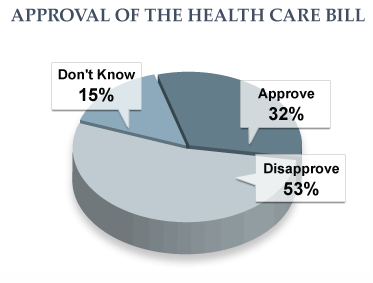
Fifty-three percent of Americans say they disapprove of the new reforms, including 39 percent who say they disapprove strongly. In the days before the bill passed the House, 37 percent said they approved and 48 percent disapproved.

image

Less than 20% of Americans thinks the new health care reforms will help them personally … 36% think the new reforms will hurt them

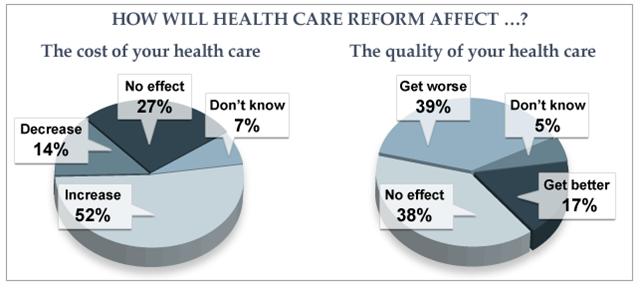
Just over half think the new health care reforms will increase their health care costs, and 39 percent think the quality of their health care will get worse.

image

Only 34 percent of Americans approved of the president’s handling of health care — an all-time low.

Mr. Obama’s overall approval rating also hit an all-time low in this poll at 44 percent, as Americans continue to worry about the economy.

Full article:
http://www.cbsnews.com/8301-503544_162-20001700-503544.html?tag=contentMain;contentBody

Film execs attempt to strike gold on the silver screen

April 5, 2010

Takeaway: 3-D films have drawn customers back into theaters and now film executives are looking to cash in on their captivity.

After deploying the greatest ticket price increases in recent memory, will these executives bring home the gold, or crumble to the critics?
 
* * * * *
Excerpt from Wall Street Journal, “Higher Prices Make Box-Office Debut” by Lauren A.E. Schuker and Ethan Smith, March 24, 2010

Major U.S. movie-theater chains, seeking to capitalize on the surge in revenues fueled by such 3-D hits as “Avatar” and “Alice in Wonderland,” are imposing some of the steepest increases in ticket prices in at least a decade.
The increases, in one case as much as 26%, vary from theater to theater, but many cinemas are raising prices most—or even solely—for 3-D showings, which accounted for the vast majority of last year’s 10% jump in domestic box-office sales. 3-D movies accounted for 11% of domestic ticket sales in 2009, up from just 2% in 2008.

At an AMC theater in a Boston suburb, 3-D ticket prices are jumping more than 20% to $17.50 from $14.50, while the adult admission price for a conventional film will remain at $10.50. A 3-D Imax movie at New York City’s AMC Loews Kips Bay will cost $19.50, up from $16.50.
 
Their moves come on the heels of a record-setting year at the domestic box office, with revenue surpassing $10 billion for the first time. Movie attendance in the U.S. and Canada grew 5.5% in 2009, to 1.42 billion, the highest level since 2004. Ticket sales so far this year are up nearly 10% from a year earlier.

Movie theaters typically had charged $2 to $3 extra for 3-D tickets. But the brisk demand for those premium-priced tickets led many exhibitors to believe that they were underpriced.

About 83% of the record $2.6 billion in ticket sales for “Avatar” came from 3-D and Imax screens. And Walt Disney Co.’s “Alice in Wonderland” also set records when it hit 3-D screens earlier this month.

While the price increases could boost theater owners’ already buoyant revenues, some industry watchers think the could also spark a consumer backlash. Studios, theater operators and trade groups have long touted films as a bargain, compared with other forms of entertainment, intensifying their pitch during the recession.

“The U.S. economy isn’t in the greatest shape, and there is definitely risk here in pushing price too far in a weak economy,” said a media analyst.

Some movie-studio executives expressed concern that the price increases might be too much too soon. “The risk we run is that we will no longer be the value proposition that we as an industry have prided ourselves on,” said a distribution executive at one major studio, who added that he was worried movies would become “a luxury item.”

Warner Bros. executive said: “Sure, it’s a risky move, but so far charging a $3 or $4 premium has had no effect on consumers whatsoever, so I’m in favor of this experiment to raise prices even more. There may be additional revenue to earn here.”

Studios are also in a bind. While many are wary of appearing to gouge consumers beset by a weak economy, they are also facing higher costs as they produce more movies in the technology-heavy 3-D format. Though ticket prices are set by theater operators, the proceeds are split roughly 50-50 with movie studios.

Five major 3-D films are opening in theaters over the next three months, starting this weekend with DreamWorks Animation’s “How to Train Your Dragon.” That rich selection is one reason theater owners chose to raise 3-D ticket prices now. It may also help set consumers’ expectations for future 3-D films.
 
“This is a truly unique event for the movie industry,” said one industry analyst. “I can’t remember the last time I saw such a major change in ticket pricing.”
  
Edit by BHC
 

* * * * *
Full Article:
http://online.wsj.com/article/SB10001424052748703312504575142143922186532.html
* * * * *