Archive for April 6th, 2010

TAXES: Read this if you’re married … or if you’re thinking about getting married (or unmarried)

April 6, 2010

The Bush tax cuts completely did away with the income tax marriage penalty, right ?

Au contraire, mon ami. 

That’s just an urban legend repeated so many times that many have been led to believe it. 

Me included.

* * * * *

Let’s go through the numbers with an example:

Assume a couple — boyfriend and girlfriend (or any other combination of two people) — each earn $100,000 in taxable income.

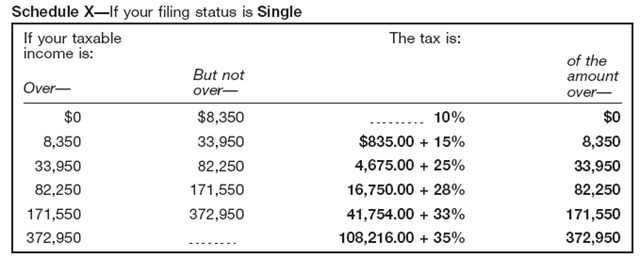
According to the 2009 schedule X tax table (individuals), they’d each pay $21,720 if they file separately. 
(The tax table is at the end of this post if you want to check my arithmetic)

So, the unmarried couple pays a total of $43,440 in income taxes (2 X $21,720) — that’s an effective tax rate of 21.7%.

* * * * *

What if they were married and filed a joint return?

Well, the good news is that the standard deduction ($11,400) is twice an individual’s standard deduction — it wasn’t until Bush fixed it.  And, their personal exemption amount ($7,300) is double an individual’s (because they’re below the phase out income level).

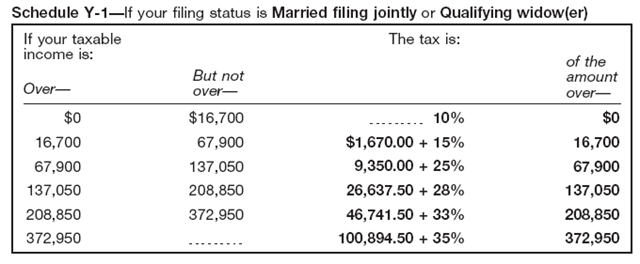
So, we can just pull their number from the $200,000 taxable income line of the 2009 schedule Y tax table (married filing jointly).

The answer: their tax liability is $44,277.50 — about 2% higher than if they were unmarried and filing individually.

Technical note: Married filing separately doesn’t make the problem go away.  You’re either married or your not.

If you think a 2% difference is just rounding error, let’s move up the tax schedule.

Assume that he & she (or whatever) each earn $200,000 taxable income.    Their combined income tax liability would be $102,285 if they were unmarried and filing individually, and $110,362 if they were married and filing jointly — a spread of almost 8%.

For sure, that’s some serious money …

Technical note: The penalty is relative small at incomes below $50,000 (per person) … and relatively small at very, very high incomes that are taxed mostly at the highest bracket rates.

Bottom line: The marriage penalty may have been reduced, but it’s still there … and in a later post, I show how it swells when Obama lets parts of the Bush tax cuts expire.

* * * * * * * * * * * * * * * * * * * * * * * * *

2009 Tax Rate Schedules
image

image

http://www.unclefed.com/IRS-Forms/taxtables/index.html

* * * * *

Next up: Those (expletive deleted) Bush tax cuts …

Wash Post: The answer was a doozy … “Holy filibuster, Batman”

April 6, 2010

Punchline: I once worked with a guy who sorted managers into two categories: simplifiers and complicators … his view: the former always win.

If ObamaCare is so good and the President is so smart, articulate, and practiced on the subject … why can’t he explain it?

Here’s the Wash Post recap; below are links to the text & video of the President’s answer … and a great summation by Charles Krathammer.

From the Washington Post, “Obama’s 17-minute, 2,500-word response to woman’s claim of being over-taxed”, April 2, 2010

Even by President Obama’s loquacious standards, an answer he gave here in Charlotte on health care was a doozy.

Toward the end of a question-and-answer session with workers at an advanced battery technology manufacturer, a woman asked the president whether it was a “wise decision to add more taxes to us with the health care package”.

“We are over-taxed as it is”. 

Obama started out feisty.

“Well, let’s talk about that, because this is an area where there’s been just a whole lot of misinformation, and I’m going to have to work hard over the next several months to clean up a lot of the misapprehensions that people have.”

He then spent the next 17 minutes and 12 seconds lulling the crowd into a daze.

His discursive answer – more than 2,500 words long — wandered from topic to topic, including commentary on the deficit, pay-as-you-go rules passed by Congress, Congressional Budget Office reports on Medicare waste, COBRA coverage, the Recovery Act and Federal Medical Assistance Percentages (he referred to this last item by its inside-the-Beltway name, “F-Map”). He talked about the notion of eliminating foreign aid (not worth it, he said). He invoked Warren Buffett, earmarks and the payroll tax that funds Medicare (referring to it, in fluent Washington lingo, as “FICA”).

Always fond of lists, Obama ticked off his approach to health care — twice. “Number one is that we are the only — we have been, up until last week, the only advanced country that allows 50 million of its citizens to not have any health insurance,” he said.

A few minutes later he got to the next point, which seemed awfully similar to the first. “Number two, you don’t know who might end up being in that situation,” he said, then carried on explaining further still.

“Point number three is that the way insurance companies have been operating, even if you’ve got health insurance you don’t always know what you got, because what has been increasingly the practice is that if you’re not lucky enough to work for a big company that is a big pool, that essentially is almost a self-insurer, then what’s happening is, is you’re going out on the marketplace, you may be buying insurance, you think you’re covered, but then when you get sick they decide to drop the insurance right when you need it,” Obama continued, winding on with the answer.

Halfway through, an audience member on the riser yawned.

But Obama wasn’t finished. He had a “final point,” before starting again with another list — of three points.

“What we said is, number one, we’ll have the basic principle that everybody gets coverage,” he said, before launching into the next two points, for a grand total of seven.

His wandering approach might not matter if Obama weren’t being billed as the chief salesman of the health-care overhaul. Public opinion on the bill remains divided, and Democratic officials are planning to send Obama into the country to persuade wary citizens that it will work for them in the long run.

It was not evident that he changed any minds at the event.

The audience sat politely, but people in the back of the room began to wander off.

Even Obama seemed to recognize that he had gone on too long. He apologized — in keeping with the spirit of the moment, not once, but twice. “Boy, that was a long answer. I’m sorry,” he said, drawing nervous laughter that sounded somewhat like relief as he wrapped up.

But, he said: “I hope I answered your question.”

Source article:
http://voices.washingtonpost.com/44/2010/04/obamas-17-minute-2500-word-res.html

Video of Obama’s answer:
http://www.youtube.com/watch?v=0Jz6y_16NI8

Text of Obama’s answer:
http://whitehouse.blogs.foxnews.com/2010/04/02/obamas-17-minute-14-second-answer-on-higher-taxes-and-health-care/ 

=> Krauthammer’s rephrasing of the answer:
http://www.wikio.co.uk/video/krauthammer-20-seconds-correct-answer-obama-rant-3041426

Ball Park Franks turned Oscar Meyer into just another dog

April 6, 2010

Key Takeaway: Sometimes taking advantage of a deep consumer insight is all a brand needs to do in order to be the top dog in a category.

Ball Park Franks, which focused for years on linking their product to the outdoor grilling experience, realized that mom is the one who does the vast majority of hot dog purchasing in the family.

By concentrating their marketing efforts on mom’s ability to satisfy their family’s cravings for flavorful, high-quality food, Ball Park was able to appeal to both the purchaser and end-user of its product.

There is no doubt that Ball Park’s profits plumped when they cooked up this strategy.

* * * * *

Excerpted from Brandweek, “How Sara Lee’s Ball Park Brand Became the Top Dog” by Elaine Wong, March 28, 2010

For years, Ball Park was the No. 2 player in hot dogs. That is, until parent company Sara Lee—maker of Hillshire Farm meats and Jimmy Dean breakfast sandwiches—turned to insights, backed by innovation, to take share from and ultimately usurp the lead spot from Kraft competitor Oscar Mayer…The brand’s ascension was informed by research which showed that moms were the primary buyers of the product, but that teenage boys, too, enjoyed eating it.

Brandweek: At a recent industry conference, you spoke about how Sara Lee is using insights to drive innovation. Give us an example of how that worked for a major brand.

Philippe Schaillee:

For many years, we communicated Ball Park through traditional TV and print, primarily to a male audience. We had this character called Frank, and we’d talk about the grilling occasion and that great experience you’d get from [cooking with] Ball Park hot dogs.

Looking back, I’d say that was [both] intuition and research-based, but it wasn’t really insights- based.

As we dove much deeper into an understanding of the consumer and shopper, we learned a few things.

One was that the brand was overindexing with males. They are looking for the heartiness and real quality of a Ball Park hot dog. But [the brand] was also overindexing more with teenage boys than with adult males.

Once we learned that, we started to look into the shopper of this [brand] and learned that she was really looking for a hearty solution for her teenage son and husband.

She [wanted something that wasn’t] just a lower quality snack or that would get them into this mindless eating behavior, but something that was solid, yet still fast and convenient. That [discovery] was a breakthrough.

BW: And then what?

PS: We decided we had an opportunity to build this platform around “guy foods.”

However, the person we had to reach out to and that we had to convince from a purchasing behavior perspective was mom.

So, from an activation perspective, we shifted our spending radically from what, before, was 80 percent against a male target, to 70 percent [to reach] this female shopper, and the other 30 percent was spent against [targeting] teenage boys.

Our communication to teenage boys, [meanwhile,] was a radical departure from the past.

Teenage boys watch TV, but they are absolutely not loyal. That is not where we should be spending our money, [nor do they] really read any magazines or newspapers. Where we have to be to reach that target is in the individual gaming and online action sports [arena]…

We teamed up with a couple of sports spokespersons to build credibility and really ensure that the Ball Park brand would be [engaged in and participating in] the action sport, versus just advertising at [the event].

As for business results, after having eternally been the No. 2 brand in the hot dog category, we overtook Oscar Mayer about two years ago, and we’ve been growing our share advantage every year.

When looking at equity parameters like awareness and household penetration, our loyalty metrics are inching up, and we’ve seen that with teenage boys, especially. We’ve moved from being not on their radar screen to more on their radar screen.

Edit by JMZ

* * * * *

Full Article:
http://www.brandweek.com/bw/content_display/news-and-features/direct/e3ie9fc421daf51cf828daadc047e8488cc?pn=1