Archive for April 9th, 2010

TAXES: Funding ObamaCare with a 3.8% non-payroll payroll tax … here’s the impact on your wallet

April 9, 2010

In a prior post, we walked through the impact if Obama selectively lets the parts of the Bush tax cuts expire in 2011 — those parts that effect individuals earning more than $200,000 and couples earning more than $250,000.

In a nutshell, here’s what we concluded …

  • The tax rate on capital gains will go up 5% … and the tax rate on dividends will go up at least 5% (to the capital gains tax rate) and maybe all the way up to ordinary income tax rates.
  • For ordinary income, the effective (not marginal) tax rate increase on ordinary income will be about 1/2% for each $100,000 of taxable income (i.e. ordinary income plus dividends and capital gains) over $200,000.

For example, assume a couple has $200,000 in taxable ordinary income and $100,000 in dividends and capital gains, giving them total taxable income of $300,000.   Their tax hit will be about $6,000 — $5,000 from the increase in dividend and capital gains tax rates (5% X $100,000) and $1,000 from the increase in the effective rate on ordinary income ($300,000 minus $200,000 = $100,000 => 1/2% rate increase times $200,000 = $1,000).  In rough numbers, their income taxes would go from $67,000 to $73,000 — an increase of almost 9% — and their effective tax rate would go from 21% to over 24%.

But, that’s only part of the story.

Remember that the original Senate bill funded roughly 1/2 of ObamaCare from MediCare cuts and roughly 1/2 from an excise tax on employer provided Cadillac health insurance plans — a plan originally teed up by Obama.  When the unions marched on the White House and reminded the President who got him elected, Obama recalibrated upward the threshold defining a Cadillac plan, delayed the implementation of that tax until 2018, and replaced the lost tax revenue with a supplemental 3.8% payroll tax on AGI (Adjusted Gross Income — which includes ordinary income plus dividends and capital gains) over $200,000 — starting in 2013

Technical note:  The base Medicare tax rate is currently applied as a payroll tax on so-called earned income.  Employees pay 1.45% and employers are required to match the 1.45% — for a total of 2.9%.  Under ObamaCare, for “unearned income” — mostly dividends and capital gains — there is no employer per se, so the taxpayer is charged the full 2.9% base … plus, a supplemental .9% was added on for good measure — raising the total to 3.8%

So, comparing 2013 to the current tax rates

  • The tax rate on capital gains will go up 5% … and the tax rate on dividends will go up at least 5% (to the capital gains tax rate) and maybe all the way up to ordinary income tax rates.
  • For ordinary income, the effective (not marginal) tax rate increase on ordinary income will be about 1/2% for each $100,000 of taxable income (i.e. ordinary income plus dividends and capital gains) over $200,000.
  • There is a 3.8% “payroll tax” on all AGI over $200,000 — that includes ordinary income plus dividends and capital gains.

Let’s rework our example …

Again, assume a couple has $200,000 in taxable ordinary income and $100,000 in dividends and capital gains, giving them total taxable income of $300,000.

Their tax hit (versus 2009) will be about $9,800 …

  • $5,000 from the increase in dividend and capital gains tax rates (5% X $100,000)
  • $1,000 from the increase in the effective rate on ordinary income ($300,000 minus $200,000 = $100,000 => 1/2% rate increase times $200,000 = $1,000).
  • $3,800 in additional “payroll taxes” ($300,000 minus $200,000 = $100,000 times 3.8% = $3,800

In rough numbers, their income taxes would go from $67,000 to $76,800 — an increase of almost 15% — and their effective tax rate would go from 21% to over 25.5%.

Keep in mind, that this is just Federal income taxes.  Add on another 5% to 10% for state and local income taxes … then draw your own conclusions re: fairness and effect on the economy. …

* * * * *

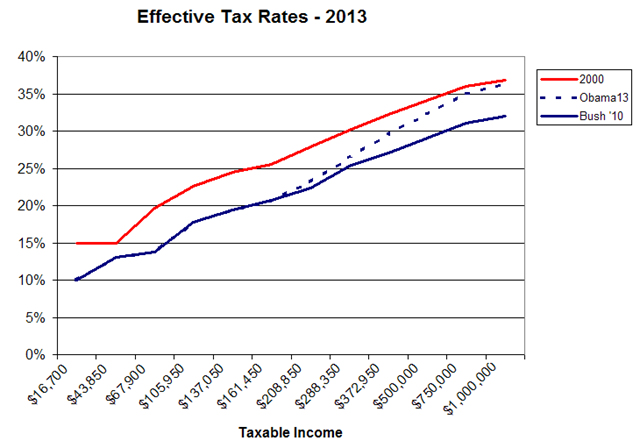
Here’s a handy tool for estimating effective tax rates now, and prospectively in 2013.
image


* * * * *

Next up: The triumphant return of the marriage penalty

>> Current Posts

It’s not a fine, it’s not a tax … it’s a "different tax status" … just like being married

April 9, 2010

Remember those 16,000 new IRS agents who will be policing implementation of ObamaCare ?

Well, turns out that they won’t be collecting fines or taxes … they’ll just be reclassifying non-compliers into “alternative tax statuses”.  Whew.

Who comes up with this stuff ?

Here’s a minute of spin worth watching …

Memo to Playboy: Even a bunny knows when to stop …

April 9, 2010

TakeAway:  Playboy’s loyal collectors have followed the brand for decades and some have even dedicated entire wings of their houses to Playboy paraphernalia.

So, you know something has gone really wrong when these loyalists complain about Playboy’s latest category extensions. 

Though it is better to get consumers to switch within a brand franchise, it appears that Playboy has gone beyond the loyalists perceptions of fit.  Maybe Playboy executives need to step back and reacquaint themselves with the loyalists associations to and beliefs about the brand.   

* * * * *

Excerpted from WSJ, “As Playboy Bunny Logo Multiplies, Collectors Are Barely Interested in It,” By Russell Adams, April 5, 2010

Over the past nine months, Playboy has turned its bunny loose, slapping its famous logo on a tanning spray, a disposable lighter, a mattress, a couch and a line of drinks designed to boost the libido.

The new Playboy paraphernalia should be welcome news for Ken Ritchie, who has a wing on his house precisely to hold stuff like this.

Ken has spent most of his adult life collecting and selling Playboy merchandise. For about a decade, he was spending $3,000 a month on paraphernalia … But Mr. Ritchie turns up his nose at what Playboy is selling now.

“These are a lot of silly things that have no connection with Playboy,” Mr. Ritchie says. “How many guys do you think are going to go out and buy navel rings because they’ve been licensed by Playboy? It’s not a must-have item.”

Playboy launched more than a magazine when it put Marilyn Monroe on its inaugural issue in 1953. It created a brand that came to represent a rebel ethos … Over the years Playboy Enterprises has capitalized on it by attaching its logo to nightclubs, cuff links and other trinkets.

As advertising has drained from its magazine, Playboy has come to rely more heavily on its licensing efforts. That’s rankled some core fans, highlighting the delicate task facing Playboy and other struggling magazine companies: how to capitalize on their brands without diminishing their value in the eyes of the people who cherish—and in some cases profit from—them most …

Playboy has been licensing its brand on an array of seemingly random products for decades … However Playboy has sought to usher the brand up-market during the last 20 years … canceled licensing contracts with makers of items such as fuzzy dice and air fresheners and instead targeted high-end apparel and accessories for women.

Playboy’s new CEO … is shifting gears, making expansion of licensing a priority. “I think we might have been a bit more conservative about category expansion previously” …

The CEO acknowledges that it is difficult to expand the high-margin licensing business and please hard-core collectors at the same time. The ubiquity that fuels strong sales is precisely what turns off collectors …

Still, the CEO says Playboy takes pains to determine whether new products will sully its media properties or other products. “So far, we can’t point to an example of a product we’ve licensed that we regret,” …

In February, Playboy reached a deal to outsource its licensing business in Asia, where Playboy-branded apparel has become especially popular among young women.

That doesn’t sit well with male collectors … they are reluctant to put on a Playboy shirt given the growing popularity of Playboy apparel among women. “Now it’s almost too feminine to wear something like that,” …

Edit by TJS

* * * * *

Full Article
http://online.wsj.com/article/SB10001424052748703447104575118051700987106.html

* * * * *