Punch lines:
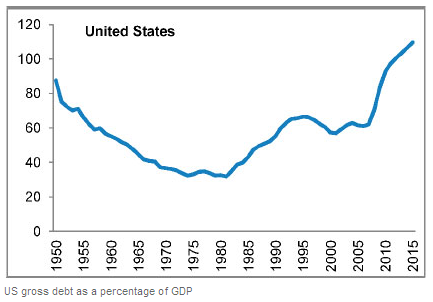
(1) In a year or two, the US national debt will be larger than the annual output of the US economy (i.e. debt > 100% GDP) … up from 60% in the prior decade.
(2) Empirical evidence demonstrates that increases in marginal tax rates won’t collect ‘revenues’ more than 20% of GDP … since the dwindling number of tax payers change their behavior to minimize their tax bite.
Hauser’s Law (below) is a great piece of economic analysis …
* * * * *
Excerpted from WSJ: The Revenue Limits of Tax and Spend, May 17, 2010
Washington has adopted the Greek model of debt, dependency, devaluation and default.
Prospects for restraining runaway U.S. debt are even poorer than they appear.
Based on President Obama’s fiscal 2011 budget, the Congressional Budget Office (CBO) estimates a deficit that starts at 10.3% of GDP in 2010 … then narrows to 5.6% in 2020.
As a result the net national debt (debt held by the public) will more than double to 90% by 2020 from 40% in 2008.
And, these debt estimates are incomplete and optimistic. They do not include deficit spending resulting from the new health-insurance legislation. And, as usual, they ignore the unfunded liabilities of social insurance programs.
The revenue numbers rely on increased tax rates beginning next year resulting from the scheduled expiration of the Bush tax cuts. The feds assume a relationship between the economy and tax revenue that is divorced from reality.
Six decades of history have established that increases in federal tax rates, particularly if targeted at the higher brackets, produce no additional revenue. For politicians this is truly an inconvenient truth: conventional methods of forecasting tax receipts from increases in future tax rates are prone to over-predict revenue.
The chart below shows how tax revenue has grown over the past eight decades along with the size of the economy.

Note the close proportionality between revenue and GDP since World War II, despite big changes in marginal tax rates in both directions.
Known as “Hauser’s Law” the relationship reveals an upper limit for federal tax receipts at about 19% of GDP.
Why the limit?
The tax base … represents a living economic system that makes its own collective choices.
In a tax code of 70,000 pages there are innumerable ways for high-income earners to seek out and use ambiguities and loopholes. The more they are incentivized to make an effort to game the system, the less the federal government will get to collect.
Changes in marginal tax rates do not make a perceptible difference to the ratio of revenue to GDP.
* * * * *
Full article:
http://online.wsj.com/article/SB10001424052748704608104575217870728420184.html?mod=WSJ_hps_MIDDLEFifthNews


 The Homa Files