Archive for October 21st, 2011

Squeezing Buffett’s numbers … Part 5 (and done !)

October 21, 2011

OK, today should about do it.

After a recap, I’ll drop my conclusion on you … my very surprising conclusion

First. a recap to get everybody on the same page.

In Part 1, we looked hard at Buffett’s effective income tax rate (17.4%), and showed how he could get to that low rate by offsetting practically all of his ordinary income with $23 million in deductions.

This conclusion debunks the popular pundit point that he gets to the rate by having practically all of his income in capital gains and dividends.

In Part 2, we showed that about $20 million of the deductions are probably charitable contributions – a device that rich folks use to (1) do good things and (2) to manage down their tax liabilities.

Better to give to a cause that you believe in, right? Why give it to the government and have it waste the money?

In Part 3, we agreed that Buffett’s tax rate as a percentage of his taxable income is probably less than his secretary’s – partially due to his capital gains being taxed at a comparatively low rate, but mostly because he shelters his ordinary income with charitable deductions.

And, we showed how ordinary earners can get to a rate lower than Warren’s … just by donating a huge chunk of their income to charity. Not realistic, but mathematically possible.

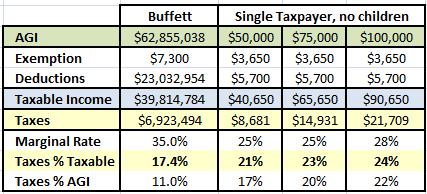
In Part 4, we showed that Buffett’s tax rate as a percentage of AGI is only 11% …. about half of the estimated rate for our hypothetical secretary surrogates.
image

Now, my first reaction when I stared at the taxes to AGI rate was “Wow, Buffett’s right – he’s nothing but a coddled piker.”

But now, I’m not so sure.

On one hand, his paying a rate (to taxable income) that’s 5 points less than his secretary doesn’t seem fair.  Especially since he gets to the rate by exploiting some dreaded tax loopholes, aka. “deductions”.

The situation seems even worse when you consider his taxes to AGI rate – a mere 11% – less than half of his secretary’s rate (I suspect).

Gotta jack up taxes, right?

Not so fast.

Let’s construct another measure: the GBSR™ — “Give Back to Society Rate

Since I’m coining the measure, I’ll define the GBSR™ as the sum of taxes paid plus charitable contributions – since those are all money that’s supposed to be going to the common good, albeit administered by different organizations – divided by AGI.

OK, so what’s Buffett’s GBSR?

Well, based on my estimates, Buffett pays about $7 million in Federal taxes, about $3 million in state taxes, and about $20 million to charities.  ,,, for a total of $30 million … which dived by his $63 million AGI … gives a GBSR™ rate of almost 50% (47.6% to be precise).

Now, let’s pretend that Buffett’s secretary profiles like our $100,000 ordinary earner above.  Her charitable deductions would be at most $5,700.  Otherwise she wouldn’t be taking the standard deduction, she’d itemize.

So, her GBSR™ @ $100,000 AGI is 27.5%   ($5,700 + $21,709 = 27,409 / $100,0000 = 27.5%).

That means that Buffett’s GBSR™ is almost twice his secretary’s.

Hmmm.

Maybe he’s not such a bad guy and I should stop ranting about him.

And, maybe he should stop causing trouble for other folks by constantly whining about the tax code.

It just may be that the tax code is leading to the right answer.

Just have to look around the trees to see the forest.

AMEN

>> Latest Posts

If you aren’t being paid enough, taxpayers will make up the difference … huh?

October 21, 2011

Gene Sperling – one of the Obama’s economic hacks – has an editorial in today’s WSJ trying to defend the “pass it now” Jobs Bill.

First, he argues that

“It provides a strong and immediate boost to demand that could create up to 1.9 million jobs, increase growth by up to 2%, and lower unemployment, according to independent economists such as Moody’s Analytics.

First, note that the administration has at least learned a lesson re: setting benchmarks.  The squirrely “up to” is a maximum, not a minimum.  So, the result can be anything less than those benchmarks and they can declare success. Huh?  I wish my pay-for-performance targets had been “up to a 2 point share gain”.  I would have gotten rich.

Second, I like the phrase “such as Moody’s Analytics”.  Obama has been saying “all economists agree”.  Based on SAT training, we all know that “all” is usually not the answer.  The only economist I’ve seen on record is Mark Zandi at Moody’s.  He’s the guy who said the first stimulus would keep unemployment under 8%.  And, oh yeah, one of Moody’s biggest shareholder’s is Warren Buffett.  Coincidence?

Sperling also argues that the provisions of the Jobs Bill are “specifically designed to take on the problem of long-term unemployment.” It includes:

  • A tax credit for hiring the long-term unemployed and veterans
  • A ban on hiring discrimination against the unemployed
  • Major reforms to our unemployment-insurance system, including wage insurance to assist workers whose new job pays less than their old
  • A “Bridge to Work” program to help the unemployed reconnect with the labor force through temporary work
  • Job-search assistance for all long-term unemployed
  • Support for unemployed workers looking to become entrepreneurs.

Some on these provisions are laudable – at least on the surface.  I don’t think anybody is against helping veterans, or providing job search assistance.

Bot others are questionable.  For example, take the provision that would give those claiming discrimination a right to sue, and violators would face fines of up to $1,000 per day, plus attorney fees and costs.

Why do we need that?

Sperling says “the National Employment Legal Program recently found, in a span of four weeks, over 150 Internet job postings that include “do not apply” notices discriminating against those who are currently unemployed.”

Oh my God — 150 evil posting in a month … out of the gazillion web postings each month  Statistically insignificant – and certainly not worth another slew of frivolous law suits.  Cue the trial lawyers.

And, if your new job pays less, taxpayers will make up the difference?

Who thinks this stuff up?

>> Latest Posts

Unfit to serve … under 6% qualify for military

October 21, 2011

The  ABC News headline reads

“Nearly one-fourth of the students who try to join the U.S. Army fail its entrance exam”.

That’s true, but it’s only part of the story.

A study by The Education Trust found that 23 percent of recent high school graduates don’t get the minimum score needed on the enlistment test to join any branch of the military.

Here’s the line that caught my eye.

The military exam results are also worrisome because the test is given to a limited pool of people:

Pentagon data shows that 75 percent of those aged 17 to 24 don’t even qualify to take the test because they are physically unfit, have a criminal record or didn’t graduate high school.

Doing the arithmetic, the military is drawing from a pool that only contains 5.75% of those aged 17 to 24.

Holy smokes …

>> Latest Posts