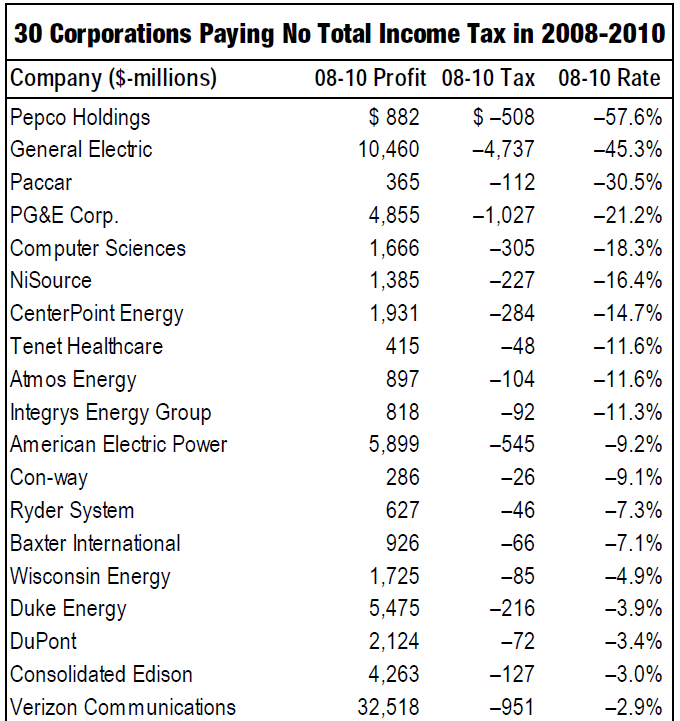
CTJ (Citizens for Taxpayer Justice) recently released a report titled “Corporate Taxpayers & Corporate Tax Dodgers, 2008-2010”
Here’s their list of the Top 30 “Tax Dodgers” … below the table is CTJ’s decoding of how they do it

Accelerated Depreciation
In early 2008, in an attempt at economic stimulus for the flagging economy, Congress and President George W. Bush dramatically expanded depreciation tax breaks by creating a supposedly temporary “50% bonus depreciation” provision that allowed companies to immediately write off as much as 75 percent of the cost of their investments in new equipment right away.
This provision was extended and expanded through 2012 under President Barack Obama.
Stock options
Most big corporations give their executives (and sometimes other employees) options to buy the company’s stock at a favorable price in the future.
When those options are exercised, companies can take a tax deduction for the difference between what the employees pay for the stock and what it’s worth (while employees report this difference as taxable wages).
Paying executives with options took off in the mid-1990s, in part because this kind of compensation was exempt from a law enacted in 1993 that tried to reduce income inequality by limiting corporate deductions for executive pay to $1 million per executive.
Tax options were also attractive because companies didn’t have to reduce the profits they report to their shareholders by the amount that they deducted on their tax returns as the “cost” of the stock options.
Industry-specific tax breaks.
The federal tax code also provides tax subsidies to companies that engage in certain activities. For example:
- research (very broadly defined);
- drilling for oil and gas; providing alternatives to oil and gas;
- making video games;
- ethanol production;
- not moving operations offshore;
- maintaining railroad tracks;
- building NASCAR race tracks;
- making movies;
… and a wide variety of activities that special interests have persuaded Congress need to be subsidized through the tax code.
Offshore tax sheltering.
Over the past decade or so, corporations and their accounting firms have become increasingly aggressive in seeking ways to shift their U.S. profits, on paper, into offshore tax havens, in order to avoid their U.S. tax obligations.
These typically involve various artificial transactions between U.S. corporations and their foreign subsidiaries, in which revenues are shifted to low- or no-tax jurisdictions, while deductions are created in the United States.
Some companies have gone so far as to renounce their U.S. “citizenship” and reincorporate in Bermuda or other tax-haven countries to facilitate taxsheltering.



 The Homa Files