Archive for August 14th, 2012

Why has the stock market has been strong despite a weak economy?

August 14, 2012

Back about 40 years ago, an economist-wannabe co-authored a study in the Journal of Finance titled “The Supply of Money and Common Stock Prices”.

image

The article summarized an econometric study that demonstrated a tight link between the amount of money floating around and, on a slightly time-delayed basis, the price of stocks.

OK, fast forward to today.

Now, when the Feds expand the money supply, it’s called “Quantitative Easing” … or QE, for short.

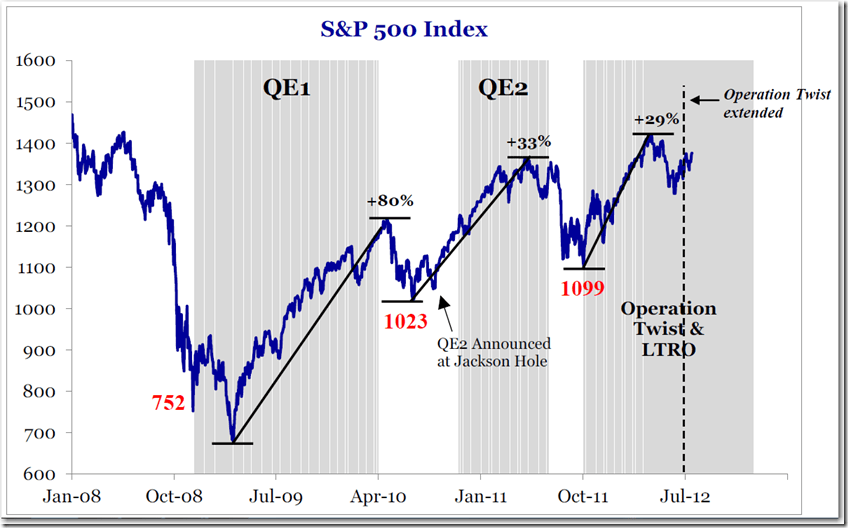
Recently, Jason Trennert of Strategas Research Partners published a revealing chart that visually relates stock prices (the S&P 500) to the recent periods of quantitative easing.

Hmmm.

Looks like the supply of money and common stock prices are still related.

Partially explains why the Dow is over 13,000 despite a sluggish and uncertain economy.
image

>> Latest Posts

You probably paid too much … especially if you’re bad at math.

August 14, 2012

Ac couple of weeks ago we reported a study that consumers almost invariably pick 33% more stuff than a 33% price discount.

Ouch.

Consumers are notoriously bad at spotting real values. Why?

According to the Atlantic ….

  • First: Consumers don’t know what the heck anything should cost, so we rely on parts of our brains that aren’t strictly quantitative.
  • Second: Although humans spend in numbered dollars, we make decisions based on clues and half-thinking that amount to innumeracy.

More specifically, here are some more ways consumers end up paying too much …

  1. Anchoring Effect: People are heavily influenced by the first price we see … it’s called “anchoring” …  that’s why the appliance salesman shows you the most-featured, highest-priced appliance first … it makes every other appliance seem like deal.
  2. Aversion to Extremes: People are  terrified of extremes … they don’t like buying the cheapest item … or the most costly …  they shy away from prices that appear too high or too low.For example, in one famous study, people were offered 2 kinds of beer: premium beer for $2.50 and bargain beer for $1.80.

    Around 80% chose the more expensive beer.

    When a third beer was introduced, a super bargain beer for $1.60, 80% bought the $1.80 beer and the rest $2.50 beer. Nobody bought the cheapest option.

    Then researchers removed the $1.60 beer and replaced with a super premium $3.40 beer.

    Most people chose the $2.50 beer, a small number $1.80 beer and around 10% opted for the most expensive $3.40 beer.

  3. Shining Light Effect: Savvy restaurants, for example, design their menus to draw our eyes to the most profitable items by things as simple as pictures and boxes.Good rule of thumb: If you see a course on the menu that’s highlighted, boxed, illustrated, or paired with a really expensive item, it’s probably a high-margin product that the restaurant hopes you’ll see and consider.
  4. Dulled senses: Alcohol narrows the range of complicating factors people can hold in their heads at once.  People are easily made dumber by alcohol, time, decisions.When we’re drunk, stressed, tired, and otherwise inattentive, we’re more likely to ask and answer simple questions about buying things.

    Cheap candy bars and gum are situated near the check-out at grocery stores because that’s where exhausted shoppers are most likely to indulge cravings without paying attention to price.

  5. Concealed habits: To save some $$$, cancel recurring payments like gym memberships and subscriptions to papers and services you don’t use.Cancelling is a hassle, right?

    So what?

    Cancel that subscription.

  6. Peace of mind… allows some companies to make more money on extended warranties and service contracts than they do on their productsExcept for PCs (high prices, risk of crashes), extended warranties don’t pay-off … otherwise, why would retailers push them so aggressively?

>> Latest Posts