Background
A colleague and I have been exchanging ideas on this topic.
He’s more liberal than me (no surprise), so it’s an interesting exercise.
We’re starting to find some common ground and develop testable hypotheses.
Here’s one of our initial observations.
Chime in, please … would love your input on this and subsequent reveals.
The big shift in government’s “mission”
Long ago, say 40 or 50 years, the central government mission was to provide essential common services … such as military defense and national infrastructure (aka. “Transportation”).
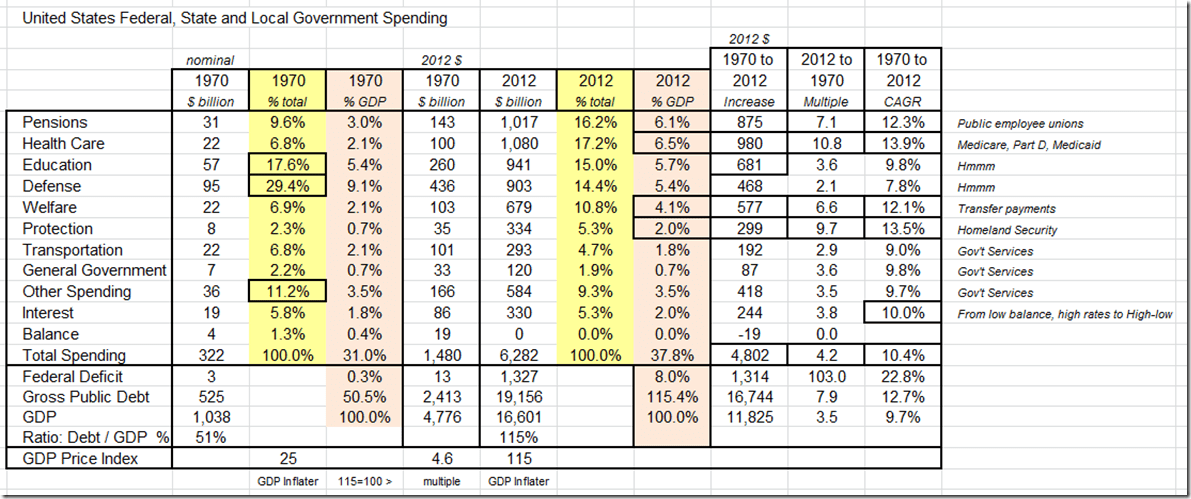
That mission has become more “mixed” over time (see chart below).
Spending on the original essential common services – while still substantial — are proportionately decreased.
For example, military defense was almost 30% of Federal spending in 1970 … it’s less than 15% in 2012.
Some additional layers of spending – consistent with the original mission of essential common services – have been added.
For example, Homeland Security (aka. “Protection”) has been substantially ramped up.
But, the bulk of additional spending over time is attributable to health & welfare entitlements, public employee pensions, education (mostly new Federal programs and administration).
Time bomb warning: Note that “Interest” on the public debt has remained proportionately constant over the 40 year period.
But, of course, the components are very different.
In 1970, there was relatively low debt but high interest rates.
In 2012, we have very high debt with historically low interest rates.
The obvious uh-oh: what happens when interest rates jump up to more “normal” levels?
In other words, spending trends seem to validate the observation that the implicit “government” mission has expanded from a relatively sharp focus on providing essential common services by (1) expanding the scope of declared “essential common services (think DOE and Dept. of Education) and (2) re-missioning to become increasingly a transfer payment hub for “safety net” entitlements.
Ergo the rub.
More to come.
Your views?
>> Latest Posts
SHARE THIS POST WITH FRIENDS & FAMILY



 The Homa Files