Archive for November 20th, 2012

Demand for full-time employees is dwindling … so is the supply.

November 20, 2012

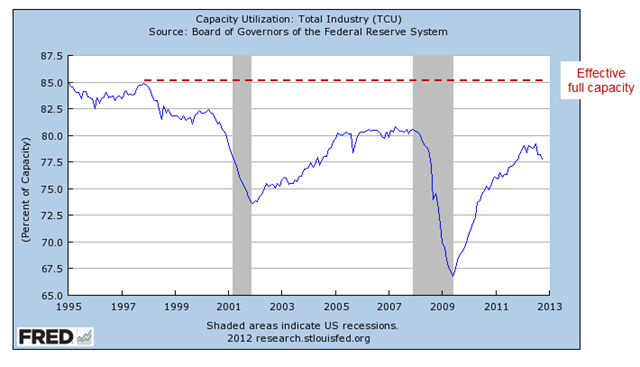
Punch line: The employment market is likely to stay in the doldrums … employers – still operating below effective full capacity – are leveraging the productive full-time employees they retained during the recession, shifting some of them to part-time status … and supplementing them with temporary workers and new part-timers.  And, the labor force participation rate is dropping as workers become demotivated and disincentivized.
image

= = = = =

The Demand Side

Full time work is about to get scarcer.

image

By hiring part-time workers who put in less than 30 hours per week, employers can avoid a mandate dictated by the new health reform law: either provide expensive health insurance or pay a fine equal to $2,000 per worker.

In a July survey, 32% of retail and hospitality company respondents told [Mercer] that they were likely to reduce the number of employees working 30 hours a week or more.

Already, some companies are putting plans into action.

  • Darden Restaurants [parent of Red Lobster and Olive Garden] was among the first companies to say it was changing hiring in response to the health-care law.
  • Pillar Hotels & Resorts this summer began to focus more on hiring part-time workers among its 5,500 employees, after the Supreme Court upheld the health-care overhaul.
  • CKE Restaurants Inc., parent of the Carl’s Jr. and Hardee’s burger chains, began two months ago to hire part-time workers to replace full-time employees who left.
  • Home retailer Anna’s Linens  is cutting hours for some full-time employees to avoid the insurance mandate if the healthcare law isn’t repealed.

Source: Forbes

= = = = =
The Supply Side

A new book by University of Chicago economist Casey Mulligan explains that through a major expansion of the welfare state we are paying people not to work:

He says that public policies enacted during the Obama administration’s first four years have been affecting the supply side of the market as reflected in the labor force participation rate.
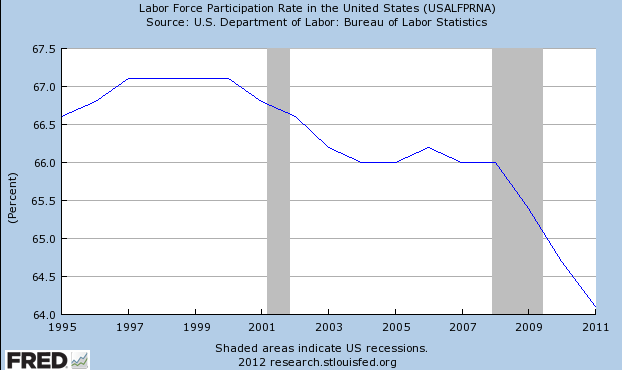
image .

In the matter of a few quarters of 2008 and 2009, new federal and state laws greatly enhanced the help given to the poor and unemployed — from expansion of food-stamp eligibility to enlargement of food-stamp benefits to payment of unemployment bonuses — sharply eroding (and, in some cases, fully eliminating) the incentives for workers to seek and retain jobs, and for employers to create jobs or avoid layoffs.

If a person gets laid off and is offered a new job paying $500 a week …. his take home pay would be about $250 after deducting taxes and work related expenses.

Since untaxed unemployment benefits total $289, clearly he is better off not working … [at least for 99 weeks].

All in all, Mulligan estimates that about half the precipitous 2007-2011 decline in the labor-force-participation rate and in hours worked can be blamed on easier eligibility rules for disability benefits,  unemployment insurance, food stamps and housing aid.

Source: Forbes

* * * * *
Tax moves … higher Fed taxes motivating folks to bolt.

November 20, 2012

Except for eccentric billionaires, I haven’t heard about people renouncing their US citizenship and relocating to foreign tax havens.

But, in the past week, I’ve heard 4 stories of sober-minded friends starting to implement plans to move to states with no or low income taxes and no estate taxes.

That’s not a new thing, but the breadth of interest and urgency is something I haven’t seen before.

Some is induced by aging … 3 of the 4 are nearing retirement age.

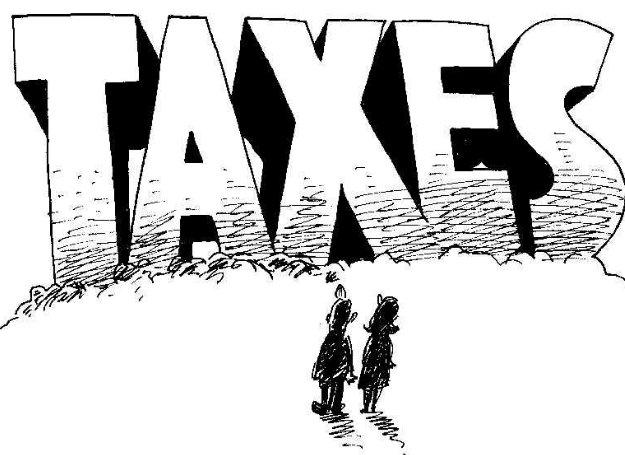
The flashpoint, though, is ignited by Obama’s re-election and his rants and threats to jack up taxes.

image

Savvy folks understand that (a) more than folks making $250K will be impacted, and (b) many of the tax increases are already baked in courtesy of ObamaCare.

So, the thinking goes: “I can’t control the Fed taxes I pay but I can control the local taxes I pay … so, I’m moving to a low tax locale to offset the hit Obama’s putting on me.”

The interesting irony: the destination states are red ones … or purple ones (think Florida).

The bulk of the migration will be wealthier folks bolting from high tax & spend blue states (think CA, MD, NY, NJ) … giving the blue states  a declining tax base and forcing them to jack up state taxes on everybody else to feed their tax and spend monsters.

An unintended consequence of the caviler Fed tax policy Obama is pushing … watch it develop.
* * * * *
Follow on Twitter @KenHoma

Which Kraft brands are getting the boot?

November 20, 2012

Punch line: Since splitting earlier this year, Kraft Foods and Mondelez are both pursuing similar growth strategies: trimming slower, smaller brands and focusing efforts on powerhouse brands to drive economies of scale.

* * * * *
Excerpted from brandchannel’s, “The Kraft/Mondelez Dilemma: Which Brands to Trim, Which Brands to Boost?”

MondelezPic_460

One of the main reasons for Kraft to split into its new Kraft Foods and Mondelez International units was to free the latter to pursue the beckoning opportunities in the global snacking business without being tied down to the slower-growth, mature North American groceries business.

Both newly independent entities are pursuing something of the same strategy to tap into their separate growth opportunities: paring back non-performing, small brands, and applying innovation resources and expansion ambitions to big brands

Mondelez has said that it may divest some products as it seeks to streamline its range. The company will pursue a “simplification agenda,” Tom Cofer, head of Europe, confirmed to Bloomberg.

Not to be outdone, Kraft Foods also is planning “product pruning.” Kraft hasn’t indicated what products and brands it will trim, but analysts have speculated that Oscar Mayer, Gevalia coffee, Jell-O and Planters comprise a list of “power” and “jewel” brands safe from disposition. On the other hand, Breakstone sour cream, Grey Poupon mustards and A-1 steak sauces could be targets for divestiture.

Kraft Foods’ board of directors, meanwhile, just approved a $650 million “restructuring, related implementation and spinoff transition program,” the company reported in an SEC filing, which includes severance, asset disposal and professional service fees.

Mondelez has indicated that it will be creating new synergies among the many powerhouse brands in its stable … to supercharge growth especially in emerging markets including the Middle East, even as it trims in more mature markets, such as Canada.

So, for instance, Mondelez is leveraging a “nervous” Cadbury’s long presence in India to help growth of its Oreo brand, in part by packaging Oreos in that market in Cadbury’s signature purple packaging rather than the red and white of Oreo’s Nabisco brand.

Mondelez also is trying to goose growth with marketing innovations such as its use of a new digital-advertising diagnostics tool and by its plans to crowdsource some marketing tactics in Europe.

Significant growth is what Mondelez, and Kraft Foods, need — otherwise, what was the split for?

Edit by BJP

* * * * *
Follow on Twitter @KenHoma

PVP: Cable company pricing strategies (yes, there’s method to the madness)

November 20, 2012

Punch line: Cable pricing strategies appear to be a mystery to most, but Comcast confirms the company, does in fact, have a strategy for those wacky prices.

* * * * *
Excerpted from WSJ’s, “Cord-Cutting: Cable’s Offer You Can’t Refuse”

1114_trump_630x420

When Georgia-based medical student Cathy Vu called Comcast last month to cancel her TV service and keep just Internet, she got a shock.

Taking the Internet alone would cost her more, not less, a month.

Cable providers are making their Internet-only plans less attractive than their cable and Internet packages.

Unbundling often doesn’t pay*

  • Comcast: TV + Internet for about $50/month for the first 6 months vs. standalone samespeed Internet for about $70/month.
  • Verizon FiOS: TV + Internet for about $85/month (two-year contract) vs. standalone Internet for about $80/month.
  • Time Warner Cable: TV + Internet for about $50/month for 12 months vs. standalone Internet for about $45/month for 12 months.

People are pretty much forced into buying both services.  Comcast confirms the pricing strategy, saying it is more valuable for the cable operator to pursue customers who will take multiple services than “single play” customers.

Several pay-TV executives say that cord-cutting is still a small trend that has largely stemmed from weak economic conditions.

But one little-discussed factor is cable operators’ pricing policies, which can prompt people to keep TV even if they don’t particularly want it.

In addition, Comcast, Time Warner Cable and Verizon said that a customer who takes multiple services is more likely to stick with the cable company and add more products later on.

“The deeper the discount, the higher the churn” at the end of the promotional period, one cable executive said.

Edit by BJP

* * * * *
Follow on Twitter @KenHoma