Archive for December 18th, 2012

Politics: Boehner, Obama & W.C. Fields

December 18, 2012

According to CNBC, fiscal cliff talks moved forward in the past couple of days.

  • Obama has been steadfast that income tax rates go up for millionaires & billionaires making more than $250,000.
  • Boehner had been equally adamant that – as a matter of principle – no rates could go up.
  • Over the weekend, Boehner reportedly said he’d agree to higher tax rates starting at the $1 million income level
  • Obama reportedly countered by upping his threshold from $250,000 to $400,000
  • Boehner immediately expressed indignation and rejected the counter-offer

Reminded me of an old W.C. Field’s routine …

image

Here’s the way the skit goes ..

(more…)

Unexpected Journey: From Roosevelt Island to 34th & O …

December 18, 2012

We’re not talking Hobbit, we’re talking Pepper.

We’re talking a real unexpected journey.

First, some background for non-Georgetown folks.

Theodore Roosevelt Island is a “living memorial” to America’s 26th president, a great outdoorsman and conservationist.

The national park – located across the Potomac from Georgetown – has “miles of trails running through wooded uplands and swampy bottomlands”.

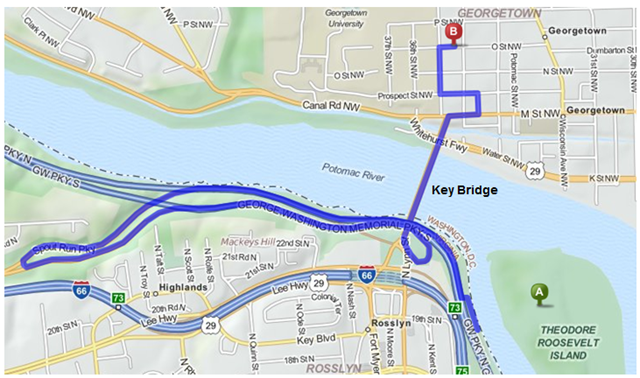
Mapquest says that it’s 3.61 miles from Roosevelt Island to the corner of 34th & O St.

Mapquest’s suggested route  is depicted below – follow the windy road out of the park, head over the Key Bridge, turn right on M Street, then head up the side streets.

You probably get the picture.

image

It’s an easy trip by car, and a nice run on a Sunday morning.

More specifically, it’s a nice run for a well-conditioned guy or gal.

But, what about for a dog?

Here’s where the story gets interesting.

(more…)

Problem Solving Skills: Identifying Core Issues

December 18, 2012

In a prior post Effective problem-solving … the five key skills, we isolated 5 key problem solving skills.

image

Let’s drill down on #1 …

* * * * * *
(1) Identify core issues quickly

One of my observations was drawn for the Center for Creative Leadership which has found that : “Managers faced with a complex problem typically end up solving the wrong problem.”

How can that be?  What explains the misses?

Based on my experiences, there are 4 at least 4 frequently encountered stumbling blocks that managers often encounter.

  1. Wandering in a foreign land: Often, managers just don’t have the perspective – drawn from experience or education or whatever – to fully understand the nuances of a problem or recognize the tell-tale patterns.
  2. Trees obscure the forest: The initial observation related to complex problems, which – by definition — come laden with extraneous or equivocal information that sometimes clouds the picture and causes cognitive solution.
  3. Unconscious biases take over: For example. how about cutting the Federal deficit?  If you present the problem to a fiscal conservative, they’ll immediately start probing for spending cuts.  If you ask a liberal, they’ll start figuring how to raise taxes.  Same problem.  Different perspectives drive by in-going biases.
  4. (Preference for simpler problems: In his book “Thinking Fast, Thinking Slow”, Adam Tversky argues that most mortals – when confronted by a hard, complicated problem exhibit a burning urge to to solve a simpler problem … one they’ve seen before, or one that seems simpler and more solvable.

* * * * *
So, how to jump over these stumbling blocks?

Here are some suggestions …

  • Start generic, then get specific: If you’re unfamiliar with a particular industry or situation, take it up a level of abstraction.  That is, conceptualize it with relevant elements that are more familiar.  Then, adjust to the specifics of the situation.
  • Clear clutter, structure problem: Get down to the absolute essentials. Purge the problem of the distracters that aren’t germane or the factors that aren’t  likely to influence the answer.  Don’t be lured to information that may be interesting but not determining.  Once the canvas is cleaner, patterns should be easier to discern.
  • Stay focused and be objective: This hard because many biases are sub-conscious.  Ask yourself if a person with a different slant would come to the same conclusion.
  • Refrain: “What’s the question?” … Keep pushing yourself to test “is this the central problem … or, just a symptom?”

* * * * *
Follow on Twitter @KenHoma           >> Latest Posts