Earlier this year, CNN reported (and editorialized):
Retail workers have just scored an unprecedented win against a retail giant.
Walmart, the nation’s largest private employer, announced that it will raise the wages of approximately 500,000 of its employees by lifting its base wage to $10 by 2016.
To be sure, Walmart’s announcement is an impressive development in the fight for better wages.
It’s a step in the right direction, but not enough.

======
Let’s fast-forward to this week …
======
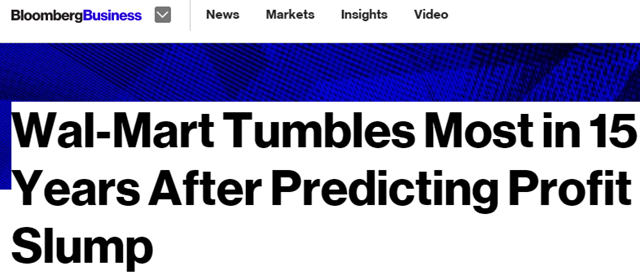
What happened?
Wal-Mart suffered its worst stock decline in more than 27 years after predicting that profits will decline 6% to 12% next year.
Why the drop in earnings?
“Stagnant growth” due to a slow economy and share losses to online retailers and, oh yeah, much higher labor costs.
Wal-Mart has been pumping money into its workforce and e-commerce capabilities in a bid to reignite stagnant sales growth.
The company raised its base employee wages to $9 an hour in April and plans to boost hourly pay to at least $10 next year.
The effort, combined with an expanded training program, added about $1 billion in costs this year and $1.5 billion next year. Source
In other words, the increase in wages wasn’t accompanied by a productivity increase …. sales per employee declined.
That’s not a social observation, it’s an economic observation.
You can’t blame the employees for the “structural” sales decline, but it does impact them.
How will management get profits moving upward again?
======
First, the company said that it will slow the pace of new store openings.

Fewer new stores means less hiring, slower growth in its labor force.
======
Second, Wal-Mart’s CEO said that the company would be “restructuring its portfolio of businesses”.
English translation: more emphasis on labor-light online sales and less emphasis on labor-intensive brick & mortar.
So, of course, the company will be sorting through its portfolio of stores: “rationalizing” employee headcounts and shuttering unprofitable stores … many of which were marginal before the wage hikes and unprofitable after.
======
Put it all together and you get a predictable outcome.
Jack up wages without an economic rationale – higher productivity, stronger growth — and eventually the piper gets paid.
Surviving employees get fatter paychecks … but other employees lose their jobs.
That’s the way it works.
#HomaFiles
Follow on Twitter @KenHoma >> Latest Posts
 The Homa Files
Leave a comment