Archive for the ‘Health Care / Medical Insurance’ Category

Dear Secretary Sebelius … Your’s truly, Anthem Blue Cross / Blue Shield of California

March 10, 2010

Anthem BC /BS has provided ObamaCare supporters with a talking point: profit-mongering health insurance companies are arbitrarily jacking up premiums to unprecedented and unconscionable levels.  ObamaCare will put a stop to that pronto.

Further the President said that insurance execs can’t come up with any reasonable explanation for the rate changes.

Well, Anthem has penned a letter to Sec. Sebelius explaining the rate changes (link to letter is below)

While the letter is a bit long-winded, here are the key points … which, incidentally, make sense to me.

  • In 2009, Anthem’s average premium increase was 2%.
  • But the average claims per member — the underlying cost of serving subscribers — increased by 8% in 2009.
  • So, Anthem’s individual health insurance business in California lost money in 2009.
  • An independent actuarial firm concluded that Anthem’s proposed 2010 rates were actuarially sound, reflecting the expected medical costs associated with the membership in these plans.
  • Anthem’s proposed 2010 rates satisfy or exceed the medical loss ratio required by California law i.e. the underlying medical costs are driving the rates
  • The 39% increase reported in the media is an isolated case; some premiums went down by as much as 20%.
  • After these premium changes are enacted, the average individual market premium in California  will still be about 1/2 the average individual market premium in New York.

Full letter:
http://www.wellpoint.com/pdf/SebeliusLetter02112010.pdf

Thanks to DNF  for feeding the lead.

Heads up: The capital gains hurt on the horizon … and the giant sucking sound from the stock market.

March 9, 2010

The unions cut a special behind-closed-doors deal with the President to delay the tax on Cadillac heath insurance plans until 2018.  Though Obama proposes eliminating the Cornhusker kickback, he plans to keep his word to the SEIU on this break.

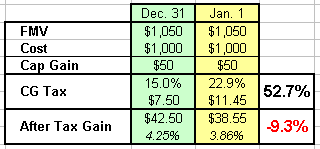
To compensate for the lost tax revenue, Obama proposes extending Medicare “payroll taxes” to unearned income — i.e. interest, dividends and capital gains. 

That’s a 2.9% increase in capital gains taxes.

Keeping in mind that the Bush tax rates expire on Dec 31, the capital gains tax rate will go from 15% to 22.9% — a 52.7% increase !

As the simple example below shows, after-tax gains get crushed — overnight — when the new rates take effect.

Note: Potentially making matters worse, I expect the Medicare tax on unearned income to become effective on the date Obama signs the bill … or worse, I wouldn’t be surprised if Team Obama made the tax hike retroactive to Jan. 1, 2010. The sucking sound you’ll hear is the stock market losing steam …

image

OK, so he was off by $1 trillion (twice) … don’t get bogged down in the (flakey) numbers..

March 9, 2010

Liberal pundits tout President Obama’s intellect and grasp of “the details”. 

May be true, but a couple of recent trillion dollar “gaps” gotta make objective observers scratch their heads.

Either he doesn’t know, he’s sloppy, or he’s fibbing.  Pick one.

* * * * *

First, the CBO says that the national debt will rise by at least $1.2 trillion more than Obama’s White House projects.  Oops.

Excerpted from 247WallSt.com: Mr. Obama’s Missing $1 Trillion,  March 8, 2010 at 5:22 am

The Congressional Budget Office said the national debt will be rise by $9.8 trillion by 2020. The figure is $1.2 trillion higher than White House estimates.

The CBO estimates are lower than the President’s on both the receipt and expense sides of the ledger.

The differences between the White House estimates and those of the CBO are profound when the ten years are added up.

US debt held by the public is 67% of GDP under the President’s forecast, but 90% when the CBO estimates are used as the basis of calculations.

The President’s projections are obviously optimistic. If he is wrong, the price will be high enough that America may not be able to meet its debt obligations with any ease by the end of the decade. That could mean default on US sovereign debt, or austerity  greater than the American public has seen in decades.

http://247wallst.com/2010/03/08/mr-obamas-missing-1-trillion/

* * * * *

Then yesterday, the President pitched his health care plan to nodding supporters as “reducing most people’s premiums and bringing down our deficit by up to $1 trillion dollars over the next decade”.  Oops, again.  Off by about $1 trillion … 

Excerpted from White House Blog: Obama Overstates Health Care Savings by $868 Billion, March 8, 2010

In what the White House calls the final push for health care reform, President Obama said: “Our cost-cutting measures mirror most of the proposals in the current Senate bill, which reduces most people’s premiums and brings down our deficit by up to $1 trillion dollars over the next decade because we’re spending our health care dollars more wisely,”

The President was so proud of these cost-saving numbers in the latest version of health care reform, he delved into a bit of Washington-speak to back them up.

“Those aren’t my numbers,” President Obama said to the rising applause of the estimated 1,300 in attendance. “They are the savings determined by the Congressional Budget Office, which is the nonpartisan, independent referee of Congress for what things cost.”

That part is true. The budget office does keep score of what things cost. More precisely, the budget office projects what things cost or save over a given period of time.

But the budget office did not say the Senate health care bill would save $1 trillion over the next decade. Not even close.

It estimated the bill’s tax hikes and MediCare cuts would exceed new spending by $132 billion from 2010 to 2019, leaving President Obama’s “next decade” estimate $868 billion short. [Or, more than $1 trillion if you add back the so-called MediCare “doctor’s fix”.]

That’s some rounding error.

When contacted, a White House official said the President  meant to say the Senate bill would save $1 trillion in its second decade.

But, the CBO has said “Projections for years beyond 2019…would not be meaningful because the uncertainties involved are simply too great.”

http://whitehouse.blogs.foxnews.com/2010/03/08/obama-overstates-health-care-savings-by-868-billion/

Healthcare: Pay for quality, not quantity … now, how exactly is that going to work?

March 9, 2010

On the Sunday talk shows, e of Team Obama’s mantras is that under government-run healthcare, payments to doctors will be made based on quality (outcomes) rather than the quantity of procedures being done.

Nice philosophically, but how to make it happen ?

Couple of observations:

  • Quality over quantity should be easier in education than healthcare since students can be tested for progress.  But, virtually all merit pay programs for teachers (i.e. outcome-based) have been rejected out of hand or fail.  But, they’ll work in healthcare … hmmm.
  • A common method for controlling output quality is to control input quality.  In healthcare, that means rejecting the toughest cases and treating only the sure winners.  For example, when I first investigated corrective eye surgery, the docs rejected me.  My eyes were too bad, and they wanted to tout the percentage of patients that they got to 20/20.
  • It’s argued that a key to controlling quality is to make primary care physicians the coordinators of all medical services. That’s silly because:

    (1) there is a shortage of primary care docs (evidence: how quickly can you get an appointment when you’re sick? how about an appointment outside the 9 to 5 work day window?);

    (2) been there, tried that – in the past, most plans required that a patient see a primary care doc to get a referral to a specialist – the referral was almost always given – net impact: a step was added to the process

  • The Mayo Clinic  — always cited as the model of outcome based systems — has stopped accepting Medicare in its Arizona facilities.  Hmmm. Guess it didn’t drive costs down low enough …

I guess it’s better to bum’s rush through legislation than to give it serious thought.  Disappointing.

Liar, liar … pants on fire !

March 5, 2010

OK, all politicians lie.  That’s not new news. But …

If you haven’t seen these clips, watch them now. 

Two separate clips … definitely “must see TV”.

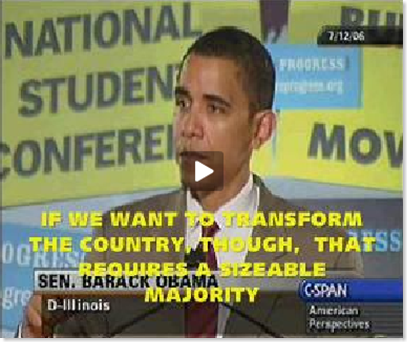
In his words: “Reconciliation is  a majoritarian abuse of power” and “Democrats Should Not Pass Healthcare With a 50-Plus-1 Strategy.”

Makes Tiger Woods seem like a pillar of trustworthiness …

image 
http://www.breitbart.tv/obama-american-agenda-flashback-dems-should-not-pass-healthcare-with-a-50-plus-1-strategy/

image
http://www.powerlineblog.com/archives/2010/02/025673.php

A colossal waste of time — if we’re lucky.

March 5, 2010

Punch line: ObamaCare’s essential mistake is to choose health-care expansion over health-care reform.

Another insightful column from Peggy Noonan.

* * * * *

Excerpted from WSJ: What a Disaster Looks Like , Mar 5, 2010

ObamaCare will have been a colossal waste of time—if we’re lucky.

It is now exactly a year since President Obama unveiled his health care push and his decision to devote his inaugural year to it—his branding year, his first, vivid year.

What a disaster it has been.

At best it was a waste of history’s time, a struggle that will not in the end yield something big and helpful but will in fact make future progress more difficult. At worst it may prove to have fatally undermined a new presidency at a time when America desperately needs a successful one.

In terms of policy, his essential mistake was to choose health-care expansion over health-care reform. This at the exact moment voters were growing more anxious about the cost and reach of government.

The practical mistake was handing the bill’s creation over to a Democratic Congress that was becoming a runaway train. This at the exact moment Americans were coming to be concerned that Washington was broken, incapable of progress, frozen in partisanship.

New presidents should never, ever, court any problem that isn’t already banging at the door. They should never summon trouble.

Mr. Obama did, boldly, perhaps even madly. And this is perhaps the oddest thing about No Drama Obama: In his first year as president he created unneeded political drama, and wound up seen by many Americans not as the hero but the villain.

And now here are two growing problems for Mr. Obama.

The first hasn’t become apparent yet, but I suspect will be presenting itself, and soon. In order to sharpen the air of crisis he seems to think he needed to get his health-care legislation passed, in order to continue the air of crisis that might justify expanding government and sustaining its costs, and in order, always, to remind voters of George W. Bush, Mr. Obama has harped on what a horror the economy is. How great our challenges, how wicked our businessmen, how dim our future.

The president can’t be a hope purveyor while he’s a doom merchant, and he appears to believe he has to be a doom merchant to justify ramming through his legislation. This particular legislation is not worth that particular price.

All this contributes to a second problem, which is a growing credibility gap. In his speech Wednesday, demanding an “up or down” vote, the president seemed convinced and committed — but nothing he said sounded true. His bill will “bring down the cost of health care for millions,” it is “fully paid for,” it will lower the long term deficit by a trillion dollars.

Does anyone believe this?

Does anyone who knows the ways of government, the compulsions of Congress, and how history has played out in the past, believe this? Even a little?

It would be a relief to have a president who could weigh in believably and make clear what his own bill says. But he seems to devote more words to obscuring than clarifying.

The only thing that might make his assertions sound believable now is if a group of congressional Republicans were standing next to him on the podium and putting forward a bill right along with him. 

GOP support won’t happen, for three reasons. First, they enjoy Obama’s discomfort. Second, they believe the bill is not worth saving, that at this point no matter what it contains —a nd at this point most people can no longer retain in their heads what it contains — it has been fatally tainted by the past year of mistakes and inadequacies.

And the third reason is that the past decade has taught them what a disaster looks like, and they’ve lost their taste for standing next to one.

Full article:
http://online.wsj.com/article/SB10001424052748704187204575101742162779612.html?mod=djemEditorialPage_h

Remember when Obama touted Buffett as the smartest businessman around ?

March 3, 2010

Well, haven’t seen Buffett at the WH as much as the SEIU president.  In fact, don’t recollect seeing there at all in the past year.  Hmmm.

My bet: Warren probably won’t make the President’s invitation list any time soon, now that he advocates scrappoing the ObamaCare bill and starting over with a sharp focus on reducing healthcare costs.

* * * * *

Excerpted from Politico: Warren Buffett would scrap health care bill, 3/1/10 

In a CNBC interview,  CEO Warren Buffett said that President Barack Obama should start over on health care …  scrapping the current health care bills and starting over.

Buffett said the current bill does not focus on controlling costs, which he sees as the central problem that must be addressed to reform the system.

“What we have now is untenable over time …  like a tapeworm eating, you know, at our economic body.”

“We have a health system that, in terms of costs, is really out of control.”

While Buffett applauded Obama for taking up the reform effort, he said that “unfortunately, we came up with a bill that really doesn’t attack the cost situation that much.”

Asked if he would be in favor of scrapping the Senate health care bill, Buffett responded: “I would be.”

If the president were to start over, Buffett would advise him to “just  say that one way or another, we’re going to attack costs, costs, costs.”

Buffett urged Obama to say that “we’re going to cut off all the kinds of things like the 800,000 special people in Florida or the Cornhusker kickback, as they called it, or the Louisiana Purchase, and we’re going to — we’re going to get rid of the nonsense. We’re just going to focus on costs and we’re not going to dream up 2,000 pages of other things.”

Buffett would like to expand access to health insurance, but he said he does not “believe in insuring more people till you attack the cost aspect of this.”

Full article:
http://www.politico.com/news/stories/0310/33693.html

"Paul" scores a direct hit …

March 1, 2010

Ken’s Take: Rep. Paul Ryan (or simply “Paul” in Obama protocol) was the star of the ObamaCare infomercial on Thursday.  His pointed, fact-based questions about the “reduced deficit” accounting” went conspicuously unanswered by the President. 

Obama didn’t score them as “legitimate points” and they weren’t summarily dismissed as mere “talking points” … but Obama did say he didn’t want the discussion to get “bogged down in the numbers”. 

Why waste valuable time on facts when you can be hearing “legitimate points” about wingnuts wearing their sister’s dentures?

* * * * *

Excerpted from IBD: Rebuttals To Ryan? We’re Still Waiting, 02/26/2010 

It was the Wisconsin congressman who made the most pointed remarks about Obama’s reform proposal. For example:

• “This bill does not control costs (or) reduce deficits. Instead, (it) adds a new health care entitlement when we have no idea how to pay for the entitlements we already have.”

• “The bill has 10 years of tax increases, about half a trillion dollars, with 10 years of Medicare cuts, about half a trillion dollars, to pay for six years of spending. The true 10-year cost (is) $2.3 trillion.”

“The $247 billion Medicare “doctor fix” was outboarded from the plan as an unfunded item.”

• “The bill takes $52 billion in higher Social Security tax revenues and counts them as offsets. But that’s really reserved for Social Security. So either we’re double-counting them or we don’t intend on paying those Social Security benefits.”

• “The bill takes $72 billion from the CLASS Act (long-term care insurance) benefit premiums and claims them as offsets.”

• “The bill treats Medicare like a piggy bank, (raiding) half a trillion dollars not to shore up Medicare solvency, but to spend on this new government program.”

• “The chief actuary of Medicare (says) as much as 20% of Medicare providers will either go out of business or have to stop seeing Medicare beneficiaries.”

• “Millions of seniors who have chosen Medicare Advantage (Medicare through a private insurer) will lose the coverage that they now enjoy.”

Full article:
http://www.investors.com/NewsAndAnalysis/Article.aspx?id=522446


QuickTakes from the ObamaCare Summit

February 26, 2010

I had it on as background music yesterday.  It was a complete waste of time (for them and me), but there were some notables.

(1) Lamar Alexander did a solid job in the GOPs opening statement — he was a great choice

(2) Paul Ryan did a great job laying out the economics in terms simple enough that even Dem reps could understand — which they don’t.

(3) Dick Durbin did a nice job defending trial lawyers: “malpractice suits and settlement amounts are going down not up — so what’s the problem”

(4) Good points by McCain re: the special deals … especially protecting seniors in FL but not in AZ

(5) The GOP doctors disappointed me … I thought they would be the secret weapon … but, they didn’t say anything that was particularly compelling

(6) One more sob story and I would have screamed … it’s legislation via anecdote

(7) I wish they had allotted Biden more time … his shallow comments at least have entertainment value

(8)  Probably reflects my biases, but I thought Obama was generally unpresidential and often downright rude : (a) “… because I’m the President” (b) “Call me Mr. President, but I’ll just call you Bob, and Mary, Harry … not Senator or Congressman” (c) “The campaign’s over John” (d) “Get off your talking points (I have some talking points that I want to share)” (e) “Pssst” … whispering to aides when GOP was talking.

* * * * *

Biggest TakeAway: When the Dems go the reconciliation route, the country will erupt …

Voting with conviction, for survival, or just scorching the earth ?

February 26, 2010

I’ve been concerned for awhile that there’s a strange political dynamic that might come into play re: the healthcare votes.

Conventional wisdom says that Dem reps from conservative states (think Lincoln in Arkansas) would bend over backwards to vote their constituents’ opposition to ObamaCare as a means of preserving their jobs.

My concern: if they aren’t in close races — i.e. probably going to lose in a landslide —  what keeps them from voting against their constituents’ preferences?

Answer: nothing …

Not every Democrat’s top priority is to minimize his party’s electoral losses.

Some would sacrifice the majority in Congress (or their own seats) to achieve the ideological goal of revolutionizing private health care in America.

If Democrats can be persuaded that they’re going to lose anyway, a major political argument against ObamaCare is off the table, and they can vote their ideology.

Source article:
http://online.wsj.com/article/SB10001424052748704188104575083601589992816.html?mod=djemEditorialPage_h

How to reform healthcare … really !

February 25, 2010

Bottom line: The critical problem is rising costs. The solution is more competition, greater individual control over health spending and structural changes that enhance the healthcare delivery system. e.g. more community clinics.

These guys hit the mail on the head !

* * * * *

Excerpted from WSJ: A Better Way to Reform Health Care, Feb. 24, 2010

None of key ObamaCare elements — mandates, heavy-handed insurance regulation, and entitlement-based, middle-income subsidies – address health care’s fundamental problem: high and rising costs. They simply expand health-insurance coverage. The inevitable consequence will be to exacerbate the cost problem. 

To bring down costs, we need to change the incentives that govern spending. Right now, $5 out of every $6 of health-care spending is paid for by someone other than the person receiving care —insurance companies, employers, or the government. Individuals are insulated from the reality of what their decisions cost. This breeds overutilization of low-value health care and runaway spending.

To reduce the growth of costs, individuals must take greater responsibility for their health care, and health insurers and health-care providers must face the competitive forces of the market.

Three policy changes will go a long way to achieving these objectives: (1) eliminate the tax code’s bias that favors health insurance over out-of-pocket spending; (2) remove state-government barriers to purchasing and providing health services; and (3) reform medical malpractice laws.

The tax code’s favorable treatment of employer-sponsored health insurance over out-of-pocket health-care payments means that, for most families, buying health care through an employer is 30%-40% cheaper than buying it directly.

The best way to address this clear bias is by making all health spending — including out-of-pocket payments, purchases of individual insurance, and purchases of COBRA coverage — tax-deductible. It could also be achieved by expanding Health Savings Accounts and Flexible Spending Accounts, which also level the tax playing field between insured and out-of-pocket spending. That is, they make the tax treatment of insured and out-of-pocket spending more similar.

Many health-policy analysts have argued that counting employer-sponsored insurance premiums as taxable income would be a more effective way to undo the current tax code’s bias toward employer-sponsored health insurance. In theory, we agree.

But the fate of the so-called tax on Cadillac insurance plans only serves to underscore the wisdom of leveling the playing field by making all health-care spending tax deductible. The beneficiaries of these high-priced plans, such as labor unions and public-sector employees, lobbied intensely and largely against the tax, and the president’s plan defers the tax until 2018. The end result is the essential elimination of the plan’s only tangible improvement to incentives.

There are two additional steps to reforming private insurance markets.

First, individuals must be allowed to buy health insurance offered in states other than those in which they live.

The current approach of state-by-state regulation has raised costs by reducing competition among insurance companies. It has also allowed state legislatures to impose insurance mandates that raise prices, while preventing residents from getting policies more suitable for their needs.

Second, reasonable caps on damages for pain and suffering need to be established in medical malpractice cases. Caps on these kind of damages reduce costs and decrease unnecessary, defensive medicine.

These three policies fundamentally change incentives among individuals, insurers, and providers to gradually slow the growth in costs by reducing inefficient demand without sacrificing quality and innovation.

Taken together, the policy changes outlined here will produce a substantial decline in health-insurance premiums. Premiums will fall as workers opt for health plans with higher copayments. Insurance companies will lower premiums in the face of stiffer competition. And doctors will practice less defensive medicine.

It is also important to increase access to health care — but this should not be confused with increasing access to health insurance, and it cannot be achieved without getting costs under control. There are several ideas for improving access worth considering: removing artificial barriers to entry for physicians and within specialty groups, allowing states greater flexibility with Medicaid, providing tax credits for health spending, and expanding programs that provide services directly, such as Community Health Centers.

The president’s plan is failing because it does not speak to the concerns of the majority of Americans. Instead of addressing the high and rising costs of care, it proposes mandates, invasive regulation, and unaffordable new entitlements. This will not bring health-care costs down—it will only make this problem worse.

Full article:
http://online.wsj.com/article/SB10001424052748704804204575069133264585068.html?mod=WSJ_newsreel_opinion

They’re too dumb to understand … majority (of people) still oppose ObamaCare … too bad, right?

February 25, 2010

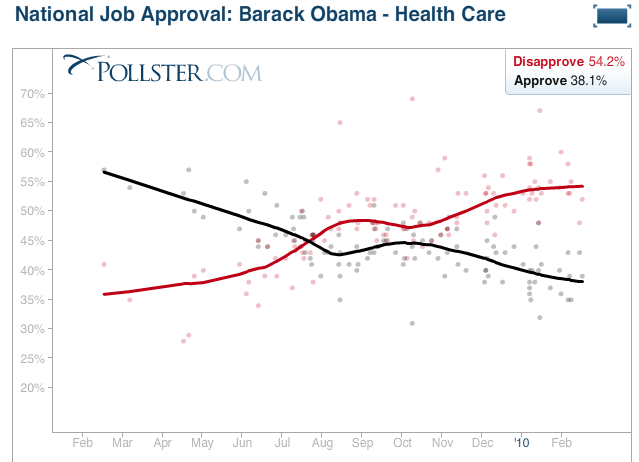
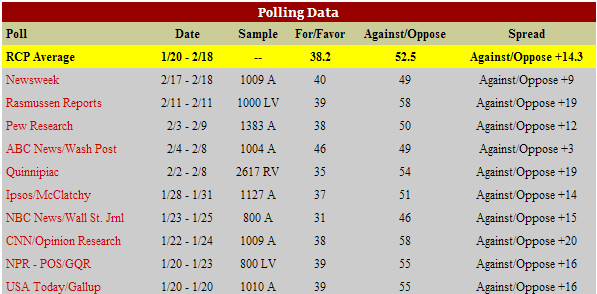
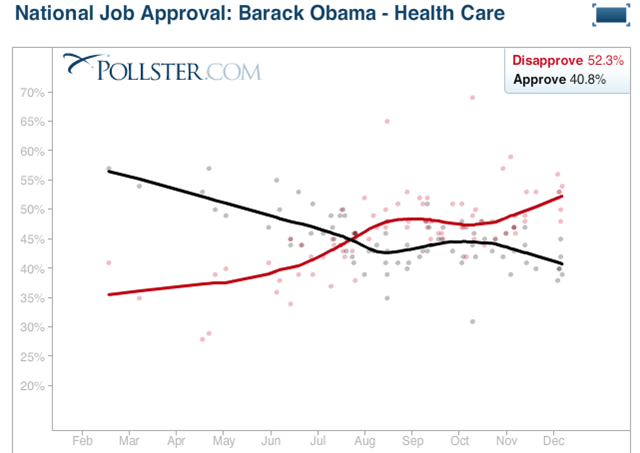
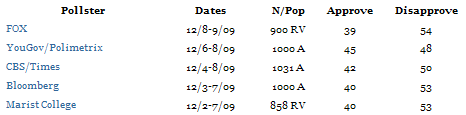
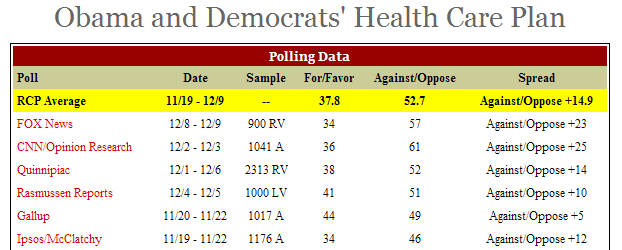
I cringe when I hear an Obamatron say that that the majority of Americans support the proposed changes to the healthcare system. 

Some stuff is nuanced, but that’s just a flat out, boldface lie !

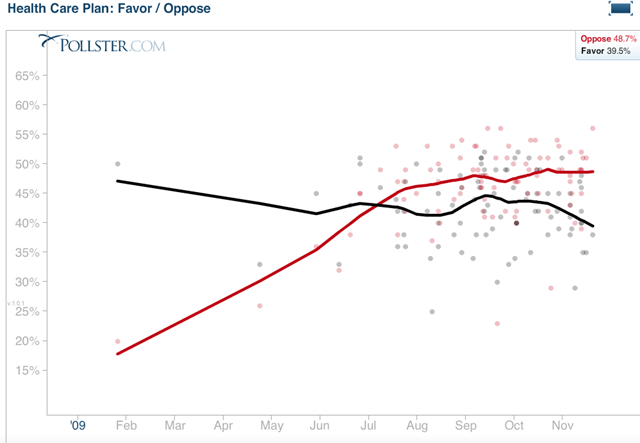
Below are Pollster.com’s poll-of-polls — with it’s increasing wide margin of disapproval — and a recap of all recent major polls. 

I guess our elected representatives don’t care — we just need to be protected from ourselves.

image

image

Pivoting away from jobs (again) … let’s raise taxes (a lot).

February 24, 2010

HomaFiles was all over this earlier this year: “Uh-oh. New Dem idea: Extending the Medicare tax to interest, dividends, and cap gains”
https://kenhoma.wordpress.com/2010/01/14/uh-oh-new-dem-idea-extending-the-medicare-tax-to-interest-dividends-and-cap-gains/

Bottom line: Not only will the tax rates on dividends and capital gains go up when the Bush tax cuts expire, but a funding source for ObamaCare will be application of MediCare payroll taxes to so-called “unearned income” — i.e. dividend and capital gains.

Here’s a point the WSJ missed: Many seniors live off of their retirement savings — English translation: dividends and capital gains.  Let’s gig the Seniors by extending their contributions’ stream for MediCare, but cutting the benefits. Nice.

Also, note that individuals will be responsible for both the “employee contribution” and the “employer contribution” since there’s no employer. Huh?

* * * * * 

Excerpted from WSJ: Obama’s New Investment Tax – A sneaky Medicare levy on dividends and capital gains, Feb. 24, 2010

The White House’s new health-care proposal’s fine print goes describes one of the largest tax increases in history.

This new ObamaCare bargain would for the first time apply the 2.9% Medicare payroll tax to “interest, dividends, annuities, royalties and rents,” so-called passive income that we are told includes capital gains.

This antigrowth investment tax … comes on top of the Senate’s 0.9-percentage-point increase in the payroll tax, which would bring the combined employee-employer share to a capital and jobs stiffling 3.8%.

The rate hike on investment income would presumably take effect at the same time the 2001 and 2003 Bush tax cuts are due to expire next year, bringing the top rate to 22.9% as the current top capital gains rate would also rise to 20% from 15%. That’s a 52% jump … and the rate can always be inched up later once the tax is already in place.

* * * * *

The White House levy muddies up both the tax code and Medicare financing.

The Medicare payroll levy was designed as a social insurance program with some connection, however attenuated, between taxes paid and benefits received.

When Medicare passed in 1965 it was modeled after Social Security and the tax was supposed to be equivalent to a “premium” for guaranteed health-care insurance for seniors; everyone “contributed” at the same rate.

Until 1993, the payroll tax was assessed only on the first $135,000 of wages … then the Clinton Administration and the Democratic Congress lifted the Medicare cap entirely.

The Clinton move was bad enough but Mr. Obama’s plan fundamentally changes the nature of the government’s health-care financing.

Medicare’s liabilities mean that it must receive injections of general revenue, but never before have Medicare’s own “dedicated” revenues been siphoned off to fund another entitlement.

Essentially, it turns Medicare financing into a wealth transfer program at a stroke.

Full article:
http://online.wsj.com/article/SB10001424052748704188104575083520811873704.html?mod=djemEditorialPage_h

You can’t make me do that …

February 23, 2010

Last week I noted that Virginia was about to enact a law outlawing the ObamaCare individual mandate which force a person to buy health whether the wanted it or needed it, or not. 

The states rights legislation is spreading like wildfire.

* * * * *

Excerpted from WSJ: Health Backlash in the States, Feb.  20, 2010

The backlash against ObamaCare is moving beyond the Tea Parties and has now arrived in state capitals.

In more than 30 states, legislators are proceeding to pass statutes or ballot initiatives that would guarantee the right to choose medical services and insurance.

These laws are generally called Health-Care Freedom Acts. If enacted, they will set off a Constitutional 10th Amendment fight over whether there are limitations on the powers of the federal government to regulate health care and override the protections in these state laws.

Almost all these measures would make it illegal for the government at any level to require a citizen of the state to purchase health insurance. This would let Americans opt out of any federal “individual mandate,” which makes people buy insurance or pay a tax, a la Massachusetts and both the House and Senate bills in Congress.

Second, the bills would guarantee the right of residents to pay directly for health services without incurring penalties or fines. This means citizens could go outside any government-run system to purchase private treatments from the doctor or hospital of their choice. Often, the federal Medicare program doesn’t let doesn’t let doctors charge extra for specialized care.

Virginia’s legislature has already passed such a law.

If Congress passes some version of health legislation, the federal law may pre-empt these state laws. But states do have the right to provide extra protections beyond what federal law guarantees. Many states, for example, have freedom of speech protections that go beyond federal law.

The major constitutional issue is whether Uncle Sam has the right to supercede state laws, based on the Commerce Clause of the Constitution, and compel Americans to join a federal health system, as they must with Social Security and Medicare.

Full article:
http://online.wsj.com/article/SB10001424052748704804204575069821900574214.html?mod=WSJ_Opinion_AboveLEFTTop

VA outlaws individual health insurance mandates … and that’s a big deal !

February 15, 2010

Excerpted from NY Times: Virginia Advances Legislation Against Insurance Requirement, February 10, 2010 and TheHill: Virginia moves to block federal insurance mandate, Feb.10, 2010

Virginia may become one of the first states to shield its residents from a proposed federal requirement that they purchase health insurance.

Virginia took another step on Tuesday toward becoming the first state to enact legislation to exempt its residents from a central feature of President Obama’s health care plan: a requirement that everyone buy health insurance or pay a penalty.

The measure is expected to be signed into law shortly by Gov. Bob McDonnell.

About two thirds of the states have some form of this legislation in the works, many of them constitutional amendments.

All seek to foil any attempt by the federal government — and the insurance industry — to make everyone buy insurance, a measure known as the individual mandate.

The mandate has proven exceptionally unpopular to healthcare critics on both the left and right. Liberals feel the mandate functions as a gift to private insurers, who would profit from an insurance requirement not linked to a public healthcare plan. Meanwhile, conservatives stress such a requirement is beyond federal lawmakers’ constitutional powers.

Supporters say the individual mandate is essential to making insurance affordable because it would expand the risk pool to include healthy people who don’t have insurance now.

  • Ken’s Translation: Mandate makes healthy people who consume few healthcare resources (mostly twenty-somethings) to buy expensive insurance in order to subsidize people who consume mucho healthcare resources(mostly old people). 

The law is murky because the United States Constitution establishes the supremacy of national law over state law.

Nonetheless, an individual mandate may be vulnerable in part because there is no precedent for such a requirement. Such a mandate may be impossible to enforce and that these state measures may only encourage citizens in their efforts to resist compliance.

Opponents of an individual mandate argue that is an overreach of federal authority and unconstitutional.

Robert Marshall, the delegate in Virginia who introduced the measure, quoted from the Federalist Papers and denounced the mandate as tyrannical.

“In 220 years, Congress has never tried to compel people to purchase any good or service,” he told his colleagues, according to a report in The Virginian-Pilot. “You are the sentinels of the lives, liberty and property of your constituents. I urge you to protect them against the usurpers in Washington, D.C.”

http://prescriptions.blogs.nytimes.com/2010/02/10/virginia-advances-legislation-prohibiting-insurance-requirement/

http://thehill.com/blogs/blog-briefing-room/news/79207-virginia-moves-to-block-federal-insurance-mandate

When political deals backfire … not the Cornhusker Kickback, the Pfizer Fiasco.

February 5, 2010

Bottom line: Rather than fight on principle, Pfizer decided to cut ObamaCare deals … and is now left holding the bag.  Talk about getting what you deserve !

* * * * *
Excerpted from WSJ : Pfizer’s Bad Political Bet, Feb 4, 2010

The sight of ObamaCare on life support has many Democrats disappointed. It could be worse. They could be Pfizer CEO Jeffrey Kindler.

The twin events of an Obama presidency and a financial crisis rattled corporate America.

Public anger put companies on the defensive. A liberal president vowing to punish firms that didn’t aid his agenda got companies scared.Fortune 500 execs could stand up for a free market that benefits consumers and shareholders, or hitch their cart to the new Democratic majority.

Pfizer’s Mr. Kindler is a case study in the hitch-and-hope mentality—a CEO who became the motivating force behind Big Pharma’s $80 billion “deal” on reform, and industry support of ObamaCare.

With that health agenda burning, the choice isn’t looking so grand.

Pfizer was long a company that zealously guarded against government interference.The Pfizer board made Mr. Kindler CEO in 2006—picking a … a Democrat and political junkie.  Mr. Kindler was primed for the Obama ascendancy.

Mr. Kindler heeded congressional threats that companies would do well to have more Democrat-heavy lobby shops. Pfizer also aggressively shifted political giving. According to OpenSecrets.org, in the 2006 campaign cycle it gave 33% of its money to Democrats. In the 2008 cycle, 52%. In the 2010 cycle so far, 61%. In 2009 Pfizer became the fourth largest federal lobbyist, spending nearly $25 million. The year before it hadn’t even made the top 20.

With these gestures, Mr. Kindler surely believed Democrats would treat his industry gently.

The strategy: The industry would pledge $80 billion to reform. In return it would get greater volume and a requirement that people buy brand-name drugs. Democrats would also fight against drug reimportation and forgo price controls.

No one pushed harder than Mr. Kindler. The CEO made no fewer than five trips to the White House last year. He pressed the industry’s $150 million ad campaign promoting ObamaCare, rolled out with liberal activist groups.

Critics warned the legislation would lead to a government takeover and price controls. They warned Democrats would take the money and double-cross them.

None of it phased the industry, right up until ObamaCare imploded.

Having got this far (with Big Pharma’s help), Democrats are more desperate than ever to pass “something.” It won’t include any upside for drug companies. There is talk instead of “popular” stand-alone legislation, including reimportation, Medicare price controls, and slashing the industry’s 12-year patent exclusivity on biologics.

Big Pharma can’t count on former conservative protectors. Republicans were sympathetic to its decision to “sit at the table,” but grew furious when it engaged in active advocacy of the Democratic agenda.

One House Republican staffer predicts the next time drug companies “ask us to stand in front of the train,” the answer will be: “Since you were so happy to work with Democrats, call them. Go on, go: Call Rahm [Emanuel]. Call [Henry] Waxman.”

Public anger over ObamaCare doesn’t help the industry’s reputation. Many Americans now view drug companies in the same light as “crony capitalist” banks or energy firms.

Mr. Kindler might take solace that he’s not alone. Insurers, hospitals, utilities — many chose to accommodate a president whose health-care and climate agendas are now teetering.

There’s a lesson here for corporate America. Try standing up for the free markets and limited government that have always been the foundation of U.S. business. It might work out better.

http://online.wsj.com/article/SB10001424052748704041504575045702997683276.html?mod=djemEditorialPage_h#articleTabs%3Darticle

Tanning salons sigh relief as bullseye shifts to big banks

January 21, 2010

Big winner from Mass results are tanning salons since taxing them was going to fund part of ObamaCare.  Maybe, just maybe, they dodged a bullet.

Now, the administration is picking on somebody its own size — the Wall street banks.

Since the announced “fee” on big banks got some populace traction, why not put on a full court press?

* * * * *

WSJ: Proposal Set to Curb Bank Giants, Jan. 21, 2010
 
President Barack Obama is expected to propose new limits on the size and risk taken by the country’s biggest banks, marking the administration’s latest assault on Wall Street in what could mark a return, at least in spirit, to some of the curbs on finance put in place during the Great Depression.

The past decade saw widespread consolidation among large financial institutions to create huge banking titans. If Congress approves the proposal, the White House plan could permanently impose government constraints on the size and nature of banking.

The goal would be to deter banks from becoming so large they put the broader economy at risk and to also prevent banks from becoming so large they distort normal competitive forces.

Mr. Obama is also expected to endorse measures which would place restrictions on the proprietary trading done by commercial banks, essentially limiting the way banks bet with their own capital.

The proposal could have the biggest effect on Bank of America Corp., Wells Fargo & Co., and J.P. Morgan Chase & Co., which control a large amount of U.S. deposits, as well as Goldman Sachs, Morgan Stanley and Citigroup Inc., which have a large presence on Wall Street.

The rules could also keep banks out of the business of running hedge funds, investing in real estate or private equity, all businesses that have become important, profitable parts of these banks.

If investors believe the new rules could take effect, they could sell off the shares of most of the big financial stocks in the belief these companies would be facing years of turmoil and potentially lower profits.

The White House proposal would seek to return the “spirit of Glass Steagall,” meant to limit large banks from becoming too big and complex that create enormous risk.

Full article:
http://online.wsj.com/article/SB10001424052748704320104575015910344117800.html?mod=WSJ_hps_LEFTWhatsNews

Bumper sticker says it all …

January 18, 2010

image

If you're an Amish union member living in Nebraska (with elderly parents living in Florida) … this plan's for you.

January 15, 2010

If you’re keeping track of the special ObamaCare deals:

States have to pay for extended Medicaid — except Nebraska. 

Seniors lose Medicare Advantage — except in Florida. 

Everybody must buy healthcare insurance — unless they’re Amish — since the Amish have a religious objection to insurance.

And, in the latest backroom deal, Cadillac health insurance plans face a 40% excise tax — unless the insured is in a union … at least until 2018.

I figure that by the time all of the special deals are cut and  this junk law is passed,  Lloyd Blankfein (CEO of Goldman Sachs) and Jamie Dimon (CEO of JP Morgan) will only two people in America without a special deal —  and will be paying  for the entirety of the ObamaCare program.

Maybe that’s a good thing.

Here are details …

Source: NY Post: Another Rank Deal, January 15, 2010

What happens when the irresistible force of the Democratic urge to tax runs up against the immovable object of Democratic loyalty to the labor unions?

Another ugly deal in a health-care bill that already was a grotesquerie of pay offs to favored politicians and interests. The levy in question is a 40 percent excise tax on high-end employer-provided insurance plans that – typically – has been sold as a tax on “the rich.” It’s called the “Cadillac tax,” a name redolent of corporate executives cackling in their Escalades over their cushy benefits.

The unions, which make it a point to negotiate generous insurance plans with their employers (to the point of bankrupting them), were chagrined to learn that for purposes of this tax, they’re among the rich. They howled in terms that could have been drawn from Henry Hazlitt’s free-market classic, Economics in One Lesson: The Shortest and Surest Way to Understand Basic Economics.

The excise tax is supposed to be paid by evil insurers and employers. Except in this one case affecting their self-interest directly, the unions see through the fiction and understand that the tax will trickle down onto them. How disorienting to hear unions implicitly recognize that corporations ultimately don’t pay taxes, their customers and employees do.

“While the excise tax is slated to be imposed on the insurers on so-called high cost plans, the tax will be passed on to enrollees in the form of higher premiums, co-pays or reduced benefits,” a coalition of public-employee unions wrote congressional leaders. “Characterizing this tax proposal as a ‘Cadillac tax’ is a misnomer. It hits the average blue collar and white collar employee.”

The unions also bristled at a fairly typical trick of liberal taxation – bracket creep. The Cadillac tax affects few people when it begins in 2013. Since it’s not indexed to account for the ever-rising expense of health care, though, it will catch more and more people over time.

This is why New York Times columnist Bob Herbert called it “a middle-class tax time bomb,” and Nancy Pelosi made an oblique reference to Pres. Barack Obama breaking his promise not to increase taxes for anyone making less than $250,000 a year. Obama’s support for the Cadillac tax not only violates that forlorn pledge, but directly contradicts one of his chief lines of attack against John McCain in the 2008 campaign.

McCain wanted to end the tax exemption for employer-provided insurance coverage and compensate people with a tax credit to buy their own plans, a systematic approach to controlling costs and increasing choice. Obama’s plan will increase costs and reduce choice, but he needs $150 billion in revenue over ten years to try to make it look deficit-neutral, so he’s – as he put it in his unrelenting anti-McCain ads – “taxing health benefits for the first time in history.”

But pressure from the unions has now forced the White House to agree to raise the $23,000-per-household threshold of the tax slightly and – more importantly – exempt insurance plans that are the product of collective-bargaining agreements until 2018. This Labor Loophole stands in the finest tradition of the Louisiana Purchase and the Cornhusker Kickback. With no possible public-policy justification, it puts the awesome power to tax and spend at the service of nakedly political ends.

Oliver Wendell Holmes famously said that taxes are the price of civilization. In this case, taxes are the price of not belonging to a group that pours countless millions of dollars into the Democratic coffers. Under the Cadillac tax, there’s one set of rules for the Service Employees International Union and another for everyone else.

Obama is currently haranguing the banks so he doesn’t get pegged as a “Wall Street Liberal.” The more dangerous rubric for him is a “Washington Liberal,” a politician knee-deep in the special-interest politics of the Beltway as he pushes an unpopular agenda of rapid government expansion. Obama’s style of politics has gone from inspiring to revolting in the space of a year.

http://www.realclearpolitics.com/articles/2010/01/15/another_rank_deal_99912.html

The perils of ‘free’ …

January 14, 2010

Punch line: Economists have shown that if a good’s price is zero or decreasing, then the demand for this good will likely increase. And, that applies to healthcare.

* * * * *

Excerpted from American.com: The High Cost of No Price, January 12, 2010

A simple chart shows why healthcare spending has gone out of control. The graph shows out-of-pocket payments by consumers and spending by Medicaid, Medicare, and private insurers on healthcare from 1965 to 2008.

image 

In 2008, consumers were only directly responsible for 11.9 percent of total national healthcare expenditures, down from 43 percent in 1965.   This means that someone other than consumers pays roughly 88 percent of all healthcare costs, giving consumers little incentive to mind costs and much incentive to over-consume.

Since the passage of Medicare in 1965, consumers’ out-of pocket spending on healthcare has decreased steadily as a percentage of overall U.S. healthcare spending. While real and nominal out-of-pocket healthcare payments increased over the period, growth in these costs was dwarfed by a much more rapid growth in overall spending. On average, consumers’ out-of pocket healthcare costs increased 6.7 percent each year, while national healthcare expenditures increased by an average 9.8 percent each year.

By contrast, increases in expenditures by private insurers, Medicaid, and Medicare accounted for the majority of this excess cost growth — since 1965, private insurers’ spending has increased by an average 10.8 percent annually, Medicaid spending has increased by an average 15.4 percent, and Medicare spending has increased by an average of 15.6 percent each year. The rate of growth in both Medicare and Medicaid spending far outpaces the rate of growth in out-of-pocket and private insurance costs.

When people aren’t exposed to the true cost of their care — even if they pay for it in foregone wages and higher taxes — they consume more.

It’s that simple.

Full article:
http://www.american.com/archive/2010/january/the-high-cost-of-no-price

Uh-oh. New Dem idea: Extending the Medicare tax to interest, dividends, and cap gains.

January 14, 2010

I don’t know how I missed this one. 

In the secret WH talks re: reconciling the House and senate bills, another taxing idea slipped out:

Boosting the Medicare payroll tax – either by increasing the rate or extending it to unearned income – is still a live option, according to sources familiar with the talks. 
http://www.politico.com/news/stories/0110/31480.html#ixzz0caQSCeWR

“They” like to call it unearned income.  We  income taxpayers (i.e. the minority) like to call it interest, dividends and capital gains — earnings previously sheltered from FICA and Medicare.

Now, this is getting personal.

Want to opt out of ObamaCare? … Declare yourself Amish.

January 13, 2010

This is getting nuttier by the day. 

States have to pay for extended Medicaid — except Nebraska. 

Seniors lose Medicare Advantage — except in Florida. 

Cadillac health insurance plans face a 40% excise tax — unless the insured is in a union. 

And now, everybody must buy healthcare insurance — unless they’re Amish — since the Amish have a religious objection to insurance. 

Anybody know how to become Amish?

Hmmm.  What if you’re just allergic to insurance?

* * * * *
Sourced from Watertown Daily Times: Amish families exempt from insurance mandate, Jan. 9, 2010

Federal health care reform will require most Americans — but not all — to carry health insurance or risk a fine. People with religious objections can opt out

For example, Amish families  are free from that requirement.

They, as well as some other religious sects, are covered by a “religious conscience” exemption, which allows people with religious objections to insurance to opt out of the mandate.  The provision is in both the House and Senate versions of the bill, making its appearance in the final version routine unless there are last-minute objections.

Amish people generally rely upon a community ethic that disdains government assistance. Families rely upon one another, and communities pitch in to help neighbors pay health care expenses.

Lawmakers reportedly included the provision at the urging of Amish constituents, although the legislation does not specify that community and the provision could apply to other groups as well, including Old Order Mennonites and perhaps Christian Scientists.

Congressional aides said the exemption is based on a carve-out the Amish have had from Social Security and Medicare taxes since the 1960s. Whether Amish businesses, however, would fall under the bill’s mandates is still an open question.

Sen. Charles E. Schumer, D-N.Y., who was a key negotiator on the Senate bill, supports the religious exemption, and called the provision a “no brainer.”

Note: the Amish do buy vehicle insurance. 

Hmmm.  Must be for buggies since they don’t drive cars.

Source article:
http://www.watertowndailytimes.com/article/20100109/NEWS02/301099964

Memo to C-Span: “Take a hike. I was just kidding” (update)

January 8, 2010

OK, whether you’re for ObamaCare or against it, you gotta feel a bit squimish that the bill is being crafted in secret — literally behind locked doors — with rushed votes that preclude reps from reading it.

Now, President Obama is “hands on” in the process — with some of the meetings taking place at the White House — in secret, of course.

C-Span has offered to televise all of the negotiations.  A logical offer since candidate Obama pledged to hold all of the negotiations in public and ,explicitly promised — on several occasions — to televise them on C-Span

Here are 2 clips  that are worth watching …

Candidate Obama mash-up of the repeated, explicit promise to televise the negotiations:
http://www.breitbart.tv/the-c-span-lie-did-obama-really-promise-televised-healthcare-negotiations/

Commentary by left-leaning Jack Cafferty of CNN:
http://www.realclearpolitics.com/video/2010/01/07/cnns_cafferty_rips_obama_openness_pledge_as_a_lie.html

Heath care prescription: more doctors, enabled RNs and PAs, way less paperwork

January 7, 2010

Punch line: According to honchos from Johns Hopkins and Emory Med Schools, health insurance doesn’t guarantee health care — we need initiatives to boost the ranks of physicians and make all physicians more productive.

* * * * *

Excerpted from Baltimore Sun Times: Prescription: more doctors, January 1, 2010

That 30 million Americans may soon be able to obtain health care insurance is at the core of the Senate and House health care bills.

But let’s be clear: “insurance” doesn’t guarantee “care.”Indeed, the legislation is giving “bus tickets” – that is, health insurance – to uninsured Americans. But there are no buses running on those routes.

Without important changes in how many doctors we produce and how we pay to train them, millions of newly insured Americans will simply not have access to a physician.

In fact, we don’t have enough doctors for the 256 million Americans who are insured right now.

The U.S. Department of Health and Human Services notes that the United States has a current shortage, at minimum, of 16,000 primary care physicians.

Some facts:

The U.S. medical schools train about 27,000 new doctors a year.

Today, the overall number of physicians in the U.S. is lower than the average per capita number of doctors in other nations such as Sweden, Denmark, Spain and France, and we now “import” some 25% of our physicians from other countries.

According to HHS, overall demand for physician services will increase an estimated 22% between 2005 and 2020, and the United States will face a shortage of more than 125,000 physicians in the next 15 years.

http://online.wsj.com/article/SB10001424052748703483604574630321885059520.html?mod=djemEditorialPage

* * * * *

The solution is to increase the supply of physicians, especially those in primary care and general surgery … and to increase Medicare-funded residency slots for physicians.

Already, the nation’s medical schools have pledged to increase enrollment by 30 percent by 2015.

Training slots for residents have been capped at present levels for more than a decade.

An increase of 15,000 positions would produce an additional 40,000 physicians over the next 10 years, helping the nation manage the projected shortage by 2025 of 125,000 physicians. And unless we significantly expand training positions, the number of physicians per capita will begin to decrease in the next 10 years.Moreover, there are other steps we can take:

Double the number of National Health Service Corps awards.

Under this program, medical school tuition is paid off by physicians agreeing to practice for several years in underserved areas.

This would not only help with the supply issue, but the more persistent problem of how doctors are distributed around the country. There are plenty of physicians in high-income ZIP codes in the United States. The shortage is most acute in rural areas where access is difficult and where the poverty level is high.

Changing doctors’ traditional practice model.

Nurse practitioners and physician assistants should be more fully integrated into clinical practice, handling the simple, uncomplicated cases. This would allow the physician to spend more time managing patients with chronic and complex conditions.

The new best-practice model should include designing a “medical home” for all patients, utilizing – and paying – all health professionals as part of team that coordinates care, enhances efficiency and increases patient satisfaction.

Cutting through the “hassle factor” of medical administrative costs.

An in-depth survey published in the journal Health Affairs in May showed physicians spend an average of three hours a week on the phone or corresponding with insurance claims adjusters.

Nowhere addressed seriously in House and Senate legislation are the paperwork and multiple insurance claim forms that many physicians name – along with other administrative issues – as their No. 1 complaint.The cumulative cost of the time physicians spend interacting with insurers is $23 billion to $31 billion annually – money and time that could be better spent on direct patient care.

* * * * *

As the House and Senate conferees refine legislation promising new benefits to 30 million Americans, we trust that, unlike the bus tickets to nowhere, attention is focused on funding and training a health care workforce that guarantees access to all.

Dr. Michael M.E. Johns is university chancellor and professor in the schools of Medicine and Public Health at Emory University. Dr. Edward D. Miller is dean and CEO of Johns Hopkins Medicine.

Full article:
http://www.baltimoresun.com/news/opinion/oped/bal-op.doctors01jan01,0,7827816.story

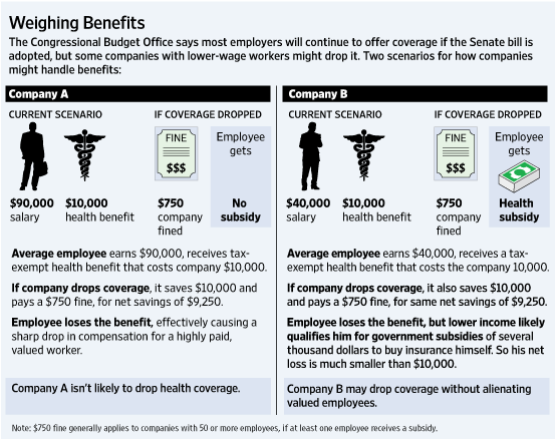
Behavioral Economics: Why companies will drop their health insurance plans …

January 7, 2010

Nice examples that cut to the chase …

click to enlarge

image
From WSJ, Businesses Brace for Health Bill’s Costs, Dec. 23, 2009 
http://online.wsj.com/article/SB126153353820802365.html?mod=WSJ_hpp_LEFTTopStories

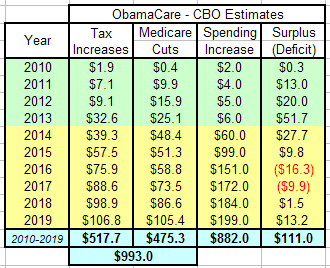
Funding ObamaCare … taxes going up, up, up

January 6, 2010

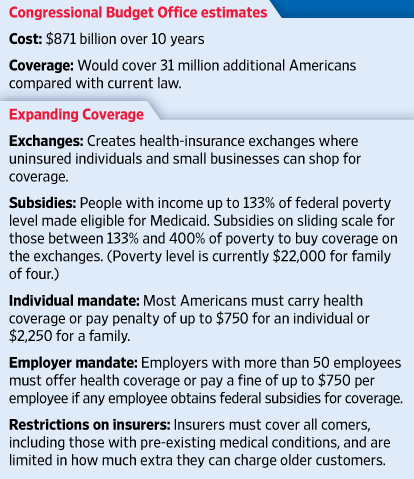
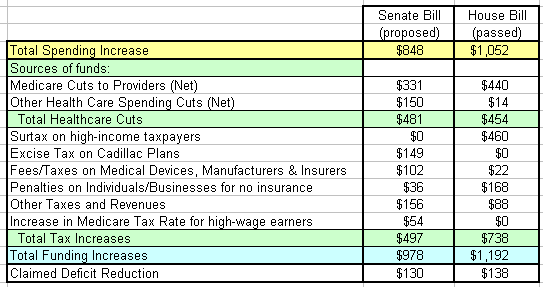
Based on the CBO scoring (before discovery of double-counting the Medicare savings):

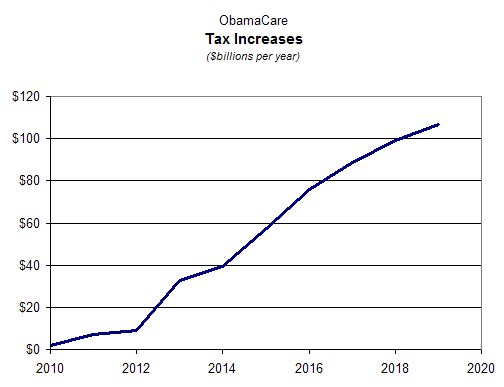
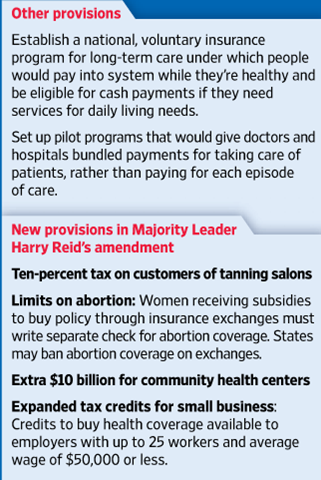
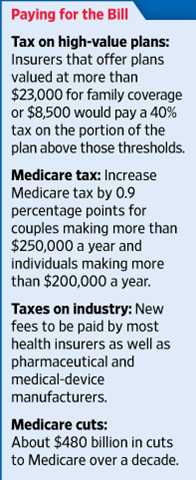
Almost $1 trillion in additional government spending over 10 years … funded roughly half from Medicare cuts and half from tax increases … with the tax increases on a sorry trajectory.

Draw your own conclusions.

image

image

Uh-oh … Mayo Clinic to Medicare Seniors: "Sorry, cash only"

January 5, 2010

Ken’s Take: The Mayo & Cleveland Clinics are frequently cited as ObamaCare’s best practice models. Yesterday, the Mayo Clinic in Arizona stopped taking Medicare patients — unless they’re willing and able to pay CASH out of their own pockets.  Oops.

Why?

The Centers for Medicare and Medicaid Services cautioned that, under the proposed benefit cut, “providers for whom Medicare constitutes a substantive portion of their business could find it difficult to remain profitable and might end their participation in the program (possibly jeopardizing access to care for beneficiaries).”
http://www.investors.com/NewsAndAnalysis/Article.aspx?id=517004

So, Americans who have paid into the Medicare system for their entire working lives end up paying for health care out of their own pockets. Is that fair?

* * * * *

Excerpted from Bloomberg News: Mayo Clinic in Arizona to Stop Treating Some Medicare Patients , Dec. 31, 2009

The Mayo Clinic, praised by President Barack Obama as a national model for efficient health care, will stop accepting Medicare patients at one of its primary-care clinics in Arizona, saying the U.S. government pays too little.

More than 3,000 patients eligible for Medicare … will be forced to pay cash if they want to continue seeing their doctors at a Mayo family clinic in Glendale.

A Medicare patient who chooses to stay at Mayo’s Glendale clinic will pay about $1,500 a year for an annual physical and three other doctor visits, according to an October letter from the facility. Each patient also will be assessed a $250 annual administrative fee.

* * * * *

Obama has frequently cited the nonprofit Rochester, Minnesota-based Mayo Clinic and the Cleveland Clinic in Ohio for offering “the highest quality care at costs well below the national norm.”

Mayo’s move to drop Medicare patients may be copied by family doctors, some of whom have stopped accepting new patients from the program.

“Many physicians have said, ‘I simply cannot afford to keep taking care of Medicare patients … If you truly know your business costs and you are losing money, it doesn’t make sense to do more of it.”

Medicare Loss

The Mayo organization lost $840 million last year on Medicare. The program’s payments cover about 50 percent of the cost of treating elderly primary-care patients at the Glendale clinic where “Medicare payments no longer reflect the increasing cost of providing services for patients.”

* * * * * *

Nationwide, doctors made about 20 percent less for treating Medicare patients than they did caring for privately insured patients in 2007.

Medicare covered an estimated 45 million Americans at the end of 2008.

While 92 percent of U.S. family doctors participate in Medicare, only 73 percent of those are accepting new patients under the program .

There not enough new doctors becoming family doctors, internists and pediatricians who oversee patients’ primary care.

“Some primary care doctors don’t have to see Medicare patients because there is an unlimited demand for their services … When patients with private insurance can be treated at 50 percent to 100 percent higher fees … then Medicare does indeed look like a poor payer.”

Full article:
http://www.bloomberg.com/apps/news?pid=20601070&sid=aHoYSI84VdL0

Mayor Bloomberg boils down the healthcare bill … in 2 sentences !

December 31, 2009

Key Point: NYC Mayor Michael Bloomberg — a supporter of healthcare reform — criticizes the bill’s lack of transparency, sensibility, and consequences

* * * * *

Many who have long touted health care reform are turning up their noses at the final product.

Michael Bloomberg, New York’s independent mayor, told “Meet the Press” over the weekend:

I have asked congressperson after congressperson. Not one can explain to me what’s in the bill, even in the House version … And so for them to vote on a bill that they don’t understand whatsoever, really, you’ve got to question how — what kind of government we have.”

The mammoth 2,100-page health care bill passed by the Senate “makes no sense whatsoever — not to conservatives, not to liberals, not to anyone.”

“Rather than reform a system that everyone agrees is a failure, it will subsidize that system and compel participation in it.”  

Mr. Bloomberg added that his own reading of the Senate bill led him to conclude that it would blow a hole in the New York State budget and force closure of perhaps 100 health clinics.

Excerpted from WSJ: Like Mushrooms, Health Care ‘Reform’ Flourishes in the Dark, Dec. 28, 2009
http://online.wsj.com/article/SB10001424052748703278604574624230633163104.html?mod=djemEditorialPage

Nelson’s political right-to-life threatened by a Cornhusker Rebellion …

December 31, 2009

Everybody in earth orbit knows that Sen Ben Nelson of Nebraska sold his right-to-life principles for a couple of hundred million dollars and cast the deciding vote for ObamaCare.  Apparently, he expected Nebraskans to savor the Medicaid bribe he took on their behalf.  Oops.

It looks like the Nebraska senator’s health-care vote may have killed him politically.

A new Rasmussen Reports poll — the first state-wide poll since the controversial deal he cut in exchange for his deciding vote on the Senate health care bill –shows that if he were running for re-election today, Mr. Nelson would lose to Nebraska’s GOP Governor David Heineman by a stunning 61% to 30%.

Only three years ago, Mr. Nelson won his current term with a solid 64% of the vote.

Clearly, the senator’s fall in public esteem is a direct reaction to his having voted for the health care bill as part of a deal in which Nebraska was exempted from the costs of new federal Medicaid mandates.

The ObamaCare bill was already unpopular enough in Nebraska but became even more so when state residents discovered they would be saddled with it anyway, plus exposed to national ridicule over Mr. Nelson’s sweetheart deal.

Now 53% strongly oppose the bill, while another 11% somewhat oppose it.

Only 17% favor the deal that Mr. Nelson struck in order to vote for the bill.

But the poll also shows a path to redemption.

Asked how they would vote in the 2012 election if Senator Nelson changed his vote and prevented the health care bill from becoming law, Nebraska voters give Governor Heineman a lead of only 47% to 37% … that simply reversing his health-care vote immediately reduces Mr. Nelson’s deficit by two-thirds.

“The poll suggests the anger of Nebraska voters is deep and unusually intense, and not likely to dissipate quickly.”

No doubt it was precisely his concern about the unpopularity of the bill back home that prompted Mr. Nelson to hedge his bets when he announced he would support it — he made clear at the time he might not vote for it again if the final compromise between House and Senate versions tilts too far to the left.

Given the shocking slump in his standing back home, Mr. Nelson might like to keep those remarks handy during the coming weeks as the two bills are hammered together.

Source: WSJ, Ben Nelson’s Purgatory, Dec. 30, 2009
http://online.wsj.com/article/SB10001424052748704152804574628591826272498.html?mod=djemEditorialPage

Ken’s Bet: Nebraska voters are just teasing Nelson with the ray of hope if he changes his vote.  The voters seem more principled than the Senator and smart enough to know that if he betrayed their trust once, he’ll do it again.  In 2013, Nelson will be a high paid lobbyist or Obama’s Ag Secretary.

Unintended consequences? About limiting insurance companies to 20% of premiums on admin and comp …

December 23, 2009

Reid thinks he was really clever with the ObamaCare provision that limits insurance companies to spending 20% or less of premiums collected on SG&A — sales, general & admin costs — including exec comp.

Ken’s Bet: It’ll cause healthcare costs and premiums to go up.  Here’s why …

Assume that Acme Insurance currently collects $7.5 million in premiums — pays out $5.25 million to healthcare providers (docs, hospitals, pharmacies, etc.) — and spends $2.25 million (30%) on SG&A.

Reid thinks his rule will cut premiums by about $1 million — thanks to a roughly $1 million cut in SG&A.

WRONG !

Here’s a more likely outcome:

Acme holds its SG&A constant and simply starts selling more liberal plans (maybe all the way up to the Cadillac limit) to force fit within the 20% limit — for example, Acme charge $11.25 million in premiums to cover $9 million in payouts ( lower co-pays & deductibles, more botox) and allow $2.25 of SG&A (20% of $11.25).

PRESTO!

Rather than healthcare costs coming down and premiums getting reduced, premiums and healthcare expenditures go up by 50% … SG&A stays the same … insurance execs still drive fancy cars.

Ken’s Take: The DC boneheads have zero conception of how businesses run …

Reprise: The looming Medicaid tsunami …

December 23, 2009

I posted this a couple of weeks ago —  an editorial by the head of Johns Hopkins. 

His view: A vast expansion of the Medicaid program — without adequate risk-adjusted reimbursement rates — will impose unsustainable costs on healthcare providers.

With the Senate bill on its way to passage, it’s worth a re-read — a prediction of what’s to come from somebody who knows.

* * * * *
Excerpted from WSJ:  Health Reform Could Harm Medicaid Patients, Dec. 4, 2009 

Both the House and Senate health-care reform bills call for a large increase in Medicaid—about 18 million more people will begin enrolling in Medicaid under the House bill starting in 2013.

A flood of new patients will be seeking health services, many of whom have never seen a doctor on more than a sporadic basis. Some will also have multiple and costly chronic conditions. And almost all of them will come from poor or disadvantaged backgrounds.

Johns Hopkins’  Priority Partners handles Medicaid patients under a capitated system — that is, it receives a set payment per individual per month from the state.

Over time, we’ve developed the ability to manage the care of these individuals in a way that is both cost effective and that provides them with quality care. We’ve done it by tapping into our extensive delivery system, which includes four hospitals, a nursing home, the largest community-based primary care group in Maryland, and much more.

We’ve hit above-national benchmarks on all clinical quality measures, reduced monthly costs for patients with substance abuse and highly complex medical needs, and 70% of our patients tell us they’re satisfied with our care.

The key fact is that for years the state did not cover all the costs our Medicaid program incurred. As a result of new patients whose costs were not completely covered by the state, Priority Partners lost $57.2 million from 1997 to 2005.

We stanched the losses by ensuring that the payment from the state was appropriately risk adjusted to match the health conditions of our members, and by investing heavily in primary-care and care-management and disease-management programs.

Yet this past year the losses began again, because the state expanded the program’s eligibility to 116% of the federal poverty level up from 40%.

So we are struggling with a large group of new patients—about 30,000 people. Today, like in the late 1990s, a health-care surge is overwhelming our managed-care system. The capitated rate for the new beneficiaries is not yet risk-adjusted. Priority Partners has lost a devastating $15 million in just nine months.

Congress can help, or at least learn from our experience to use the reform legislation to bend the cost curve if it encourages other states to institute and appropriately fund capitated systems that allow capable providers to adjust payments based on risk. The key is that federal support to states for Medicaid must appropriately adjust rates to match the risk of providing health care to the group of people who are covered by Medicaid.

The Senate bill would increase eligibility for Medicaid to those who make 133% or less of the federal poverty level. The Kaiser Family Foundation reports there are 308,000 people who meet that threshold in Maryland.

Even if only half of those individuals seek Medicaid coverage, such a large expansion would likely have an excruciating impact on the state’s budget.

Without an understanding by policy makers of what a large Medicaid expansion actually means, and without delivery-system reform and adequate risk-adjusted reimbursement the current health-care legislation will have catastrophic effects on those of us who provide society’s health-care safety-net.

In time, those effects will be felt by all of us.

Full article:

http://online.wsj.com/article/SB10001424052748703939404574567981549184844.html?mod=djemEditorialPage

Going for the capillaries (and not the jugular): Nailing the tanning salons

December 22, 2009

There was an interview on one of the biz shows yesterday — a poor stiff who owned a couple of tanning salons.

They guys was pale .  (Pardon the pun) 

He said: “life savings in the salons … eeking out a living … getting slammed by the recession since tanning is as discretionary as spending gets … was stunned to hear about the 10% tax … will probably have to shut down”

When asked “Were your lobbyists asleep at the switch?”, he answered “Are you kidding, what lobbyists?”

Maybe it’s a good idea to shut down tanning salons — frankly, I don’t have a point of view on that one.

But, raises a couple of questions:

1) How much tax revenue will be raised via the tanning salon tax if all the tanning salons close?

2) Is it right for the full force of the government to come down on a piddly business like tanning salons?

3) Why not tatoo parlors?  Or, funnel cake stands?  Or, (fill in the blank)

Hands off Wall Street, big insurance, big pharma, etc., but nail the tanners … Geez.

Key provisions of the Senate healthcare bill ..

December 21, 2009

Below is the WSJ’s summary.

Big deals:

  • Roughly $50 billion per year each from tax increases and Medicare cuts
  • Massive expansion of Medicaid … estimated 1/2 of the newly insured
  • Roughly 10 million “young healthies” who self-insure mandated to buy insurance
  • .9% increase in Medicare taxes if over $250,000
  • Excise tax on Cadillac insurance plans (except for longshoremen)
  • $10 billion for community health centers

Ken’s Favorite: 10% tax on tanning salons

Pay-offs for votes:

  • Nebraska, Louisiana, Vermont and Massachusetts are getting more federal help with Medicaid than other states. In the case of Nebraska — represented by Sen. Ben Nelson, who’s providing the critical 60th vote for the legislation to pass — the federal government is picking up 100 percent of the tab of a planned expansion of the program, in perpetuity.
  • Florida’s beneficiaries of Medicare Advantage plans — the private managed-care plans within Medicare —  will have their benefits grandfathered in thanks to a provision tailored by Sen. Bill Nelson.
  • Longshoremen were added to the list of workers in high-risk professions who are shielded from the full impact of a proposed new tax on high-value insurance plans.

 From the WSJ: 

image

image image
http://online.wsj.com/public/resources/documents/info-enlargePic07.html?project=imageShell07&bigImage=wsj_healthpol091220.gif&h=569&w=959&title=WSJ.COM&thePubDate=20080826

Can’t blame Bush for this one …

December 21, 2009

The politics of healthcare reform are simply amazing. 

Over 3/4s of Americans are reasonably satisfied with their healthcare insurance and the healthcare they receive — and they expect taxes to go up, insurance premiums to go up, and healthcare to get worse with longer waits and more denied services. 

Still, the Senate passed — on a straight party line vote — a law that roughly 2 out of 3 Americans oppose. 

Now they — the Democrats in general and Pres. Obama specifically — “own” the healthcare system.  Rightly or wrongly, every premium increase, every delayed doctor’s appointment, every service denied, etc., will be chalked up to ObamaCare.  Turnabout is fair play !

* * * * *
Excerpted from RCP: Democrats Risk Another Jacksonian Moment, December 21, 2009

Democratic leaders are courting disaster with this health care bill. With it, they’ve moved their questionable wheelings and dealings from the margins to the center of American life. Consider some of the special deals:

Nebraska, Louisiana, Vermont and Massachusetts are getting more federal help with Medicaid than other states. In the case of Nebraska — represented by Sen. Ben Nelson, who’s providing the critical 60th vote for the legislation to pass — the federal government is picking up 100 percent of the tab of a planned expansion of the program, in perpetuity.

Florida’s beneficiaries of Medicare Advantage plans — the private managed-care plans within Medicare —  will have their benefits grandfathered in thanks to a provision tailored by Sen. Bill Nelson.

Longshoremen were added to the list of workers in high-risk professions who are shielded from the full impact of a proposed new tax on high-value insurance plans.

We might be on the verge of another Jacksonian moment: a time when the people awake from their slumber, angrily exercise their sovereign authority, and mercilessly fire the leaders who have for too long catered to the elites rather than average people.

In true Jacksonian fashion, the country fired the Republicans in 2006 and 2008 because they bungled the war in Iraq and allowed the economy to sink into recession.

The people might soon have another Jacksonian moment, and fire these equally useless Democrats for hampering the recovery, exploding the deficit, and playing politics with health care.

The fact that the President can’t find a single Republican vote out of more than 200 potential supporters is a strong indication that this is a bad bill.

Ben Nelson sits in the middle of the Senate. He could be a Democrat or a Republican. If he were a Republican, but everything else about him were the same, would he have voted for this? Of course not. That should tell you everything you need to know about this bill: partisanship and pay-offs. 

Full article:
http://www.realclearpolitics.com/horseraceblog/2009/12/democrats_risk_another_jackson_1.html

About the Cadillac excise tax …

December 18, 2009

Ken’s Take: I’m a big fan of the so-called Cadillac tax — not because it hacks off the unions (that’s a lucky strike by-product) — but because it it about the only vehicle being discussed that might contain some healthcare costs. 

In fact, I’m an advocate of putting all company paid premiums on W-2s and then allowing taxpayers reasonable deductions for health insurance premiums (say, $5,000 per person).

And, as a political junkie, I love when WH spokepeople contradict each other, e.g. Summers: recession is over”, Romer: “no, it’s not”.  Here’s another example …

* * * * * *

Excerpted from WSJ: White House v. White House,  Dec.18, 2009 

The ad hoc arguments that WH spokesmen use to put out one healthcare political fire invariably contradict those they’re using to put out another.

Among labor’s complaints is a 40% excise tax on high-cost insurance plans, given that union-negotiated benefits are more generous than average.

So Jason Furman, the deputy economic director, declared that this so-called Cadillac tax “will affect only a small portion of the very highest cost health plans — a total of 3% of premiums in 2013.”

But wait: White House budget director Peter Orszag has been emphasizing the excise tax as critically important in the cost-control stone soup that he’s been trying to sell.

As he put it earlier this month, “You’re creating an incentive for plans for employers to design their plans in such a way that they’re under that threshold. . . . You’re creating an incentive to slow the growth rate in private health costs.”

So a tax that applies to 3% of premiums is going to reshape the entire health-care market? These guys can’t even get their blog posts straight.

The White House brain trust seems to have been placed in a blind trust, and is finding it so hard to make a coherent case.

* * * * *

Mr. Furman used to advocate policies that really would make a difference, by “helping consumers become more cost conscious about their health-care choices,” as he put it in a 2007 Brookings paper. He estimated that increasing cost-sharing could lower total health spending from 13% to 30%.

Full article:
http://online.wsj.com/article/SB10001424052748704238104574602191760050978.html?mod=djemEditorialPage

If people were cars, healthcare would be fixed …

December 17, 2009

TakeAway: The problem with health care is not that we can’t afford insurance. The problem is that we can’t afford health care.

* * * * *

Excerpted from Reason: The Problem is Cost of Care – Understanding America’s dysfunctional health care system, December 10, 2009

The U.S. has the world’s most expensive health care, $8,000 per person per year, eating up 16 percent of our GDP.

There are many ways of paying these costs, of course, ranging from private insurance such as Blue Cross to public insurance such as Medicare. Many people pay out of their pockets, and local and state taxpayers pick up the rest.

The problem is that health care costs have increased at an annual rate double, or more than double, the rate of inflation for the last two decades.

Right now, our attempts at reform are doomed by a law of accounting physics: Insurance can’t cost less than the health care it insures.  That means that subsidizing insurance likely makes the problem worse.  

Consider: I have car insurance. But my insurance doesn’t pay for oil changes.

Instead, I go down to the Happy Lube, without an appointment, get a diagnosis of the needs of my car, and choose services based on a price list published online.

Now, if I fail to get my car’s oil changed, or to perform other needed services, the engine will be damaged. That’s expensive to fix, but my insurance does not cover the costs. I bear the costs, so I care for the engine.

Health care is a little different.

Many of us have “engines,” or other parts, that may not work very well, especially as we grow older.

Things happen that may not be our fault, and even if they are we’d like to be able to buy some insurance against the worst consequences, the catastrophic injuries or illnesses that are part of every human society. The problem is that how we pay affects how much we pay.

Again, compare it to car insurance, for two people.

Imagine neither of us has to pay for our car repairs, from accidents or engine wear. We can go to the garage as often as we like, and get whatever service we want, for free.

The car repair shop can charge our insurance whatever they want, because insurance pays everything. An oil change would bill out at $600; an alignment would bill our insurance $2,200, with another $800 tacked on to pay for micro-digital wheel axis imaging.  

Of course, the services aren’t really free. At the end of every year, we sum the total repair costs for both people, and each of us pays half of that total.  

The cost of that free car care would be enormous, because of all the unnecessary and overly expensive charges. Of course, the government could subsidize the final bill; would that help? The answer is no, for two clear reasons.

First, having the government (meaning taxpayers) subsidize the total would do nothing to reduce the runaway cost increases. Buyers won’t shop around if they don’t know or care about real costs. Subsidies mean I don’t pay if I spend, and I don’t save if I’m frugal.

Second, let’s expand the example from two people (each paying half) to 300 million people getting free care (but paying an equal share of total costs). We have met the public option, and it is us! Once we are all paying ourselves, there is no one else to hit up to help with the costs. We are simply taking each person’s money in taxes, then giving some of it back in subsidies. There is no saving, even to individuals.

The French economist, Frederic Bastiat, diagnosed the problem long ago when he said, “The public option is the conceit that each of us should have free health care at the expense of all of us.”

The solution is out there, but it will require a fundamental change in the way we think.

Competition among insurers, without decreases in underlying medical costs, may actually harm people through bad service and arbitrary denial of claims.

Instead, we need competition among medical providers, just like oil change services now.

LASIK surgery, one of the few areas of medical services open to competition and listed prices, has fallen in cost by 70 percent or more in the last 15 years. And quality has gone up dramatically.

Walk-in clinics and fee-for-service arrangements for check-ups, or simple diagnoses like strep throat or  infected thumbs, are already widely available, cost relatively little, and require no appointment.

Subsidizing insurance is a terrible idea. But that is the main focus of the health care reform bills passed by the House, and now being considered in the Senate.

Why pin all our hopes on an approach that can’t possibly succeed?

Full article:
http://reason.com/archives/2009/12/10/the-problem-is-cost-of-care

Digitizing the healthcare market … one doc at a time.

December 16, 2009

Bottom line: Why not fix what’s broken rather than just creating mayhem ?

* * * * * 

Excerpted from WSJ: Health Care’s ‘Radical Improver’, Dec. 12, 2009

Choice & Rationing

For all the talk about expanding coverage, the real problem is that “You can’t buy what you want.”

(Politicians are) living in this alternate universe where there’s no such thing as a market in health care and they don’t understand why one might be remotely useful.”

The profound problem with U.S. health care is that there’s “no landscape of choices, or choosers.” Due to the complexity of America’s third-party laundromat for health dollars—your doctor’s clerical staff bills your treatment to an insurance company picked by your employer, and it pays him with your money via premiums or foregone wages—”few doctors in America know the actual value of the services they render.”

The government imposes standardized rules and mandates with no concern for how much they will cost or who will bear the burden. Given the choice, consumers might decide on cheaper policies that cover some services but not others, or decide to run more risk.

Another way of putting it is that if the politicians have their way, “everyone will have access to transportation, and it will be a black Escalade, with spinners. That’s it. There’s no Hyundais, no bicycles, no nothing.”

And that’s scandalously unfair. “These poor people who clip the things off the backs of cans to make the tomatoes cheaper are subsidizing the hypochondriac who gets his shoulder done with an arthroscope because it clicks when he serves at tennis.”

Under ObamaCare, Mr. Bush says, “everyone is going to get health care according to the wise-men benefit panel, who will tell you exactly what it is, and then they’ll run out of money, so every year the wise panel will just squish the benefit a little. People will start to say, well, that’s not going to work for me.”

Central health planning won’t have any longevity, and eventually people “will start leaking out into the [private] market once we run out of money.”

* * * * *

A Digital Revolution ?

Now, most transactions are conducted on paper. Few people really understand how to navigate the dense and bewildering coding rules for dozens of different insurers or the fee schedules for government payers like Medicaid. Claims were denied with no explanation or vaporized in purgatory.

One reason the digital revolution has so far passed over the health sector is sheer bad product. The adoption of EMR in health systems across the country has been dogged by cumbersome interfaces, error propagation and other drawbacks.

Much of the the nearly $47 billion in stimulus cash the White House has budgeted to prime the pump for health IT adoption is going to legacy software companies, with code that was written in the ’70s.  They’re getting federally sponsored life support.

The irony is that … the status quo for all its flaws is capable of organic change and real progress without the blunt-force trauma Congress is likely to inflict. Or in spite of it.

Athena is one of the country’s most innovative health IT firms. Its core business helps doctors manage their practices and get paid, but the larger purpose of the company, is to try to shore up health care’s resemblance to a normal market.

Athena designed a program to digitize records and automate billing. It now colonizes the wilderness of paperwork and habitual financial chaos that defines running a doctors office, and it is also moving into clinical record-keeping for individual patients. Some 15,000 physicians in 43 states use Athena as a virtual office, a number that is growing at an annual 30% clip.

It is a massive logistical undertaking. Athena’s main facility is housed in a decommissioned World War II arsenal on the Charles, where 30,000 pounds of paper is processed every month, most of the tonnage being paper checks.

Incredibly, doctors also receive on average 1,185 faxes each month—mostly lab results—and those are handled too.

State Medicaid programs, by the way, are easily the worst payers. In New York, for instance, claims must be tendered on a dead-tree form instead of electronically and in blue ink—black is grounds for rejection—and then go on to spend a full 161 days, or almost a half year, in accounts receivable.

While streamlining this disorder frees up time for the company’s clients to treat patients, it also throws off vast data, which are fed in central servers, aggregated and analyzed.

This “athenanet” system is among the few health-tech offerings based on “cloud computing”—in the sense that the applications are accessed on the Web, instead of a computer’s hard drive, allowing constant updates and refinements. If a regulation changes or an insurer adjusts a payment policy, it is reflected on athenanet almost in real time; on the clinical side, the program can adapt at the same rapid pace as medicine itself.

Full article:
http://online.wsj.com/article/SB10001424052748704240504574586260904799386.

Healthcare reform … historic firsts … uh-oh.

December 16, 2009

Excerpted fron RCP: The Liberals’ Weaselly Panic, by Rich Lowry, December 15, 2009 

President Obama and Harry Reid can rightly claim to be making history.

If he passes health-care reform, they’ll depend on a series of historic “firsts.”

  • It’d be the first time Congress had passed a major new entitlement program without bipartisan support;
    [Unless you count the Congressional dude from Louisiana.]
  • It’d be the first time it passed such a program without popular support;
    [A CNN poll last week found the public against it by a nearly 2-1 margin.]
  • It’d be the first time that such a large-scale program would be passed without anybody knowing (or particularly caring) what’s in it.
    [This is bipartisanship Harry Reid style – nontransparency for everyone. Who needs openness and legislative details when you’re remaking one-sixth of the economy?’

Full article:
http://www.realclearpolitics.com/articles/2009/12/15/the_liberals_weaselly_panic_99557.html

An open letter to Sen. Mark Warner …

December 15, 2009

I received the following “personal” email from Sen. Mark Warner (D-VA).

Ken —

I wanted to take just a moment of your time to provide an update on my efforts to improve the Senate health care reform bill.

I led 10 other Senate freshmen on Tuesday in announcing a package of amendments which will we believe will encourage a broader — and quicker — shift toward a more innovative, 21st Century health care system.

[couple of paragraphs of talking points]

I was elected to bring common-sense reforms to government. I will only support a final bill if I am convinced it will lower the deficit, drive down health care costs over the long term, and improve the value and quality of the health care Virginians receive.

Thanks,
Mark Warner

Since I don’t think he reads my emails to him, I thought I’d give you a peek at my reply.

Mark —

I have 3 questions for you:

(1) When you ran a company, did you run debt ratios comparable to those you’re now foisting on American taxpayers?

(2) Aren’t you supposed to be representing the people of Virginia? 

According to the most recent Rasmussen survey, 54% of Virginians oppose the health care plan proposed by the president and congressional Democrats … 85% of them (46% of the total) strongly oppose the proposed healthcare plan.

(3) Do you think the 28% of Virginians who strongly favor the proposed health care proposal will be enough to re-elect you? 

Please stop voting like a lemming and keep your commitment to bring “common-sense reforms to government”.

Thanks,

Ken Homa

I’ll keep you in the loop when “Mark” replies.

* * * * *

Rasmussen Reports

54% in Virginia Oppose Health Care Plan, December 09, 2009

A new Rasmussen Reports survey of Virginia voters finds that 54% oppose the health care plan proposed by the president and congressional Democrats … 85% of them (46% of the total) strongly oppose the proposed healthcare plan.

Forty-five percent (45%) favor the plan …  only about 1 in 4 people in the total sample strongly favor the plan.

http://www.rasmussenreports.com/public_content/politics/general_state_surveys/virginia/54_in_virginia_oppose_health_care_plan

Democracy in action: “Damn the will of the people!” … say, what?

December 14, 2009

Elections have consequencesyou elected us (hah-hah) …  now, we’ll do what we damn well please (because we’re way smarter and way more moral than you are) … and, oh yeah, we won’t even let you see what we’re doing (you can’t handle the truth)

That’s what the politicians seem to be saying these days.

Practically every poll — save for ones fabricated by NBC, CBS, ABC — say the same thing: a CLEAR MAJORITY of Americans DISAPPROVE of current ObamaCare plans. RealClearPolitics’ poll of polls have the approve-disapprove split approaching 2/3s – 1/3.

Do the Washington nitwits really think that there won’t be mayhem and backlash if they ram in their half-baked programs?

Go figure.

image

image

http://www.pollster.com/polls/us/jobapproval-presobama-health.php?xml=http://www.pollster.com/flashcharts/content/xml/USObamaJobPresHealth.xml&choices=Disapprove,Approve&phone=&ivr=&internet=&mail=&smoothing=&from_date=&to_date=&min_pct=&max_pct=&grid=&points=1&lines=1&colors=Disapprove-BF0014,Approve-000000,Undecided-68228B

image
http://www.realclearpolitics.com/epolls/other/obama_and_democrats_health_care_plan-1130.html#polls

Got Blue Cross – Blue Shield? … Then get out your wallet if ObamaCare passes.

December 11, 2009

TakeAway: Another study predicts higher insurance prices.  The culprit: adverse selection.

* * * * *

Excerpted from WSJ: Blue Cross Blue Patients, Dec 5, 2009

The Blue Cross Blue Shield Association has found that premiums in the individual market will rise on average by 54% over the status quo, which translates into an extra $3,341 a year for families and $1,576 for singles.

The Congressional Budget Office also found this week that ObamaCare will boost premiums in the individual market by as much as 13%. But the White House called that a triumph because the higher costs will be offset by taxpayer subsidies that will be transferred to the federal balance sheet.

The Blue Cross study is in fact more precise than CBO’s because it is based on real market data, rather than modeling assumptions. The association mined the actuarial data from its six million individual or small-business policies, nearly one-eighth of those sold in the U.S.

Lo and behold, Blue Cross found costs will rise if Democrats force insurers to cover anyone who applies and then limit how much insurers are allowed to charge based on age or health condition. Economists call this adverse selection; people will wait until they’re sick to buy coverage, and the Democratic rules make it perfectly rational for them to do so. 

The reality is that all health-care costs are ultimately borne by consumers, whether through more expensive premiums, lower wages or higher taxes.

The regulatory schemes favored by Democrats can’t change that law of economics …

Full article:
http://online.wsj.com/article/SB10001424052748704007804574574170859847850.html?mod=djemEditorialPage

Just consider it tough love …

December 10, 2009

Anti-ObamaCare groups have started running ads in swing states (Louisiana, Arkansas, Maine) targeted at healthy young adults who currently choose to self-insure for healthcare — that is, they realize that healthcare insurance is — for them — way most costly than just “paying retail” for the limited healthcare services they use.

Under ObamaCare, all of these folks will be “mandated” (i.e. forced) to buy health insurance.  If the insurance costs more than 12% of their earnings, then they get taxpayer subsidies to close the gap. 

The ads hit the point that these young healthies will — in effect — be subsidizing the folks whose healthcare expenses exceed their premiums.

* * * * *

Click arrow to watch


The looming Medicaid tsunami …

December 8, 2009

TakeAway: A vast expansion of the Medicaid program — without adequate risk-adjusted reimbursement rates — will impose unsustainable costs on healthcare providers.

* * * * *

Excerpted from WSJ:  Health Reform Could Harm Medicaid Patients, Dec. 4, 2009 

Both the House and Senate health-care reform bills call for a large increase in Medicaid—about 18 million more people will begin enrolling in Medicaid under the House bill starting in 2013.

A flood of new patients will be seeking health services, many of whom have never seen a doctor on more than a sporadic basis. Some will also have multiple and costly chronic conditions. And almost all of them will come from poor or disadvantaged backgrounds.

Johns Hopkins’  Priority Partners handles Medicaid patients under a capitated system — that is, it receives a set payment per individual per month from the state.

Over time, we’ve developed the ability to manage the care of these individuals in a way that is both cost effective and that provides them with quality care. We’ve done it by tapping into our extensive delivery system, which includes four hospitals, a nursing home, the largest community-based primary care group in Maryland, and much more.

We’ve hit above-national benchmarks on all clinical quality measures, reduced monthly costs for patients with substance abuse and highly complex medical needs, and 70% of our patients tell us they’re satisfied with our care.

The key fact is that for years the state did not cover all the costs our Medicaid program incurred. As a result of new patients whose costs were not completely covered by the state, Priority Partners lost $57.2 million from 1997 to 2005.

We stanched the losses by ensuring that the payment from the state was appropriately risk adjusted to match the health conditions of our members, and by investing heavily in primary-care and care-management and disease-management programs.

Yet this past year the losses began again, because the state expanded the program’s eligibility to 116% of the federal poverty level up from 40%.

So we are struggling with a large group of new patients—about 30,000 people. Today, like in the late 1990s, a health-care surge is overwhelming our managed-care system. The capitated rate for the new beneficiaries is not yet risk-adjusted. Priority Partners has lost a devastating $15 million in just nine months.

Congress can help, or at least learn from our experience to use the reform legislation to bend the cost curve if it encourages other states to institute and appropriately fund capitated systems that allow capable providers to adjust payments based on risk. The key is that federal support to states for Medicaid must appropriately adjust rates to match the risk of providing health care to the group of people who are covered by Medicaid.

The Senate bill would increase eligibility for Medicaid to those who make 133% or less of the federal poverty level. The Kaiser Family Foundation reports there are 308,000 people who meet that threshold in Maryland.

Even if only half of those individuals seek Medicaid coverage, such a large expansion would likely have an excruciating impact on the state’s budget.

Without an understanding by policy makers of what a large Medicaid expansion actually means, and without delivery-system reform and adequate risk-adjusted reimbursement the current health-care legislation will have catastrophic effects on those of us who provide society’s health-care safety-net.

In time, those effects will be felt by all of us.

Full article:
http://online.wsj.com/article/SB10001424052748703939404574567981549184844.html?mod=djemEditorialPage

Your health insurance premiums will go down $2,500 … Not !

December 1, 2009

Candidate Obama said repeatedly that his healthcare reforms would bring down family insurance premiums by $2,500.
http://blogs.wsj.com/health/2008/07/23/parsing-obamas-promise-to-lower-insurance-premiums-by-2500/

The CBO analysis of the Reid Senate bill concludes that many folks premiums will go up, not down.

Oops.

* * * * *

Excerpted from Washington Post Online, CBO: Senate health plan will increase some premiums — and expand coverage, Nov. 30, 2009

The Senate’s plan to overhaul the health insurance system would increase premiums in the individual market … and six in 10 families would have their premium payments subsidized, congressional budget analysts said.

By 2016, two years after the Senate reforms are to take effect, the CBO projected that premiums for 32 million people in the individual insurance market would be driven as much as 30 percent higher because insurance companies would be required to offer better coverage than they do now.

But that increase would be partially offset by lower costs for insurers, who would have access to a new pool of younger, healthier customers who might previously have gone without insurance.

The result: Nongroup premiums on average would increase by about 13 percent compared with current law, to $5,800 for individuals and $15,200 for family coverage. But the CBO predicts that 57 percent of purchasers in that market would also be receiving federal subsidies that would cover roughly two-thirds of that cost, leaving them paying 60 percent less for insurance than if the legislation were not enacted.

But Republican Senate leader Mitch McConnell said: “At the beginning of the health care debate, we were told that this trillion-dollar experiment would lower premiums for American families.And yet just this morning, the independent Congressional Budget Office provided an analysis showing that the Democrat bill will actually increase premiums for American families.So a bill that’s being sold as a way to reduce costs actually drives them up.”

“The bottom line is this: after 2,074 pages and trillions more in government spending, massive new taxes and a half-trillion dollars in cuts to Medicare for seniors, most people will end up paying more or seeing no significant savings.”

Full article:
http://voices.washingtonpost.com/capitol-briefing/2009/11/cbo_senate_health_plan_will_in.html

“Open Enrollment” … finally, I actually looked at my health insurance costs … you should, too!

December 1, 2009

I’m embarrassed to admit that, in the past, I just hadn’t given much thought to my company provided health care insurance.

The premiums – or more precisely, my share of the premiums – seemed reasonable, our docs were on the plan, and the plan covered our needs fairly. Every year, I simply continued the coverage I had in place the prior year.

Since I’ve gotten deep into the health care reform fiasco, I was more diligent this year.

Below is what I found, and far below are some observations re: Cadillac insurance plans.

* * * * *

The Plans

My employer offers 3 plans that are relatively comparable in coverage.  See the chart below for premium details.

The 3 plans differ slightly in co-pays, deductibles, limits, etc., but I concluded that the differences aren’t “statistically significant”. (Note: I didn’t even consider the lowest cost alternative – a Kaiser HMO).

image

First, note that – depending on the specific plan — my employer pays somewhere between 59% and 77% of the total premiums – employees pay between 41% and 23%.   I’m told that the split is comparable to most company plans – with the COMPANIES paying at least half of the premiums, often more, sometimes much more.

The shocker was the range in total premiums by carrier – for roughly equivalent coverage.  For example, the UHS premium for a couple ($15,376) is more than $6,000 higher (almost 70%) than the premium from CareFirst Blue Shield ($9,088).

Note that there’s a modest “marriage penalty”.  The total premiums for a couple are more than twice the individual premiums – by about 10%.

If you’re going to have kids, you might as well have a lot of them.  The family rate is 3 times the individual rate, regardless of the number of children in the family.  Hmmmm.

On balance, the premium levels are about what I expected.  Per capita health care expenditures average a bit over $7,000 – pretty much in line with UHS – the high cost provider.

I’d been riding along with United Healthcare (UHS).  I knew they were premium priced, but I didn’t realize by how much. Ouch.  My shiny new CareFirst card is in the mail, and my projected 2010 disposable pay is plus $4,000 … not bad.

Teaching point: Do the homework when selecting healthcare insurance plans.  There’s serious money involved.

* * * * *

Cadillac Plans

Company paid premiums are not subject to income taxes.  I think that’s unfair (to folks paying 100% of their policy’s premiums), and arbitrary (it sure looks like compensation).  I’m all for rolling company paid premiums into W-2s,  giving taxpayers an exclusion – say, $3,000 for individuals, $6,000 for couples, $10,000 for families, and then income-taxing the balance.

While the approach is different (largely to “hide the weenie”), I agree with the spirit of the Senate bill.  Taxing Cadillac plans can raise some money, and might start to cap the upside on coverage.  In effect, the folks getting the best health care benefits have to ante in to support folks who get none or relatively little.  Seems fair to me.

The Senate proposal is to levy a 40% tax on the excess of premiums over $8,500 a year for individuals or $23,000 for families.  If anything, the levels – which were set to outboard lucrative union plans  —  are too low – probably by a factor of 2 based on my company plans.

Side note: I haven’t heard or seen anything that distinguishes between premiums paid by individuals and premiums paid by companies.  Obviously, premiums paid by an employee aren’t wages to be taxed.

The healthcare bills … get out your wallets !

November 30, 2009

There are so many numbers being thrown around re: healthcare costs and the proposed ObamaCare proposals that’s it’s easy to lose the forest in the trees.

Here’s what you need to know … in round numbers.

First, U.S. healthcare expenditures average a bit over $7,000 per capita.

There are roughly 47 million uninsureds – but that number includes, for example, illegal immigrants who Pres. Obama says won’t be covered.  The proposed Senate bill covers 30 million uninsureds.

So, by simple arithmetic, the annual gross cost to cover the 30 million is about $210 billion – 30 million times $7,000.

Now, it starts to get tricky.

Reid proposes a $848 bullion increase in government healthcare spending over 10 years; Pelosi passed a bill north of $1 trillion across 10 years. (See chart below)

But, both bills delay the start of benefits for 4 years, so there are only 6 years of benefits in the 10 year projections.

The implication: Reid’s bill costs about $140 billion per year once it’s up & running;  Pelosi’s bill costs about $165 billion. For simplicity, we’ll strike an average and round down to $150 billion.

Now, $150 billion is less than the $210 billion it costs to cover 30 million uninsureds ar $7,000 a pop.  How can that be?

Well, some of the newly covered uninsureds will be paying their own way — in total or in part.   For example, some healthy young folks who can afford health insurance but make an economically rational choice to self-insure.  They’ll be “mandated” to buy insurance – and fined or jailed if they don’t.  Other folks will get taxpayer subsidized insurance but – based on means tests – will have to pay part of the premiums. 

My take: the spending estimates are probably reflective of what the bills say – the projections “haircut” the costs of the 30 million uninsureds and add in the costs of building and running the forthcoming government bureaucracy (think electronic medical records and thousands of watchdogs and claims processors pirated from the DMV and IRS).

That’s the spending.  How will it be paid for?

In round numbers, they’re talking about $1 Trillion of new spending … financed about 1/2 from heathcare cuts (mostly MediCare) – and about 1/2 from higher taxes. 

Taxes are projected to go up about $50 to $75 billion per year.  Healthcare cuts are estimated to be about $50 billion per year. (Keep in mind that the tax increases and healthcare cuts start immediately, benefits are delayed until year 5).

So, over the first 10 years, the early-starting cuts and taxes balance out against the late-starting benefits to the uninsureds … and even provide some excess taxes to pay down the deficit. (yeah, right !)

But, what happens each year, starting in year 5 when the benefits begin?

Well, based on the above calculations, the are $150 billion per year in increased spending, but only $100 billion per year in compensating healthcare cuts and tax increases.

Oops.

Looks like another $50 billion in healthcare cuts (i.e. rationing) and tax increases are coming down the pike.

That, my friends is all you need to know.

* * * * *

Here’s a simple “sources & uses” statement.  All numbers in billions.  Read ‘em and weep …

             Click to enlarge
image
http://www.taxfoundation.org/blog/show/25527.html

Support for healthcare plans drops below 40% …

November 30, 2009

Based on Pollster.com’s “poll of polls”, almost half the country opposes the proposed healthcare plan(s) … and fewer than 4 in 10 folks favor it (or “them”).

Still, our elected representatives in DC keep pushing forward any way, to legislate “the will of the people”.

Anybody see a contradiction in there ?

image
http://www.pollster.com/polls/us/healthplan.php

Rationing? What rationing ?

November 25, 2009

TakeAway: The flap over breast cancer screening has provided a fascinating insight into life under ObamaCare.

* * * * *

Excerpt from WSJ: Liberals and Mammography, Nov.24, 2009

The political left supports medical rationing even as it disavows that any such thing is happening.

No sooner had the Health and Human Services Department’s U.S. Preventative Services Task Force recommended against mammography for women under 50 than Secretary Kathleen Sebelius rushed to say don’t worry.

The New York Times, ran at least four much-ado-about-nothing items even as it endorsed the reduced screening.

What’s really going on here is that the left knows its designs will require political rationing of care, but it doesn’t want the public to

Americans will simply have to accept that the price of government-run health care in the name of redistributive justice is that patients and their doctors must bow to the superior wisdom of HHS task forces.

http://online.wsj.com/article/SB10001424052748704779704574552320222125990.html

Why doesn’t Pro-Choice extend to mammograms and pap smears?

November 25, 2009

I don’t get it.

Liberal Dems (think Rep. Wasserman-Schultz from Florida) assert that women have the “right” to a tax payer funded elective abortion.  

I disagree with her, but that’s not my point.

Last week, guidelines were announced (and pulled back) that would limit government reimbursements for mammograms and pap smears.

If a women has a right to choose what happens to her body when it comes to abortions, shouldn’t she have the right to choose a potentially life saving diagnostic test? 

Why should the government say yes to the former, and no or maybe to the latter?

Anybody else notice the irony ?

Snookered: about that abortion funding amendment

November 17, 2009

Rep. Bart Stupak, an avid pro-lifer, led the effort to get the PelosiCare bill amended to specifically exclude funding of abortions.

When the amendment passed, about 40 Dem pro-lifers became comfortable voting for the bill,

Even before the ink dried, the pro-choicers went on the attack.  Dem leaders quelled the couter-insurrection by hinting that the provision would be stricken when the Senate and House bills went “to conference”.

Now, according to Axlerod (on Fox News nonetheless), Pres. Obama will aid and abet stripping abortion language from any healthcare bill.  In doing so, the president would be heeding the call of abortion rights supporters like Planned Parenthood that have called the White House their “strongest weapon” in keeping such restrictions out of the bill.

* * * * *

Question #1: Didn’t Stupak smell this one coming? 

Answer: No.  He assumed a certain honor among thieves.

Silly boy.

* * * * *

Question #2: Why did he Congressional GOPers vote in favor of the Stupak Amendment?  If they had voted no and it failed to pass, then the Dem pro-lifers would have voted against the bill.

Answer: Reportedly, GOP pro-lifers gave Stupak their word that they’d vote in favor of the amendment and didn’t want to go back on their word.

Silly boys (and girls)

* * * * *

Full article:
http://www.foxnews.com/politics/2009/11/15/axelrod-signals-obama-try-strip-abortion-language-health-care/