Archive for the ‘KEH Points-of-View’ Category

Energy – T. Boone Picken’s Plan

July 10, 2008

T. Boone Picken’s Plan to Escape the Grip of Foreign Oil
OpEd excerpted from the WSJ July 9, 2008

T. Boone Pickens has started running TV ads explaining the severity of the energy crisis and touting wind power as a quick, partial solution.  His WSJ OpEd spells out his plan:

“Each year we import more and more oil. In 1973, the year of the infamous oil embargo, the United States imported about 24% of our oil. In 1990, at the start of the first Gulf War, this had climbed to 42%. Today, we import almost 70% of our oil … [So] our economic engine is now 70% dependent on the energy resources of other countries, their good judgment, and most importantly, their good will toward us.

This year, we will spend almost $700 billion on imported oil, which is more than four times the annual cost of our current war in Iraq … if we don’t do anything about this problem, over the next 10 years we will spend around $10 trillion importing foreign oil. That is $10 trillion leaving the U.S. and going to foreign nations, making it what I certainly believe will be the single largest transfer of wealth in human history.

I have a clear goal in mind  … to reduce America’s foreign oil imports by more than one-third in the next five to 10 years.

Start with wind power  …  the U.S. has the capacity to generate 20% of its electricity supply from wind by 2030 …  [take] the energy generated by wind and use it to replace a significant percentage of the natural gas that is now being used to fuel our power plants.

Today, natural gas accounts for about 22% of our electricity generation in the U.S.  …  use new wind capacity to free up the natural gas for use as a transportation fuel. That would displace more than one-third of our foreign oil imports.

Natural gas is the only domestic energy of size that can be used to replace oil used for transportation, and it is abundant in the U.S. It is cheap and it is clean. With eight million natural-gas-powered vehicles on the road world-wide, the technology already exists to rapidly build out fleets of trucks, buses and even cars using natural gas as a fuel. Of these eight million vehicles, the U.S. has a paltry 150,000 right now.

[To get started] the government must mandate the formation of wind and solar transmission corridors, and renew the subsidies for economic and alternative energy development .

We need action. Now.”

                                      * * * * *

Observations:

1. Gotta like the guy’s passion and clarity of thought.  And, he puts his money where his mouth is – in ads and development capital.

2. Why not? Doesn’t solve the problem completely, but at least it hacks away at it.  No apparent downside. Doesn’t conflict with political agendas. 

3.  My bet? Politicos will take Picken’s ad quote “we can’t drill our way out of the problem” out of context and use it to support drilling bans. 

4. Watch: Congress will convene hearings on wind power and drag their feet.

                                   * * * * * 

Full story at:
http://online.wsj.com/article/SB121556087828237463.html?mod=opinion_main_commentaries

Thanks to Christian Walker (MSB MBA alum) for the heads-up on the article

Want more from the Homa Files?
 Click link =>  The Homa Files Blog
Energy – T. Boone Picken's Plan

July 10, 2008

T. Boone Picken’s Plan to Escape the Grip of Foreign Oil
OpEd excerpted from the WSJ July 9, 2008

T. Boone Pickens has started running TV ads explaining the severity of the energy crisis and touting wind power as a quick, partial solution.  His WSJ OpEd spells out his plan:

“Each year we import more and more oil. In 1973, the year of the infamous oil embargo, the United States imported about 24% of our oil. In 1990, at the start of the first Gulf War, this had climbed to 42%. Today, we import almost 70% of our oil … [So] our economic engine is now 70% dependent on the energy resources of other countries, their good judgment, and most importantly, their good will toward us.

This year, we will spend almost $700 billion on imported oil, which is more than four times the annual cost of our current war in Iraq … if we don’t do anything about this problem, over the next 10 years we will spend around $10 trillion importing foreign oil. That is $10 trillion leaving the U.S. and going to foreign nations, making it what I certainly believe will be the single largest transfer of wealth in human history.

I have a clear goal in mind  … to reduce America’s foreign oil imports by more than one-third in the next five to 10 years.

Start with wind power  …  the U.S. has the capacity to generate 20% of its electricity supply from wind by 2030 …  [take] the energy generated by wind and use it to replace a significant percentage of the natural gas that is now being used to fuel our power plants.

Today, natural gas accounts for about 22% of our electricity generation in the U.S.  …  use new wind capacity to free up the natural gas for use as a transportation fuel. That would displace more than one-third of our foreign oil imports.

Natural gas is the only domestic energy of size that can be used to replace oil used for transportation, and it is abundant in the U.S. It is cheap and it is clean. With eight million natural-gas-powered vehicles on the road world-wide, the technology already exists to rapidly build out fleets of trucks, buses and even cars using natural gas as a fuel. Of these eight million vehicles, the U.S. has a paltry 150,000 right now.

[To get started] the government must mandate the formation of wind and solar transmission corridors, and renew the subsidies for economic and alternative energy development .

We need action. Now.”

                                      * * * * *

Observations:

1. Gotta like the guy’s passion and clarity of thought.  And, he puts his money where his mouth is – in ads and development capital.

2. Why not? Doesn’t solve the problem completely, but at least it hacks away at it.  No apparent downside. Doesn’t conflict with political agendas. 

3.  My bet? Politicos will take Picken’s ad quote “we can’t drill our way out of the problem” out of context and use it to support drilling bans. 

4. Watch: Congress will convene hearings on wind power and drag their feet.

                                   * * * * * 

Full story at:
http://online.wsj.com/article/SB121556087828237463.html?mod=opinion_main_commentaries

Thanks to Christian Walker (MSB MBA alum) for the heads-up on the article

Want more from the Homa Files?
 Click link =>  The Homa Files Blog

Oil Econ: Losing Our Financial Independence ?

July 9, 2008

Pump Prices Hurt Americans Not Just in Pocketbook

Highlights from the WSJ July 8, 2008

Referencing a McKinsey Research Study


“Both presidential candidates are focusing on the economy this week, and for good reason: $4-a-gallon gasoline has Americans sliding into pocketbook shock.


But pain at the pump is only one reason energy now should be the central issue of this year’s campaign. Here’s the other, more insidious one: High oil prices are shredding America’s financial independence and producing a massive transfer of wealth from U.S. pocketbooks into the hands of suspect actors around the world, including Iran, Venezuela and Russia.


The U.S., in other words, now has an energy problem that is not only draining the bank accounts of its own citizens, but filling up the bank accounts of some who work against American interests around the globe … Oil-producing countries are accumulating piles of excess cash that they can use — and are using — to buy pieces of Western companies … (to buy) the  U.S. Treasury bonds that finance the federal government’s budget deficit (foreigners buy 80% of all newly issued Treasury bills) … (and) to advance anti-American political [and military] agendas.


To their credit, Sens. John McCain and Barack Obama are trying to raise awareness of the corrosive national-security effects of oil prices. In his recent centerpiece address on energy, Sen. McCain declared: “When we buy foreign oil, we are enriching some of our worst enemies.” As far back as last fall, Sen. Obama said in a speech that money spent on foreign oil “corrupts budding democracies and allows dictators from hostile regimes to threaten the international community.” 
                                              * * * * *

Observations:


1.  Right now, about 1/3 of US oil is sourced domestically, about 1/3 comes from friendly nations (Canada, Mexico), and about 1/3 from problematic nations.  Let’sdrive less and drill more to at least cover the most problematic 1/3 of our consumption.


2. Both candidates have to stop parsing words and make the issue visceral —  e.g. “roughly $1 of each gallon of $4 gas goes into the pocket of folks who don’t like us and want to hurt us”  — “what are the prospects for long-term job security if US companies are increasingly foreign-owned?”


3. Shouldn’t the Congress be doing something a little more action-oriented  than “negotiating to hold a bipartisan energy summit”?  Geez guys, do something already… 
                                               * * * * *    


Full WSJ article:
http://online.wsj.com/article_print/SB121546528614733687.html


McKinsey Global Institute special research study
“The New Power Brokers, Oil, Hedge Funds, Asia” 
http://www.mckinsey.com/mgi/publications/The_New_Power_Brokers/index.asp 


Idea: Hybridize the Govt Vehicle Fleet

July 3, 2008

Ever notice all of those Post Office mini-trucks cruising their routes?

Bet you have since the USPS is often reported to operate the largest fleet of vehicles in the country (maybe the world). 

Assume that each those vehicles is on the road 6 to 8 hours per day; probably covering 76 to 100 miles per day.  That’s 24,000 to 36,000 miles per year (2 or 3 times an average family vehicle);  At a charitable 15 MPG — that’s about 2000 gallons of gas per year. 

At a Prius-like 45 MPG, that number goes down to about 650 gallons annually — 1,350 gallons less per year.   Multiply that times the number of vehicles in the fleet (thousands),  and we’re talking MILLIONS of gallons of gas. 

Rather than coaxing consumers to buy hybrids one at a time, why not convert the entire USPS fleet in one fell swoop? 

More broadly, why not legislate that all government vehicles be hybrids, flex-fuel, or some other energy saving alternative.  Makes sense to me. 

                                     * * * * *
Side note: According to Phrases.org “fell swoop” means “suddenly; in a single action”.  They say that Shakespeare either coined the phrase, or gave it circulation, in Macbeth, 1605:

MACDUFF: [on hearing that his family and servants have all been killed]
All my pretty ones?
Did you say all? O hell-kite! All?
What, all my pretty chickens and their dam
At one fell swoop?

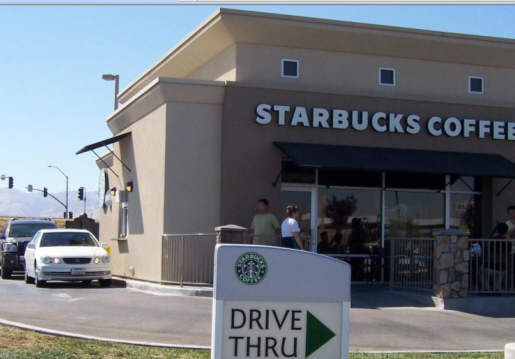
Limits: Starbucks Wakes Up and Smells the Coffee

July 2, 2008

STAR dims as latte hits thirty BUCKS per gallon.

Starbucks announced that it is shuttering 500 more stores (the company announced 100 closings last month), cutting 12,000 jobs (7% of its 172K “partners”), and slowing new store development.

Excerpts from the Wall Street Journal (with my take):

WSJ: “The pullback is a sign that the Seattle-based coffee giant is continuing to see weak sales as high gas prices and other pressures on consumer spending prompt Americans to cut back on extras”.

KEH: Latte @ $3 per 12 ounce serving = $31.99 … ouch

WSJ: “Starbucks has been struggling to attract customers amid the slowdown in consumer spending and increasing competition from other coffee and restaurant chains, such as fast-food giant McDonald’s.”

KEH: McD’s wins taste tests and costs $2 / cup less … Hmmm … 

WSJ: “The company said it will eliminate as many as 12,000 full-time and part-time retail positions in connection with the closures; some baristas will get jobs at other stores … Workers will find out whether their store is closing by the middle of this month.”

KEH: Isn’t SBUX supposed to be the model of kumbaya HR management?  Worse than getting fired is being told that you’ll be told in a couple weeks.

WSJ: “Starbucks said the sites earmarked for closure include those that aren’t profitable at the moment or aren’t expected to provide the company with acceptable returns on its investment.

KEH: I guess that previously, unprofitable stores with low ROIs were just fine.

WSJ: “(SBUX is coming off a period of rapid expansion intended to ) to boost sales growth and siphon traffic away from some of its stores where long lines were driving away customers … company research showed people sometimes weren’t willing to cross the street to buy a cup of coffee.”

KEH: Not to pay $5 a cup, that is.

WSJ “But the density of Starbucks stores in places like New York and other large cities turned the chain into a symbol of ubiquity, spawning countless jokes. Last year, as Starbucks’s sales began to soften, it became clear that the company’s expansion was cannibalizing its sales in a way that was threatening the chain’s success, as well as causing the quality at its existing locations to slip”.

KEH It’s called “decreasing marginal returns” … or, simply “hitting the wall”

WSJ “(CEO Howard) Schultz has been pushing through changes, including the introduction of a new, milder daily brewed coffee that the company says has helped boost Starbucks’s drip-coffee sales. But, in doing so, he has alienated a small group of loyal Starbucks customers who prefer the strong coffees on which the chain built its reputation”.

KEH: Remember New Coke? 

KEH: Starbuck’s had a great run.  Welcome to the real world.

Numbers – Price Gouging? Windfall Profits?

June 26, 2008

FYI: (a) I’m not a financial analyst or investment adviser (b) I’m not a big fan of oil companies (c) I do own some shares of Chevron Texaco  and Slumberger — not enough to sway my thinking (d) $4 per gallon for gas gives me pain at the pump, too

            * * * * *

Critics characterize oil companies’ profits as “obscene”, “unconscionable”, and “windfall”.

In a previous post, I compared Exxon Mobil (the poster boy for big oil) to two other mega-corps — Coke & Microsoft.  The data says that Exxon’s profit margins are lower, its effective tax rate is higher, and its ROA (return on assets) is well below Microsoft’s and roughly at par with Coke’s.  Draw your own conclusions.

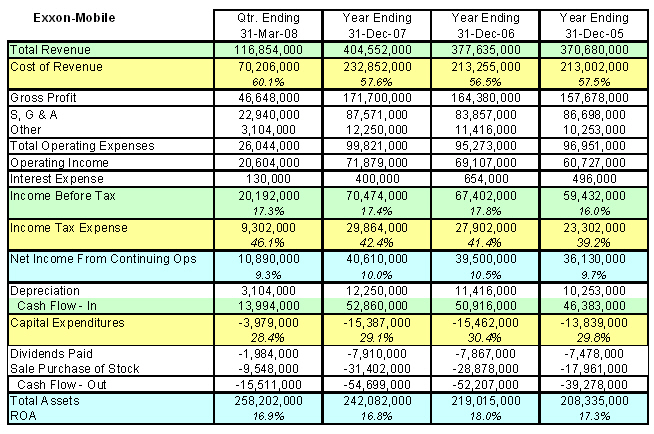
Drilling deeper on Exxon’s financial performance over the past couple of years (see chart below for details) and putting them in the perspective of standard financial ratios leads me to 5 pivotal conclusions.

1) Exxon is a very, very big company with a market cap over $450 Billion  … so all of its numbers seem supersized

2) From “50,000 feet” , there’s no evidence of price gouging … gross margins have been flat, before and after rhe run-up in crude oil prices

3) Exxon’s already paying a lot of taxes — over 40% of pretax profits, about $90 Billion since Jan. 2005

4) There’s plenty of reinvestment … capital expenditures about 30% of cash flow

5) Almost 70% of cash flow is going directly (and immediately) to shareholders in the form of dividends and stock repurchases

Some Details

1) Size & growth: Revenues have increased by about 9% from 2005 to 2007 (2% in 2006, 7% in 2007) to a whopping $404.5 billion.  Unfortunately, it’s tough to split the increases between volume (more oil sold) and price. Seems reasonable to conclude that a lot of it is price since refinery capacity is relatively fixed.

2) Margins & prices: “Cost of Revenue” has held relatively flat at about 57.5% so, by definition, gross profit margins (the flip side of cost of revenue) have been relatively flat at 42.5%.   Translation: Exxon’s “percentage mark-up” over its costs has stayed flat — if price gouging, would expect margins (i.e. mark-up) to increase.  Of course, as costs go up, the profit margin expressed in dollars (instead of percentages) goes up.  It’s reasonable to infer that Exxon’s profit — in dollars per barrel — is increasing along with crude oil prices, but that’s not evidence of gouging behavior.

3) Taxes: Exxon paid over $90 Billion in taxes from January, 2005 to March, 2008 — an effective tax rate over 40% (46.1% in Q1 of this year)

4) Reinvestment: over the 3 year period, Exxon invested about 30% of its cash flow — almost $50 Billion — in capital expenditures (presumably for drilling rigs, refineries, etc.)

5) Shareholder distributions:in recent years, about 70% of cash flow has been distributed directly to shareholders in dividends ($31.4 Billion in 2007) and stock buybacks (about $85 Billion since Jan. 2005)

So what ?

1) Retail gas prices have gone up proportionately to crude oil prices and gross margins have been flat — where is the evidence of the much touted price gouging?

2) The financial ratios are relatively constant across the years — pre and post the crude oil run up.  Where’s the windfall?

3) An effective tax rate over 40% strikes me as pretty high.  How much higher does it need to be pushed to be a  “fair share”?

4) $50 Billion in capital expenditures — 30% of cash flow — sounds like reinvestment to me.  It’s not in alternative energy sources, but as I like to say “there’s a reason they’re called oil companies”

5) In my opinion, oil company execs have been greedy (and stupid) raking off so much compensation.  But, keep in mind that most of the company’s cash flow is going directly to shareholders, either in dividends or stock buybacks (which prop up the share price for shareholders who sell) .

Note: Exxon has about 5.3 Billion shares outstanding — about 1/2 in the hands of institutions (think mutual funds) and 1/2 held by individuals.  They invested to be owners, and they’re the direct and immediate beneficiaries of Exxon’s financial success.  Said differently, any windfall profits tax would come directly out of their pockets into somebody else’s. Think about it — how fair is that?

Click chart to make it bigger  

Numbers – Obscene Profits ?

June 25, 2008

It’s a popular refrain: oil companies are making too much money and they’re failing to develop alternative energy sources.

McCain says: “I am very angry, frankly, at the oil companies not only because of the obscene profits they’ve made but at their failure to invest in alternate energy to help us eliminate our dependence on foreign oil.”

Memo to Sen. McCain: There’s a reason they’re called “oil companies” — that’s their business — that’s what they do.

Obama says:“I’ll make oil companies like Exxon pay a tax on their windfall profits, and we’ll use the money to help families pay for their skyrocketing energy costs and other bills.”

Memo to Obama: putting more money into the hands of the buyers of relatively scarce commodities will simply bid up prices faster.  It’s  fundamental economics: called the “budget effect”. Any “relief.” is briefly transitional. 

Even O’Reilly piles on, saying that the oil companies are reaping unconscionable profits by price gouging “the folks”. 

What about the obscene,  unconscionable windfall profits?  What do the numbers say?

First, on a comparative basis, it’s tough to make the case (chart below). 

Comparing Exxon Mobil to fan favorites Coke and Microsoft is revealing: 

  • Exxon’s 17.4% EBIT (earnings before interest and taxes — a measure of their profit margins — the difference between their operating costs and the prices they charge) is lower — much lower — than either Microsoft’s (39.3%) and Coke’s (28.9%)
  • Exxon already has a higher effective tax rate (42.4%) than either Microsoft (30%) or Coke (22.7%).
  • So, Exxon’s net income after taxes (10%) is about half of Coke’s (20.7%) and about 1/3 of Micosoft’s (27.5%)

Of course, applying 10% to Exxon’s gigantic revenue base ($404 billion) gives a very big number — $40 billion.  But, it takes a correspondingly enormous level of capital investment (think rigs and refineries) to generate that level of sales.  Exxon has almost $250 billion in assets — one measure of a business’ capital intensity.  Exxon earns a 16.8% return on its assets — 5 percentage points less than Microsoft, and roughly the same as Coke (depending on whether or not Coke’s “intangible assets” are counted).

Bottom line: For sure, Exxon’s profits are high.  But, they’re not “obscene”  or “unconscionable” … unless Coke and Microsoft’s are, too.  

That leaves the question of “windfall” for a follow-up post.                               


Hmmm: ANWR in Pictures (and Words)

June 23, 2008

According to Jonah Goldberg, writing in the National Review Online:

Both the New York Times and Washington Post editorial boards enthusiastically supported drilling in ANWR in the late 1980s. The Post noted that the area “is one of the bleakest, most remote places on this continent, and there is hardly any other where drilling would have less impact on surrounding life. . . . ”

ANWR is roughly the size of South Carolina … however, the area where, according to Department of Interior estimates, some 5.7 billion to 16 billion barrels of recoverable oil reside is much smaller and …  would amount to the size of Dulles airport.  

In the winter, it reaches 70 degrees below zero (not counting wind chill, which brings it to 120 below) and is in round-the-clock darkness.


In summer, the coastal plain is mostly mosquito-plagued tundra and bogs. (The leathernecks at Prudhoe Bay joke that “life begins at 40” — because at 40 degrees, clouds of mosquitoes and other pests take flight from the ocean of puddles).  

So, we should sacrifice national security and pay more at the pump to save this pristine land ???

Photos from  http://www.anwr.org/photo.htm
Article excerpts from http://article.nationalreview.com/?q=NTM2NzI5MmU5NTUwYzZjYTYxYWMxNjZhOWQ2NjNhODk=&w=MQ==

Survey: Pick Your Favorite

June 21, 2008


Copyright protection established on June 21, 2008