Archive for the ‘MARKETING’ Category

Idea – Power of Free (from Predictably Irrational)

September 9, 2008

Excerpted from: Predictably Irrational by Dan Ariely, HarperCollins Books, 2008

“Free has a certain gravitational pull – everybody likes something for nothing. Free gives such an emotional charge that people perceive what is being offered as immensely more valuable than it really is.” 

Examples

Opting for a “stripped down”  free checking account  over one with a nominal charge account and a plethera of services; 

Buying 2 of something to get a third one free (even if you don’t need the 2nd or the 3rd ones) ; 

Taking a “no closing costs” mortgage with a higher interest rate; 

Hitting the buffet table for seconds, and thirds, and … 

Snatching up free pens, calendars, koozies … to throw them out when you get home

 
Why?

“Most transactions have an upside and a downside –  when something is free. people forget about the downside.  … humans are intrinsically afraid of loss.  The real lure of free is tied to this fear.  There is no visible possibility of loss when somebody chooses something that’s free.  Of course, that’s not true”  … [since “free” may require a commitment of time, headaches, or disposal fees]. 


Example: Amazon Free Shipping

In the US, Amazon has had great success offering free shipping on orders greater than $25.  Many customers started upsizing their orders (e.g ordering an additional book) just to take advantage of the free shipping offer.

In France, Amazon introduced a comparable program with a token charge for shipping (about 25 cents).  While there was a small uptick in sales, it paled in comparison to the sales increase associated with the totally free shipping program.

In other words, whereas shipping for a quarter – a savings of a couple of bucks – was largely ignored by customers, free shipping generated an enthusiastic response.

“The difference between two cents and one cent is small. 
 The difference between one cent and zero is huge.”  


                                       * * * * * 

Observations

1. The aura of “free” creates a market inefficiency – breaking  buyers’ stream of rationality 

2. Amazon’s free shipping is a compelling real life example. 

3. Lesson: If you’re going to give something away – give it away –  don’t nickel-and-dime into “no man’s land”

 
BTW: Based on my experience, Amzon’s free shipping is often just as fast as it’s regular shipping.  Sure, the items are :”flying standby”, but there is usually space on the truck.

Want more from the Homa Files?
 
Click link =>  The Homa Files Blog

Product Innovation: Establishing & maintaining dominance …

September 9, 2008

Excerpted from Strategy & Business, “The Unique Advantage”, by Alexander Kandybin and Surbhee Grover, Aug. 26, 2008

Successful consumer packaged goods (CPG) innovators, those whose new products establish and maintain dominance in the marketplace, tend to focus on seven areas. None of them represents a “silver bullet” on its own, and many of them are common sense, but together they make innovation more difficult to copy and lead to greater returns and higher growth.

1. Technology and patents. New technologies … providie companies with a way to meet new consumer needs, including those that consumers don’t yet know they have.  Patents can sustain a meaningful advantage in the marketplace. 

2. Claims. Claims add substantial value when they are tied exclusively to a product and can be held for a significant period of time.

3. Ingredient synonymy. Arm & Hammer, Planters, and POM Wonderful, respectively, have each carved out an enviable position by becoming virtual synonyms for their category. Such domination affords pricing power for products that are essentially commodities.

4. Unique brand characteristics. Strong brands can build an identity in consumers’ minds that transcends products.

5. Product experience. Successful products have an emotional component that builds a bridge to consumers, becoming part of their lives.

6. Packaging.  Packaging innovation can leverage technology, emphasize unique brand characteristics, enhance the product experience, and in fact prove very difficult to duplicate.

7. Effective vertical integration. [Keeping things “in house” can protect proprietary technologies and “secret sauces” ]

Edit by DAF

* * * * *

Full article:
http://www.strategy-business.com/press/article/08306?pg=all&tid=230

* * * * *

Want more from the Homa Files?
 
Click link =>  The Homa Files Blog

* * * * ** * * * *

Books – Predictably Irrational

September 8, 2008


Predictably Irrational: The Hidden Forces That Shape Our Decisions
by 
Dan Ariely, HarperCollins Books, 2008


Basic Premise:

“Standard economics assumes that people are rational — that they have all the pertinent information about their decisions, that they can calculate the value of the different options they face, and that they are cognitively unhindered in weighing the ramifications of each potential choice”.  That is, that people are capable of making the right decisions for themselves. But, Ariey — and other behavioral economists — observe that “people are really far less rational than standard economic theory assumes.  Moreover, their irrational behaviors are neither random nor senseless. They are systematic, and often repeated, so they are predictable”. For example:

  1. People tend to overvalue stuff that they own … it’s called the “endowment effect”.
  2. Ownership can be real & full, or virtual & partial (e.g. bidding for items on eBay)
  3. The sense of ownership is enhaced by “sweat equity” … the IKEA effect.
  4. Most people will opt for a mid-priced version of a product (over the high or low priced version) … it’s called “aversion to extremes”.
  5. A higher priced pill is perceived to relieve pain more than a lower priced pill … even when they’re the same pills — real or placebos.
  6. People can’t resist the power of free offers … even when they’re not really free.
  7. Many people will travel 15 minutes to save $10 on a $25 item (say, a DVD), but won’t travel 15 minutes to save the same $10 on a higher priced item (say, a car) … even though the time and savings are the same … it’s called the “relativity effect”.
  8. Many people will do jobs (“favors”) for their friends for free — as long as the task is unrelated to their “day job”.
  9. Many people who do favors for others are insulted if they are offered monetarycompensation, but willingly take small gifts for their efforts.
  10. Most people wouldn’t consider taking a few bucks from the petty cash drawer, but many people think it’s ok to jack a pen from their office.
  11. In experiments, most “tempted students cheated on tests … but there was an upper limit — they only cheated “a little bit”.
  12. Students who sign honor pledges on exams are far less likely to cheat … even if their school doesn’t have an honor code 

* * * * * 

The book is a quick, easy read, and the author has a cool web site:
www.predictablyirrational.com


I’ll cite a few of the book’s more interesting examples in subsequent posts.


* * * * * 

Want more from the Homa Files?
 
Click link =>  The Homa Files Blog

* * * * *


Product Innovation: The perils of playing “small ball”

September 8, 2008

Excerpted from Strategy & Business, “The Unique Advantage”, by Alexander Kandybin and Surbhee Grover, Aug. 26, 2008

In mature, slow-growth industries such as food and consumer products … Companies often spend relatively little on R&D, and … their innovation results are marginal.

Much of the problem can be traced to conventional wisdom (that) the secret to growth … is to develop new products based on consumer needs, which are discovered through consumer research and focus groups. And  if a new idea is not great … marketing and advertising can always … turn a so-so concept into a hit.  And the first to market … will capture most of the profits.

This kind of thinking leads to … a long list of line extensions — new flavors of an established soda brand, say — rather than the kind of game-changing innovations that can make a real difference to the bottom line.

New products that stand alone longest in the marketplace, without serious competition, bring in the highest returns.

Meeting consumer needs is a necessary but no longer sufficient condition of sustainable innovation.  Rather than thinking about new products as a way to get customers excited for a little while, companies need to think about their innovation strategy as a way to build a high, hard wall between those customers and their strongest competitors … hifting some investment away from marketing and advertising toward the development of … game-changing new products … that are difficult to copy.  

Higher R&D spending does not guarantee success … (but) a minimum innovation investment is required for breakthrough thinking. Without it, companies tend to fill the pipeline with the “base hits” of line extension … falling into a self-created loop of low investment, low returns, and steady but slow growth … that provides the illusion that the company is succeeding

So, the tendency is for companies to focus on relatively small, often superficial line extensions that can be churned out quickly … but require inflated advertising budgets that reflect a defensive mind-set .. (and divert resources from)  breakthrough innovation … locking companies into a pattern of high marketing spending and a need for endless small launches.

* * * * *

Mature companies also need a strategy for when difficult to copy ideas are in short supply. Here, we suggest defying conventional wisdom about being first to market. If a product can be copied, it’s often more profitable to be the copier.

* * * * *

There will always be a place for line extensions backed with big campaigns and for being first to market. It is possible to gain additional benefits by building scale, amplifying the effects of hard-to-copy innovations by spreading them across multiple products.

* * * * *

It’s even possible to gain scale of a kind with a highly nimble, prolific innovation organization. Launching a steady stream of good ideas, as P&G has done in home products in recent years, can give a brand a reputation for fresh thinking that transcends the individual ideas and translates into market share gains. 

Edit by DAF

* * * * * 

Full article:
http://www.strategy-business.com/press/article/08306?pg=all&tid=230

* * * * *

Want more from the Homa Files?
 
Click link => 
The Homa Files Blog

* * * * *

When customers talk smack online …

September 5, 2008

Excerpted from WSJ, “How to Handle ‘IHateYourCompany.com’,” Sep 5, 2008

In recent years, disgruntled consumers have launched hundreds of Web sites to air their grievances — from starbucked.com and ihatestarbucks.com to boycottwalmart.org and againstthewal.com.

…The Internet has become a mecca for disgruntled consumers, creating new challenges for companies accustomed to controlling their message tightly. While companies can’t pull down a negative YouTube video or erase a critical Twitter post, they have more power when it comes to domain names.

That doesn’t mean, however, that they should snap up every domain with a vaguely negative-sounding name and then let them gather dust, according to Internet-strategy consultants. Rather, companies should register or buy just the sites that get the most traffic…

Once they are in control of these domains, companies … (can) use them as a vehicle to solicit feedback from customers. Otherwise, angry customers will …  simply find another site on which to complain about the company…

While some of the gripe sites that remain in the hands of critics have fizzled, others have grown bigger. Take BankofAmericaSucks.com, which was started by (a) former Bank of America customer … after a dispute with the bank over a car loan. It now is home to thousands of postings, and it calls itself the “Official Bank of America consumer opinion site.”

Consumers continue to post complaints on the site…The site is mentioned in numerous blogs and newspaper articles, and appears among the top 15 results on a Google search for “Bank of America.”

Edit by SAC

 * * * * *

Note: In 2005, Forbes created a list of  the 9 angriest corporate hate sites. These sites targeted: KB Homes, PayPal, Allstate Insurance, Microsoft, American Express, Wal-Mart, Verizon, United Airlines and UPS.  While an updated list has not been published it is clear that consumers continue to organize complaints and fuel their hate online. 

* * * * *
Full article:
http://online.wsj.com/article/SB122057760688302147.html?mod=2_1567_topbox

* * * * *

Want more from the Homa Files?
Click link =>
The Homa Files Blog

* * * * *

Marketing: Japanese Super Brands

September 5, 2008

Excerpted from Brand Channel, “More Than a Name: Japanese Super-brands Diversify”, by Barry Silverstein, August 22, 2008

After World War II, Japan reinvented itself and developed into a global economic powerhouse.

Some believe a primary reason for this growth was the Japanese keiretsu system. Essentially, keiretsu were major families of affiliated corporations that had ties to a key bank, which both controlled and provided security to the companies. As a result, companies were “protected” financially, similar to the way Japanese companies protected their employees.

The keiretsu system spawned powerful conglomerates that for a time were insulated from economic woes. But  … “The [keiretsu] system is, in large part, to blame for Japan’s bubble economy of the 1980s that ultimately burst.”

Nonetheless, the keiretsu system was the basis for giant corporations that diversified to an extreme degree. Keiretsu could be vertical, such as Honda and Toyota, or horizontal, such as Mitsubishi and Fuyo (which spawned Canon, Hitachi, Nissan, and Yamaha, among others).

* * * * *

Mitsubishi is an excellent example. Mitsubishi started in 1870 as a shipping company. Today, this global giant has hundreds of companies under its loose umbrella, some of which do not carry the Mitsubishi brand name.

To bring some commonality to Mitsubishi companies, a corporate mark was created. It depicts three connected red diamond shapes. The word “Mitsubishi” is a combination of the Japanese words mitsu (three) and hishi (water chestnut). Hishi is traditionally used to denote a rhombus or diamond shape.

Companies with Mitsubishi in their names include Mitsubishi Chemical Corp., Mitsubishi Electric Corp., Mitsubishi Heavy Industries, Ltd., and Mitsubishi Motors Corp. Mitsubishi companies without Mitsubishi in the name include Kirin Holdings Company, Ltd., Nikon Corp., and Nippon Oil Corp.

* * * * *

Suppose two consumers have very different experiences with Mitsubishi-branded products.

For example, one consumer purchases a Mitsubishi automobile and has a good experience. Another consumer purchases a Mitsubishi television and has a bad experience. Will the first consumer look favorably upon and consider purchasing a television carrying the Mitsubishi brand name? If the second consumer decides to buy a car, will he or she be negatively predisposed toward a Mitsubishi-branded vehicle?

Emotionally, each consumer might transfer the positive or negative experience with the Mitsubishi brand from one product to another. These feelings about the brand could transcend product category.

Rationally, however, if a Mitsubishi-branded product is highly rated in a product category, it deserves consideration. If the consumer had a negative experience with the brand in one category, and wants to make an objective purchase in another product category, this creates a potential dilemma.

* * * * * 

Brand influence in the above example assumes the same consumer is the purchaser of both a car and a television. But what happens when the Japanese super-brand manufactures products with the same brand name in two entirely different and highly specialized categories?

Take Yamaha, for instance. On the one hand, this Japanese super-brand is renowned for musical instruments such as keyboards and drums. On the other hand, Yamaha is just as well known as a brand of motorcycles. Both corporate entities use the Yamaha name and mark.

Only if a musician playing a Yamaha instrument also rides a Yamaha motorcycle will the identical consumer come into contact with the same brand name in these specialized categories.

Nonetheless, the consumer’s experience with the brand in either category could influence overall brand perception. With a positive perception, the consumer thought process might be: “I bought a Yamaha keyboard and it was great… I bet their motorcycles are good, too.”

* * * * *

Bad product experiences not withstanding, brand diversification has another important benefit: Brand recognition can extend a consumer’s receptivity to other products in allied categories.

For example, a satisfied owner of a Honda automobile may seek out other Honda products. That consumer might become a buyer of a Honda motorcycle, a Honda snowblower, a Honda lawn mower, or a Honda outboard motor for a boat. The perceived quality of the Honda vehicle can lead to a satisfied consumer making other related Honda purchases.

While Japanese super-brands are not always regarded as great brand marketers, it is the quality of their products that creates the perception of great brands.

To the credit of the Japanese super-brands, they have almost uniformly built a reputation for quality, regardless of business category. This is one of the attributes that led to Japanese automakers dominating that industry.

* * * * *

Other Asian super-brands have followed the diversification strategy with success. The Korean companies Samsung and LG are good examples.

In some cases, diversifying a single brand name can have a diluting effect and may turn out to be a bad strategy. “Sony’s diversification not only drains the brand’s resources to a great extent but also diverts the brand focus from the core of the brand.”

For the most part, however, Japanese super-brands derive considerable benefit from diversification. In a world of ever-increasing options, a product with a Japanese brand name is often regarded as the best choice.

* * * *

Barry Silverstein is a 25-year advertising and marketing veteran and co-author of The Breakaway Brand (McGraw Hill, 2005).

Full article:
http://www.brandchannel.com/start1.asp?fa_id=437

* * * *

Want more from the Homa Files?
Click link =>
  The Homa Files Blog

* * * * *

Succeeding at the Bottom of the Pyramid …

September 4, 2008

Excerpted from Knowledge at INSEAD, “Strong partnership key to success in bottom of the pyramid innovation”, by Grace Segran, August 26, 2008

For those at the ‘bottom of the pyramid’ (BoP), the four billion people or so living on less than two dollars a day, life is hard. Although collectively they have considerable combined purchasing power, they have up to now been traditionally overlooked by businesses.

However, major multinational corporations (MNCs) are now seeing opportunities in developing products for the BoP markets, while making a difference to the lives of the poor people.

“For this concept to work, there needs to be strong collaboration between firms, governments, NGOs (non-governmental organisations) and social entrepreneurs.”

* * * * *

There is often a disconnect between multinationals and those at the bottom of the pyramid

The operations of firms – especially the MNCs – have become rather disconnected or disembedded from local economies.

NGOs tend to know more about the characteristics of local poverty and what is best for the poor people in a specific area, whereas large companies generally have a limited understanding of the situation on the ground.

If BoP products – that is, products specifically developed to address the needs of the low-income segments – do not take into account the local specificities of poverty, they may be useless for the people in a certain district or the project may even have a negative impact on their lives.

* * * * *

Mainstreaming low-income projects and bringing them to a larger scale is one of the main challenges facing companies today.

Unilever’s ‘shakti’ project considered a leading BoP example .  Unilever, developed a range of products for low-income households in remote areas of India. It packaged common household products like shampoo and soap in sachets and sold them door-to-door, helped by so-called ‘shakti ladies’ who make a living from this activity. The ‘shakti’ range now constitutes a significant part of Unilever’s Indian revenues – reportedly nearly 15 per cent.

* * * * *

Bringing such projects to scale is a challenge for several reasons.

First, firms lack the internal capabilities to develop these projects as they require both strong entrepreneurial skills, as well as the ability to understand and address social issues such as access to water, energy, and housing.

Often the firm’s expectations for immediate profit goes against the development of successful BoP projects, the core of which aim to create mutual value for both the firm and the poor. [Economies of sca;e are slow to be realized — if they ever are.]

It requires a substantial amount of effort to transform a small pilot project into a large, mainstream activity. Among their portfolio of business development projects, companies often opt for more profitable projects that can deliver in the short term.

Since BoP projects have strong local links, firms may face difficulties in trying to replicate a successful business model in another geographical area of the same country or to export it to a different country.

“These projects should be local answers to local problems.”

Another challenge is for low-income projects is to demonstrate a significant impact on the lives of the poor. Does it really improve their living conditions? Are the poor getting a fair deal, while their bargaining power in their dealings with firms is rather limited?

* * * * *

Full article:
http://knowledge.insead.edu/PartnershipBottomPyramidInnovation080803.cfm

* * * * *

Want more from the Homa Files?
Click link =>
  The Homa Files Blog

* * * * *

Honda – Finally, fuel efficiency is paying strategic dividends …

September 3, 2008

Excerpted from NY Times, “Honda Stays True to Efficient Driving”, by Bill Vlasic, August 26, 2008

* * * * *

During the glory days of big pickups and sport utility vehicles, one automaker steadfastly refused to join the party.

Despite the huge profits that its competitors were minting by making larger vehicles, Honda Motor never veered from its mission of building fuel-efficient, environmentally friendly cars like its Accord sedan, even when the sentiment was “there’s no return on that.”

But in today’s fuel-conscious automotive market, Honda is reaping the rewards for its commitment.

No major automaker in America is doing better than Honda … While competitors are scrambling to shift their product lineups to build more small vehicles and slash their bloated inventories of trucks, Honda can barely keep up with demand, particularly in the subcompact category.

Sales of its tiny Fit have soared … and Honda accelerated the introduction of the 2009 model, which will go on sale Tuesday.

The Fit’s four-cylinder engine gets 34 miles per gallon in highway driving .

Honda’s focus on fuel efficiency is paying off on the bottom line as well … By comparison, G.M. and Ford have lost billions this year as the market has moved away from the big vehicles that once generated the bulk of their profits. Detroit is moving radically to downsize its vehicle lineups.  Even Honda’s larger Japanese rival, Toyota, is hustling to adjust to the rapidly changing United States market.

Honda’s newest factory, in southern Indiana, is set to begin production of Civic compact cars this fall.

* * * * *

Honda’s focus on fuel efficiency and the environmental impact of its vehicles dates back to the Clean Air legislation of the 1960s and 1970s.  Honda adopted an internal motto — “Blue skies for our children” — as a guideline for future vehicle development.

Honda has posted the highest corporate average fuel economy of any automaker for its overall fleet of vehicles over the last 15 years.

Honda has never aspired to build a full line of trucks and S.U.V.’s.  “Even when the large S.U.V.’s and trucks were big sellers, they did not fit with our philosophy.”

* * * * *

When the new plant goes into production in Indiana, Honda’s North American production capacity will increase to 1.4 million vehicles a year to meet the growing demand for its small cars.

* * * * *

Even with the success of its smallest cars, Honda executives concede that the company has some catching up to do with Toyota in hybrid vehicles.

While Honda offers a hybrid version of the Civic, Toyota’s Prius model is the runaway leader in the category.

But Honda recently announced plans to introduce a five-door, hybrid-only model in North America next year to compete with the Prius. Honda is expected to price the vehicle lower than the Prius to attract younger buyers.

Honda is also planning a two-door, sporty hybrid and a hybrid version of the Fit.

* * * * *

At its headquarters here in Torrance, the vehicle that draws the most attention these days is the company’s hydrogen-powered, fuel-cell vehicle dubbed the FCX Clarity …  it represents the next step for a company committed to clean technology.

* * * * *

Full article:
http://www.nytimes.com/2008/08/26/business/26honda.html?_r=2&oref=slogin&ref=business&pagewanted=print

* * * * *

Want more from the Homa Files?
Click link =>
  The Homa Files Blog

* * * * *

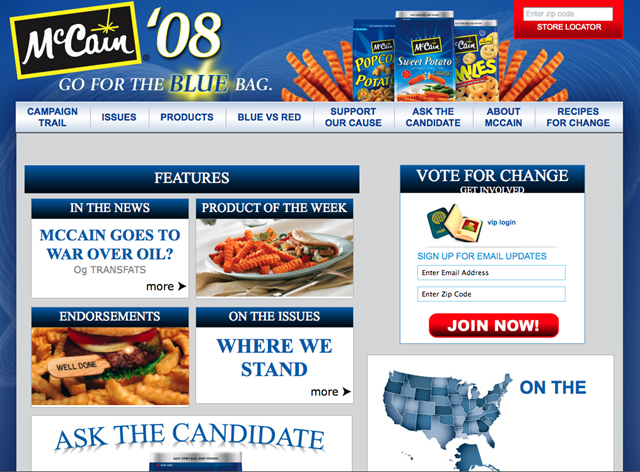
Marketing: Vote for McCain to be your next…potato?

September 3, 2008

Excerpted from Promo Magazine, “McCain Foods Ties Campaign to Presidential Election,” Aug 27, 2008

McCain Foods USA is out with a new marketing ploy that plays off the upcoming presidential election to ramp up product sales.

The campaign…positions McCain Foods’ potatoes as a candidate consumers should consider. The company has high hopes shoppers will connect its name with that of Republican presidential hopeful Sen. John McCain of Arizona as part of its political parody…

On the campaign website (www.mccainpotatoes.com), visitors can ask the “spokespotato” candidate questions and receive immediate responses,…take online polls, find product information and sign up for e-mail updates.

The site…also lets people read humorous responses from McCain Foods on key issues, such as the economy and the environment. For the economy, it says, “When you buy more McCain Potatoes, it creates more jobs. For us. What did you expect? Another stimulus check?”

McCain Foods isn’t the first company to make a marketing ploy off politics. Denny’s Restaurants launch a campaign this year that gets people to “Vote 4 Real” for its breakfast food over fast food competitors.


Picture 1


* * * * *

Full Article: http://promomagazine.com/interactivemarketing/news/mccain_foods_marketing_campaign_0827/

* * * * *

Want more from the Homa Files?
Click link =>
  The Homa Files Blog

* * * * *

Energy – Why do gas prices move up and down ?

August 27, 2008

In last week’s post “Thinking about $4 per gallon gas”, I wondered why oil companies waited so long to push prices up to $4 — the apparent price that the market will bear — and why they don’t just let the price stick at $4 now that it has been tested.

Chris Hairel , MSB MBA alum, emailed a nice recap of the oil to gas value chain.

Bottom line: cost-plus pricing in a very competitive market.

Worth reading …

* * * * *

The downstream refined products value chain — from crude oil to retail gasoline and other oil-based products — has six segments, each with its own unique industry structure, pricing levers and regulation:

* * * * *

Refineries – the key asset in the business where the object is to maximize the economic value added of the refined products.

Refineries are basically price takers since their company trading group supplies them with crude oil and the projected prices for refined products.

Working with the trading group, the refinery is charged with turning that crude oil into the most profitable collection of products given the quality of the crude and the capabilities of the refinery.

* * * * *

Bulk Markets – The trading group assumes title of the product as it leaves the refinery and arranges transportation to the terminals based on projected demand in the rack (or wholesale market).

Along the way the traders seek to increase the realized price for their products, react to supply disruptions or unexpected demand.

Bulk is a relatively efficient market with good price transparency based on key trading hubs like New York Harbor, Houston and Chicago.

The NYMEX futures market provides a facility for hedging and for paper speculation. Trading parties include oil companies, major users of petroleum products, independent pipeline companies and speculators.

Pricing is market-based and profit-optimized by the traders.

* * * * *

Pipelines – Interstate pipelines with multiple customers are regulated by the Federal Energy Regulatory Commission .

Their tariffs (i.e. prices) are set based on a government sanctioned rate of return. So. pricing is essentially a cost-plus process.

Pipeline owners are not permitted to share information about who else is using the pipeline with their affiliated companies, nor can they give (or take) preferential treatment with respect to supply allocation or delivery scheduling.

* * * * *

Rack Markets and Terminals – Rack markets cover the wholesale market for a city.

Prices in rack markets are set daily for the next day. The marketing group for an oil company looks at demand by channel of trade (i.e. branded, unbranded, spot), recent price history in the area and the supply situation.

The pricing mechanism itself may be based on an index, a cost plus or other model, but there’s some leeway on the decision under certain circumstances. For example, pricing is actually used as a key demand management lever since companies can purposefully price themselves out of the spot or unbranded channel in order to save product for branded customers.

Despite what the pricers do, most transaction pricing  is determined by long term contracts. These contracts usually allow customers to “swing” their volumes. A customer may commit to buying an average of 5,000 gal a day, but the contract management process will look at the monthly volume and divide by 30 – the customer can usually manage their buying pattern to buy more on days when gas is cheap and less when it’s more expensive. .

* * * * *

Secondary Transportation – These are the tanker trucks that move product from the terminal to the retail station. The logistics are typically handled by jobbers or independent marketers that almost always price on a cost-plus basis.

* * * * *

Retail – Retail gas stations typically price on a cost-plus basis with a slim retail margin added on.

The bulk oil stations’ profits isn’t from the gasoline !  Gas is simply the “leader” product that attracts traffic (literally) which often loads up with high margin coffee, soda, cigarettes, etc.

* * * * *

Retail gasoline prices

Retail gasoline prices tend to respond quickly to market forces for 3 reasons: (1) cost-plus pricing, (2) retail competition, and (3) fear of government intervention.

* * * * *

(1) Cost-plus pricing

Since cost-plus pricing is prevalent at all stages of the value chain, refined products’ prices and crude oil prices tend to move together.

Refiners’ margins are often forecasted using what’s called the 3-2-1 spread. Take the price difference between three WTI NYMEX contracts and the sum of two NYMEX gasoline contracts plus one heating oil contract – then trade accordingly.

When crude falls. the entire complex floats down with it since the bulk market is fairly efficient and the downstream segments all use a cost-plus pricing model.

If domestic bulk markets fail to react to lower crude prices, several large players can bring product in from Europe to capture the arbitrage.

Since the vast majority of transactions are priced on a cost-plus basis, companies compete on their ability to “buy right”,  on the efficiency of their operations, and their opportunity for more profitable ancillary sales. .

* * * * *

(2) Retail CompetitionFew prices are signaled to potential customers more visibly than gasoline prices.

There are often 2 or 3 gas stations on a corner,  so consumers are tempted to chose the cheapest one even if it’s only a cent or two cheaper per gallon. The conventional wisdom is that brand loyalty is low. 

The same price pressures evident in the wholesale rack markets since unbranded retailers have the option of buying from multiple terminals. If Shell is less expensive than Exxon on a particular day, Shell gets the sale in the unbranded and spot channels of trade.

* * * * *

(3) Threat of Regulation

A third force is the threat of government action.Pricing through the entire oil value chain is very transparent.  Timely price data available from multiple sources for every segment of the market (DOE data, NYMEX, bulletin board exchanges, broker quotes, daily PLATT and OPUS surveys, AAA retail surveys, etc.).Oil companies generate two-thirds of their profits from crude oil production and refining. The wholesale and retail marketing and distribution parts of the business is generally considered mote of a cost of going business (i.e. overhead) than a profits source.  So, oil companies would rather play it safe (from government regulators) than try to eek out an extra half percentage point of profit at the wholesale or retail level.

* * * * *

Want more from the Homa Files?
Click link =>
  The Homa Files Blog

* * * * *

Brands – Reviving those oldies but goodies …

August 22, 2008

Excerpted from NYT, “Those Shelved Brands Start to Look Tempting”, Aug. 21, 2008

During economic downturns, consumer products marketers takiw stock of brands they already own to see if any can be revived or renewed. It can cost significantly less to bring back a brand — or restore the luster to a faded one — than to develop a new product, because spending huge sums to generate awareness is not necessary.

For instance, in considering a comeback for Eagle snacks, research found that “6 out of 10 adults remember the brand” … Reserve Brands is reintroducing Eagle in stores and vending machines … plans to reintroduce Eagle include new snacks under names like Bursts and Poppers, to “modernize the brand and contemporize it.”

“It would take $300 million to $500 million to recreate that brand awareness today.”

Eagle is among scores of products that marketers abandoned because of declining sales, stronger competitors or a desire to focus on newer brands deemed more contemporary.

Marketers are also taking another look at products that are still in production but have been forgotten or neglected, known as ghost brands or orphan brands.

Makers of such products usually cut advertising budgets in the face of declining sales. That slows sales further, which leads to more budget cuts — creating a downward spiral, difficult to avoid, that can land a ghost or orphan in the netherworld of once-popular, now-deceased trademarks.  

To keep some of its venerable brands fresh — brands like Aleve, Alka-Seltzer, Bayer, Flintstones and One A Day vitamins, and Phillips’ Milk of Magnesia — Bayer HealthCare is pursuing a strategy … focused on “marketing innovation, product innovation and technology innovation.”

For instance, new advertising campaigns for Alka-Seltzer draw on its heritage while at the same time updating brand catch phrases like “I can’t believe I ate the whole thing” and “Try it; you’ll like it.”

There are also new products being brought out under the umbrella of the well-known brands, among them Alka-Seltzer Wake-Up Call, a hangover treatment, and Phillips’ Colon Health, a probiotic supplement in caplet form.

Other older brands may be ripe for revival because “as the population ages, there are certain brands that really resonate with consumers.”

* * * * *

Full article:
http://www.nytimes.com/2008/08/21/business/media/21adco.html?_r=2&adxnnl=1&oref=slogin&ref=business&adxnnlx=1219320567-FO5ND1sKBcpwsKMnC8H6nQ

* * * * *

Want more from the Homa Files?
Click link =>
  The Homa Files Blog

* * * * *

Pricing Tactics – To increase sales, just drop the dollar sign … huh?

August 21, 2008

Excerpted from WSJ online, “To Get Customers to Spend More, Drop the Dollar Signs”. August 18, 2008

Researchers at Cornell University found that restaurant owners who drop the dollar sign from their menus got clients to spend more — $5.55 more per meal on average, to be exact.

The researchers noted that just seeing the dollar symbol agitated diners so much that they spent less.

Something as simple as how you display prices can have an impact on customer perception and actual sales  …  like that penny-off trick to enhance perceived value  … $9.99  just seems less than 10 bucks.

Source:
http://blogs.wsj.com/independentstreet/2008/08/18/to-get-customers-to-spend-more-drop-the-dollar-signs/

* * * * *

Want more from the Homa Files?
Click link =>
  The Homa Files Blog

* * * * *

Pricing – Airlines bring back "structural" price discrimination …

August 20, 2008

Excerpted from WSJ: “Airlines Revive Minimum Stays On Cheap Fares”, August 19, 2008

One of the craziest aspects of the airline business is that two passengers sitting side-by-side can pay vastly different fares for the same seat — sometimes hundreds of dollars.

Airlines contend business travelers buy a different product.

A business traveler pays more for a seat purchased close to departure because the airline has taken an economic risk to hold that inventory back. And business travelers pay more for tickets with fewer restrictions — you pay a lot for the ability to change or cancel.

* * * * *

Now, get ready for a wave of annoying airline rules requiring you to stay at your destination a minimum number of days or over a Saturday night — if you want the cheapest tickets.

The move is an effort to force (price insensitive) business travelers, who usually need the most flexibility and want to be home on the weekends, to pay more for their flights.

Airlines have increased restrictions on cheap fares by raising overnight requirements, upping what had commonly been only a one-night stay requirement to two and three nights.

Airlines tried to bring back Saturday-night stay requirements earlier this year.  For many years the Saturday-night requirement was a prime tactic airlines used to separate business travelers from leisure customers. The Saturday-night stay forced many business travelers to either pay hundreds of dollars more for each ticket, or to spend an extra night or two on the road to save money. If the choice was a $300 ticket or a $2,000 ticket, many companies would ask travelers to stay over Saturday night at a nice hotel, have a nice meal and still save hundreds.

But the change didn’t stick, mostly because discounters compete on so many routes these days … without onerous restrictions.

(So) business travelers see them as a more-viable alternative as the price gap widens in fares. If big airlines run their prices up too high by making discounted tickets unavailable to business travelers, they risk losing customers. That’s been the history, likely to repeat this fall.

Full article:
http://online.wsj.com/article_print/SB121909457563650833.html

* * * * *

Thanks to Justin Bates, MSB MBA for the heads-up.

* * * * *

Want more from the Homa Files?
Click link =>
  The Homa Files Blog

* * * * *

Marketing – When Teens Tighten their Wallets

August 8, 2008

Excerpted from WSJ: “Retailers Catch Teenage Blues”, August 8, 2008

Teens may dread going back to school, but the retail chains catering to them eagerly await this season for a reliable boost from kids who need new clothes. In this slow economy, however, teen retailers are showing signs of stress and beginning to worry that the late-summer boom might not arrive this year.

The teen stores have long been considered recession-resistant because young customers’ spending — often linked to allowances and summer jobs — typically holds constant in a slow economy. Back-to-school purchases were viewed as a must for taste-fickle teens who often cajole their parents in August and September into giving them extra cash.

The July results show that this year’s economic slowdown is dealing wider blows. The principal culprit: energy prices, which analysts say are fast stripping teens of their ability to buy the gas they need to get to the malls where many of these stores are located.

Strong performance in junior apparel from Wal-Mart, the world’s largest retailer, suggests it might be taking sales away from teen retailers.

For many retailers, this time of year is typically the second most profitable of the year. If performance is down this fall, it could be an unpleasant preview of what is usually the chains’ most promising time of year, the holiday season.

The industry appears divided on how to respond.

Middle-end stores like Hot Topic and American Eagle already are looking to promotions in the middle of the back-to-school selling season.

But higher-end operations like Abercrombie appear to be clinging to their price points, a bet that its brand name can weather the storm and competition with department stores. Abercrombie “prides itself being an aspirational brand, and part of that is not to mark down and have sale events. They feel like that dilutes brand equity.”

Other stores are learning to sit pretty at lower price points. Teen retailer Aeropostale Inc. is running a fleet of more than 800 stores throughout the U.S. with clothing styles not too dissimilar from those found at Abercrombie — but at prices about 30% lower.

Other chains are taking a fast turn toward markdowns

It is unclear whether these moves will be enough to lure young buyers back into the mall. Megan Tysoe, a 19-year-old Georgetown University student, says she spent $300 a month on clothes last summer using paychecks from a summer job. But this year she is working an unpaid internship as a paying job couldn’t be found. And Ms. Tysoe has words that should cause worry for retailers: “Instead of buying new things, my friends trade clothes with each other.”

Full article:
http://online.wsj.com/article/SB121810860555720233.html?mod=hps_us_whats_news

* * * * *

Want more from the Homa Files?
 
Click link =>  The Homa Files Blog

* * * * *

Starbucks – Grasping for (iced coffee) straws ?

August 6, 2008

Excerpted from CNN.com Aug. 5, 2008

Looking to bring more value-seeking consumers through its doors for a late afternoon caffeine fix, Starbucks … now offers its morning customers any iced grande beverage for $2 after 2 p.m.

The price is a big cut from the normal price of most grande-sized iced drinks. A grande iced latte, for example, costs about $4. To get the discount, customers must present a receipt from their morning Starbucks visit.

The company said it is …  answering consumers’ calls for more value at the chain, which has seen traffic drop as gas prices rise and consumer spending falters.

“It’s easy for baristas to implement and it’s easy for customers to understand.”

In some cities, it has offered discounted drinks on Fridays, Saturdays and Sundays. In July, the chain also gave away 12-ounce iced coffees on Wednesdays to customers in New York City, Philadelphia, Washington, Boston and Detroit who turned over an “iced brewed coffee card,” a reusable voucher distributed in stores and newspaper inserts.

“Certainly a discounting approach could lead to a better perception of value in the short run but the longer-term question remains — at the regular everyday price point, would the consumer still see Starbucks as offering the right value for them?”  “That remains uncertain.”

Full post:
http://www.cnn.com/2008/US/08/05/starbucks.deal.ap/index.html

* * * * *

Observations

1.  “Easy for customers to understand” … they’ve got to be kidding … the more hoops that folks have to jump through, the less likely a promotion will succeed.

2.  How will they handle loyal customers who don’t do coupons (or morning coffee) and see the guys in front of them get a half-priced iced-coffee.

3. Does Starbucks know that 2-bucks (no “bounce back” coupon) gets you an large iced coffee at Mickey D’s?  Mrs. H. seems to like them …

4.  Ken’s fundamental law of marketing: if you you want to do something, do it … don’t do it half-way with hooks, lines, and sinkers … otherwise, just don’t do it.

* * * * *

Thanks to Dave Fedlam MSB MBA ’09 for the heads-up … Dave says ” as a typical non-Starbucks customer, 2 cups of coffee for $6/day doesn’t really seem like much of a deal at all.”* * * * *

Want more from the Homa Files?
 
Click link =>  The Homa Files Blog

* * * * *

Mktg: Mickey D – How to Raise Prices (w/o Raising Prices)

August 4, 2008

Excerpted from WSJ: McDonald’s Tests Changes In $1 Burger As Costs Rise, 08-04-08

McDonald’s is testing modifications to its popular $1 double cheeseburger, and higher prices for the sandwich … selling it with one slice of cheese instead of two, and billing it as a “double hamburger with cheese ” …. or offering a double hamburger without (any) cheese …  or  selling the traditional double cheeseburger at prices ranging from $1.09 to $1.19.

Launched in 2003, the Dollar Menu has been a key driver of sales at McDonald’s 14,000 U.S. restaurants and has helped it ride out dips in consumer spending. But recently, franchisees have complained that the menu has brought too much unprofitable traffic into their restaurants.

* * * * *

As of late June, sales of the chain’s lattes, cappuccinos and other espresso drinks were off their peak … lower-priced beverages, including $1.89 iced coffee and a $1 … sweet-tea promotion, have pulled some sales away from the espresso drinks … 

McDonald’s overall beverage expansion, adding espresso drinks, smoothies, cold tea, bottled drinks and ice-blended coffee beverages at U.S. locations, is on track to exceed the company’s goal of adding $125,000 a year in sales per restaurant … and adding $1 billion a year to the company’s sales.

http://online.wsj.com/article/SB121780568775808337.html?mod=2_1567_topbox

* * * * *

Observations

1.  One way to increase price is to skinny back the product — put fewer cornflakes in the box.

2.  The $1 double cheeseburger is the heart of the menu — dropping it will be a big deal — no way I step up to $1.19 or buy a chesseburger with no cheese.

3.  Has the multi-dollar cup of coffee market peaked ?

* * * * *

Want more from the Homa Files?
 
Click link =>  The Homa Files Blog

* * * * *

Marketing – Reviving Old Brands

July 14, 2008

New Life from Tired Brands
Excerpted from Booz & Co., Startegy+Business

Punch line: Sometimes, it’s easier and less costly to leverage the residual awareness of an archived brand than to launch a new brand from scratch.  Key is assessing the legacy brand’s actionable equity.

The story:

The Ford Taurus was the #1 US car model in the early 1990s.  Ford diluted the brand by chasing fleet volume (companies & rental cars).  Eventually, Ford decided to shelve the brand name and introduce the Ford 500 brand — a costly failure.  Ford subsequently phased out the 500,  and revived the Taurus name.  Why? Very hgh brand awareness with manageable negatives.

Booz says that you can determine if a brand has the foundation for a new life via a 4-part “tool” called BVA — Brand Vitality Assessment:

1. Purchase Funnel Assessment (PFA) — how do prospects convert from awareness to trial to repurchase?

2. Brand Equity Review — what are customer perceptions of strengths & weaknesses?

3. Competitive Dynamics Assessment — why did the brand fell off the radar?

4. Value Proposition Check — differentiating benefits worth the price?

                                        * * * * *
Observations

1. Nothing new re: analyses (we cover them all at MSB), but they’re nicely bundled and put in a useful context. 

2. May inspire some situations which have brands on the shelf that may be revivable.

3. For MSBers, should bring back memories of Markstrat.

4. Worth reading to brush up on the 4 analyses.

For full article:
http://www.strategy-business.com/resiliencereport/resilience/rr00060

Want more from the Homa Files?
 
Click link =>  The Homa Files Blog

Brands – GM to reconsider its line-up (again)

July 7, 2008

Excerpt from the Wall Street Journal

“For decades, GM has believed a key to making money in North America was maintaining market share … and having different brands helps the company reach more potential customers and gives it more tools in fighting (competitors). 

The company currently sells vehicles under eight different brands, but most, including Buick, Saturn and Saab, struggle to attract buyers despite offering new models that cost GM billions of dollars to develop.

Critics have said keeping so many brands is a drain on resources and leaves many of its divisions competing with each other.

The company will continue to reconsider its mix of brands. All but Cadillac and Chevrolet (60% of GM sales; 12.5% market share), which GM considers core to its business, are undergoing close scrutiny,

The company has already decided to put its Hummer division up for sale.

(Another brand) under examination is Saturn, a maker of economy cars that analysts believe has never made money in its nearly 20-year history.”

                      * * * * *

Observations:

1. I always say that product is the heart of marketing strategy. Branding can only boost strong products, not perpetually cover up for weak ones.

2. In highly segmented markets (such as autos), a multiple brand strategy makes sense — as long as each brand has the potential to reach critical mass, and duplication of efforts and spending is tightly managed.

3. Remember when Saturn was GM’s star brand — a “new kind of car company” with a cult-like following?  Hmm … sound familiar? 

4. How can we expect struggling auto makers — whose highest priority is just staying alive — to lead the movement to more energy efficient cars? 

See the full article at
http://online.wsj.com/article/SB121539865693931653.html?mod=hps_us_whats_news