Archive for the ‘Taxes’ Category

When is candy not candy ?

May 21, 2010

Punch line: States want to cut deficits by taxing candy. That’s not as easy as it sounds …

* * * * *

Excerpted from WSJ: Candy Taxes Struggle to Define Candy, May 17, 2010

Many states don’t tax food – which  considered is essential.  Taxing food might push the poor toward malnourishment or unhealthy eating.

The food exemption has traditionally extended to candy and soda.

As they struggle with budget deficits, states from New York to Washington are looking to candy and soda taxes to help bridge the gap. .

More than a dozen states have passed or proposed some sort of candy or soda tax in the 2010 legislative session, and most of them are bound to face some sort of confusion.

The hard part: defining candy.

The distinction between candy and food can be hard to pin down.

  • In Washington, a new candy tax will apply to Butterfinger candy bars, yet Kit-Kat wafers remain excise free (this because the law exempts foods with flour in them).
  • in Colorado, Kit-Kats go untaxed, but Twix bars face levies.
  • In Illinois, retailers in Chicago are unsure if Twix Bars — some of which contain flour and peanut butter — are food or candy.

Bottom line: one man’s food is another man’s candy …

Full article:
http://blogs.wsj.com/economics/2010/05/17/candy-taxes-struggle-to-define-candy/

Let’s defy history and tax our way to a stable economic footing … NOT !

May 19, 2010

Punch lines:

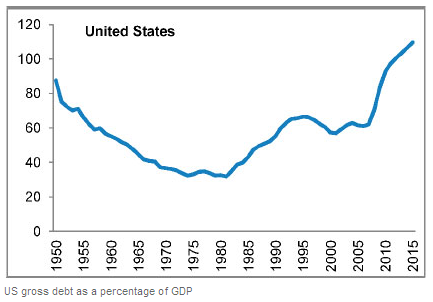
(1) In a year or two, the US national debt will be larger than the annual output of the US economy (i.e. debt > 100% GDP) … up from 60% in the prior decade.

image

(2) Empirical evidence demonstrates that increases in marginal tax rates won’t collect ‘revenues’ more than 20% of GDP … since the dwindling number of tax payers change their behavior to minimize their tax bite.

Hauser’s Law (below) is a great piece of economic analysis …

* * * * *

Excerpted from WSJ: The Revenue Limits of Tax and Spend, May 17, 2010

Washington has adopted the Greek model of debt, dependency, devaluation and default.

Prospects for restraining runaway U.S. debt are even poorer than they appear.

Based on President Obama’s fiscal 2011 budget, the Congressional Budget Office (CBO) estimates a deficit that starts at 10.3% of GDP in 2010 … then narrows to 5.6% in 2020.

As a result the net national debt (debt held by the public) will more than double to 90% by 2020 from 40% in 2008.  

And, these debt estimates are incomplete and optimistic. They do not include deficit spending resulting from the new health-insurance legislation. And, as usual, they ignore the unfunded liabilities of social insurance programs.

The revenue numbers rely on increased tax rates beginning next year resulting from the scheduled expiration of the Bush tax cuts. The feds assume a relationship between the economy and tax revenue that is divorced from reality.

Six decades of history have established that increases in federal tax rates, particularly if targeted at the higher brackets, produce no additional revenue. For politicians this is truly an inconvenient truth: conventional methods of forecasting tax receipts from increases in future tax rates are prone to over-predict revenue.

The chart below shows how tax revenue has grown over the past eight decades along with the size of the economy.

image

Note the close proportionality between revenue and GDP since World War II, despite big changes in marginal tax rates in both directions.

Known as “Hauser’s Law”  the relationship reveals an upper limit for federal tax receipts at about 19% of GDP.

Why the limit?

The tax base … represents a living economic system that makes its own collective choices.

In a tax code of 70,000 pages there are innumerable ways for high-income earners to seek out and use ambiguities and loopholes. The more they are incentivized to make an effort to game the system, the less the federal government will get to collect.

Changes in marginal tax rates do not make a perceptible difference to the ratio of revenue to GDP.

* * * * *

Full article:
http://online.wsj.com/article/SB10001424052748704608104575217870728420184.html?mod=WSJ_hps_MIDDLEFifthNews


Your green neighbor wants an electric car … get out your wallet!

May 14, 2010

This week I was again struck by the irony: the US Feds – who have no money and are deeply in debt — are going to borrow still more money from China to bail out the Greeks – who are deeply in debt.  That’s nuts.

And, the few remaining US taxpayers are going to asked (make that ‘told’) that they (and the Chinese lenders) subsidize their neighbors new green rides. 

And incumbents wonder why voters are dispatching them one after another …

* * * * *

Excerpted from WSJ: Welfare Wagons The new electric cars are powered by taxpayer credits, May 12, 2010

Congratulations. You’re about to buy a fancy new Nissan Leaf or Chevy Volt . . . for someone else.

The all electric  Nissan Leaf is a car for a wealthy hobbyist — good for a trip of 100 miles after which it becomes an inert lump at the end of your driveway (or behind a tow truck) for the many hours it will take to recharge. 

The Leaf will roll out in December with a surprisingly modest price of $25,280. That’s after a $7,500 federal tax credit is counted.

Buyers will also have to spring for a $2,200 charging station, but another tax credit ($1,100) cuts the cost in half.

Some states – e.g. bankrupt California, Georgia and Tennessee — will chip in additional consumer tax credits as high as $5,000.

  • Note: total tax credits = $13,600

By pricing low and going for volume, Nissan is making a calculated grab for the lion’s share of the available tax dollars — and also pressuring Washington to extend the program when the money runs out.

iPad lust applies to cars too, and early adopters can be expected to line up around the block.

But it is insane to subsidize these vehicles with taxpayer dollars.

Tax handouts for electric vehicles are emblematic of an alarmingly childish refusal to take account that the U.S. government is deeply in debt. Running up more debt to subsidize electric runabouts for suburbanites is not such a sign.

* * * * *

Even if you believe saving gasoline is a holy cause, subsidizing electric cars simply is not a substitute for politicians finding the courage to jack up gas prices.

Think about it this way:

  • You can double the fuel efficiency of any car by putting a second person in it.
  • You can increase its fuel efficiency to infinity by refraining from frivolous trips.

These are the incentives that flow from a higher gas price.

Exactly the opposite incentives flow from mandatory investment in higher-mileage vehicles. If you paid a lot for a car that costs very little to operate, why not operate it? Why bother to car pool? Why not drive across town for a jar of mayonnaise?

* * * * *

Full article:
http://online.wsj.com/article/SB10001424052748703880304575236692175987752.html?mod=djemEditorialPage_h

Taking money from widows and orphans (and retirees) … I’m talking the Feds, not Goldman Sachs

May 6, 2010

Appropriately, much attention is starting to get focused on the likely TRIPLING of the marginal tax rate on dividends (see the WSJ article below). 

Right now, the top rate on ordinary dividends is 15%.  The current Senate budget resolution calls for the rate to jump on January 1 to the pre-Bush ordinary income tax rate of 39.6%.  In 2013 — when the ObamaCare tax collection mechanism gets revved up — you can add another 3.8%, pushing the high marginal rate up to a whopping 43.4%

That’s for rich folks.  But what about the widows, orphans, and retirees?

Many folks don’t realize that the current 15% dividend tax rate only applies to folks in the upper tax brackets — starting, for married folks, at $67,800.  Married folks below that threshold are in the zero, 10% or 15% marginal tax brackets — their current tax rate on ordinary dividends is ZERO !  That’s right, ZERO.

So, if their dividend tax rate for low-earners also gets upped to their ordinary income tax rates, most of them will be paying 15%.  Statistically speaking, that’s significantly different from zero.

Going after the dividend receiving fixed income retirees … hmmm… I think they call that an unintended conseuence.

* * * * *

Excerpted from WSJ: The Dividend Tax Bill Arrives, April 29, 2010

As the big tax increase day of January 1, 2011 approaches, the Democrats running Congress are beginning to lay out their priorities. Get ready for bigger rate increases than previously advertised.

Last week the Senate Budget Committee passed a fiscal 2011 budget resolution that includes an increase in the top tax rate on dividends to 39.6% from the current 15% — a 164% increase. This blows past the 20% rate that President Obama proposed in his 2011 budget and which his economic advisers promised on these pages in 2008.

(See “The Obama Tax Plan,” August 14, 2008, by Jason Furman and Austan Goolsbee: “The tax rate on dividends would also be 20% for families making more than $250,000, rather than returning to the ordinary income rate.”)

And that’s only for starters. The recent health-care bill includes a 3.8% surcharge on all investment income, including dividends, beginning in 2013. This would nearly triple the top dividend rate to 43.4% in Mr. Obama’s four years as President. We suppose the White House would call this another great victory for income equality.

* * * * *

Dividends which are payouts from business earnings are already taxed once at the corporate rate of 35%. The individual dividend tax is a second levy on that same income, and at a rate of 43.4% would take the total tax on each dollar paid in dividends to something like 60 cents.

You can expect fewer businesses either to offer or increase dividend payouts, which means less dividend revenue for the government.

The punitive tax rate on dividends combined with the deductibility of interest on borrowing also increases the tax code’s bias toward debt over equity. But aren’t we supposed to be living in a new era of healthy deleveraging?

* * * * *
Full article:
http://online.wsj.com/article/SB10001424052748703709804575202481173165478.html?mod=djemEditorialPage_h

Tax Facts: Hooray for married people.

April 27, 2010

Too bad they’re a diminishing breed …

* * * * *

Excerpted from IBD: New Tax Math: Single Moms + Big Brother, 04/23/2010

The news that the U.S. has become a two-class society — i.e., half of Americans pay federal income taxes and half don’t — has been bouncing around the media and shocked some Americans who had no knowledge of this appalling economic fact.

Married taxpayers pay 75% of all federal income taxes, whereas two-thirds of single parents who file as head of household pay no income tax at all.

In 2008, 40.6% of children born in the U.S. were born outside of marriage; that’s 1,720,000 children …  7% of those babies were born to girls under age 18 … over three-fourths were born to women over 20.

LBJ’s Great Society set up a  system whereby millions of people were taught they had an “entitlement” to pick the pockets of law-abiding, taxpaying families if they met two conditions: They didn’t work, and they were not married to someone who did work.

Now, about 40% of Americans receive federal government handouts of cash and valuable benefits …  20% of Americans get 75% of their income from the federal government and another 20% get 45% of their income from the government.

Obama’s stimulus law will add nearly $800 billion in welfare spending over the next decade.

That means $22,500 for every poor person in the U.S., which will cost over $10,000 for each family that pays federal income taxes.

Full articler:
http://www.investors.com/NewsAndAnalysis/Article.aspx?id=531278

Here come the bumper stickers …

April 20, 2010

President Obama seems to have struck a nerve with unhappy taxpayers by mocking them: “They should be telling me thank you!”

The campaign bumper stickers have already started appearing.
 

image

image

image

Obama says that taxpayers should be saying thank you … huh ?

April 19, 2010

Obama mocked Tea Partiers, saying that they should be thanking him. 

President Barack Obama struck a hyperpartisan note Thursday, telling Democrats that he was “amused” by the Tax Day Tea Party rallies. 

Obama, addressing a Democratic National Committee (DNC) fundraiser in Miami, did little to endear himself to the Tea Party groups protesting around the country, saying:

 “”I’ve been a little amused over the past couple of days where people have been having these rallies about taxes …they should be saying thank you”  because of the tax cuts he has signed into law. 

‘You Would Think They’d Be Saying Thank You’, April 16, 2010
http://thehill.com/homenews/administration/92625-obama-amused-by-tea-party-rallies 

click for video:
http://tinyurl.com/y3a88zf
 

Oh really ?  

His rationale: he cut taxes for 95% of Americans. 

Give me a break, please. 

First, the tax break he was selectively talking about was a whopping dollar-a-day refundable tax credit that was part of the Stimulus package. 

Second, most of it went to the people who don’t pay income taxes anyway.  Those folks are already saying thank you … when they’re not saying “gimme, gimme, gimme” 

Third, the dollar-a-day program is more than offset by $670 Billion in enacted tax increases, about 1/2 of which hits folks reporting less than $200,000 in income … that works out to about $2,100 per citizen, and $4,200 per taxpayer collected by 16,000 additional IRS agents. 

According to a Ways and Means Committee staff analysis:

“The list of $670 billion in tax increases includes at least 14 violations of the President’s pledge not to raise taxes on Americans earning less than $200,000 for singles and $250,000 for married couples.”

This specific group of tax hikes totals $316 billion over 10 years.

http://www.house.gov/budget_republicans/press/2007/pr20100415whereisbudget.pdf

As RealClearPolitics opined:

President Obama just can’t help himself from playing the Comic-in-Chief and ridiculing his opponents.

It’s good for a laugh from the partisan crowd, sure, but it often comes across to average folks (and, of course, to the opposition) as petty and/or unpresidential.

That’s not … what the public might expect from a President who promised to rise above petty partisan politics.

http://realclearpolitics.blogs.time.com/2010/04/16/obama-may-not-be-so-amused-in-november/

Pay your taxes, fool? … Didn’t you know that — according to Harry Reid — “Paying taxes is strictly voluntary”

April 19, 2010

“Paying taxes is strictly voluntary” … so says Harry Reid

Don’t you feel silly for sending in a check yesterday ?

It makes me shiver to think that this guy is the second most powerful person in the country (after Nancy Pelosi)

This is worth watching …

image
http://www.youtube.com/watch?v=R7mRSI8yWwg

Pay your taxes, fool? … Didn't you know that — according to Harry Reid — “Paying taxes is strictly voluntary”

April 19, 2010

“Paying taxes is strictly voluntary” … so says Harry Reid

Don’t you feel silly for sending in a check yesterday ?

It makes me shiver to think that this guy is the second most powerful person in the country (after Nancy Pelosi)

This is worth watching …

image
http://www.youtube.com/watch?v=R7mRSI8yWwg

News Flash: Nearly half of US households escape fed income tax … psst, I told you so (July 31, 2008)

April 15, 2010

Last week, there was a flurry of news activity over a report that nearly half of all U.S. households will pay no federal income taxes for 2009.

It was treated as new news.  Geez.

Homa Files were all over this as far back as July 31, 2008. 

For all the wonky facts & a complete analysis see:
Under Obama, Tax Payers Will be a Minority !
https://kenhoma.wordpress.com/2008/10/28/under-obama-tax-payers-will-be-a-minority/

Note: This is the Homa Files post with all-time record for most hits.

 I hate to be an “I told you so” (yeah, right) … but hears the AP report … almost 2 years later.

As President Obama likesto say “Elections have consequences”.

* * * * *

Excerpted from AP: Nearly half of US households escape fed income tax, April 9, 2010

The federal income tax is the government’s largest source of revenue, raising more than $900 billion — or a little less than half of all government receipts .

So, Tax Day is a dreaded deadline for millions, but for nearly half of U.S. households it’s simply somebody else’s problem.

About 47 percent will pay no federal income taxes at all for 2009 … up from 38% in 2007.

Either their incomes were too low, or they qualified for enough credits, deductions and exemptions to eliminate their liability.

In recent years, credits for low- and middle-income families have grown so much that a family of four making as much as $50,000 will owe no federal income tax.

Tax cuts enacted in the past decade have been generous to wealthy taxpayers making them a target for President Barack Obama and Democrats in Congress.

Less noticed were tax cuts for low- and middle-income families, which were expanded when Obama signed the massive economic recovery package last year.

The result is a tax system that exempts almost half the country from paying for programs that benefit everyone, including national defense, public safety, infrastructure and education. It is a system in which the top 10 percent of earners paid about 73 percent of the income taxes collected by the federal government.

The bottom 40 percent, on average, make a profit from the federal income tax … the government sends them a payment. Not just a refund of of excess withholding — so-called “refundable credits”.

“We have almost 50 percent of families who are getting something for nothing.”

Some of the blame goes to former President George Bush.  In 2008, he signed a law providing most families with rebate checks of $300 to $1,200.

Last year, Obama signed the economic recovery law that expanded some tax credits and created others.

Obama’s Making Work Pay credit provides as much as $800 to couples and $400 to individuals. The expanded child tax credit provides $1,000 for each child under 17. The Earned Income Tax Credit provides up to $5,657 to low-income families with at least three children.

There are also tax credits for college expenses, buying a new home and upgrading an existing home with energy-efficient doors, windows, furnaces and other appliances.

Many of the credits are refundable, meaning if the credits exceed the amount of income taxes owed, the taxpayer gets a payment from the government for the difference.

Obama has pushed tax cuts for low- and middle-income families and tax increases for the wealthy, arguing that wealthier taxpayers fared well in the past decade, so it’s time to pay up. The nation’s wealthiest taxpayers did get big tax breaks under Bush, with the top marginal tax rate reduced from 39.6 percent to 35 percent, and the second-highest rate reduced from 36 percent to 33 percent.

But income tax rates were lowered at every income level. The changes made it relatively easy for families of four making $50,000 to eliminate their income tax liability.

Here’s how they do it, according to Deloitte Tax:

The family was entitled to a standard deduction of $11,400 and four personal exemptions of $3,650 apiece, leaving a taxable income of $24,000. The federal income tax on $24,000 is $2,769.

With two children younger than 17, the family qualified for two $1,000 child tax credits. Its Making Work Pay credit was $800 because the parents were married filing jointly.

The $2,800 in credits exceeds the $2,769 in taxes, so the family makes a $31 profit from the federal income tax. That ought to take the sting out of April 15.

Full article:
http://finance.yahoo.com/news/Nearly-half-of-US-households-apf-1105567323.html?x=0&.v=1

* * * * *

Why it matters 

The Tax Foundation — a nonpartisan tax research group – has repeatedly warned that 

“While some may applaud the fact that millions of low- and middle-income families pay no income taxes, there is a threat to the fabric of our democracy when so many Americans are not only disconnected from the costs of government but are net consumers of government benefits.

The conditions are ripe for social conflict if these voters begin to demand more government benefits because they know others will bear the costs.” 

 http://www.taxfoundation.org/research/show/1111.html

TAXES: The triumphant return of the marriage penalty … on steroids this time.

April 13, 2010

Here’s probably the quirkiest part of the selective expiration of the Bush tax cuts that Obama has baked into his budget …

Obama repeatedly promised that individuals earning less than $200,000 — and families earning less than $250,000 wouldn’t see their taxes go up by as much as a dime.

Think about that for a second …

Let’s pretend there’s an unmarried couple (boyfriend and girlfriend, or any other combination) with each individual earning $200,000.

As individuals, if Obama keeps his pledge,  they incur no additional income taxes in 2011 when parts of the Bush tax cuts are allowed to expire, and no additional “payroll taxes” in 2013 when the ObamaCare surcharge goes into effect.

But, if the couple is married and files jointly, they’d have $400,000 of family income and officially be reclassified as “rich people” … uh-oh !

By my count, their marriage penalty would be over $23,000.

Their “base” income taxes would go from $102,285 to $118,340 —  an increase in their effective tax rate from just over 25% to 30%.

                        image

                        image 

Plus, they’d be slapped with the 3.8% payroll tax on all income over $200,000.  That tacks on another $7.600.

That makes their total income tax bill $125,940 — 23% higher than if they were unmarried and filing as individuals.

Now, that’s a marriage penalty !

TAXES: Funding ObamaCare with a 3.8% non-payroll payroll tax … here’s the impact on your wallet

April 9, 2010

In a prior post, we walked through the impact if Obama selectively lets the parts of the Bush tax cuts expire in 2011 — those parts that effect individuals earning more than $200,000 and couples earning more than $250,000.

In a nutshell, here’s what we concluded …

  • The tax rate on capital gains will go up 5% … and the tax rate on dividends will go up at least 5% (to the capital gains tax rate) and maybe all the way up to ordinary income tax rates.
  • For ordinary income, the effective (not marginal) tax rate increase on ordinary income will be about 1/2% for each $100,000 of taxable income (i.e. ordinary income plus dividends and capital gains) over $200,000.

For example, assume a couple has $200,000 in taxable ordinary income and $100,000 in dividends and capital gains, giving them total taxable income of $300,000.   Their tax hit will be about $6,000 — $5,000 from the increase in dividend and capital gains tax rates (5% X $100,000) and $1,000 from the increase in the effective rate on ordinary income ($300,000 minus $200,000 = $100,000 => 1/2% rate increase times $200,000 = $1,000).  In rough numbers, their income taxes would go from $67,000 to $73,000 — an increase of almost 9% — and their effective tax rate would go from 21% to over 24%.

But, that’s only part of the story.

Remember that the original Senate bill funded roughly 1/2 of ObamaCare from MediCare cuts and roughly 1/2 from an excise tax on employer provided Cadillac health insurance plans — a plan originally teed up by Obama.  When the unions marched on the White House and reminded the President who got him elected, Obama recalibrated upward the threshold defining a Cadillac plan, delayed the implementation of that tax until 2018, and replaced the lost tax revenue with a supplemental 3.8% payroll tax on AGI (Adjusted Gross Income — which includes ordinary income plus dividends and capital gains) over $200,000 — starting in 2013

Technical note:  The base Medicare tax rate is currently applied as a payroll tax on so-called earned income.  Employees pay 1.45% and employers are required to match the 1.45% — for a total of 2.9%.  Under ObamaCare, for “unearned income” — mostly dividends and capital gains — there is no employer per se, so the taxpayer is charged the full 2.9% base … plus, a supplemental .9% was added on for good measure — raising the total to 3.8%

So, comparing 2013 to the current tax rates

  • The tax rate on capital gains will go up 5% … and the tax rate on dividends will go up at least 5% (to the capital gains tax rate) and maybe all the way up to ordinary income tax rates.
  • For ordinary income, the effective (not marginal) tax rate increase on ordinary income will be about 1/2% for each $100,000 of taxable income (i.e. ordinary income plus dividends and capital gains) over $200,000.
  • There is a 3.8% “payroll tax” on all AGI over $200,000 — that includes ordinary income plus dividends and capital gains.

Let’s rework our example …

Again, assume a couple has $200,000 in taxable ordinary income and $100,000 in dividends and capital gains, giving them total taxable income of $300,000.

Their tax hit (versus 2009) will be about $9,800 …

  • $5,000 from the increase in dividend and capital gains tax rates (5% X $100,000)
  • $1,000 from the increase in the effective rate on ordinary income ($300,000 minus $200,000 = $100,000 => 1/2% rate increase times $200,000 = $1,000).
  • $3,800 in additional “payroll taxes” ($300,000 minus $200,000 = $100,000 times 3.8% = $3,800

In rough numbers, their income taxes would go from $67,000 to $76,800 — an increase of almost 15% — and their effective tax rate would go from 21% to over 25.5%.

Keep in mind, that this is just Federal income taxes.  Add on another 5% to 10% for state and local income taxes … then draw your own conclusions re: fairness and effect on the economy. …

* * * * *

Here’s a handy tool for estimating effective tax rates now, and prospectively in 2013.

image


* * * * *

Next up: The triumphant return of the marriage penalty

>> Current Posts

TAXES: What if you're in the minority — folks paying income taxes — and Obama let's the Bush tax cuts expire ?

April 8, 2010

OK, what’s the effect if Obama lets the Bush tax cuts expire? Big hurt or little hurt ?

Here’s a first cut …

* * * * *

Base Case

Assume a married couple earning a combined $250,000 in taxable income.  Their tax liability based the 2009 tax rate schedule would be $60,320 an effective tax rate of 24%

image

Literally reverting back to the pre-Bush 2000 tax rate schedule, they’d owe $73,048 — a 29% effective tax rate — and a 21% increase over the current tax rates.

image

That’s a big hurt … and probably an unlikely worst case scenario.

* * * * *

Likely Obama Plan

Remember that Obama has often said “not a dime more in taxes for families making less than $250,000″ … and sometimes said the same for individuals making less than $200,000.

In fact, according to the Tax Foundation, the plan outlined in the Obama administration’s budget is to allow:

  • The top tax rate to revert from 35% to 39.6%. 
  • The 33% tax rate to revert to 2001 law (rate of 36%) but the income threshold where that bracket starts will shift up to $250,000 in taxable income (couples) and $200,000 for singles
  • The rate on long-term capital gains to revert to 2001 law (rate of 20%) but only for couples with over $250,000 in AGI the year the gain is realized ($200K threshold for singles)
  • The rate on dividends to be hiked to long-term capital gains rates, i.e. up to 20%, but below ordinary income tax rates.

    Excerpted from Tax Foundation: Fate of Bush Tax Cuts Uncertain As Expiration Approaches, March 25, 2010   http://www.taxfoundation.org/research/show/26062.html

* * * * *

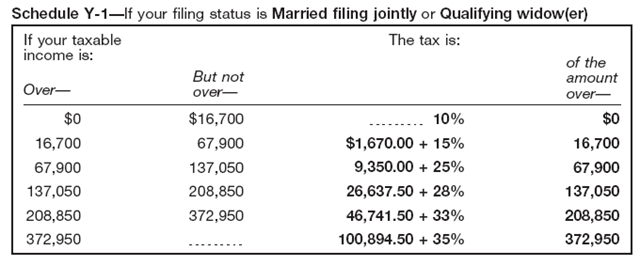
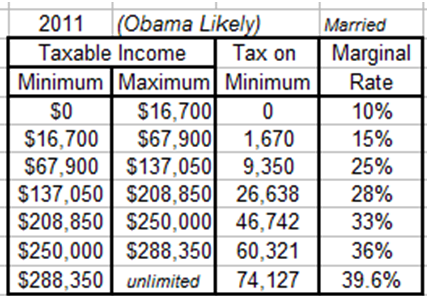
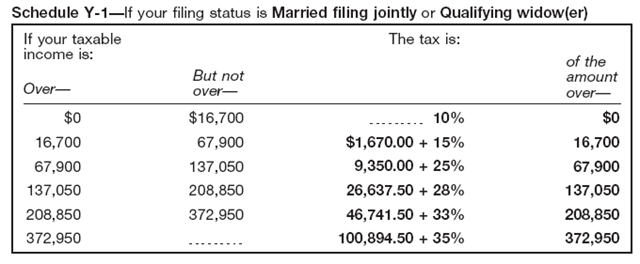
If the Tax Foundation is right, here’s what the brackets would look like for married couples per the Obama budget:

image

If Obama keeps his word on this one, our illustrative couple earning $250,000 won’t pay higher income taxes.

What about their friends who earn more and have more wealth to spread around ?

Well, a couple earning $500,000 would have their tax liability go from $137,500 (an effective tax rate of about 27.5%) —  to $150,000 (an effective tax rate of about 30%) — roughly a 9% increase in their taxes paid.

Draw your own conclusion whether that’s a lot or a little …

Note: This is only the increase due to the tax brackets shift if the Bush tax cuts are allowed to expire … it does not consider:

  • The impact of the likely increase increase in the capital gains tax rate (from 15% to 20%), or the increase in the dividends tax rate (from 15% to either 20% or the ordinary income tax rate)
  •  … or the triumphant return of the marriage penalty (on steroids this time)
  •  … or the 3.8% payroll tax surcharge on AGI over $200,000 (including dividends and capital gains)  to be added in 2013 to pay for ObamaCare. 

I’ll cover capital gains and dividends below … and  the marriage penalty and ObamaCare payroll tax surcharge in subsequent posts.

* * * * *

Estimating your tax hit

Here are some back-of-the-envelope ways to ballpark how much more you’ll be paying in income taxes in 2011 …

If your taxable income (AGI minus deductions) is less than $200,000 (individuals) or $250,000 (couples) — and if Obama keeps his campaign pledge — then your income taxes won’t go up.

If taxable income is over the thresholds …

The tax rate on capital gains will go up 5% … and the tax rate on dividends will go up at least 5% (to the capital gains tax rate) and maybe all the way up to ordinary income tax rates.

For ordinary income, the effective (not marginal) tax rate increase on ordinary income will be about 1/2% for each $100,000 of taxable income (i.e. ordinary income plus dividends and capital gains) over $200,000.

For example, assume a couple has $200,000 in taxable ordinary income and $100,000 in dividends and capital gains, giving them total taxable income of $300,000.   Their tax hit will be about $6,000 — $5,000 from the increase in dividend and capital gains tax rates (5% X $100,000) and $1,000 from the increase in the effective rate on ordinary income ($300,000 minus $200,000 = $100,000 => 1/2% rate increase times $200,000 = $1,000).  In rough numbers, their income taxes would go from $67,000 to $73,000 — an increase of almost 9% — and their effective tax rate would go from 21% to over 24%.

* * * * *

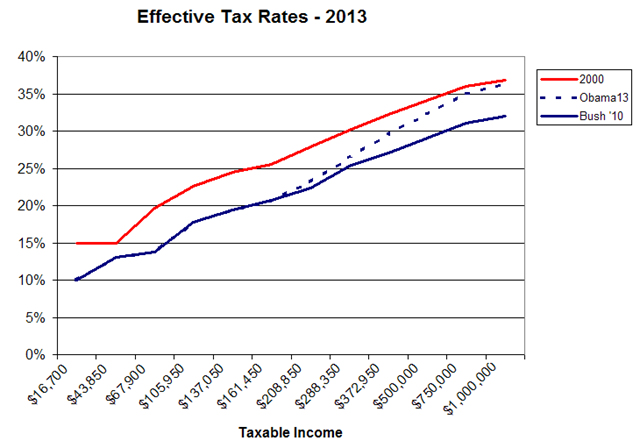
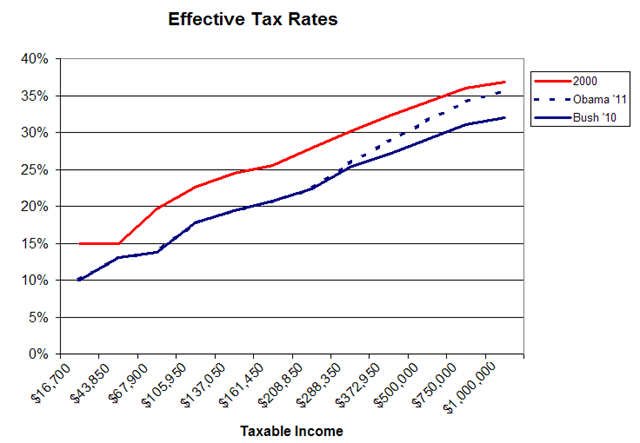
Here’s a handy chart for eyeballing 2011 effective ordinary income tax rates at a range of taxable income levels. 

Technical note: Remember to separate out capital gains and dividends from taxable ordinary income — since they get a 5% hit. But, use total taxable income (ordinary income plues dividends and capital gains ) to estimate the increase in the ordinarary income effective tax rate.

In a subsequent post, I’ll incorporate the ObamaCare 3.8% payroll tax on AGI over $200,000 to be added in 2013 and look at the return of the uber-marriage penalty.

image

* * * * *

Next up: The payroll tax surcharge …  add 3.8% for all income over $200,000

TAXES: What if you’re in the minority — folks paying income taxes — and Obama let’s the Bush tax cuts expire ?

April 8, 2010

OK, what’s the effect if Obama lets the Bush tax cuts expire? Big hurt or little hurt ?

Here’s a first cut …

* * * * *

Base Case

Assume a married couple earning a combined $250,000 in taxable income.  Their tax liability based the 2009 tax rate schedule would be $60,320 an effective tax rate of 24%

image

Literally reverting back to the pre-Bush 2000 tax rate schedule, they’d owe $73,048 — a 29% effective tax rate — and a 21% increase over the current tax rates.

image

That’s a big hurt … and probably an unlikely worst case scenario.

* * * * *

Likely Obama Plan

Remember that Obama has often said “not a dime more in taxes for families making less than $250,000″ … and sometimes said the same for individuals making less than $200,000.

In fact, according to the Tax Foundation, the plan outlined in the Obama administration’s budget is to allow:

  • The top tax rate to revert from 35% to 39.6%. 
  • The 33% tax rate to revert to 2001 law (rate of 36%) but the income threshold where that bracket starts will shift up to $250,000 in taxable income (couples) and $200,000 for singles
  • The rate on long-term capital gains to revert to 2001 law (rate of 20%) but only for couples with over $250,000 in AGI the year the gain is realized ($200K threshold for singles)
  • The rate on dividends to be hiked to long-term capital gains rates, i.e. up to 20%, but below ordinary income tax rates.

    Excerpted from Tax Foundation: Fate of Bush Tax Cuts Uncertain As Expiration Approaches, March 25, 2010   http://www.taxfoundation.org/research/show/26062.html

* * * * *

If the Tax Foundation is right, here’s what the brackets would look like for married couples per the Obama budget:

image

If Obama keeps his word on this one, our illustrative couple earning $250,000 won’t pay higher income taxes.

What about their friends who earn more and have more wealth to spread around ?

Well, a couple earning $500,000 would have their tax liability go from $137,500 (an effective tax rate of about 27.5%) —  to $150,000 (an effective tax rate of about 30%) — roughly a 9% increase in their taxes paid.

Draw your own conclusion whether that’s a lot or a little …

Note: This is only the increase due to the tax brackets shift if the Bush tax cuts are allowed to expire … it does not consider:

  • The impact of the likely increase increase in the capital gains tax rate (from 15% to 20%), or the increase in the dividends tax rate (from 15% to either 20% or the ordinary income tax rate)
  •  … or the triumphant return of the marriage penalty (on steroids this time)
  •  … or the 3.8% payroll tax surcharge on AGI over $200,000 (including dividends and capital gains)  to be added in 2013 to pay for ObamaCare. 

I’ll cover capital gains and dividends below … and  the marriage penalty and ObamaCare payroll tax surcharge in subsequent posts.

* * * * *

Estimating your tax hit

Here are some back-of-the-envelope ways to ballpark how much more you’ll be paying in income taxes in 2011 …

If your taxable income (AGI minus deductions) is less than $200,000 (individuals) or $250,000 (couples) — and if Obama keeps his campaign pledge — then your income taxes won’t go up.

If taxable income is over the thresholds …

The tax rate on capital gains will go up 5% … and the tax rate on dividends will go up at least 5% (to the capital gains tax rate) and maybe all the way up to ordinary income tax rates.

For ordinary income, the effective (not marginal) tax rate increase on ordinary income will be about 1/2% for each $100,000 of taxable income (i.e. ordinary income plus dividends and capital gains) over $200,000.

For example, assume a couple has $200,000 in taxable ordinary income and $100,000 in dividends and capital gains, giving them total taxable income of $300,000.   Their tax hit will be about $6,000 — $5,000 from the increase in dividend and capital gains tax rates (5% X $100,000) and $1,000 from the increase in the effective rate on ordinary income ($300,000 minus $200,000 = $100,000 => 1/2% rate increase times $200,000 = $1,000).  In rough numbers, their income taxes would go from $67,000 to $73,000 — an increase of almost 9% — and their effective tax rate would go from 21% to over 24%.

* * * * *

Here’s a handy chart for eyeballing 2011 effective ordinary income tax rates at a range of taxable income levels. 

Technical note: Remember to separate out capital gains and dividends from taxable ordinary income — since they get a 5% hit. But, use total taxable income (ordinary income plues dividends and capital gains ) to estimate the increase in the ordinarary income effective tax rate.

In a subsequent post, I’ll incorporate the ObamaCare 3.8% payroll tax on AGI over $200,000 to be added in 2013 and look at the return of the uber-marriage penalty.

image

* * * * *

Next up: The payroll tax surcharge …  add 3.8% for all income over $200,000

Encore – Those %#@! Bush Tax Cuts

April 7, 2010

This brief was originally posted July 23, 2008. 

Since expiration of the Bush tax cuts is looming soon, I thought they’re worth another look — just as background 

In subsequent posts, I’ll deal with the likely implications of letting the cuts expire … 

* * * * *

Summary: We’ve all heard the  rants about the cuts in the top bracket rate, capital gains rate, dividend taxes, and estate taxes.

But, when was the last time that your heard a candidate (on either side) or a pundit (O’Reilly included) mention the new 10% bracket, larger and refundable child and earned income credits, negative income taxes, elimination of the marriage tax penalty, or expanded college benefits?

* * * * *

The income tax cuts of 2001 and 2003 are shorthanded by the press and political candidates as “Bush’s tax breaks for the wealthy — who didn’t even want them”, and are blamed for an accelerating polarization of wealth distribution (i.e. rich get richer, poor stay poor).

Warren Buffet says his secretary pays more taxes than he does (really?). McCain says he’ll stay the course. Obama says that he’ll roll back the tax cuts if he’s elected and redistribute them to the “folks who need them the most”.

All of the rhetoric got me thinking.  Somewhat embarrassed, I realized that I didn’t know exactly what was in the Bush tax plan.  (Quick Test: take out a sheet of paper and jot down the tax breaks enacted as part of the Bush plan)

Prompted by curiosity (and a modicum of selfish interest) I did some digging.  Here’s what I found, along with my “take”:

The top marginal income tax rate  was cut from 39.5% to 35% (applied to Taxable Income >$350,000)
– the 36% marginal rate was cut to 33%  (TI > $161,000)
– the 31% marginal rate was cut to 28%  (TI> $77,000)
– the 28% marginal rate was cut to 25%  (TI > $32,000)
…  a clear benefit to the top half of income earners; with the biggest benefit to the highest earners

Capital gains and dividend tax rates were reduced to 15% for high-earners, zero for low earners … more of a benefit to high-earners, but 1/3 of households own stock and more than 1/4 of returns (including many retirees) report dividend income … turned out to be a windfall for hedge funds and private equity via the “carried interest” loophole (more on that in a subsequent post)

A low-income 10% tax rate bracket was introduced … benefit to many low-earners previously in the 15% bracket

Child Care Credit and Earned Income Tax Credit were increased and made refundable … resulting in zero or negative tax due balances for millions of people (note: “refundable” means that any negative tax due is paid to the citizen — a very important policy shift)

Income limits were eliminated on personal exemptions and itemized deductions … the former helps low earners most — since it’s a higher proportion of income; the latter benefits higher earners most — since they are the ones who itemize deductions. (Note: roughly 2/3’s of tax filers take the standard deduction)

Marriage penalty was neutralized … benefits middle-earning couples most

College education benefits were liberalized, e.g. 529 plans, student loan interest deduction, tax-free employer paid tuition … benefits mid- and high-earners most (since their family members disproportionately attend college)

Estate taxes were reduced and to be phased out… only impacts wealthy folks with estates that are big enough to be subject to “death taxes”


* * * * *

Details re: “Bush Tax Plan” – 2001 and 2003

Officially, the first round of Bush tax cuts were codified in the “Economic Growth and Tax Relief Reconciliation Act of 2001” which was approved by the Congressional conference committee on May 25, 2001; signed into law shortly thereafter; but phased in over a several year period.  The key provisions of the law (as reported in the conference committee’s report):
Introduce a 10-percent rate bracket… reducing the rate from 15% to 10% for the first $6,000 of taxable income for single individuals ($7,000 for 2008 and thereafter), $10,000 of taxable income for heads of households, and $12,000 for married couples filing joint returns ($14,000 for 2008 and thereafter).

Reduce individual income tax rates  … from 28 percent, 31percent, 36 percent, and 39.6 percent are phased-down over six years to 25 percent, 28 percent, 33 percent, and 35 percent, effective after June 30, 2001.

click table to make it bigger

Phase-out of Itemized Deductions and Restrictions on Personal Exemptions … by eliminating all limitation on itemized deductions and any restrictions on personal exemptions for all taxpayers by one-third in taxable years beginning in 2006 and 2007, and by two-thirds in taxable years beginning in 2008 and 2009, and by 100% for taxable years beginning after December 31, 2009.

Increase and Expand the Child Tax Credit… Increasing the child tax credit to $1,000, phased-in over ten years. and by making the child credit — subject to certain income limitations — non-taxable and refundable (i.e. payable to the person if the net tax liability is zero),

Provide relief from the “marriage penalty” … by increasing the basic standard deduction for a married couple filing a joint return; by increasing the size of the 15-percent regular income tax rate bracket for a married couple filing a joint return to twice the size of the corresponding rate bracket for an unmarried individual filing a single return.; and by increasing limits on the Earned Income Tax Credit.

Provide Education Benefits… by increasing the annual limit on contributions to education IRAs to $2,000; by expanding the reach of 529 tuition programs; by extending the non-taxibility of employer paid tuition; and by raising income phase out levels for deductability of student loan interest.

Phase-out and Repeal of Estate and Generation-Skipping Transfer Taxes:

* * * * *

In 2003, a second round of tax changes was enacted in the “JOBS AND GROWTH TAX RELIEF RECONCILIATION ACT OF 2003” which:

Accelerated the phase in of the 10% bracket, the reduction in other bracket rates, the child care tax credit, and marriage penalty relief.

Provide reductions in taxes on capital gains and dividends … reducing the 10- and 20-percent rates on capital gains on assets held more than one year to five ( zero, in 2008 ) and 15 percent, respectively. and providing that dividends received by an individual shareholder from domestic and qualified foreign corporations generally are taxed at the same rates that apply to capital gains.

* * * * *

Source Reports
http://www.jct.gov/x-50-01.pdf
http://www.house.gov/jct//x-54-03.pdf

* * * * *

Next up: What if Obama let’s the Bush tax cuts expire ?  You may be surprised …

TAXES: Read this if you’re married … or if you’re thinking about getting married (or unmarried)

April 6, 2010

The Bush tax cuts completely did away with the income tax marriage penalty, right ?

Au contraire, mon ami. 

That’s just an urban legend repeated so many times that many have been led to believe it. 

Me included.

* * * * *

Let’s go through the numbers with an example:

Assume a couple — boyfriend and girlfriend (or any other combination of two people) — each earn $100,000 in taxable income.

According to the 2009 schedule X tax table (individuals), they’d each pay $21,720 if they file separately. 
(The tax table is at the end of this post if you want to check my arithmetic)

So, the unmarried couple pays a total of $43,440 in income taxes (2 X $21,720) — that’s an effective tax rate of 21.7%.

* * * * *

What if they were married and filed a joint return?

Well, the good news is that the standard deduction ($11,400) is twice an individual’s standard deduction — it wasn’t until Bush fixed it.  And, their personal exemption amount ($7,300) is double an individual’s (because they’re below the phase out income level).

So, we can just pull their number from the $200,000 taxable income line of the 2009 schedule Y tax table (married filing jointly).

The answer: their tax liability is $44,277.50 — about 2% higher than if they were unmarried and filing individually.

Technical note: Married filing separately doesn’t make the problem go away.  You’re either married or your not.

If you think a 2% difference is just rounding error, let’s move up the tax schedule.

Assume that he & she (or whatever) each earn $200,000 taxable income.    Their combined income tax liability would be $102,285 if they were unmarried and filing individually, and $110,362 if they were married and filing jointly — a spread of almost 8%.

For sure, that’s some serious money …

Technical note: The penalty is relative small at incomes below $50,000 (per person) … and relatively small at very, very high incomes that are taxed mostly at the highest bracket rates.

Bottom line: The marriage penalty may have been reduced, but it’s still there … and in a later post, I show how it swells when Obama lets parts of the Bush tax cuts expire.

* * * * * * * * * * * * * * * * * * * * * * * * *

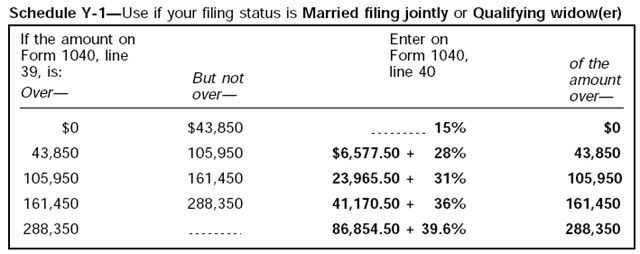
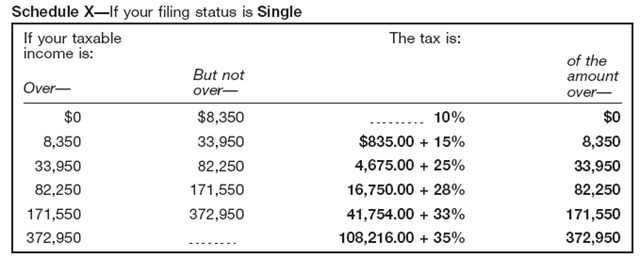
2009 Tax Rate Schedules

image

image

http://www.unclefed.com/IRS-Forms/taxtables/index.html

* * * * *

Next up: Those (expletive deleted) Bush tax cuts …

TAXES: ’tis the season, so …

April 5, 2010

I figure that attentiveness to income tax issues is probably at a high point as we close in on April 15, so I have loaded several tax-relevant posts for the next several days. 

Among the topics:

  • Did the marriage penalty really get eliminated?  Answer: no.
  • Where the Bush tax cuts really just for the wealthy?  Answer: no.
  • So what if Obama let’s the Bush tax cuts expire? Answer: uh-oh
  • What about the 3.8% non-payroll payroll tax on dividends and capital gains? Answer: uh-oh (again)
  • What about the marriage penalty? Answer: it gets a dose of steroids
  • So, what’s like to happen … really? Answer: gonna get interesting

Stay tuned over the next week or so …

Heads up: The capital gains hurt on the horizon … and the giant sucking sound from the stock market.

March 9, 2010

The unions cut a special behind-closed-doors deal with the President to delay the tax on Cadillac heath insurance plans until 2018.  Though Obama proposes eliminating the Cornhusker kickback, he plans to keep his word to the SEIU on this break.

To compensate for the lost tax revenue, Obama proposes extending Medicare “payroll taxes” to unearned income — i.e. interest, dividends and capital gains. 

That’s a 2.9% increase in capital gains taxes.

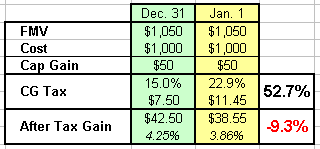
Keeping in mind that the Bush tax rates expire on Dec 31, the capital gains tax rate will go from 15% to 22.9% — a 52.7% increase !

As the simple example below shows, after-tax gains get crushed — overnight — when the new rates take effect.

Note: Potentially making matters worse, I expect the Medicare tax on unearned income to become effective on the date Obama signs the bill … or worse, I wouldn’t be surprised if Team Obama made the tax hike retroactive to Jan. 1, 2010. The sucking sound you’ll hear is the stock market losing steam …

image

Swelling ranks of Federal government employees owe $3 billion in unpaid taxes … ah, give ’em a break.

March 8, 2010

There were 3 related stories last week that have to make you scratch your head … or scream.

First, the monthly BLS jobs report indicated that 36,000 more jobs were lost (“good news” according to Harry Reid) … job losses in the private sector were offset by more jobs added in government. The federal government now spends about $125 billion annually on compensation for about 2 million civilian employees.
http://www.bls.gov/news.release/empsit.nr0.htm

Second, USA Today reported that Federal employees earn higher average salaries than private-sector workers in more than eight out of 10 occupations and that federal workers earned an average salary of $67,691 in 2008 for occupations that exist both in government and the private sector. The average pay for the same mix of jobs in the private sector was $60,046 — a difference of almost 13%. That doesn’t include the value of health, pension and other benefits, which averaged $40,785 per federal employee in 2008 vs. $9,882 per private worker. So, the total of comp plus benefits is $108,476 for a Federal employee, $69,928 for a private sector grunt — a difference of over 55%.
http://www.usatoday.com/news/nation/2010-03-04-federal-pay_N.htm

Now, the coup de grace: According to Internal Revenue Service documents, 276,300 federal employees and retirees owe $3,042,200,000 in back taxes. Rep. Jason Chaffetz (UT) introduced a bill to collect “seriously delinquent” taxes from federal employees and congressional staffers. The amendment was voted down, ostensibly because it would “overburden the Office of Personnel Management, which would be responsible for administering the provision”. And, oh yeah, government employees’ unions lobbied against the changes.

Keep reading for details …

* * * * *

Provision to fire tax-delinquent federal employees pulled

A legislative compromise that would have allowed agencies to fire tax-delinquent federal employees fell apart on Thursday.

An amendment to the 2009 Contracting and Tax Accountability Act would have targeted “seriously delinquent” federal employees and congressional staffers.

Democrats raised concerns about whether the amendment would overburden the Office of Personnel Management, which would be responsible for administering the provision.

Govexec.com, March 4, 2010
http://www.govexec.com/dailyfed/0310/030410rb1.htm

* * * * *

Feds owe Uncle Sam $3B in unpaid taxes

At a time when the White House is projecting the largest deficit in the nation’s history, Uncle Sam is trying to recover billions of dollars in unpaid taxes from its own employees.

Federal workers owe more than $3 billion in income taxes they failed to pay in 2008. According to Internal Revenue Service documents, 276,300 federal employees and retirees owe $3,042,200,000.

The agency with the most tax scofflaws is the U.S. Postal Service, with 28,913 employees who owe $297,933,756.

“We urge our employees to comply with all tax laws and are encouraged that many who have been delinquent have agreed to payment plan with the IRS,” USPS spokesperson Mark Saunders said.

“We remind our employees of this responsibility as part of our mandatory annual ethics training.”

Notable agencies on the list:

Executive Office of the President (includes the White House): 50 employees owe $812,917;

U.S. Senate: 231 employees owe $2,469,026;

U.S. House of Representatives: 447 employees owe $5,809,631;

Wtop.com, December 14, 2009
http://www.wtop.com/?nid=428&sid=1838232

Blue states bleed red ink … surprised?

March 2, 2010

Punch line: What do you get when you have union dominance, lots of  state employees, and a comfortable environment for moochers?  Well, a Dem majority with mountains of debt, lots of unfunded pension liabilities, and enough social services to choke a horse. 

* * * * *

Excerpted from Forbes: Political Litmus Test: Bluest States Spilling The Most Red Ink, 02.25.10 

Want to know which states are in the worst financial condition? One telling indicator that might not immediately come to mind is whether most of its citizens identify themselves as Democrats.

The five states in the worst financial condition–Illinois, New York, Connecticut, California and New Jersey–are all among the bluest of blue states.

Forbes’ metrics for each state included unfunded pension liabilities, changes in tax revenue, credit ratings, debt as a percentage of Gross State Product, debt per capita, growth expectations for employment and the state economy, net migrations and a “moocher ratio” that compares government employees, pension burdens and Medicaid enrollees to private-sector employment.

Why do Democratic states appear to be struggling more than Republican ones? It comes down to stronger unions and a larger appetite for public programs.

“Unions in general have more influence in Democratic-controlled states … where they’re strong you have bigger demands for social services and coalitions with construction companies, road builders and others that push up debt.”

Of the 10 states in the worst financial condition, eight are among a total of 23 defined by Gallup as “solidly Democratic,” meaning the Democrats enjoy an advantage of 10 percentage points or greater in party affiliation. These states include the ones listed above as making up the bottom five, plus Massachusetts, Ohio and Wisconsin.

Of the three other basement-dwellers, Kentucky is defined as “leaning Democratic” (a five- to 10-percentage-point Democratic advantage) and the remaining two–Louisiana and Mississippi–are termed politically “Competitive” (less than a five-percentage-point advantage for either party). Louisiana tilts slightly Democratic and Mississippi slightly Republican.

The majority Republican states ranked among the financially healthiest are Utah, Nebraska, Texas, North Dakota and Montana.

Utah, the fiscally fittest state, has debt of just $442 and unfunded pension obligations of $7,272 per resident. It is also America’s second reddest state with a 21-percentage-point Republican advantage in party affiliation. The Beehive state boasts a triple-A credit rating from Moody’s.

Illinois is in the worst financial condition, with per-capita debt of $1,877 and unfunded pensions of $17,230. Moody’s rates Illinois’ general obligation debt A1, ahead of only California’s.

Full article:
http://www.forbes.com/2010/02/25/democratic-states-bad-financial-shape-personal-finance-blue.html

Unstimulata: New-Home Sales Drop 11.2% … and a reprise of my Rx

February 26, 2010

Bottom line: No surprise, the housing market is still in the doldrums.

Below are the details … and below them are a reprise of my November 2008 post with a plan for handling part of the foreclosure problem and getting housing back on track.

* * * * *

Excerpted from WSJ: U.S. New-Home Sales Drop 11.2%, Feb. 24, 2010

U.S. new-home sales unexpectedly fell in January, setting a record low and erasing all gains made in the market during the past year as the economy recovers from recession.

Demand for single-family homes fell 11.2% from the previous month to a seasonally adjusted annual rate of 309,000.

Over the past year, sales had climbed, albeit slowly and unevenly, because of low prices, low mortgage rates, and tax incentives. But Wednesday’s report wiped out the advance and showed, year over year, sales were 6.1% down from January 2009.

Wednesday’s new-home sales data showed inventories picking up slightly. There were an estimated 234,000 homes for sale at the end of January, up from 233,000 in December. The months’ supply at the current sales rate rose, to 9.1 from 8 in December.

The median price for a new home fell, year over year, in January by 2.4%, to $203,500 from $208,600 in January 2009.

Full article:
http://online.wsj.com/article/SB10001424052748704240004575085232728239148.html?mod=djemalertNEWS

* * * * *

Rallying private capital to stabilize the housing market

Ken’s Plan Summary: (1) eliminate ALL of the capital gains taxes on residential property that is bought from now until, say, December 31, 2010 and held for at least 18 months, (2) allow these “qualified residential properties”, if they are rented, to be depreciated for tax purposes at an aggressively accelerated rate (say, over 5 or 10 years) to generate high non-cash tax losses, and (3) allow ALL tax losses generated by these “qualified residential rental properties” to offset owners’ taxable ordinary income with no “passive loss’ limitations, thereby reducing their federal income tax liability.

The positive results are practically guaranteed.  Nonetheless, I haven’t even heard the ideas mentioned.  Guess the politically correct folks in DC don’t read the Homa Files.

* * * * *

From HomaFiles archive, “Big Idea: Rallying private capital to stabilize housing prices”, November 23, 2008.

A stark reality of the current mortgage crisis is that there have been — and will continue to be – an unprecedented and destabilizing number of foreclosures that need to be absorbed into the housing market.  Until they are, home prices will continue to slide and the crisis will persist..

To date, most of the government’s programmatic emphasis has focused on mitigating the financial pressures on lending institutions and investors who funded bad loans, by injecting supplementary capital (loans or preferred stock purchases), or by buying toxic securities..  Some political rhetoric has centered on preventing distressed citizens from “losing their homes”, but few substantive steps have been taken.  Why?

First, once a mortgage has been “securitized” – as most have been — there are contractual limitations on possible loan modifications.   In these instances, mortgage “servicers” have their hands tied.  They are only empowered to collect payments and foreclose on non-payers, with very little latitude between the extremes.

Second, there is the proverbial elephant in the middle of the room.  Many so-called home owners are – truth be told — really “occupants” not “owners”.  Some have no equity in the homes.  Some never did – even before housing prices crashed, submerging loan balances under water.   Many wouldn’t qualify today for restructured loans under the most liberal of terms – e.g. lowered interest rates, extended payment periods, reduced principle balances (to the current fair market value of the homes).  Whether the people legitimately qualified for their initial loans is irrelevant.  Whether their initial loan terms were predatory is also largely irrelevant. Objectively, the low bar is whether they can foot the bill for a restructured mortgage.  The emerging evidence seems to suggest that many – maybe most – can’t.

That leads to an inescapable conclusion: regardless of what remedial government bailouts are enacted – the housing market will continue to be flooded with foreclosures.

So, a pivotal economic policy question is how to get the foreclosed properties off the market and into the hands of private owners (i.e. not onto the government’s asset rolls), and how to keep them there until they can be remarketed at an orderly pace and higher prices.

Three straightforward changes to the income tax code – throwbacks to yesteryear — could provide the necessary financial incentives to rally private capital back into the housing market to buy, hold, and rent foreclosed homes: (1) eliminate ALL of the capital gains taxes on residential property that is bought from now until, say, December 31, 2010 and held for at least 18 months, (2) allow these “qualified residential properties”, if they are rented, to be depreciated for tax purposes at an aggressively accelerated rate (say, over 5 or 10 years) to generate high non-cash tax losses, and (3) allow ALL tax losses generated by these “qualified residential rental properties” to offset owners’ taxable ordinary income with no “passive loss’ limitations, thereby reducing their federal income tax liability.

For example, assume that an investor buys a foreclosed home for $200,000 and rents it out at a price that simply breaks even on a cash flow basis.  That is, the rental price just covers interest, taxes, insurance, maintenance, etc.  Assuming a 5-year accelerated depreciation schedule, the rental would generate an annual non-cash tax loss of $40,000 that could be used to offset the investor’s ordinary income.  If the investor were in the Obama-boosted 39.6% marginal tax bracket, that ordinary income offset could save the investor almost $16,000 in federal income taxes each year that the property is held and rented.  If the home were then resold – say, in 3 years for $250,000 –  the investor would book $170,000 in capital gains (the $50,000 home price increase, plus the $120,000 in depreciation claimed against ordinary income when the property was being rented), but the investor would owe no capital gains taxes.

Such a program potentially offers several benefits: (1) it would entice private capital to buy (and hold) foreclosures and other distressed residential property, (2) it would likely provide affordable rental housing to people (maybe the current occupants of the homes) who realistically can’t and shouldn’t shoulder the costs of home ownership , and (3) it might take some of the sting out of President-elect Obama’s proposed tax hikes.

It’s a win-win solution to part of a thorny problem.

Original post:
https://kenhoma.wordpress.com/2008/11/25/big-idea-rallying-private-capital-to-stabilize-housing-prices/
© K.E. Homa 2008

Pivoting away from jobs (again) … let’s raise taxes (a lot).

February 24, 2010

HomaFiles was all over this earlier this year: “Uh-oh. New Dem idea: Extending the Medicare tax to interest, dividends, and cap gains”
https://kenhoma.wordpress.com/2010/01/14/uh-oh-new-dem-idea-extending-the-medicare-tax-to-interest-dividends-and-cap-gains/

Bottom line: Not only will the tax rates on dividends and capital gains go up when the Bush tax cuts expire, but a funding source for ObamaCare will be application of MediCare payroll taxes to so-called “unearned income” — i.e. dividend and capital gains.

Here’s a point the WSJ missed: Many seniors live off of their retirement savings — English translation: dividends and capital gains.  Let’s gig the Seniors by extending their contributions’ stream for MediCare, but cutting the benefits. Nice.

Also, note that individuals will be responsible for both the “employee contribution” and the “employer contribution” since there’s no employer. Huh?

* * * * * 

Excerpted from WSJ: Obama’s New Investment Tax – A sneaky Medicare levy on dividends and capital gains, Feb. 24, 2010

The White House’s new health-care proposal’s fine print goes describes one of the largest tax increases in history.

This new ObamaCare bargain would for the first time apply the 2.9% Medicare payroll tax to “interest, dividends, annuities, royalties and rents,” so-called passive income that we are told includes capital gains.

This antigrowth investment tax … comes on top of the Senate’s 0.9-percentage-point increase in the payroll tax, which would bring the combined employee-employer share to a capital and jobs stiffling 3.8%.

The rate hike on investment income would presumably take effect at the same time the 2001 and 2003 Bush tax cuts are due to expire next year, bringing the top rate to 22.9% as the current top capital gains rate would also rise to 20% from 15%. That’s a 52% jump … and the rate can always be inched up later once the tax is already in place.

* * * * *

The White House levy muddies up both the tax code and Medicare financing.

The Medicare payroll levy was designed as a social insurance program with some connection, however attenuated, between taxes paid and benefits received.

When Medicare passed in 1965 it was modeled after Social Security and the tax was supposed to be equivalent to a “premium” for guaranteed health-care insurance for seniors; everyone “contributed” at the same rate.

Until 1993, the payroll tax was assessed only on the first $135,000 of wages … then the Clinton Administration and the Democratic Congress lifted the Medicare cap entirely.

The Clinton move was bad enough but Mr. Obama’s plan fundamentally changes the nature of the government’s health-care financing.

Medicare’s liabilities mean that it must receive injections of general revenue, but never before have Medicare’s own “dedicated” revenues been siphoned off to fund another entitlement.

Essentially, it turns Medicare financing into a wealth transfer program at a stroke.

Full article:
http://online.wsj.com/article/SB10001424052748704188104575083520811873704.html?mod=djemEditorialPage_h

MediCare & Seniors’ Rx Plans … either cut ’em or shut the blank up!

February 2, 2010

Here are my pets from the Team Obama budget and the yak that romanced its announcement …

  1. I’m officially tired of hearing the President whine that Bush created the deficit with his “costly prescription drug plan”.  If Team O doesn’t like it, then show some cahones and cut it.  Otherwise stop strolling down memory lane.  (Note: they don’t have the fortitude to kill it — it’s just a talking point.)
  2. Half of ObamaCare ($50 billion per year) was to be funded with MediCare waste and fraud.  Why don’t they get cracking on the waste and fraud this afternoon?  They said it’s low hanging fruit, so let’s pick it !
  3. Limit the itemized tax deductions high earners can claim for charitable donations.  Let me make sure I understand this: The Feds borrow $100 million from the Chinese to give to the Haitians … and then turn around to starve the Red Cross, Doctors Without Borders and other charitable groups that actually do something.
  4. Repeal a widely ignored law that taxes the personal use of company-issued cell phones like other fringe benefits.  Have you ever looked at your phone bills to see how much is already paid in taxes ?
  5. The budget is silent on the tanning salons’ excise tax. Nuts. That’s at the top of my list.

Uh-oh. New Dem idea: Extending the Medicare tax to interest, dividends, and cap gains.

January 14, 2010

I don’t know how I missed this one. 

In the secret WH talks re: reconciling the House and senate bills, another taxing idea slipped out:

Boosting the Medicare payroll tax – either by increasing the rate or extending it to unearned income – is still a live option, according to sources familiar with the talks. 
http://www.politico.com/news/stories/0110/31480.html#ixzz0caQSCeWR

“They” like to call it unearned income.  We  income taxpayers (i.e. the minority) like to call it interest, dividends and capital gains — earnings previously sheltered from FICA and Medicare.

Now, this is getting personal.

Raise your hand if you want to add some sales taxes onto that Internet order …

January 7, 2010

Ken’s Take: You had to know that this one was coming.

While I’m a beneficiary of the Internet sales tax rules … I agree with the guy that the sales should be taxed — whether bought in local stores or over the net.

In fact, I’d be a fan of upping sales taxes  … concurrent with blowing up the income and estate taxes, of course. 

* * * * *

Excerpted from NY Times: Sorry, Shoppers, but Why Can’t Amazon Collect More Tax?, December 26, 2009

Today, Amazon collects sales tax in only five states, which gives it a continuing advantage over companies who do collect them in all or most states. Competitors aren’t the only ones hurt by Amazon’s stance on sales taxes: it also means the loss of considerable revenue to states and localities that badly need it.

In addition to its home in Washington State, Amazon has facilities in North Dakota, Kentucky and Kansas, and collects sales taxes in these states. The company also collects sales tax in New York, but not cheerfully: Amazon has gone to court to overturn a law passed last year that compels it to collect from New York residents.

Yet these five do not exhaust the roll call of states in which Amazon has additional corporate offices, fulfillment and warehouse operations, customer service and other facilities. Fourteen more (among states with sales taxes) are listed in the company’s last annual report: Arizona, California, Delaware, Florida, Indiana, Michigan, Nevada, New Jersey, Pennsylvania, South Carolina, Texas, Virginia, West Virginia and Wisconsin. But Amazon.com does not collect for any state on that list.

Amazon uses “tax entity isolation” to put large portions of its business into tax-havens … by creating wholly owned subsidiaries for the parts that are treated separately for tax matters, so that Amazon is under no obligation to collect sales tax.

For example, Amazon has offices in four cities in California, for example, including those that are home to the subsidiary that developed the Kindle. Because the subsidiary isn’t selling the Kindle directly to consumers, Amazon is under no obligation to collect sales taxes in those locales. 

Amazon is deliberately maximizing “the significant competitive advantage it gains over its rivals when they must add the typical 5 percent to 10 percent tax to their prices, but Amazon does not.”

Amazon argues that it shouldn’t be compelled to collect sales taxes for purchases made by customers other than those who live in Washington.  “In Washington State, where we have a presence, we get police protection, we get fire protection. We send our kids to local schools … since we get no services from North Carolina and many other states, they shouldn’t be able to force us to collect taxes for them.”

And this may be a good time to point out that states and localities are having a bit of a tough time paying bills.

The Center on Budget and Policy Priorities estimates that state budget gaps for this year and next year combined will be more than $350 billion.

Wider collection of the sales tax is not going to plug a hole of that size, but every billion or two would help.

Some 147 million people, or half the nation’s population, live in sales-tax-levying states where Amazon has facilities but does not collect tax on residents’ purchases.

An Amazon spokesman described today’s sales taxes as “very complex,” but said the company would welcome a “simplified system, fairly applied to all business models.”

Full article:
http://www.nytimes.com/2009/12/27/business/27digi.html?adxnnl=1&ref=business&adxnnlx=1261944246-BDKnjFI47UhFShH1ZYYq1w

Funding ObamaCare … taxes going up, up, up

January 6, 2010

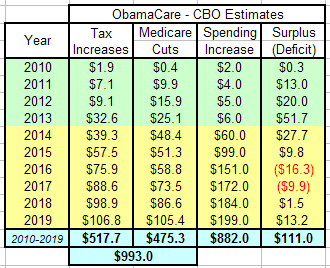
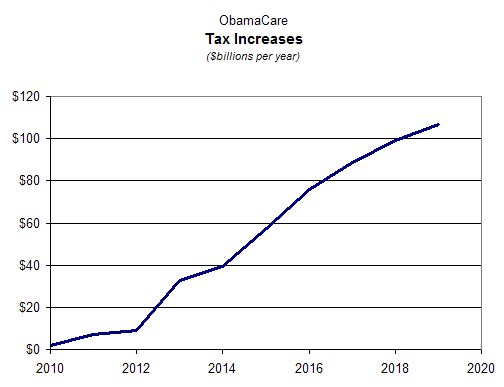
Based on the CBO scoring (before discovery of double-counting the Medicare savings):

Almost $1 trillion in additional government spending over 10 years … funded roughly half from Medicare cuts and half from tax increases … with the tax increases on a sorry trajectory.

Draw your own conclusions.

image

image

Tempting the tax cheats … Stimulus bill says "come on down".

January 4, 2010

Another fine example of our government in action …

A report from the Treasury Department’s Inspector General for Tax Administration counts 56 tax provisions in the Stimulus bill with a projected cost of $325 billion. Of those 56, 20 are tax breaks for individuals and 36 are for businesses.

The problem, the Inspector General says, is the IRS can’t verify taxpayer eligibility “for the majority of Recovery Act tax benefits and credits.”

For individual taxpayers, 13 of the 20 benefits and credits can’t be verified; for businesses, it’s 26 of 36.

In other words, Treasury finds that the biggest chunk of the $325 billion in stimulus package tax breaks can’t be adequately tracked to protect against fraud.

IBD, How Corruption Stalks The Stimulus, 12/23/2009
http://www.investors.com/NewsAndAnalysis/Article.aspx?id=516173

If you’re unhappy, move to a state with lower taxes …

December 30, 2009

Punch line: States with the highest taxes also rank as the unhappiest.

* * * * *

WSJ: Are Taxes the Root of Unhappiness?, Dec. 29, 2009

Does living in a blue state make people blue?

It seems so, according to a new study in Science magazine  … New Yorkers — with high taxes, traffic congestion, cold weather, and poor schools — are the unhappiest people in America and their neighbors in Connecticut come in a close second, followed by Michigan, Indiana, New Jersey, California, and Illinois.

And the happiest states? Drum roll, please…Louisiana, Hawaii, Florida, Tennessee, and Arizona.

Eight of the ten happiest states lean right while eight of the ten unhappiest tilt left.

The people who say they’re satisfied with their lives aren’t just delusional or overly optimistic, and people who say they’re unsatisfied aren’t just pessimists. People have legitimate reasons to be happy or unhappy.

And well, high taxes seem to be a big reason—ostensibly an even bigger reason than weather given that California is one of the unhappiest states and inclement Louisiana is the happiest.

According to the Tax Foundation 2008 analysis, three of the top five unhappiest states—New York, Connecticut and New Jersey — have the highest state-local tax burdens.

On the other hand, four of the top five happiest states—Louisiana, Florida, Tennessee and Arizona — are among the states with the lowest state-local tax burdens. True, correlation doesn’t prove causation, and high taxes alone don’t always make people miserable, but there’s something going on here.

In states with high property, income, and sales taxes like New York, people have less money to spend on other things that make them happy. They have less money to spend on vacations, hobbies, home improvements, eating out and child care. Another problem may be that people receive a low return on their tax dollars.

People are least happy in states that impose high taxes but don’t provide matching public benefits (e.g. good highways to relieve congestion and reduce commute times). It’s in states where taxes disproportionately subsidize public employee pensions and entitlement programs, but don’t much improve the general public’s quality of life, that people are most unhappy.

This intuitively makes sense. If you’re paying more than a third of your income in taxes, as many New Yorkers do, then you expect to realize the benefits from your hard-earned tax dollars. You expect quality schools, good roads, low crime rates, and quick commutes. You expect your local and state governments to be responsive to your needs, not to the cash flows of entrenched public employee unions and other special interests.

Many liberal state governments like those in Albany, Trenton and Sacramento are spending more and more on entitlement programs and public employee pensions, racking up more and more debt, and imposing more and more taxes to pay for it all –while ignoring their taxpayers’ needs.

Taxpayers, however, aren’t just getting unhappy. They’re getting out. United Van Lines’ 2009 annual study shows that New York, New Jersey, Michigan and Illinois are among the states with the highest outbound migration while Alabama and Tennessee are among the states with the highest inbound migration.

This doesn’t bode well for high-spending, high-tax states like New York where outbound migrants’ income is 13% greater than that of inbound migrants. In 2006, this differential meant a loss of $4.3 billion in taxpayer income for the state.

Taxes may not be the root of all unhappiness, but they do result in some very sad citizens.

Full article (with stats explanation)
http://online.wsj.com/article/SB10001424052748703278604574624743612652998.html?mod=djemEditorialPage

Oh my god, am I becoming a populist? … I'm ok on raising a tax.

December 10, 2009

The punch lines

(1) “The House raises taxes on carried interest”

(2) Obama says “we’re proposing a complete elimination of capital gains taxes on small business investment” for one year.

* * * * *

Ken’s Take:

(1) Oh, those poor private equity guys.  The taxation of so-called carried interest is complicated, but reduces down to the fact that private equity firms have enjoyed a massive tax break for years.  Whether that tax break has fueled innovation and growth or simply lined the pockets of the equitists is subject to debate. My view: more the latter than the former.  So, I say: go get ’em.

(2) From a personal standpoint, I favor low or no capital gains taxation.  Why not?  I have some horses in that race.

But, for the life of me, I can’t figure out how a 1-year suspension of small business capital gains taxes helps small businesses and promotes hiring. 

What appreciated assets is a typical small business going to sell in the next 12 months that would qualify for a gain?  Except for small financial firms that hold and trade securities and family farms that are passing down generationally,  I can’t figure out how small businesses benefit from this move.

Does seem that — if we have any appreciated assets — we should all become small businesses and sell them in 2010.

If somebody can explain this to me, please hit the reply button … I must be missing something.

* * * * *

Excerpted from WSJ: Zero to 35 in 24 Hours, Dec.10, 2009 

On Tuesday, Mr. Obama announced that “we’re proposing a complete elimination of capital gains taxes on small business investment” for one year.

On Wednesday, the House voted to change the capital gains rate for venture capitalists, private equity fund managers and managers of real-estate and oil-and-gas partnerships. But rather than eliminating the tax, the House more than doubled it, moving the tax rate to 35% from 15% by reclassifying such gains as ordinary income.

The new 35% rate applies to what is known as “carried interest,” which is income that only materializes if fund managers wisely invest the fund’s capital and only after other investors in the fund have benefited. Venture and private equity fund managers already pay normal income taxes on their regular salary derived from management fees. The carried interest, no sure thing, represents a capital gain on a successful investment and has therefore been taxed that way.

Some argue that partnerships should be taxed just like other corporations before money is distributed to partners. We think that’s a reasonable argument in the context of lowering the 35% U.S. corporate tax rate to something remotely competitive in the world economy. By itself, this tax increase is simply a drag on investment and job growth.

Mr. Obama now has a chance to respond with similar speed and show his commitment to lower capital-gains taxes on start-up investments. A Statement of Administration Policy condemning the House bill would discourage the Senate from making a similar mistake.

Full article: 
http://online.wsj.com/article/SB10001424052748704240504574586274278223030.html?mod=djemEditorialPage

Oh my god, am I becoming a populist? … I’m ok on raising a tax.

December 10, 2009

The punch lines

(1) “The House raises taxes on carried interest”

(2) Obama says “we’re proposing a complete elimination of capital gains taxes on small business investment” for one year.

* * * * *

Ken’s Take:

(1) Oh, those poor private equity guys.  The taxation of so-called carried interest is complicated, but reduces down to the fact that private equity firms have enjoyed a massive tax break for years.  Whether that tax break has fueled innovation and growth or simply lined the pockets of the equitists is subject to debate. My view: more the latter than the former.  So, I say: go get ’em.

(2) From a personal standpoint, I favor low or no capital gains taxation.  Why not?  I have some horses in that race.

But, for the life of me, I can’t figure out how a 1-year suspension of small business capital gains taxes helps small businesses and promotes hiring. 

What appreciated assets is a typical small business going to sell in the next 12 months that would qualify for a gain?  Except for small financial firms that hold and trade securities and family farms that are passing down generationally,  I can’t figure out how small businesses benefit from this move.

Does seem that — if we have any appreciated assets — we should all become small businesses and sell them in 2010.

If somebody can explain this to me, please hit the reply button … I must be missing something.

* * * * *

Excerpted from WSJ: Zero to 35 in 24 Hours, Dec.10, 2009 

On Tuesday, Mr. Obama announced that “we’re proposing a complete elimination of capital gains taxes on small business investment” for one year.

On Wednesday, the House voted to change the capital gains rate for venture capitalists, private equity fund managers and managers of real-estate and oil-and-gas partnerships. But rather than eliminating the tax, the House more than doubled it, moving the tax rate to 35% from 15% by reclassifying such gains as ordinary income.

The new 35% rate applies to what is known as “carried interest,” which is income that only materializes if fund managers wisely invest the fund’s capital and only after other investors in the fund have benefited. Venture and private equity fund managers already pay normal income taxes on their regular salary derived from management fees. The carried interest, no sure thing, represents a capital gain on a successful investment and has therefore been taxed that way.

Some argue that partnerships should be taxed just like other corporations before money is distributed to partners. We think that’s a reasonable argument in the context of lowering the 35% U.S. corporate tax rate to something remotely competitive in the world economy. By itself, this tax increase is simply a drag on investment and job growth.

Mr. Obama now has a chance to respond with similar speed and show his commitment to lower capital-gains taxes on start-up investments. A Statement of Administration Policy condemning the House bill would discourage the Senate from making a similar mistake.

Full article: 
http://online.wsj.com/article/SB10001424052748704240504574586274278223030.html?mod=djemEditorialPage

Death taxes just won’t die …

November 4, 2009

Note:  This is intended primarily for Homa Files more “mature” readers.  But, may be relevant for younger folks with rich relatives who are on their last legs …

* * * * *
Source: WSJ: State Death Taxes Are the Latest Worry, Oct 31, 2009
http://online.wsj.com/article/SB125694593227919879.html

With the federal estate tax disappearing for most people, state death taxes have emerged as a surprise new worry.

This year, the federal exemption rose to $3.5 million per individual, or as much as $7 million per married couple. At the current level, only 5,500 estates a year are federally taxable.

The problem is that most states with estate or inheritance taxes haven’t raised exemptions to match the federal limits. That means thousands of taxpayers who now escape the federal levy could still get hit with a state death tax.

As a result, tax advisers are tweaking bypass trusts that allow married couples to maximize exemptions from state taxes. They are advising taxpayers where to retire in order to pare or eliminate estate taxes.

“In the past, many people hardly gave state death taxes a thought … now they are shocked at how expensive mistakes can be.”

Adding insult to injury, Congress is talking about eliminating the federal deduction for state estate taxes. That would affect only wealthy taxpayers whose estates still exceed $3.5 million per individual.

“States are in such dire straits that most without these taxes would like to have one, and nobody who has one will let it go.”

Seventeen states and the District of Columbia currently impose estate taxes. Eight states have inheritance taxes, which are levied on heirs, not estates. Maryland and New Jersey have both.

Compared to the uniform federal tax, state taxes are a crazy quilt. In many states with inheritance taxes, rates are tied to how closely the heir is related to the late donor. Iowa and Kentucky exempt both spouses and children who inherit property, while Nebraska treats only transfers to spouses as tax-free.

Advisers say taxpayers are most likely to be tripped up by states that used to conform to the federal exemption but haven’t raised it at the same rate.

As a result, married couples in states with lower exemptions — such as New York, Oregon, Minnesota and Massachusetts (all $1 million) or Illinois ($2 million) — are setting up “bypass” trusts in wills even if they no longer need them for federal taxes.

Here’s how bypass trusts work: At the death of the first spouse, assets go into a trust that the survivor can draw on if necessary. When the second spouse dies, the remaining assets in the bypass trust pass tax-free to heirs, preserving the value of both individual exemptions.

Put another way, if a married couple lives in a state with a $1 million individual exemption, a bypass trust would let them to pass as much as $2 million tax-free to heirs.

“Without the proper trusts … a couple in New York with $2 million in assets might pay an unnecessary $100,000.”

* * * * *

The issue is figuring out the “domicile” of a taxpayer. Domicile is a much broader idea than the mere residency test that often determines where someone pays income tax.

Although one determinant of domicile is the amount of time spent in a state, it also may look at where a taxpayer votes, has church and club memberships, registers a car or even has a burial plot.

This means that a taxpayer could live in estate-tax-free Florida, California or Texas and even spend most of his time there. But if he keeps an apartment in New York or a summer home on Cape Cod and has other ties to the area, he might be considered to be domiciled there.

In the worst case, a taxpayer could be domiciled in more than one state and owe taxes to each.


image

What ever happened to "I love New York" ?

October 28, 2009

TakeAway: A new study says high taxes are driving people away from NY … especially NYC.

* * * * *

Excerpted from WSJ: Escape from New York, Oct. 28, 2009

An old saying goes that the time to live in New York is when you’re young and poor, or old and rich—otherwise, you’re better off somewhere else. .

Between 2000 and 2008, the Empire State had a net domestic outflow of more than 1.5 million, the biggest exodus of any state, with most hailing from New York City.

The departures have perilous budget consequences, since they tend to include residents who are better off than those arriving. Statewide, departing families have income levels 13% higher than those moving in, while in New York County (home of Manhattan) the differential was 28% .

In 2006 alone, that swap meant the state lost $4.3 billion in taxpayer income. Add that up from 2001 through 2008, and it translates into annual net income losses somewhere near $30 billion.

According to the Tax Foundation, between 1977 and 2008, New York has ranked first or second in the country for its state-local tax burden compared to the U.S. average.

That pattern is consistent with the annual migration patterns, showing that highly taxed and economically lackluster states were most likely to end up in residents’ rear view mirrors. According to the annual study by United Van Lines, states like New York, New Jersey, Michigan and Illinois have been big losers in recent years.

Greener pastures that drew New Yorkers included states like Florida, North Carolina and Pennsylvania.

Liberals continue to insist that they can raise taxes ever higher without any effect on behavior, but the New York study is one more piece of evidence that this is a destructive illusion.

Full article:
http://online.wsj.com/article/SB10001424052748703574604574499772371161800.html?mod=djemEditorialPage

First Cash for Clunkers … now, Carts for Clubbers.

October 20, 2009

Ken’s Take: This stuff keeps getting nuttier and nuttier. 

Half-baked ideas with shoddy implementation doesn’t strike me as a (cart) path to success.

* * * * *

Excerpted from WSJ:Cash for Clubbers – Congress’s fabulous golf cart stimulus, Oct. 17, 2009

Thanks to the federal tax credit to buy high-mileage cars that was part of President Obama’s stimulus plan, Uncle Sam is now paying Americans to buy that great necessity of modern life, the golf cart.

The federal credit provides from $4,200 to $5,500 for the purchase of an electric vehicle, and when it is combined with similar incentive plans in many states the tax credits can pay for nearly the entire cost of a golf cart. 

The golf-cart boom has followed an IRS ruling that golf carts qualify for the electric-car credit as long as they are also road worthy. These qualifying golf carts are essentially the same as normal golf carts save for adding some safety features, such as side and rearview mirrors and three-point seat belts. They typically can go 15 to 25 miles per hour.

The IRS has also ruled that there’s no limit to how many electric cars an individual can buy, so some enterprising profiteers are stocking up on multiple carts while the federal credit lasts, in order to resell them at a profit later. 

Roger Gaddis of Ada Electric Cars in Oklahoma said earlier this year. “Is that about the coolest thing you’ve ever heard?”

If this keeps up, it’ll soon make more sense to retire and play golf than work for living.

Full article:
http://online.wsj.com/article/SB10001424052748704107204574473724099542430.html

* * * * *

Tax breaks for pets … Lord, just take me now.

October 19, 2009

Ken’s Take: I say, only for pets who are in the country legally …

* * * * *

The Survey Says

According to Rasmussen …

25% of voters nationwide favor a proposal that would allow pet owners to deduct up to $3,500 for “qualified pet-care expenses” for household pets.

A proposal known as the HAPPY (Humanity and Pets Partnered Through the Years) Act was introduced in Congress earlier this year. (Details are below)

Women like the tax break more than men.

Most voters under 30 favor the approach, but their elders strongly disagree.

Democrats are more than twice as likely to favor the pet-care tax deduction than Republicans.

Full article:
http://www.rasmussenreports.com/public_content/politics/general_politics/october_2009/25_favor_tax_deduction_for_pet_expenses

* * * * *

The Details

Excerpted from NOLA.com: Capitol Hill considers tax breaks for pet owners, October 13, 2009

Legislators in Washington — with support from animal rights groups — are considering a bill that pairs tax cuts and pet ownership.

The Humanity and Pets Partnered Through the Years Act — called the HAPPY Act — aims at helping current pet owners in these tough economic times and also hopes to encourage pet adoption through attractive incentives.

With more attention being paid to the fate of pets whose owners lose their homes, interest is growing on Capitol Hill and beyond about how the government can respond.

“Taking care of pets does cost money, and during the dramatic decline of people’s income and the shaky economy, any possibility of assisting people in meeting those costs should be looked at.”

The bill includes tax breaks not only for cats and dogs, but also for legally owned exotic pets.

Considering the costs of keeping pets, which varies between about $650 a year on average for a cat and almost $900 a year on average for a dog, a tax break would be nice for many New Orleans pet owners. A cap of $3,500 would be put on the tax break per person.

* * * * *

According estimates from The Humane Society, 39 percent of American households own at least one dog, and 38 percent own at least one cat. As many as 62 percent U.S. households own a pet.

* * * * *
Excerpted from NOLA.com: Capitol Hill considers tax breaks for pet owners, October 13, 2009
http://www.nola.com/pets/index.ssf/2009/10/capitol_hill_considers_tax_bre.html

A ban on big screen TVs … only in California.

October 16, 2009

Ken’s Take: I really like this idea.  Why?  Frees up $$$ so folks can buy healthcare insurance … instead of me buying it for them.

* * * * *
From the San Francisco Business Times: California looks to limit big screen TVs, October 14, 2009

California may ban some types of big screen televisions because they use too much power.

The state’s energy commission has proposed limits on big screen plasma and liquid crystal TV sets. The move is supported by power utilities and opposed by electronics industry groups.

A vote by the commission could happen as early as Nov. 4. If the rules pass, they’ll take effect in two phases, the first in 2011 and the second, tougher level, in 2013, and would reduce energy consumption by 49 percent, the commission said.

These types of televisions use lots of power, as much as a refrigerator in some cases.

“The standards would improve the energy efficiency of televisions without affecting the quality of the television, ” said the commission. It also said the technology needed to improve the energy efficiency of sets already exists.

About 1,000 types of televisions already meet the stringent standards, the commission said.

http://sanfrancisco.bizjournals.com/sanfrancisco/stories/2009/10/12/daily42.html?ana=e_bjtt

Only in California, but maybe it’ll spread …

* * * * *

Keep the change: An excise tax on ‘caloric’ soft drinks … gimme a break.

September 30, 2009

TakeAway:  The latest headache for beverage marketers – the government has decided that adding an extra tax on sweetened beverages will help Americans lose weight and, thus, reduce health care costs .  Consumer goods companies are already taking deliberate measures to increase the health profile of product offerings.  Is government intervention necessary to help consumers make good food choices? At what point is it up to consumers to make healthy food choices?

* * * * *

Excerpted from WSJ, “New Report Argues For Tax on Soft Drinks” By Betsy McKay and Valerie Bauerlein, September 16, 2009

A report published … by the New England Journal of Medicine … called for an excise tax of a penny per ounce on caloric soft drinks and other beverages that contain added sweeteners such as sucrose, high-fructose corn syrup or fruit-juice concentrates. Such a tax could reduce calorie consumption from sweetened beverages by at least 10% and generate revenue that governments could use to fund health programs, the authors said … “Escalating health-care costs, and the rising burden of diseases related to poor diet, create an urgent need for solutions, thus justifying government’s right to recoup costs.” … The latest report joins a growing drumbeat of calls for taxes on soft drinks and other sweet beverages, which some health experts compare to calls in earlier years for cigarette taxes …

Beverage-industry executives vehemently oppose the idea, which experts say would result in significant price increases … “A penny per ounce would have a seriously negative impact on the industry, as it could potentially raise prices on key packages by 40% to 50%,” said John Sicher, editor and publisher of Beverage Digest …

Currently, 33 states have sales taxes on soft drinks, but the taxes are too low to affect consumption and the revenues are not earmarked for health programs, the new report said.

Edit By TJS

* * * * *

Full Article
http://online.wsj.com/article/SB10001424052970204518504574417380680508354.html

* * * * *

Ken’s Take: How about taxing people by the pound – say, $10 per year per pound over the national height-weight guidelines?  Why just attack old people?  Let’s go after the heavies, too.

* * * * * *


Tax revenues drop big time … let’s go after the top 1% (again) … or borrow some more from the Chinese

August 4, 2009

Summary: The recession is starving the government of tax revenue, just as the president and Congress are piling a major expansion of health care and other programs on the nation’s plate and struggling to find money to pay the tab.  The deep recession is reducing incomes, wiping out corporate profits and straining government programs.

Ken’s Take: There will be no talk of slowing spending … marginal rates will go up (for more than the top 1%) … the economy will stall (again)

* * * * *

Excerpted from: AP ENTERPRISE, Biggest tax revenue drop since 1932, Aug. 3, 2009

Tax receipts are on pace to drop 18 percent this year, the biggest single-year decline since the Great Depression, while the federal deficit balloons to a record $1.8 trillion.

  • Individual income tax receipts are down 22 percent from a year ago.
  • Corporate income taxes are down 57 percent.
  • Social Security tax receipts could drop for only the second time since 1940, and
  • Medicare taxes are on pace to drop for only the third time ever.

The last time the government’s revenues were this bleak, the year was 1932 in the midst of the Depression.

* * * * *

While much of Washington is focused on how to pay for new programs such as overhauling health care — at a cost of $1 trillion over the next decade — existing programs are feeling the pinch, too.

  • Social Security is in danger of running out of money earlier than the government projected just a few month ago.
  • Highway, mass transit and airport projects are at risk because fuel and industry taxes are declining for the 2nd straight year.
  • The national debt already exceeds $11 trillion and
  • Bills just completed by the House would boost domestic agencies’ spending by 11 percent in 2010 and military spending by 4 percent.

* * * * *

The future of current programs — not to mention the new ones Obama is proposing — will depend largely on how fast the economy recovers from the recession’.

Full article:
http://www.google.com/hostednews/ap/article/ALeqM5ibGXhJv-N7Qg6nh-nQpPOgJRTgugD99RMD200

* * * * *

Help Wanted: Smart, hard working people willing to work 60 to 80 hours per week for 40 cents on the dollar … pretty motivating, huh?

July 17, 2009

To cover the $1 trillion cost of heath care “reform”,  Team Obama has proposed raising taxes by $544 billion, almost all on the “rich” — those in the top 5% of incomes.

That raises a couple of issues:

1) What if the rich “lay down” – working less as their prospective marginal take home pay gets cut? (see chart below)

2) How to inspire the next generation to bust their butts to grab for the golden ring? Maybe “doing good” will be enough motivation, but I’ll be betting “under” on that one.

3) What happens when the filthy rich are fully taxed and there’s still a big budget gap?  My hunch: they’ll be coming after the rest of us.


Source: IBD, Tax Hike Comin’,July 16, 2009
http://www.ibdeditorials.com/IBDArticles.aspx?id=332637892829537

For details  (local + state + federal)– all states — see Tax Foundation Report
http://www.taxfoundation.org/publications/show/24863.html

* * * * *

“Will only raise taxes to the level they were under Clinton” … just kidding

July 14, 2009

Ken’s Take: During the campaign, Candidate Obama promised repeatedly: “not one dime of new taxes if you make under $250,000” and “for the top brackets, no higher than under President Clinton”.  The latter will fall by the wayside if the Rangel proposal is enacted.  Think the former is far behind ?

* * * *

Excerpted from WSJ, The Small Business Surtax, July 14, 2009

Every detail isn’t known, but late last week Ways and Means Chairman Charlie Rangel disclosed that his draft bill would impose a “surtax” on individuals with adjusted gross income of more than $280,000 a year.

This would hit job creators especially hard because more than six of every 10 who earn that much are small business owners, operators or investors, according to a 2007 Treasury study.

That study also found that almost half of the income taxed at this highest rate is small business income from the more than 500,000 sole proprietorships and subchapter S corporations whose owners pay the individual rate.

In addition, many more smaller business owners with lower profits would be hit by the Rangel plan’s payroll tax surcharge. That surcharge would apply to all firms with 25 or more workers that don’t offer health insurance to their employees, and it would amount to an astonishing eight percentage point fee above the current 15% payroll levy.

image 

Full article:
http://online.wsj.com/article/SB124753106668435899.html

* * * * *

Microsoft tries again … with Windows 7 @ intro prices

July 10, 2009

Ken’s Take: It’s almost incomprehensible that a company with Microsoft’s tech savvy and  heft could have blown it as badly as they did with Vista.  For their sake, Windows 7 had better be an acclaimed product. You can only shoot and miss so many times.

The intro pricing expense makes sense except the $10 discount is simply leaving money on the table.  Do they really think that it will motivate any incremental purchases?

* * * * *

Excerpted from WSJ, Microsoft Plans Lure for Windows 7, June 26, 2009

The product

Windows 7 is a critical test of whether Microsoft can polish the reputation of its operating system after Windows Vista suffered early technical problems.

While Windows remains by far the most dominant software for running PCs, Vista’s problems were exploited relentlessly by Apple  in marketing campaigns for Macintosh computers. Macs have gained market share steadily over the past few years.

So far, early reviews of test versions of Windows 7 have been favorable.

* * * * *

The pricing

Microsoft announced a plan to encourage pc users to move to a much anticipated new version of its operating system, Windows 7 …  scheduled for release in late October.

Until July 11, consumers can preorder an upgrade copy of Windows 7 Home Premium through retailers for $49.99.

Most new PCs coming out starting in October will have Windows 7 preinstalled.

Any consumers who buy new PCs running its current Windows Vista operating system from now until Jan. 31 will receive free upgrades to Windows 7. 

For consumers who bought PCs prior to the free upgrade program, Microsoft said it will charge $119.99 for Windows 7 Home Premium — expected to be the most popular version for consumers — instead of the $129.99 upgrade price for the comparable version of Windows Vista.

Full article:
http://online.wsj.com/article/SB124593802040653741.html#mod=testMod

* * * * *

What’s next, a tax on each sip of office coffee?

June 15, 2009

Ken’s Take: Taxing every dollar earned by the evil top 1% doesn’t come close to funding the current government spending spree.  First, it’ll be tax gimmicks like this; then higher rates – much higher rates – for the 49% of workers who pay income taxes.  It’s going to get ugly.

* * * * *

From the WSJ, “The IRS Phones Home”, June 15, 2009

With federal spending in 2009 at 28% of the economy and deficits heading north, Democrats are eyeing tax increases on everything from soft drinks to electricity to health benefits to charitable contributions. The IRS is even contemplating a new tax on the use of business cellphones.

The IRS believes that some percentage of the costs incurred by employees using company-provided wireless devices should count as a “fringe benefit” and thus be subject to taxation. Since workers inevitably end up taking personal calls or emails, the thinking goes, it’s only fair that they pay for the privilege. The IRS suggests that businesses automatically assign 25% of annual phone expenses as a taxable liability.

What’s next? Maybe a per-cup tax on office coffee, or targeting furtive visits to ESPN or Hulu on the office PC? Or maybe taxing use of the company washroom.”

Full article:
http://online.wsj.com/article/SB124501952511913563.html

Anybody concerned about the national debt ?

May 19, 2009

Ken’s Take: Next to the government just flat out wasting money, my worry is the burgeoning debt.  Some debt – ok.  But, staggering levels not ok.

When I ask students why they’re unfazed, they admit that the sums are so large that “it’s more like Monopoly money” or”payback is so far off that’s it’s not worth worrying about”.

Somebody is eventually going to have to pay the piper …

* * * * *

Excerpted from IBD, “Why No Focus On Huge Ongoing Debt?”,
May 15, 2009

Since 1961 the federal budget has run deficits in all but five years. But the resulting government debt has consistently remained below 50% of GDP; that’s the equivalent of a household with $100,000 of income having a $50,000 debt. Adverse economic effects, if any, were modest.

From 2010 to 2019, Team Obama projects deficits totaling $7.1 trillion; that’s atop the $1.8 trillion deficit for 2009.

By 2019, the ratio of publicly held federal debt to gross domestic product (GDP, or the economy) would reach 70%, up from 41% in 2008.

The CBO, using less optimistic economic forecasts, raises these estimates. The 2010-19 deficits would total $9.3 trillion; the debt-to-GDP ratio in 2019 would be 82%.

By CBO’s estimates, interest on the debt as a share of federal spending will double between 2008 and 2019, from 8% of the total to 16%.

One reason Obama is so popular is that he has promised almost everyone lower taxes and higher spending. The president doesn’t want to confront Americans with choices between lower spending and higher taxes — or, given the existing deficits, perhaps less spending and more taxes.

Closing future deficits with either tax increases or spending cuts would require gigantic changes.

Full article:
http://www.ibdeditorials.com/IBDArticles.aspx?id=327285979616580

* * * * *
Want more from the Homa Files?
     Click link =>
  The Homa Files Blog

Taxes going up? Call the movers (for your goods or your money or both)

May 18, 2009

Ken’s Take: Soaking the rich to cover governmental deficits has become the cure of choice — both Federally and in in high deficit states.   And, budget projections assume that the rich folks will just bend over — stay where they are, report the same earnings and just suck it up.

The problem is “behavioral economics” — when the game changes, people adjust to rearrange the gameboard to their best advantage.  To adjust to higher marginal rates people of means often shift income to lower tax alternatives (low tax locales, tax-free investments).  So, the taxing body (states or Feds) don’t end up realizing much of the anticipated gains.

Below are highlights from an article that spells out the effect …

* * * * *
Excerpted from WSJ, “Soak the Rich, Lose the Rich”, May 18, 2009

Americans know how to use the moving van to escape high taxes.

Here’s the problem for states that want to pry more money out of the wallets of rich people. It never works because people, investment capital and businesses are mobile: They can leave tax-unfriendly states and move to tax-friendly states.

Americans are more sensitive to high taxes than ever before. The tax differential between low-tax and high-tax states is widening, meaning that a relocation from high-tax California or Ohio, to no-income tax Texas or Tennessee, is all the more financially profitable both in terms of lower tax bills and more job opportunities.

From 1998 to 2007, more than 1,100 people every day including Sundays and holidays moved from the nine highest income-tax states such as California, New Jersey, New York and Ohio and relocated mostly to the nine tax-haven states with no income tax, including Florida, Nevada, New Hampshire and Texas. We also found that over these same years the no-income tax states created 89% more jobs and had 32% faster personal income growth than their high-tax counterparts.

There are three unintended consequences from states raising tax rates on the rich.

First, some rich residents sell their homes and leave the state;

Second, those who stay in the state report less taxable income on their tax returns; and

Third, some rich people choose not to locate in a high-tax state.

Since many rich people also tend to be successful business owners, jobs leave with them or they never arrive in the first place.

Full article:
http://online.wsj.com/article/SB124260067214828295.html

* * * * *
Want more from the Homa Files?
     Click link =>
  The Homa Files Blog

A junk food tax ? … This stuff gets nuttier by the day

May 15, 2009

Ken’s Take: Does anybody really believe that the current and prospective gov’t spending spree won’t force broad based tax increases?  Rather than hit the problem head on with individual income tax boosts, Washington appears to be going the indirect route — raising business taxes (aka “closing loopholes), capping & trading, and taxing products and services.  The indirect taxes get passed along to individuals via price increases, so businesses — not government — end up looking (emphasis on “looking”) like the bad guys.

* * * * *

From IBD, “Ill-Conceived Taxes”, May 14 

Rather than cut back on other programs, the Washington solution is to raise new taxes. To fund health care, the Senate Finance Committee is thinking about placing levies on soft drinks, alcoholic beverages, cigarettes, health savings accounts and junk food, and taxing, for the first time, employer-provided health care benefits.

The public needs to understand that it will be paying more for goods and services in return for national health care. Grocery bills will be higher; that bottle of wine that should go with dinner might have to be left on the store shelf instead; a cold Coke on a hot summer day would be a rare luxury rather than a frequent pleasure;guilty indulgences could simply become unaffordable to many.

Full article:
http://www.ibdeditorials.com/IBDArticles.aspx?id=327108098260411

* * * * *

Want more from the Homa Files?
Click link =>
  The Homa Files Blog

Tax Increases Could Kill the Recovery … and, oh yeah, will hit your pocketbook.

May 14, 2009

Ken’s Take: Anybody who thinks that they’ll be untouched by massive tax hikes is likely to be disappointed.  Somebody has to pay for the current and proposed spending binge — and there just aren’t enough rich guys making enough money to foot the bill.  Secure your wallet.

* * * * *

According to economist Martin Feldstein: 

The barrage of tax increases proposed in President Barack Obama’s budget could, if enacted by Congress, kill any chance of an early and sustained recovery.

Even if the proposed tax increases are not scheduled to take effect until 2011, households will recognize the permanent reduction in their future incomes and will reduce current spending accordingly. Higher future tax rates on capital gains and dividends will depress share prices immediately and the resulting fall in wealth will cut consumer spending further. Lower share prices will also raise the cost of equity capital, depressing business investment in plant and equipment.

The Obama budget calls for tax increases of more than $1.1 trillion over the next decade.

Mr. Obama’s biggest proposed tax increase is the cap-and-trade system of requiring businesses to buy carbon dioxide emission permits. The nonpartisan Congressional Budget Office (CBO) estimates that the proposed permit auctions would raise about $80 billion a year and that these extra taxes would be passed along in higher prices to consumers. Anyone who drives a car, uses public transportation, consumes electricity or buys any product that involves creating CO2 in its production would face higher prices.

CBO says … that the cap-and-trade price increases resulting from a 15% cut in CO2 emissions would cost the average household roughly $1,600 a year, ranging from $700 in the lowest-income quintile to $2,200 in the highest-income quintile. But while the cap-and-trade tax rises with income, the relative burden is greatest for low-income households. According to the CBO, households in the lowest-income quintile spend more than 20% of their income on energy intensive items (primarily fuels and electricity), while those in the highest-income quintile spend less than 5% on those products.

The next-largest tax increase:  increasing the tax rates on the very small number of taxpayers with incomes over $250,000. The revenue estimates don’t  take into account the extent to which the higher marginal tax rates would cause those taxpayers to reduce their taxable incomes — by changing the way they are compensated, increasing deductible expenditures, or simply earning less — it overstates the resulting increase in revenue.

The third major tax increase: changing the taxation of foreign-source income. While some extra revenue could no doubt come from ending the tax avoidance gimmicks that use dummy corporations in the Caribbean, most of the projected revenue comes from disallowing corporations to pay lower tax rates on their earnings in countries like Germany, Britain and Ireland. The purpose of the tax change is not just to raise revenue but also to shift overseas production by American firms back to the U.S. by reducing the tax advantage of earning profits abroad.

But, bringing production back to be taxed at the higher U.S. tax rate would raise the cost of capital and make the products less competitive in global markets. American corporations will therefore have an incentive to sell their overseas subsidiaries to foreign firms. That would leave future profits overseas, denying the Treasury Department any claim on the resulting tax revenue. And new foreign owners would be more likely to use overseas suppliers than to rely on inputs from the U.S. The net result would be less revenue to the Treasury and fewer jobs in America.

Excerpted from WSJ. May 13, 2009:
http://online.wsj.com/article/SB124217336075913063.html#mod=djemEditorialPage

* * * * *

Want more from the Homa Files?
Click link =>
  The Homa Files Blog

If you thought the bridge to nowhere was a bad idea …

May 8, 2009

… then sit down (absolutely necessary) and watch the attached 3-minute video clip which presents the John Murtha AIrport in Johnston, PA.

The highlights:

$150 million of government pork invested

Almost $1 million of stimulus funds

3 flights per day a.. to / from DC

20 passengers per day

These guys have absolutely no conscience …

* * * * *

ABC TV video
http://cosmos.bcst.yahoo.com/up/player/popup/?cl=13140642

* * * * *

Want more from the Homa Files?
Click link =>
  The Homa Files Blog

Easy come, easy go … about that buck-a-day "Making Work Pay" program.

April 29, 2009

Obama’s signature tax cut to “95% of families” was supposed to be a $500 refundable credit (per worker) and $1,000 per household (with more than 1 worker).

Congress pared the plan to $400 per worker — a whopping buck-a-day — and stuck it in the stimulus package.

As recently as yesterday, Obama economist Austan Goolsbee was touting it as “a generous tax break for 95% of workers”.

Uh-oh.

As part of the budget blueprint that will be passed this week (on a party line vote, for sure), Congress will let Obama’s “Making Work Pay” tax credit expire at the end of next year — along with the evil Bush tax breaks for the wealthiest Americans.

Let’s see: a couple of weeks ago, a buck-a-day was a generous tax break that would stimulate the economy; now, according to some Dems, it’s a pittance that will barely be missed.  Which is it ?

* * * * *
Reported on many sources, including:
http://www.foxnews.com/politics/first100days/2009/03/24/senate-democrats-let-obamas-tax-credit-expire-budget-blueprint/

* * * * *

Want more from the Homa Files?
Click link =>
  The Homa Files Blog

The folks who don’t pay income taxes think they pay their fair share … huh ?

April 24, 2009

52% of U.S. voters now believe they pay more than their fair share of taxes.  The split:  61% of Republicans, 48% of Democrats and 48% of independents.
http://www.rasmussenreports.com/public_content/business/taxes/most_voters_say_they_pay_more_than_their_share_of_taxes_political_class_disagrees

Ken’s Translation: The half of the population that actually pays income taxes thinks that it pays too much; the half that pays no income taxes thinks that it pays about the right amount.  Surprise, surprise, surprise.

* * * * *

51% of Americans have a favorable view of the “tea parties” held nationwide last week; 33%  view the events unfavorably; 15% hadn’t even heard about the tea parties (since they get their news exclusively from the NY Times)..  

The tea parties were viewed favorably by 83% of Republicans, 49% of unaffiliated Americans, and 28% of Democrats.
http://www.rasmussenreports.com/public_content/politics/general_politics2/51_view_tea_parties_favorably_political_class_strongly_disagrees

Ken’s Take: So, when and where will the folks who favor high taxes and out-of-control spending hold their rallies ?

* * * * *

Want more from the Homa Files?
Click link =>
  The Homa Files Blog

In praise of tax code simplification …

April 17, 2009

Ken’s Take:

(1) Of course a simpler tax code makes sense, but it’ll never happen.  Why?  Because the complicated tax code is Congress’ source of power.  It allows them to pick winners & losers — among people, ideas and, oh yeah, contributors.

(2) I’d add a 7th principle: Everybody has to have some skin in the game.

* * * * *

Excerpted from WSJ, “We Need a Simpler Tax Code”. April 10, 2009

As the national taxpayer advocate, I am required to report to Congress each year on the most serious problems facing U.S. taxpayers. With April 15 fast approaching, it will come as no surprise to many frustrated taxpayers that the complexity of the tax code tops my list.

The law should be plain enough that most people can compute their own liabilities on a single form.

In developing a comprehensive tax reform blueprint, I recommend that emphasis be given to six core principles.

First, the tax system should not be so complex as to create traps for the unwary.

Second, the tax laws should be simple enough so that most taxpayers can prepare their own returns and compute their tax liabilities on a single form, and simple enough so that IRS telephone assistors can accurately answer taxpayers’ questions.

Third, the tax laws should anticipate the largest areas of noncompliance and minimize the opportunities for such noncompliance.

Fourth, the tax laws should provide some choices, but not too many, since choices are confusing and can lead to taxpayer error.

Fifth, where the tax laws provide for refundable credits, they should be designed in a way that is minimally burdensome both for the taxpayers claiming the credits and for the IRS in administering them.

Sixth, the tax system should incorporate a periodic review of the tax code — a sanity check to guard against complexity creep.

Tax simplification would benefit all Americans, regardless of political party.

Full article:
http://online.wsj.com/article/SB123933106888707793.html

* * * * *
Want more from the Homa Files?
     Click link =>
  The Homa Files Blog

My #1 tax beef: Under the Team Obama tax plan, a majority of voters will be paying zero income taxes (or less)

April 16, 2009

Note: This analysis was originally posted on July 31, 2008 during the run-up to the election.  It proves the point (ahead of its time)  that less than half of all voters pay any income taxes now that “Make Work Pay”  has been enacted (as part of the  stimulus program).  Think about it: the majority gets to demand more government programs that they don’t pay a cent towards.  I think that’s scary.  Very scary..

It’s the post that continues to get the most hits, and the topic is ‘hot’ this week because of the tea party rallies.  So, here’s a flashback .
..

* * * * *

Despite the drumbeat of warnings from various sources, the prospects that a minority of voting age Americans will be paying Federal income taxes under the Obama tax plan doesn’t seem to arouse much visible public anxiety.


Why?


First, for those in the emerging majority that won’t pay any income taxes – or may even be getting government checks for tax credits due – the deal is almost too good to be true.  To them, Obama’s  plan must make perfect sense.  So, why rock the boat?


Second, some people argue that low-earning people who don’t pay income taxes shoulder a regressive payroll tax burden to cover Medicare and Social Security.  Yeah, but these programs – which are most akin to insurance or forced savings plans — offer specific individual benefits that are directly linked to each wage earner’s contributions.and the benefits phase down quickly as qualifying income increases.  That is, they’re not as regressive as many people argue.


Third, most of the energetic criticism of Obama’s plan has centered on its redistribution intent — taking over $130 billion of “excess” income from undeserving rich people, and giving it directly to those who earn less and need it more.


Fourth, most folks just don’t believe that the numbers will really shift enough to create a voting majority of citizens who don’t pay income taxes. They’re wrong.  Very wrong.

Here are the numbers … and why they should bother you.


* * * * *

Today, 41% of voting age adults don’t pay Federal income taxes

Based on the most recent IRS data, slightly more than 200 million out of 225 million voting age Americans filed tax returns.  That means that 25 million adults – presumably low income ones – didn’t file returns and, of course, didn’t pay any income taxes. See notes [1] to [4] below

Of the 200 million voting age filers, approximately 68 million (33% of total filers) owed zero income taxes or qualified for refundable tax credits (i.e. paid negative income taxes). [5]

Add those 68 million to the 25 million non-filers, and non-payers already total 93 million –  41% of voting age adults.

* * * * *

Obama’s Estimates – Make that 49%
Not Paying Federal Income Taxes

Obama says (on his web site) that he will give tax credits up of $1,000 per family ($500 per individual) that will  “completely eliminate income taxes for 10 million Americans”.  And, he says that he will “eliminate income taxes for 7 million seniors making less than $50,000 per year.”  [6]

Taking Obama’s estimates at face value,  the incremental 17 million that he intends to take off the income tax rolls will push  the percentage of non-payers close to 49% of voting age Americans  — within rounding distance to a majority. [7]

* * * * *

And, Obama’s estimates are probably low,
so make the number 55% (or higher)
 

Since Obama’s basic proposal is for tax credits  ($500 per person or $1,000 per family) – not  simply deductions from Adjusted Gross Income (AGI) — they will have a multiplier impact on the amount of AGI that tax filers can report and still owe no taxes.


For example, a childless married couple that files a joint return can currently report about $17,500 in  Adjusted Gross Income (AGI) and owe no income taxes. [8]


Under the Obama Plan,  that couple’s zero-tax AGI is bumped up to $27,500 since their new $1,000 tax credit covers the 10% tax liability on an additional $10,000 of AGI.  And, married couples filing jointly can keep adding about $10,000 to their zero-tax AGI for each qualifying dependent child that they claim. [9]


click table to make it bigger

click table to make it bigger

Based on the 2006 IRS data, approximately 25 million tax returns were filed that reported AGI less than  $27,500 (the post-Obama zero-tax AGI) and required that some income taxes be paid.  [10]


Assuming that 45% of those were for couples filing jointly, they represent  over 22 million adults.  For sure, these 22 million will  come off the tax rolls —  and they alone will be enough to create a non-taxpayer majority (51% of voting age adults),

click to make table bigger

And, there are more folks being pushed off the tax rolls.  About 4.7 million childless individuals earn less than $13,750  (the post-Obama zero-tax AGI for childless individuals), and currently pay some Federal income taxes.   This group will shift  to non-payer status.


So would several million joint filers who can take advantage of the Child Tax Credit to report more than $27,500 and not pay Federal income taxes.


And, some portion of the 7 million Seniors that Obama says will have their taxes eliminated — that is the Seniors couples earning more than $27,500 (but less than $50,000) — and Senior individuals earning more than $13,750 (but less than $50,000).


So, post-Obama, the percentage of non-taxpayers will  easily exceed 55% of voting age adults — a solid majority.  It won’t even be close.


* * * * *

The Bottom Line – Why You Should Worry

An income tax paying minority of voting age adults isn’t just a possibility. Under Obama’s plan, it’s a virtual certainty.  Based on the hard numbers, Obama’s plan will create a new majority — a powerful voting block: non-tax payers. UH-OH.


Again, for those in the emerging majority that won’t pay any income taxes – or may even be getting government checks for tax credits due – the deal is almost too good to be true.  To them, Obama’s  plan must make perfect sense.  Count on their perpetual support for the plan.


But for those in the new minority, watch out if the new majority decides that more government services are needed, or that  $131 billion in income redistribution isn’t enough to balance the scales.

The Tax Foundation — a nonpartisan tax research group – has repeatedly warned that  “While some may applaud the fact that millions of low- and middle-income families pay no income taxes, there is a threat to the fabric of our democracy when so many Americans are not only disconnected from the costs of government but are net consumers of government benefits. The conditions are ripe for social conflict if these voters begin to demand more government benefits because they know others will bear the costs.”  http://www.taxfoundation.org/research/show/1111.html

* * * *  *

Sources & Notes

[1] The Census Bureau reported 217.8 million people age 18 and over; as of July 1, 2003.
http://www.census.gov/Press-Release/www/releases/archives/population/001703.html
 
http://www.census.gov/popest/national/files/NST-EST2007-alldata.csv

[2] The IRS reported 138.4 million personal tax returns filed in 2006.
http://www.irs.gov/pub/irs-soi/06in11si.xls

[3] The IRS reported that in 2006, approximately 45% of filed returns were by married couples filing jointly (i.e. 2 adults per return); 55% for individual filers (including ‘married filing separately’ and ‘head of household’).  http://www.irs.gov/pub/irs-soi/06in36tr.xls

[4] Calculation: 138.4 million returns times 1.45 (adults per return) equals 200.7 million adults represented on filed returns

[5]  http://www.irs.gov/pub/irs-soi/06in01fg.xls      http://ftp.irs.gov/pub/irs-soi/06inplim.pdf

[6]  http://www.barackobama.com/issues/economy/#tax-relief

[7]  Analytical note: 93 million plus 17 million equals 110 million divided by 225 million equals 49%.

[8]  Analytical note:  $17,500 less a $10,700 standard deduction, less 2 exemptions at $3,400 each, equals taxable income of zero – so no federal income taxes are due.

[9] Analytical note:  $27,500 less a $10,700 standard deduction, less 2 exemptions at $3,400 each, equals taxable income of $10,000, which at a 10% rate is a $1,000 tax liability that gets offset by the $1,000 Obama credit, reducing the tax liability to zero.

* * * * *

Want more from the Homa Files?
 
Click link => 
The Homa Files Blog