Archive for the ‘Taxes’ Category

Dogbert for President – His Tax Plan

July 30, 2008

A few years ago I stumbled on a Dogbert cartoon.  At the time it made me smile. 

Today, the cartoon makes me nervous — very nervous.

Of course, the source of my angst is the Obama tax plan.  But, my specific concerns aren’t the ones that most pundits dwell on.

* * * * *

Buying Votes

True, Obama did hijack Dogbert’s campaign strategy and plans to raise tax rates on the top 3% of income earners (individuals and  couples earning over $250,000 annually) and to redistribute the “savings” via a new tax credit of $500 per person, or $1,000 per working family.  

Cynics point out that in the good old days, Mayor Daley’s Chicago political machine could deliver a  vote for a the price of a pack of cigarettes.  Apparently the price of a vote has gone up more than the price of gasoline.  At least votes are now  “marked to market”.  The Obama plan clearly sets the price at $500 (cash) per vote, with a perpetuity value of about $10,000 @ 5%.

* * * * *

Buying Old Folk’s Votes

And, Obama promises zero Federal taxes for seniors over 65 on income up to $50,000 . 

Mark Penn, Hillary Clinton’s former chief strategist says: “The Obama camp hit a bull’s-eye with this proposal, which has little economic justification but is great politics.” http://www.politico.com/news/stories/0708/12117.html

* * * * *

Upping High Bracket Marginal Rates

In a WSJ op-ed, Stanford economics professor Michael Boskin opines that despite the rhetoric to the contrary,  Obama’s increases don’t just hit “rich” individuals.  They also impact lot of small businesses and two-earner households in high cost-of-living areas.

Specifically, Obama would raise the top marginal rates from 35% to 39.6%,  increase the tax rate on capital gains and dividends, and uncap Social Security taxes (which currently are levied on the first $102,000 of earnings).

When payroll and state income taxes are thrown in, Boskin estimates that the high bracket marginal rate goes to over 60% —  with almost $2 of every $3 earned at the margin, going to the government for services and redistribution.

click to make table bigger

click to make table bigger

http://online.wsj.com/article/SB121728762442091427.html?mod=opinion_main_commentaries

* * * * *

Redistributing $131 Billion Annually

An analysis done by the Tax Foundation — a self-proclaimed non-partisan think tank —  indicates that Obama’s plan — as proposed — would redistribute about $131 billion each year.  Taking money from the undeserving rich, and giving it directly to the financially besieged middle (and lower) class). 
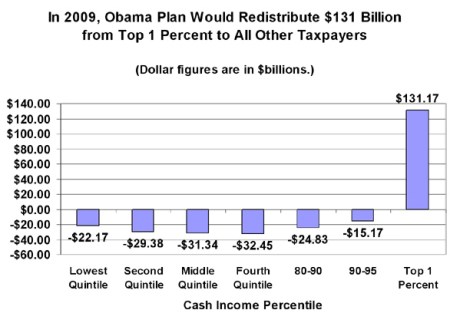
Tax Foundation - Tax Policy Center Estimate
Source: Tax Foundation – Tax Policy Center Estimate

“Hard Numbers on Obama’s Tax Redistribution Plan
http://www.taxfoundation.org/publications/show/23319.html

* * * * *

My POV

1.  On a philosophical level, I agree that the grossly uneven distribution of earning power in the US is a serious problem that needs to be fixed. 

2. But, I don’t think that the problem of income inequality should be fixed via a tax system — which was originally intended to “tax & spend” efficiently on necessary common services — not to “grab and redistribute”.  Direct transfers from one citizen’s pockets to another’s (e.g. refundable tax credits) are certainly the latter.

3. Except for the impact on small businesses, I can’t get too riled over marginal rate increases that start at $350,000; but I do think a “doughnut hole” payroll tax schedule is wacky and I think raising capital gains taxes during an economic slowdown is dangerous.

4 . My real  issue:  The numbers say that in Obama World, a minority of voting age Americans will be paying income taxes.  That scares me. What’s to stop an income tax-free majority from continually voting  to  raise taxes on the tax-paying minority to fund an ever increasing potpourri of benefits or add to the redistribution pot.

* * * * *

Next Up: The numbers are conclusive … taxpayers will be a minority.

* * * * *

Want more from the Homa Files?
 
Click link =>  The Homa Files Blog
Hmmm – Some Interesting Tax Stats

July 28, 2008

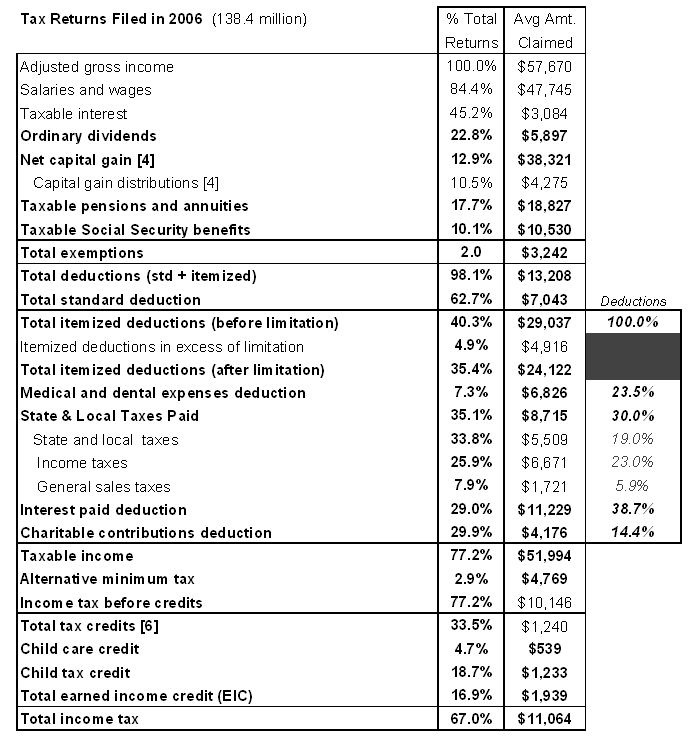
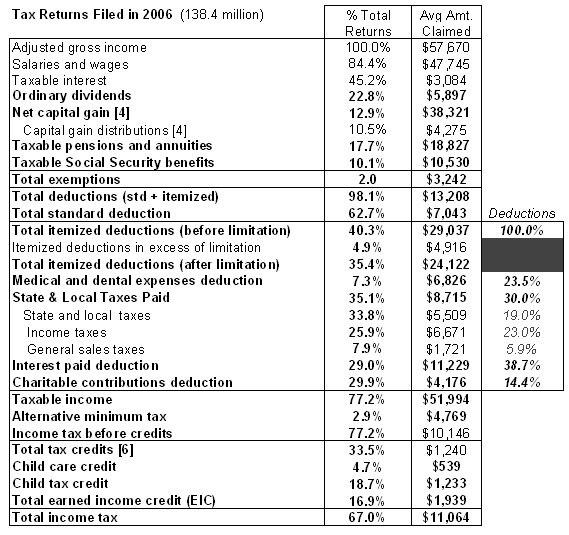
Summary: To load you with some interesting factoids for cocktail party conversations and to provide background for the next couple of analytical posts — here are some highlights from the 2006 IRS data pile (the latest year available) , and the link to the complete IRS data set (which is a treasure trove of info).

Some Highlights

138.4 million returns filed … reporting almost $8 trillion in AGI
         
 … up 8.4% from 2005 …  $57,670 average AGI

23%  reported dividend income … averaging $5,897

10.5%  reported capital gains … averaging $4,275

 63%  took the standard deduction … averaging $7,043

 37%  itemized deductions … averaging $24,122

 30%  reported charitable deductions … totaling $173 billion

2.9%  were assessed Alternative Minimum Tax
              … averaging $4,769

 19%  claimed child tax credits … averaging $1,233

 17%  claimed earned income tax credits … averaging $1,939

 67%  paid income taxes … averaging $11,064

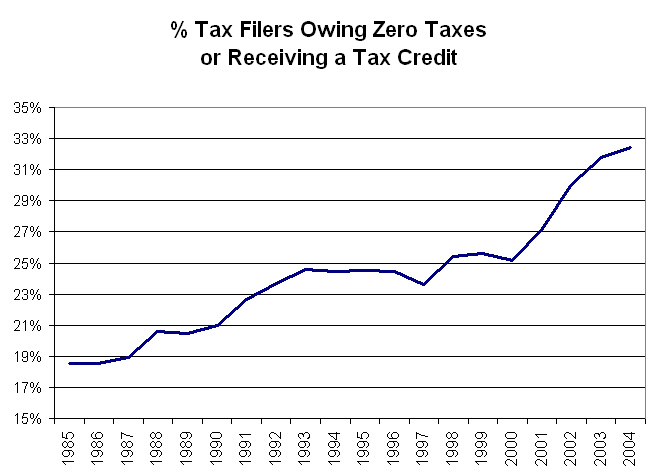
   33%  paid zero taxes (or received a refundable tax credit) 
                … up from 20% in 1990 and 25% in 2000 


 * A deeper dig on this point is coming in subsequent posts *

* * * * *

Summary Table:

click table to make it bigger

Source: IRS
http://www.irs.gov/pub/irs-soi/06in01fg.xls

* * * * *

Next up: Taxpayers –  A Dwindling Majority

* * * * *

Want more from the Homa Files?
 
Click link =>  The Homa Files Blog
Taxes – Tax Breaks for the Wealthy?

July 24, 2008

The 2008 presidential campaign is loaded with tax rhetoric.  The GOP says that the Bush tax cuts have worked and it would be crazy to raise taxes during an economic slowdown. 

The Dems say that the Bush tax plan “gave tax breaks to the rich, who didn’t even want them” — as evidenced by Warren Buffet repeatedly saying that he pays less taxes than his secretary — and that uber-earning people — e,g, greedy CEOs and hedge fund managers — aren’t paying their fair share.

What do the numbers say?

Well, several pivotal conclusions can be drawn from a comparison of published IRS data for 2000 (the year immediately prior to the first wave of so-called “Bush Tax Cuts for the Wealthy”) to the data from 2005 (the last year of IRS data available):

1. The effective tax rate for the top 1% of tax filers — those reporting AGI greater than $365,000 — did go down 4.32 percentage points from 27.45% in 2000 to 23.13% in 2005 — a 16% reduction; the effective tax rate for the top 5% earners (which, of course, includes the top 1%) went down 3.64 percentage points from 24.42% in 2000 to 20.78% in 2005 — a 15% reduction. 

Note: “effective rate” is actual income taxes paid divided by income; “marginal rate” is the percentage of “last dollars earned” paid in taxes.  So-called “payroll taxes” for Social Security and Medicare are not included (see ana;ytical note below).


2. But — and it’s a big “but” — the effective tax rate for the bottom 50% of all tax filers (those reporting less than $28,875) also went down — from 4.62% in 2000 to 2.98% in 2005 — “only” 1.62 percentage points, but representing a whopping 36% cut from the 2000 rate.

Note: 32% of tax filers paid zero income taxes or received refundable credit checks from the government


3. And, the amount of taxes paid by the top 1% as a group was approximately the same in 2000 ($388.9 billion) and 2005 ($368.1 billion); ditto for the top 5% — $553.7 billion in 2000 and $557.8 billion in 2005. 

4. During the same time period, the tax proceeds from the bottom 50% of tax filers dropped almost 25% — from $38.3 billion in 2000 to $28.7 billion in 2005. 

5. So, the tax burden absorbed by the top 1%  increased by 2 percentage points from 37.4% of total income taxes paid in 2000 to 39.4% of total income taxes paid in 2005; the top 5% share of the tax burden increased by 3.2 percentage points from 56.5% of toal income taxes in 2000 to 59.7% in 2005; the bottom half’s share of total income taxes paid dropped from 3.9% in 2000 to 3.1% in 2005. 

6. Taking a longer run view, the share of the income tax burden shouldered by the top 1% has roughly doubled over the past 25 years — from about 20% of total income taxes paid to about 40% of all income taxes paid; the share of the income tax burden shouldered by the top 5% has has increased roughly 25 percentage points over the past 25 years — from about 35% of total income taxes paid to about 60% of all income taxes paid. 


7.  The share of income taxes borne by the bottom half of tax filers has fallen from over 7% to about 3%.


* * * * *

Observations

I. The picture is certainly different when the focus shifts off marginal tax rates to the  amount of taxes paid or the share of the total income tax burden.

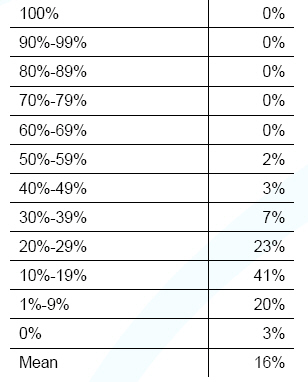
2. Broad based surveys indicate that people in general think the maximum percentage of a person’s income that SHOULD go to state, federal, and local taxes (in total) is 16%, with only 12% of respondents saying that the rate should be over 30%.

From a HarrisInterActive Poll:
Q 650: What is the maximum percentage of a person’s income that SHOULD go to taxes – that is, all taxes, state, federal, and local?

  the maximum percentage of a person's income that SHOULD go to taxes - that is, all taxes,
http://www.taxfoundation.org/files/topline-20050414.pdf

3. A tax burden of 60% of taxes paid by 5% strikes me as a pretty high number — especially since it’s 5% of tax filers not 5% of citizen-voters. Of course, “fair share” is in the eye of the beholder …

* * * * *

Data deck: 02-irs-tax-quartiles-key-metrics
Primary data source: http://www.taxfoundation.org/news/show/250.html

* * * * *

Analytical Note: This post, and a few follow-ons that I have in process, focus on individual federal income taxes.  That distinction excludes corporate taxes (an entirely different animal), state taxes (a crazy quilt of different programs), and so-called “FICA” or “payroll taxes” (for Social Security and Medicare).  The latter exclusion is admittedly dicey.  Employees’ paycheck deductions for Social Security and Medicare are a constant percentage of income (6.2% + 1.45% = 7.65%), up to $102,000 in earnings.  So, many people argue that the assessments are “regressive.”  Nonetheless, I consider these charges to be more akin to forced savings or deferred income plans since contributions are matched by employers and since the benefits received (e.g. retirement income and health insurance) are directly tied to the level of contributions.  So, I choose to outboard them from “tax and spend” analyses.  

* * * * *

Next up: More on income, deductions, credits, and taxes.

* * * * *

Want more from the Homa Files?
 
Click link =>  The Homa Files Blog