Gotta admit, I like the tussle between Team O and the Catholic Church. It’s like watching a Wrestlemania main event.
But, theological and and health issues aside, I’m shocked by Administration’s naiveté re: business and economics.
And, I think I broke the code.
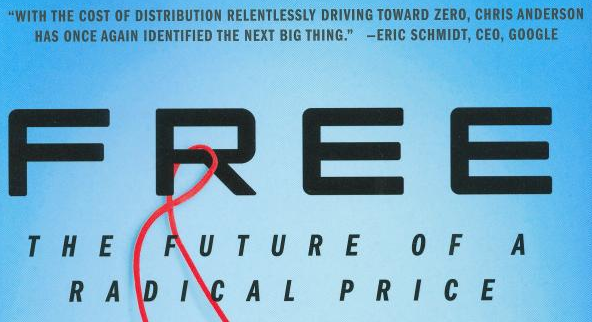
I’m betting that the only business book Obama and his advisers carry around is Chris Anderson’s 2009 best-seller: Free – The Future of a Radical Price.
Note that I said “carry around” … not “read” … because the book does a nice job of explaining the uses and mis-uses of “free”,
Why do I think so?
Easy, because the cover blurb was written by Google’s Eric Schmidt — the recently canned Google CEO and close buddy of Obama’s … and because of Obama’s penchant for declaring stuff to be “free” whether it is or isn’t.
Obviously, Team O doesn’t really get the concept.
Let’s start with the basics: nothing is free.
When something (like pills) is produced, delivered and consumed, there are associated costs.
Yes, pills may be given to the consumer without charge, but somebody has to pick-up the tab.
Since the government has no money of its own, if it nobly declares that it’ll pay for it, it’s really saying that all taxpayers will pay for it — whether they want to or not.
Note that, for obvious reasons, I said taxpayer, and not citizens.
Let’s take another variation: consumers don’t have to pay for pills — their insurance companies will be mandated to give them away for free.
Oh really.
One member of the administration said that the money will come straight from the insurance companies reserves — the money set aside to pay claims.
Well, then either other types of claims become unfunded (i.e. can’t be paid), or the insurance company just rolls over and sacrifices some profits, or premiums go up.
There aren’t any other options, and I’m betting on the last one — raising premiums.
That’s ok — in the mind of the Feds — because employers, not employees have to eat the premium increase.
Well, economists would say that the higher premiums come indirectly out of employees pockets since they will just constrain other parts of workers’ compensation packages.
You can buy into that argument or not … your choice.
Let’s pretend that the insurance company just has to eat the added costs.
Oops.
Team O walked into a logic trap.
Many large organizations self-insure. That means that insurance companies are just processing agents — the companies pay claims out of their own coffers.
It was like that at GE and Black & Decker.
And guess what, many large Catholic organizations are self-insured.
So, saying that the Catholic organizations won’t have to pay for pills, etc., — that their insurance companies will have to pay — is complete nonsense.
You see, self-insured organizations are their own insurance companies.
That’s what self-insured means!
So, even the Catholic bishops figured out that Team O’s grand accommodation is not really an accommodation at all.
It’s either the reflection of business ignorance or an intentional ruse.
Hmmm. Hard to pick.


 The Homa Files