Archive for September 1st, 2009

Mr. Dow and President Obama … hmmmm

September 1, 2009

Earlier in the month, I posted that:

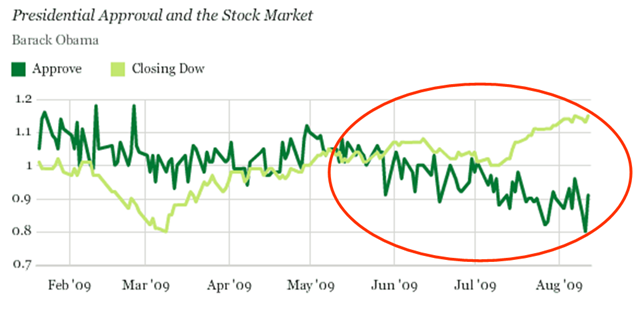
I think the recent stock market run-up is largely attributable to Pres. Obama’s declining approval ratings … and the numbers seem to corroborate the conclusion.

https://kenhoma.wordpress.com/2009/08/05/whats-driving-the-stock-market-higher-heres-an-analysis-you-wont-see-on-cnbc/

A team of of crack Gallup analysts has concluded that Presidential Approval shows no clear relationship to the Dow Jones Industrial Index.

Glancing at Gallup’s own chart, I ask: “Say what ?”

image

http://www.gallup.com/poll/122567/Presidential-Approval-Dow-No-Clear-Relationship.aspx

* * * * *

Health reform without malpractice tort reform … get serious.

September 1, 2009

Excerpted from IBD: Tort Reform Is Key To Health Reform, August 24, 2009

Many lawmakers and analysts still stubbornly insist that medical liability lawsuits do not contribute significantly to rising health care costs.

A 2006 Harvard School of Public Health study found that 40% of medical malpractice lawsuits filed in America each year were “without merit.”

Nonetheless, defending against such lawsuits imposes costs on doctors, hospitals and insurers that invariably are passed on to health care consumers.

Beyond the obvious costs of litigation, more subtle costs related to the practice of “defensive medicine” are contributing to runaway health care inflation.

How much? In a Massachusetts Medical Society survey published last November, 83% of physicians cited the fear of being sued in their decisions to practice defensive medicine.

On average, 18% to 28% of tests, procedures, referrals and consultations and 13% of hospitalizations were ordered to avoid lawsuits. All of this adds at least $200 billion to annual health care costs.

* * * * *

President Obama should reconsider his stated opposition to limiting non-economic damages in medical liability litigation.

The president and Congress should also consider additional liability reforms, such as medical courts, administrative compensation programs, “early offers” and “safe harbors” for physicians who practice in compliance with evidenced-based clinical guidelines.

If comprehensive health care reforms are to succeed, they must include liability reform.

Certainly real victims of negligence must be fairly compensated, but public policy must discourage litigation that abuses our civil justice system and makes health care less accessible and more expensive.

Full article:
http://www.ibdeditorials.com/IBDArticles.aspx?id=336004677519666

* * * * *

Inside that magazine: a video clip … hmmm, interesting idea.

September 1, 2009

Ken’s Take: An interesting play.  Nice use of technology to drag print into the current century.  CBS should get nice buzz. My bet: still too expensive for it to become a common promo device … but, costs keep coming down.

* * * * *

Excerpted from WSJ: Video is invading a new medium: print. Aug 20, 2009

In a marketing stunt to promote its fall TV series, CBS is inserting thousands of tiny screens in copies of Entertainment Weekly.

The screens measure two and a quarter inches diagonally and play about 40 minutes of clips from new and old CBS shows.

The reader/viewer can push a spot on the cardboard insert that holds the screen and watch a clip of the sitcom “Two and a Half Men.” Push another to see a preview of the new crime-investigation spinoff “NCIS: Los Angeles.” Another delivers an ad for PepsiCo Inc., which is helping fund the promotion.

The player is much like the chips that play music in some greeting cards and magazine ads and is rechargeable.

This isn’t the first time magazines and technology have teamed.

In 2005, CBS embedded People magazine with singing sound chips to promote an Elvis Presley miniseries.

Last year, the cover of October’s Esquire magazine splashed blazes of electronic ink … that flashed with messages and an illusion of a car on the road.

Full article:
http://online.wsj.com/article/SB125073451546645129.html?mod=djemMM

* * * * *