Archive for October 27th, 2009

If there are twice as many conservatives as liberals … why do I feel so lonely?

October 27, 2009

TakeAway: Conservatives continue to outnumber  liberals 2 to 1 in the American populace in 2009.

* * * * *
Excerpted from Gallup: Conservatives Maintain Edge as Top Ideological Group, October 26, 2009

Forty percent of Americans describe their political views as conservative, 36% as moderate, and 20% as liberal. This marks a shift from 2005 through 2008, when moderates were tied with conservatives as the most prevalent group.

image

* * * * *

Changes among political independents appear to be the main reason the percentage of conservatives has increased nationally over the past year: the 35% of independents describing their views as conservative in 2009 is up from 29% in 2008. By contrast, among Republicans and Democrats, the percentage who are “conservative” has increased by one point each.
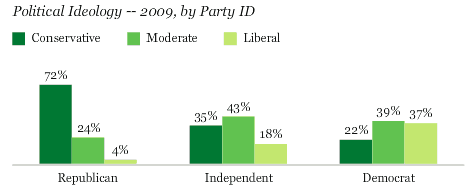
image


* * * * *

In addition to the increase in conservatism on this general ideology measure, Gallup finds higher percentages of Americans expressing conservative views on several specific issues in 2009 than in 2008.

  • Perceptions that there is too much government regulation of business and industry jumped from 38% in September 2008 to 45% in September 2009.
  • The percentage of Americans saying they would like to see labor unions have less influence in the country rose from 32% in August 2008 to a record-high 42% in August 2009.
  • Public support for keeping the laws governing the sale of firearms the same or making them less strict rose from 49% in October 2008 to 55% in October 2009, also a record high. (The percentage saying the laws should become more strict — the traditionally liberal position — fell from 49% to 44%.)
  • The percentage of Americans favoring a decrease in immigration rose from 39% in June/July 2008 to 50% in July 2009.
  • The propensity to want the government to “promote traditional values” — as opposed to “not favor any particular set of values” — rose from 48% in 2008 to 53% in 2009. Current support for promoting traditional values is the highest seen in five years.
  • The percentage of Americans who consider themselves “pro-life” on abortion rose from 44% in May 2008 to 51% in May 2009, and remained at a slightly elevated 47% in July 2009.
  • Americans’ belief that the global warming problem is “exaggerated” in the news rose from 35% in March 2008 to 41% in March 2009.

Gallup has not recorded heightened conservatism on all major social and political views held by Americans. For instance, attitudes on the death penalty, gay marriage, the Iraq war, and Afghanistan have stayed about the same since 2008.

However, there are no major examples of U.S. public opinion becoming more liberal in the past year.

Full article:
http://www.gallup.com/poll/123854/Conservatives-Maintain-Edge-Top-Ideological-Group.aspx

Hey, Mr. Prez … Here’s a way to fund about 1/2 of your healthcare package.

October 27, 2009

Did you know …

TARP will expire on December 31, unless Geithner exercises his authority to extend it to next October.

Right now, Geithner is sitting on over $300 billion of uncommitted TARP funds, thanks in part to bank repayments. Treasury believes it has the authority to spend that returned money on new adventures in housing or other parts of the economy.

Since the TARP has largely ignored its designated mission — buying up bad mortgages and their derivatives — and has evolved into a $700 billion all-purpose political slush fund, why not simply declare success and throw the money at insuring the uninsureds?

Hmmm …. 

* * * * *

HiLites from WSJ: Rolling up the TARP, Oct.  27, 2009 

Historians will debate TARP’s role in ending the financial panic of 2008, but today there is little evidence that the government needs or can prudently manage what has evolved into a $700 billion all-purpose political bailout fund.

TARP quickly became a Treasury tool to save failing institutions without imposing discipline (Citigroup) and even to force public capital onto banks that didn’t need it. This stigmatized all banks as taxpayer supplicants and is now evolving into an excuse for the Federal Reserve to micromanage compensation.

Even with the banks, TARP has been a double-edged sword. While its capital injections saved some banks, its lack of transparency created uncertainty that arguably prolonged the panic.

By stating expressly that the ‘healthy’ institutions would be able to increase overall lending, Treasury created unrealistic expectations about the institutions’ conditions and their ability to increase lending.”

TARP was then redirected well beyond the financial system into $80 billion in “investments” for auto companies. These may never be repaid but served as a lever to abuse creditors and favor auto unions.

TARP also bought preferred stock in struggling insurers Lincoln and Hartford, though insurance companies are not subject to bank runs and pose no “systemic risk.” They erode slowly as customers stop renewing policies.

TARP also became another fund for Congress to pay off the already heavily subsidized housing industry by financing home mortgage modifications. Not one cent of the $50 billion in TARP funds earmarked to modify home mortgages will be returned to the Treasury, says the Congressional Budget Office.

TARP’s Congressional Oversight Panel warns that the entire taxpayer pot could be converted into subsidies. They are especially concerned about expanding the foreclosure prevention programs that have been failing by every measure.

The political class has twisted TARP into a fund to finance its pet programs and constituents, and the faster it fades away, the better for taxpayers and the financial system.

Full article:
http://online.wsj.com/article/SB10001424052748704224004574489740879074028.html?mod=djemEditorialPage

* * * * *

On B of A and Merrill …

The government also endangered one of the banks that they considered healthy at the time.

According to Fed documents, the government viewed BofA as well-capitalized, but officials believed that its tangible common equity would fall to dangerously low levels if it had to absorb the sinking Merrill.

In other words, by insisting that BofA buy Merrill, Messrs. Paulson and Bernanke were spreading systemic risk by stuffing a failing institution into a relatively sound one.

And they were stuffing an investment bank into one of the nation’s largest institutions whose deposits were guaranteed by taxpayers. BofA would later need billions of dollars more in TARP cash to survive that forced merger, and when that news became public it helped to extend the overall financial panic.

Full article:
http://online.wsj.com/article/SB10001424052748704224004574489740879074028.html?mod=djemEditorialPage

When You Apologize – Make It Count!

October 27, 2009

Ken’s Take: In a prior post, I cited some research that proved it’s good business for companies to apologize to customers they’ve wronged — that an apology goes way further than, say, a discount on the next purchase.

I also made a passing reference to how important apologies are in personal life, too.

Following the links in the original article, I stumbled on these “8 simple principles” for making a meaningful apology …

Nothing relieves the pain caused by a mistake quite so effectively as a genuine and unconditional apology.

There is simply no way to state strongly enough what a difference it can make in relationships.

The problem with most apologies is that they’re “CPI”  — Cheap, Premature, and Incomplete — “I’m sorry if I hurt you.” “Whatever it was that I did, I apologize.”

Here are some simple principles that can make an apology more meaningful.

  1. Understand first, then apologize. Make sure you really understand what has happened and what part you played in it.
  2. Talk to everybody involved. It’s not enough that you apologize to the person you hurt directly. You need to apologize as well to the people who know what you did. 
  3. Be specific  … so it’s clear that you understand your mistake.
  4. Apologize unambiguously. Say you’re sorry, and  be careful not to qualify it at all. That’s why “I’m sorry if I hurt you” and “I don’t know what I’ve done, but I apologize” don’t cut it.
  5. Describe how your mistake has affected you. You may realize, for example, that someone you care about deeply has trouble trusting you now. If so, you need to describe that as part of your apology.
  6. Outline the steps you’re taking to avoid similar mistakes in the future. Concentrate on actual behaviors that other people should be able to observe. Then, walk the talk.
  7. Affirm yourself. If you don’t think you’re the kind of person who sets out to hurt people, you need to say so.  You need to state in clear and explicit terms that you think you’re a better person than this behavior would indicate. You need to describe how you plan to demonstrate that over the days and weeks ahead.
  8. Ask for forgiveness — but don’t  press for it quickly. You may even need to ask the other person explicitly not to forgive you too quickly so that forgiveness, when given, will be complete.

* * * **

Warning: just because the principles are simple doesn’t make them easy to apply.

For most of us, they represent a fundamentally different behavior, and changing behavior always feels awkward and uncomfortable at first.

* * * * *

Excerpted from “Apologize – and Make It Count!”

What does Obama do way more often than Bush ?

October 27, 2009

If you guessed fund-raising events, you’re right.  But, more importantly …

President Barack Obama has only been in office for just over nine months, but he’s already hit the links as much as President Bush did in over two years.

CBS’ Mark Knoller — an unofficial documentarian and statistician of all things White House-related — wrote on his Twitter feed that, “Today – Obama ties Pres. Bush in the number of rounds of golf played in office: 24. Took Bush 2 yrs & 10 months.”

This news comes on the heels of the news that Obama played golf with a woman — chief domestic policy adviser Melody Barnes — for the first time since taking office.

Source: Politico, President Obama ties George W. Bush on golf, 10/25/09
http://www.politico.com/click/stories/0910/obama_ties_bush_on_golf.html