Note: This is intended primarily for Homa Files more “mature” readers. But, may be relevant for younger folks with rich relatives who are on their last legs …
* * * * *
Source: WSJ: State Death Taxes Are the Latest Worry, Oct 31, 2009
http://online.wsj.com/article/SB125694593227919879.html
With the federal estate tax disappearing for most people, state death taxes have emerged as a surprise new worry.
This year, the federal exemption rose to $3.5 million per individual, or as much as $7 million per married couple. At the current level, only 5,500 estates a year are federally taxable.
The problem is that most states with estate or inheritance taxes haven’t raised exemptions to match the federal limits. That means thousands of taxpayers who now escape the federal levy could still get hit with a state death tax.
As a result, tax advisers are tweaking bypass trusts that allow married couples to maximize exemptions from state taxes. They are advising taxpayers where to retire in order to pare or eliminate estate taxes.
“In the past, many people hardly gave state death taxes a thought … now they are shocked at how expensive mistakes can be.”
Adding insult to injury, Congress is talking about eliminating the federal deduction for state estate taxes. That would affect only wealthy taxpayers whose estates still exceed $3.5 million per individual.
“States are in such dire straits that most without these taxes would like to have one, and nobody who has one will let it go.”
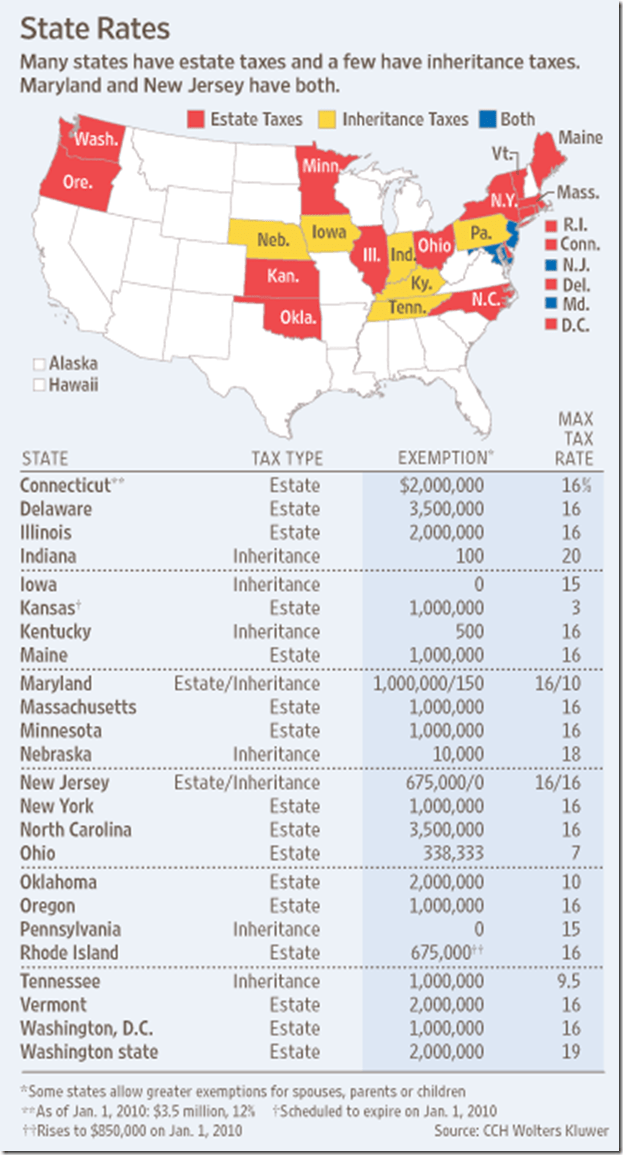
Seventeen states and the District of Columbia currently impose estate taxes. Eight states have inheritance taxes, which are levied on heirs, not estates. Maryland and New Jersey have both.
Compared to the uniform federal tax, state taxes are a crazy quilt. In many states with inheritance taxes, rates are tied to how closely the heir is related to the late donor. Iowa and Kentucky exempt both spouses and children who inherit property, while Nebraska treats only transfers to spouses as tax-free.
Advisers say taxpayers are most likely to be tripped up by states that used to conform to the federal exemption but haven’t raised it at the same rate.
As a result, married couples in states with lower exemptions — such as New York, Oregon, Minnesota and Massachusetts (all $1 million) or Illinois ($2 million) — are setting up “bypass” trusts in wills even if they no longer need them for federal taxes.
Here’s how bypass trusts work: At the death of the first spouse, assets go into a trust that the survivor can draw on if necessary. When the second spouse dies, the remaining assets in the bypass trust pass tax-free to heirs, preserving the value of both individual exemptions.
Put another way, if a married couple lives in a state with a $1 million individual exemption, a bypass trust would let them to pass as much as $2 million tax-free to heirs.
“Without the proper trusts … a couple in New York with $2 million in assets might pay an unnecessary $100,000.”
* * * * *
The issue is figuring out the “domicile” of a taxpayer. Domicile is a much broader idea than the mere residency test that often determines where someone pays income tax.
Although one determinant of domicile is the amount of time spent in a state, it also may look at where a taxpayer votes, has church and club memberships, registers a car or even has a burial plot.
This means that a taxpayer could live in estate-tax-free Florida, California or Texas and even spend most of his time there. But if he keeps an apartment in New York or a summer home on Cape Cod and has other ties to the area, he might be considered to be domiciled there.
In the worst case, a taxpayer could be domiciled in more than one state and owe taxes to each.
SHARE THIS POST WITH FRIENDS & FAMILY


 The Homa Files