Archive for November 17th, 2009

Snookered: about that abortion funding amendment

November 17, 2009

Rep. Bart Stupak, an avid pro-lifer, led the effort to get the PelosiCare bill amended to specifically exclude funding of abortions.

When the amendment passed, about 40 Dem pro-lifers became comfortable voting for the bill,

Even before the ink dried, the pro-choicers went on the attack.  Dem leaders quelled the couter-insurrection by hinting that the provision would be stricken when the Senate and House bills went “to conference”.

Now, according to Axlerod (on Fox News nonetheless), Pres. Obama will aid and abet stripping abortion language from any healthcare bill.  In doing so, the president would be heeding the call of abortion rights supporters like Planned Parenthood that have called the White House their “strongest weapon” in keeping such restrictions out of the bill.

* * * * *

Question #1: Didn’t Stupak smell this one coming? 

Answer: No.  He assumed a certain honor among thieves.

Silly boy.

* * * * *

Question #2: Why did he Congressional GOPers vote in favor of the Stupak Amendment?  If they had voted no and it failed to pass, then the Dem pro-lifers would have voted against the bill.

Answer: Reportedly, GOP pro-lifers gave Stupak their word that they’d vote in favor of the amendment and didn’t want to go back on their word.

Silly boys (and girls)

* * * * *

Full article:
http://www.foxnews.com/politics/2009/11/15/axelrod-signals-obama-try-strip-abortion-language-health-care/

Snookered: Drug makers agree to lower prices … after they raise them.

November 17, 2009

Bottom line: I wondered why pharma companies got in the ObamaCare canoe and promised cutting prices by $8 billion. 

The answer should have been obvious: all for show. 

They’re hustling to inflate prices to establish a much higher base from which they can back out the “cuts”. 

In other words, the post-reform prices will be right where they had planned them before the faux show of ObamaCare support.

Imagine that … Team Obama getting snookered,

* * * * *

Excerpted from NY Times: Drug Makers Raise Prices in Face of Health Care Reform, November 15, 2009

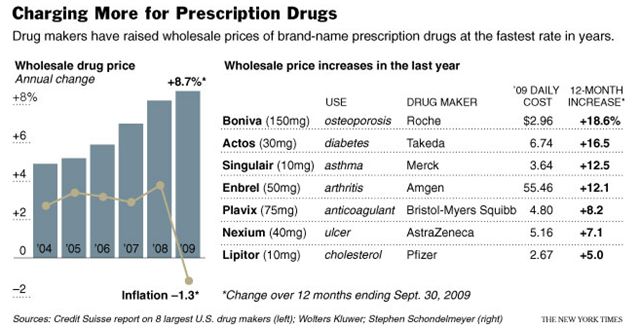
Even as drug makers promise to support Washington’s health care overhaul by shaving $8 billion a year off the nation’s drug costs after the legislation takes effect, the industry has been raising its prices at the fastest rate in years.

The industry stands to gain about 30 million customers with drug insurance from the legislation pending in Congress. But the industry also faces the prospect of tougher negotiations from both public and private buyers as the government tries to squeeze savings out of the health system.

In the last year, the industry has raised the wholesale prices of brand-name prescription drugs by about 9 percent, according to industry analysts. That will add more than $10 billion to the nation’s drug bill, which is on track to exceed $300 billion this year. By at least one analysis, it is the highest annual rate of inflation for drug prices since 1992.

Drug makers say they have valid business reasons for the price increases. Critics say the industry is trying to establish a higher price base before Congress passes legislation that tries to curb drug spending in coming years.

There was a similar pattern of unusual price increases after Congress added drug benefits to Medicare a few years ago, giving tens of millions of older Americans federally subsidized drug insurance. Just as the program was taking effect in 2006, the drug industry raised prices by the widest margin in a half-dozen years.

The drug companies say they are having to raise prices to maintain the profits necessary to invest in research and development of new drugs as the patents on many of their most popular drugs are set to expire over the next few years.

The drug industry has actively opposed some of the cost-cutting provisions in the House legislation, which passed Nov. 7 and aims to cut drug spending by about $14 billion a year over a decade.

But the drug makers have been proudly citing the agreement they reached with the White House and the Senate Finance Committee chairman to trim $8 billion a year — $80 billion over 10 years — from the nation’s drug bill by giving rebates to older Americans and the government.

But this year’s price increases would effectively cancel out the savings from at least the first year of the Senate Finance agreement. And some critics say the surge in drug prices could change the dynamics of the entire 10-year deal.

image 
http://www.nytimes.com/imagepages/2009/11/16/business/16drugprices_graphic.html

Full article:
http://www.nytimes.com/2009/11/16/business/16drugprices.html

“Adoption velocity” and abandonment: Here today, gone tomorrow …

November 17, 2009

TakeAway: Some research indicates that — counter-intuitively — products which catch on too quickly may end up being less successful overall.

* * * * *

Excerpted from Knowledge@Emory, The Long-term Downside of Overnight Success,  September 16, 2009  

Marketers may dream of coming up with a product that skyrockets in popularity as soon as it is introduced to the public.

Research, however, indicates that products which catch on too quickly may end up being less successful overall.

* * * * *

There are patterns in “cultural adoption and abandonment.” 

“We often see products, ideas and behaviors catch on and spread like wildfire. But we know less about why once-popular things become unpopular.”

“Most managers want their products to catch on faster, but our analysis suggests that this might not always be the best strategy. If something catches on too quickly, it might not only have a shorter lifespan, but may also end up being less successful overall. Faster adoption may hurt product success.”

Fads tend to be viewed negatively: “If people think that sharply increasing [popularity] will be short lived, they may avoid such items to avoid doing something that may later be seen as a flash in the pan.”

The research into the adoption and abandonment challenges some assumptions about the diffusion of a message and its saturation in the population, which is an important concept in marketing.

As a message spreads — or diffuses — through a population, it reaches more potential adopters. However, diffusion models typically assume a set target population size. But, a group may continually renew itself. Other factors, beyond diffusion and saturation, must be involved: “Adoption velocity is one such factor.”

Conventional wisdom would hold that if a message diffused through a population quickly, more potential adopters would be reached, improving the prospects for widespread adoption. “The effect of adoption velocity on the cumulative number adopters … shows that adoption velocity has a negative effect on the cumulative number of adopters.”

For example, in the music industry, new artists who bolt to the top of sales charts, often realize lower overall sales than those whose popularity grows more slowly. “This seemingly counterintuitive finding has important implications. One is that faster adoption is not only linked to faster abandonment, but may also hurt overall success.”

The research fits into the growing literature about “cultural dynamics.” By “more closely examining the psychological processes behind individual choice and cultural transmission, deeper insight can be gained into the relationship between individual (micro) behavior and collective (macro) outcomes such as cultural success.” 

Advertising might lead to fast adoption of a product, but the popularity of the product or service advertised might decline when that support dies off or switches to a substitute. “Importantly, though, results suggest that independently of its cause, a quick rise in popularity may have an accelerating effect on abandonment … as such, we anticipate that there will be an inherent tendency for items that have been adopted quickly to decline faster, even in cases where advertising persists.”

‘This is here today, gone tomorrow.'”

Full article:
http://knowledge.emory.edu/article.cfm?articleid=1266

* * * * *

When does a $1 burger make sense ?

November 17, 2009

Got this provocative email from one one of my son’s friends:

Mr. H – As patriarch of the “First Family” of the $1 menu, I wanted to bring your attention to this article. 

It appears that suspicions may have been correct –   The $1 McDouble cheeseburger is literally a LOSS LEADER. 

Who is right Burger King or their franchisees?  Why charge an unprofitable price?

Below is the article.  Far below is Ken’s Take.

* * * * *

Excerpted from AP: Food fight: Burger King franchisees sue chain, Nov.13, 2009

Restaurants, especially fast-food chains, have been slashing menu prices because of the poor economy. Executives hope the deeply discounted deals will bring in diners who are spending less when they eat out, or opting to stay home altogether.

But, Burger King franchisees sued the hamburger company this week over its $1 double cheeseburger promotion, saying they’re losing money on the deal and the company can’t set maximum menu prices.

A group that represents more than 80 percent of Burger King’s U.S. franchise owners, said the $1 promotion forces restaurant owners to sell the quarter-pound burger with at least a 10-cent loss.

The $1 double cheeseburger typically costs franchisees at least $1.10 — That includes about 55 cents for the cost of the meat, bun, cheese and toppings.

The remainder typically covers expenses such as rent, royalties and worker wages.

“New math, or old math, the math just doesn’t work.”

When the $1 double cheeseburger was announced this fall, an analyst said it could increase restaurant visits by as much as 20 percent, but that as much as half of the gain recorded from increased traffic could be lost because customers were spending less when they ordered food.

Copyright © 2009 The Associated Press. All rights reserved.
http://www.google.com/hostednews/ap/article/ALeqM5hLeKv3ns6qUW8InI9h7yHYvgzHZwD9BUB0181

* * * * *

Ken’s Take:

  1. So, the franchisees just want to cede the “value” position to Mickey D ?  Not a wise move.
  2. Why a loss leader ?  Because it draws traffic — and most customers complement the loss leader with another high margin product — e.g. soda, or fries.
  3. Technical note: the franchisee’s should be thinking about the $1 burger in terms of “incremental profitability” — incrementally, they’re still making 45 cents on each burger — the employees are still going to be there, the rent’s still going to be paid, and the lights are still going to being using electricity whether the burger is sold or not … only way the franchisee loses is through “dilution” — if a dude who would have paid 2 bucks for a burger anyway gets one for $1

Bottom line: Franchisees should fire their lawyers and flip some burgers.