Archive for January 5th, 2010

Uh-oh … Mayo Clinic to Medicare Seniors: "Sorry, cash only"

January 5, 2010

Ken’s Take: The Mayo & Cleveland Clinics are frequently cited as ObamaCare’s best practice models. Yesterday, the Mayo Clinic in Arizona stopped taking Medicare patients — unless they’re willing and able to pay CASH out of their own pockets.  Oops.

Why?

The Centers for Medicare and Medicaid Services cautioned that, under the proposed benefit cut, “providers for whom Medicare constitutes a substantive portion of their business could find it difficult to remain profitable and might end their participation in the program (possibly jeopardizing access to care for beneficiaries).”
http://www.investors.com/NewsAndAnalysis/Article.aspx?id=517004

So, Americans who have paid into the Medicare system for their entire working lives end up paying for health care out of their own pockets. Is that fair?

* * * * *

Excerpted from Bloomberg News: Mayo Clinic in Arizona to Stop Treating Some Medicare Patients , Dec. 31, 2009

The Mayo Clinic, praised by President Barack Obama as a national model for efficient health care, will stop accepting Medicare patients at one of its primary-care clinics in Arizona, saying the U.S. government pays too little.

More than 3,000 patients eligible for Medicare … will be forced to pay cash if they want to continue seeing their doctors at a Mayo family clinic in Glendale.

A Medicare patient who chooses to stay at Mayo’s Glendale clinic will pay about $1,500 a year for an annual physical and three other doctor visits, according to an October letter from the facility. Each patient also will be assessed a $250 annual administrative fee.

* * * * *

Obama has frequently cited the nonprofit Rochester, Minnesota-based Mayo Clinic and the Cleveland Clinic in Ohio for offering “the highest quality care at costs well below the national norm.”

Mayo’s move to drop Medicare patients may be copied by family doctors, some of whom have stopped accepting new patients from the program.

“Many physicians have said, ‘I simply cannot afford to keep taking care of Medicare patients … If you truly know your business costs and you are losing money, it doesn’t make sense to do more of it.”

Medicare Loss

The Mayo organization lost $840 million last year on Medicare. The program’s payments cover about 50 percent of the cost of treating elderly primary-care patients at the Glendale clinic where “Medicare payments no longer reflect the increasing cost of providing services for patients.”

* * * * * *

Nationwide, doctors made about 20 percent less for treating Medicare patients than they did caring for privately insured patients in 2007.

Medicare covered an estimated 45 million Americans at the end of 2008.

While 92 percent of U.S. family doctors participate in Medicare, only 73 percent of those are accepting new patients under the program .

There not enough new doctors becoming family doctors, internists and pediatricians who oversee patients’ primary care.

“Some primary care doctors don’t have to see Medicare patients because there is an unlimited demand for their services … When patients with private insurance can be treated at 50 percent to 100 percent higher fees … then Medicare does indeed look like a poor payer.”

Full article:
http://www.bloomberg.com/apps/news?pid=20601070&sid=aHoYSI84VdL0
The 5 things that Americans really want …

January 5, 2010

Excerpted from: WHAT AMERICANS REALLY WANT by Dr. Frank I. Luntz

* * * * *

According to Dr. Luntz, the five core attributes define what Americans really want.

1. More money.

Financial success has always been the highest priority for American men, but with the economic downturn it has leapt to the top among American women as well.

For millions of Americans approaching retirement, it’s less about more money and more about just getting back to where they once were.

For women, money is all about personal security, about having no fears and no worries of the financial kind.

Women measure success in life based on personal satisfaction and happiness — and the lack of economic anxiety leads to personal happiness.

For men, more money means more freedom, although that does manifest itself in the desire to buy more stuff. Men are much more likely than women to measure their success by their accumulation of material goods: house, car, technology, toys, the whole package.

For both men and women, money is more important today than at any time in a long time.

2. Fewer hassles.

Having fewer hassles is now the number two day-to-day priority of Americans.

Companies that sell products in shrink-wrapped hard plastic shells that are impossible to open don’t understand the importance of a hassle-free life.

Other examples are products that don’t perform like they do on television, services that sound much better in the advertisement than they are in reality, and
technologies that break or never work right in the first place.

3. More time.

Time used to be the highest priority for women — and for good reason.

From getting the kids up in the morning to paying the bills at night, women shoulder the majority of family responsibilities and household chores, even though the vast majority of women now work outside the home.

They have little time for themselves, and they crave it.

4. More choices.

There is an important distinction between choice and the right to choose.

Young people embrace as much choice as possible. Give them 15 choices of exercise equipment or 20 choices of coffee — the more the better.

Conversely, older people want the right to choose but don’t actually want to make the choice.  If you give them a choice of 20 different health-care plans, you’ve created a situation somewhere between confusion and chaos. To them, too many choices is no choice at all.

But for most Americans, limiting their choices is like denying life, liberty, and the pursuit of happiness.

If you sell the right to choose, or seem to expand people’s choices, you will find a lot of buyers.

5. No worries.

This can mean anything from “Yes, it will get done” to “I will take care of you.” It’s an expression of confidence that things will turn out right. 

* * * * *

From: WHAT AMERICANS REALLY WANT. . . REALLY – The Truth About Our Hopes, Dreams, and Fears
by Dr. Frank I. Luntz

Shoot the messenger !

January 5, 2010

Ken’s Take: I’m a big fan of Rasmussen Reports’ polls — in part because I like the answers, but more because of its track record for accuracy.

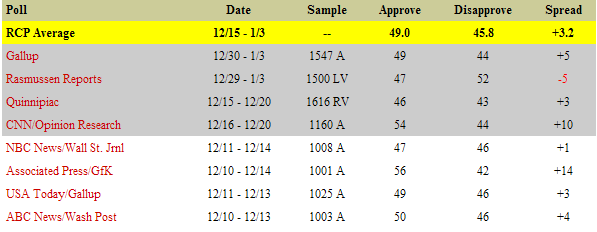
Since Rasmussen was first to report Pres Obama’s approval slide — and continues to be less favorable than the ABC, CBS, NBC, and CNN commissioned polls — the Rasmussen Reports are under attack.

Draw your own conclusion.

* * * * *

Excerpted from Politico: Low Obama favorables: Dems rip Rasmussen Reports, January 2, 2010

Democrats are turning their fire on Scott Rasmussen, the prolific independent pollster whose surveys on elections, President Obama’s popularity and a host of other issues are surfacing in the media with increasing frequency.

The pointed attacks reflect a hardening conventional wisdom among prominent liberal bloggers and many Democrats that Rasmussen Reports polls are, at best, the result of a flawed polling model and, at worst, designed to undermine Democratic politicians and the party’s national agenda. “His data looks like it all comes out of the RNC [Republican National Committee].”

While Scott Rasmussen, the firm’s president, contends that he has no ax to grind — his bio notes that he has been “an independent pollster for more than a decade” and “has never been a campaign pollster or consultant for candidates seeking office” — his opponents on the left insist he is the hand that feeds conservative talkers a daily trove of negative numbers that provides grist for attacks on Obama and the Democratic Party.

Nothing, however, sets off liberal teeth gnashing more than Rasmussen’s daily presidential tracking polls, which throughout the year have consistently placed Obama’s approval numbers around 5 percentage points lower than other polling outfits.

Ken’s Fact Check: The RCP Poll of Polls Data

image
http://www.realclearpolitics.com/epolls/other/president_obama_job_approval-1044.html

Democratic pollster Mark Mellman believes Rasmussen designs its polling questions to elicit negative responses about Obama and Democrats — a sentiment that is widely shared in the liberal blogosphere.

“I think they write their questions in a way that supports a conservative interpretation of the world … In general, they tend to be among the worst polls for Democrats, and they phrase questions in ways that elicit less support for the Democratic point of view.”

Rasmussen is quick to point out the accuracy of his surveys — noting how close his firm was to predicting the final outcome in this fall’s New Jersey governor’s race. (Rasmussen’s final survey in the race showed Republican Chris Christie edging out Gov. Jon Corzine 46 percent to 43 percent. Christie beat Corzine 48 percent to 45 percent on Election Day.)

Last year, the progressive website FiveThirtyEight.com’s pollster ratings, based on the 2008 presidential primaries, awarded Rasmussen the third-highest mark for its accuracy in predicting the outcome of the contests. And Rasmussen’s final poll of the 2008 general election — showing Obama defeating Arizona Sen. John McCain 52 percent to 46 percent — closely mirrored the election’s outcome.

Rasmussen, for his part, explained that his numbers are trending Republican simply because he is screening for only those voters most likely to head to the polls — a pool of respondents, he argues, that just so happens to bend more conservative this election cycle.

Polling all adults — a method used by Gallup, another polling firm that conducts a daily tracking poll of Obama — Rasmussen acknowledged, is “always going to yield a better result for Democrats.” But critics note that the practice of screening for only those voters regarded as most likely to head to the polls potentially weeds out younger and minority voters — who would be more likely to favor Democrats than Republicans.

Rasmussen, of course, is hardly the only pollster to come under fire this election cycle — just the one who attracts the most sustained criticism.

Last month, conservative radio host Rush Limbaugh accused the Gallup polling organization of “doing everything they can — they’re upping the sample to black Americans — to keep” Obama’s approval at 50 percent.

Full article:
http://dyn.politico.com/printstory.cfm?uuid=DCAD6DDB-18FE-70B2-A8986E439331DA11

Busted. Marketers’ grocery store tactics revealed

January 5, 2010

TakeAway:  As manufacturers and retailers strategize to squeeze pennies out of our now incredibly cost-conscious consumers, it appears the consumers are starting to catch on.

* * * * *

Excerpted from New Jersey Business, “Savvy marketing ploys can cost unwitting grocery shoppers plenty,” The Associated Press, November 06, 2009

If you ever leave the grocery store with a slight sense of bewilderment at what you’ve just bought, you are not alone.

Despite the utilitarian look of most grocers’ shelves, careful science goes into deciding how to display the thousands of items each store carries and how to make them appeal to consumers.

Marketers tug shoppers toward items they did not intend to buy … with package design, shelf placement, tie-ins and temporary price cuts …

Marketers have put more thought into grocery stores than any other type of store because they see an opportunity in the monotony of shopping for necessities …

For a bundle of 30 products that would cost an “impulsive” shopper $288 … research found a “savvy” shopper would pay just $166 at the same grocery store. In addition to guarding against marketing ploys, the savvy consumer tracked down coupons, used a store bonus card and chose the most economical sizes …

Here’s what to watch for next time you head out for groceries.

1. END OF THE AISLE: Marketers pay grocers dearly to put their wares on the end of each aisle shelves because products there can sell 30 percent more …

2. EYE-LEVEL, EYES OPEN: … Shoppers look straight ahead or, at most, from side to side, as they shop. So products on shelves at eye level often cost more than their lower-shelf siblings …

3. MORE CAN BE LESS: … One in four times a smaller version of a product was cheaper per serving …

4. D-I-Y CARROT STICKS: … convenience can be pricey.

5. DON’T PICK THEIR NUMBER: … Be wary of … the buy-five-for-$5 type. You usually don’t have to buy all five to get the promotional price …

6. THAT ONE LAST THING: The items in the display by the cash register are always marked up …

7. REMEMBER THE TRIED AND TRUE: … Buy store brands, which can be even more economical than shopping at warehouse clubs …

Edit by TJS

* * * * *

Full Article
http://www.nj.com/business/index.ssf/2009/11/savvy_marketing_ploys_can_cost.html

* * * * *