Archive for January, 2010

Of the 5 types of Americans … which are you?

January 7, 2010

Dr. Frank Luntz has used dozens of attitudinal, behavioral, and demographic questions to segment Americans into five statistically distinct psychographic categories that explain not just who they are, but also how they are likely to behave and their view of life around them.

* * * * *

Excerpted from: WHAT AMERICANS REALLY WANT by Dr. Frank I. Luntz

* * * * *

According to Dr. Luntz’s surveys, there are five segments of American consumers:

1. Thirty percent of Americans are Relationship People.

The largest segment of the American population, it’s also the youngest.

To them, relationships can mean friends, family, or spouse. Their whole idea of the good life is to be with someone all the time.

They get their satisfaction out of interacting with other people. They don’t care as much about jobs or careers. They are generally satisfied with their life today, but very nervous about tomorrow.

They don’t save; they spend, and they enjoy spending on other people as much, if not more than, on themselves.

2. Twenty-five percent of Americans are Spiritual People.

This is the oldest and most female-oriented of the five segments.

What unites them, in addition to the importance of religion and prayer, are the principles of simplicity and efficiency.

They don’t need or want to spend money to be happy.

They have older cars and TV sets; they don’t have TiVo or satellite radio.

They’re not just late adopters, they’re non-adopters because stuff doesn’t matter to them.

If Relationship People are the loudest group, Spiritual People are the quietest.

They tend to do things in their spare time that don’t require other people, such as reading and listening to music.

They appreciate the outdoors (they are environmentalists) and they have a respect for natural beauty.

3. Eighteen percent of Americans are Health People.

They’re younger than average, more male than female, and they’re the segment most likely to participate than to observe.

You won’t just meet this segment at the gym or on the basketball or tennis court — you’ll find them shopping at Whole Foods and having a snack at Jamba Juice.

They’re similar to the Spiritual segment in their desire to be outdoors, but they’re parallel to the Relationship segment in their desire to be with others.

They are the most physically active of all the groups and put a lesser emphasis on career and financial success.

4. Twelve percent of Americans are Control People.

These people can be very unpleasant to be around.

For them, it’s not about money; it’s about more time and less hassle.

They have everything planned out.

Their intensity is similar to the Health segment, but while the Healthy are engaged in physical activity, Control People are engaged in mental or intellectual activity.

Control People want to be doing something other than what they’re doing; they think today is awful, but tomorrow is going to be great.

This is the flip side, demographically, of the Spiritual segment in that these people are almost exclusively under 50 and more male than female.

They’re the mirror image in another way: Stuff matters. Their stereo is high-end, and their TV screen is huge. In fact, everything is bigger; they want the newest and the best of everything.

They’re willing to spend money, and they work longer hours than the other segments to be able to afford it.

5. Eleven percent of Americans are Financial Security People.

The fastest-growing segment, these people are always unhappy and dissatisfied, and in the current economic mess, they’re downright miserable.

They judge themselves by how other people judge them.

Their reputations mean more to them than they do for any other segment.

They’re the opposite of self-satisfied; they’re almost self-loathing.

They have a ton of material goods, but they buy things to make a status statement rather than to enjoy them.

They tend to be older and wealthier than average, although you’ll find plenty of people in their 30s in this segment.

They own; they don’t rent or lease because they want whatever it is to belong to them — and they’re dissatisfied when they can’t have everything they want when they want it.


* * * * *

From: WHAT AMERICANS REALLY WANT. . . REALLY – The Truth About Our Hopes, Dreams, and Fears
by Dr. Frank I. Luntz
Fed Economist: A Home is a Lousy Investment

January 7, 2010

Punch line: Before the housing bust, Americans tended to think their homes were their best and most important investments –- a view promoted by Washington policy makers who made home ownership a top priority.

Karen Pence, who runs the Federal Reserve’s household and real estate finance research group, argues that homes are actually a terrible investment.

* * * * *

Excerpted from WSJ: Fed Economist: Housing Is a Lousy Investment, January 5, 2010

Putting aside the fact that home prices have fallen dramatically, Pence says several factors make homes a lousy investments:

  1. An indivisible asset.
    If you own stocks and bonds and suddenly need a little cash, you can sell some of your stocks or bonds but not all. With a home, on the other hand, “you can’t just slice off your bathroom and sell it on the market.”
  2. Undiversified.
    You can buy stocks or bonds in industries or countries all over the world. A home is a bet on one single neighborhood.
  3. High transaction costs
    When you buy or sell a home, you pay real estate agent fees, mortgage fees and moving costs.
  4. Asymmetrically liquid
    That means it’s easy to get money out when home prices are going up. (You just take out a bigger mortgage.) But it’s hard to take money out when prices are going down because refinancing becomes more difficult.Put another way, the leverage that you have in your house with a large mortgage means your investment does well in good times but could be lousy in bad times.
  5. Highly correlated to the job market.
    Home prices in a neighborhood tend to rise when the job market is improving in the area and fall when the job market is worsening. This means that your main financial asset provides the smallest cushion to you when you might need it most.

Ms. Pence has been a Washington renter for many years. Ironically, though, she says she’s considering buying a house herself. The reason: Her husband wants a dog and wants to start gardening. That means moving out of the apartment.

Full article:
http://blogs.wsj.com/economics/2010/01/05/fed-economist-housing-is-a-lousy-investment/

Heath care prescription: more doctors, enabled RNs and PAs, way less paperwork

January 7, 2010

Punch line: According to honchos from Johns Hopkins and Emory Med Schools, health insurance doesn’t guarantee health care — we need initiatives to boost the ranks of physicians and make all physicians more productive.

* * * * *

Excerpted from Baltimore Sun Times: Prescription: more doctors, January 1, 2010

That 30 million Americans may soon be able to obtain health care insurance is at the core of the Senate and House health care bills.

But let’s be clear: “insurance” doesn’t guarantee “care.”Indeed, the legislation is giving “bus tickets” – that is, health insurance – to uninsured Americans. But there are no buses running on those routes.

Without important changes in how many doctors we produce and how we pay to train them, millions of newly insured Americans will simply not have access to a physician.

In fact, we don’t have enough doctors for the 256 million Americans who are insured right now.

The U.S. Department of Health and Human Services notes that the United States has a current shortage, at minimum, of 16,000 primary care physicians.

Some facts:

The U.S. medical schools train about 27,000 new doctors a year.

Today, the overall number of physicians in the U.S. is lower than the average per capita number of doctors in other nations such as Sweden, Denmark, Spain and France, and we now “import” some 25% of our physicians from other countries.

According to HHS, overall demand for physician services will increase an estimated 22% between 2005 and 2020, and the United States will face a shortage of more than 125,000 physicians in the next 15 years.

http://online.wsj.com/article/SB10001424052748703483604574630321885059520.html?mod=djemEditorialPage

* * * * *

The solution is to increase the supply of physicians, especially those in primary care and general surgery … and to increase Medicare-funded residency slots for physicians.

Already, the nation’s medical schools have pledged to increase enrollment by 30 percent by 2015.

Training slots for residents have been capped at present levels for more than a decade.

An increase of 15,000 positions would produce an additional 40,000 physicians over the next 10 years, helping the nation manage the projected shortage by 2025 of 125,000 physicians. And unless we significantly expand training positions, the number of physicians per capita will begin to decrease in the next 10 years.Moreover, there are other steps we can take:

Double the number of National Health Service Corps awards.

Under this program, medical school tuition is paid off by physicians agreeing to practice for several years in underserved areas.

This would not only help with the supply issue, but the more persistent problem of how doctors are distributed around the country. There are plenty of physicians in high-income ZIP codes in the United States. The shortage is most acute in rural areas where access is difficult and where the poverty level is high.

Changing doctors’ traditional practice model.

Nurse practitioners and physician assistants should be more fully integrated into clinical practice, handling the simple, uncomplicated cases. This would allow the physician to spend more time managing patients with chronic and complex conditions.

The new best-practice model should include designing a “medical home” for all patients, utilizing – and paying – all health professionals as part of team that coordinates care, enhances efficiency and increases patient satisfaction.

Cutting through the “hassle factor” of medical administrative costs.

An in-depth survey published in the journal Health Affairs in May showed physicians spend an average of three hours a week on the phone or corresponding with insurance claims adjusters.

Nowhere addressed seriously in House and Senate legislation are the paperwork and multiple insurance claim forms that many physicians name – along with other administrative issues – as their No. 1 complaint.The cumulative cost of the time physicians spend interacting with insurers is $23 billion to $31 billion annually – money and time that could be better spent on direct patient care.

* * * * *

As the House and Senate conferees refine legislation promising new benefits to 30 million Americans, we trust that, unlike the bus tickets to nowhere, attention is focused on funding and training a health care workforce that guarantees access to all.

Dr. Michael M.E. Johns is university chancellor and professor in the schools of Medicine and Public Health at Emory University. Dr. Edward D. Miller is dean and CEO of Johns Hopkins Medicine.

Full article:
http://www.baltimoresun.com/news/opinion/oped/bal-op.doctors01jan01,0,7827816.story

Raise your hand if you want to add some sales taxes onto that Internet order …

January 7, 2010

Ken’s Take: You had to know that this one was coming.

While I’m a beneficiary of the Internet sales tax rules … I agree with the guy that the sales should be taxed — whether bought in local stores or over the net.

In fact, I’d be a fan of upping sales taxes  … concurrent with blowing up the income and estate taxes, of course. 

* * * * *

Excerpted from NY Times: Sorry, Shoppers, but Why Can’t Amazon Collect More Tax?, December 26, 2009

Today, Amazon collects sales tax in only five states, which gives it a continuing advantage over companies who do collect them in all or most states. Competitors aren’t the only ones hurt by Amazon’s stance on sales taxes: it also means the loss of considerable revenue to states and localities that badly need it.

In addition to its home in Washington State, Amazon has facilities in North Dakota, Kentucky and Kansas, and collects sales taxes in these states. The company also collects sales tax in New York, but not cheerfully: Amazon has gone to court to overturn a law passed last year that compels it to collect from New York residents.

Yet these five do not exhaust the roll call of states in which Amazon has additional corporate offices, fulfillment and warehouse operations, customer service and other facilities. Fourteen more (among states with sales taxes) are listed in the company’s last annual report: Arizona, California, Delaware, Florida, Indiana, Michigan, Nevada, New Jersey, Pennsylvania, South Carolina, Texas, Virginia, West Virginia and Wisconsin. But Amazon.com does not collect for any state on that list.

Amazon uses “tax entity isolation” to put large portions of its business into tax-havens … by creating wholly owned subsidiaries for the parts that are treated separately for tax matters, so that Amazon is under no obligation to collect sales tax.

For example, Amazon has offices in four cities in California, for example, including those that are home to the subsidiary that developed the Kindle. Because the subsidiary isn’t selling the Kindle directly to consumers, Amazon is under no obligation to collect sales taxes in those locales. 

Amazon is deliberately maximizing “the significant competitive advantage it gains over its rivals when they must add the typical 5 percent to 10 percent tax to their prices, but Amazon does not.”

Amazon argues that it shouldn’t be compelled to collect sales taxes for purchases made by customers other than those who live in Washington.  “In Washington State, where we have a presence, we get police protection, we get fire protection. We send our kids to local schools … since we get no services from North Carolina and many other states, they shouldn’t be able to force us to collect taxes for them.”

And this may be a good time to point out that states and localities are having a bit of a tough time paying bills.

The Center on Budget and Policy Priorities estimates that state budget gaps for this year and next year combined will be more than $350 billion.

Wider collection of the sales tax is not going to plug a hole of that size, but every billion or two would help.

Some 147 million people, or half the nation’s population, live in sales-tax-levying states where Amazon has facilities but does not collect tax on residents’ purchases.

An Amazon spokesman described today’s sales taxes as “very complex,” but said the company would welcome a “simplified system, fairly applied to all business models.”

Full article:
http://www.nytimes.com/2009/12/27/business/27digi.html?adxnnl=1&ref=business&adxnnlx=1261944246-BDKnjFI47UhFShH1ZYYq1w

Nouveau rides may leave drivers up the creek without a paddle

January 7, 2010

Takeaway: Green enthusiasts applaud electric cars as a breakthrough innovation to control emissions.

However, these cars’ limited range along with an absence of charging stations may leave consumers stranded.

The product’s success is unlikely unless automakers find an effective way to fill these voids by identifying and serving a niche market better than do legacy products.

Only highly satisfied customers will tout the product’s benefits to others and thereby help the manufacturers cross the chasm to broad-based product adoption.

* * * * *

Excerpt from Washington Post, “Where can I juice up my ride?”, by Pete Whoriskey, November 17, 2009.

Electric cars entering U.S. showrooms as early as next year will be engineering marvels: stylish, battery-operated, zero-emission wonders.   While most electric cars are expected to be recharged at home, the predicament of a driver who runs out of battery power on the road has yet to be settled. 

A Nissan chief executive said in an interview that he believes that range anxiety will afflict only a portion of the potential market. For plenty of people, trips of 100 miles or less will be fine.

General Motors, meanwhile, has studied range anxiety and seems to have arrived at a different conclusion.  Accordingly, its forthcoming electric car runs on a battery for the first 40 miles, but when the charge runs low, a gasoline engine kicks in. With or without public charging stations, a Volt driver can motor on as long as there is a gas station nearby.

“For a long time, cars have represented a way to move around — freedom,” a GM executive said. “Some people are unwilling to accept restrictions to that.”

Nissan said that by forgoing the gas engine at the expense of a more limited range, Nissan will be better able to make its electric cars cheaply.

Nissan and other companies exploring the market for electric cars say it would be very difficult to win over consumers without the benefit of the $7,500 tax credit for people who purchase electric cars.

Edit by BHC

* * * * *

Full Article
http://www.washingtonpost.com/wp-dyn/content/article/2009/11/16/AR2009111603706.html?wpisrc=newsletter&wpisrc=newsletter&wpisrc=newsletter

* * * * *

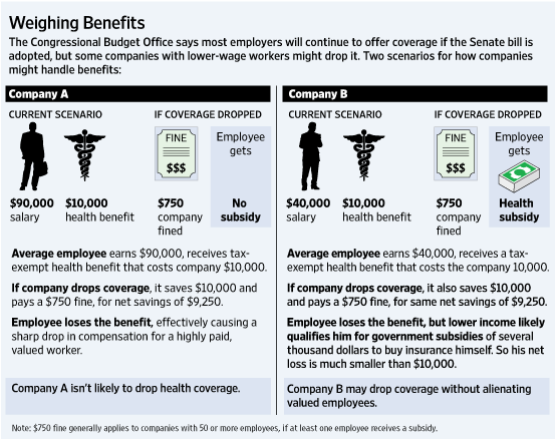
Behavioral Economics: Why companies will drop their health insurance plans …

January 7, 2010

Nice examples that cut to the chase …

click to enlarge

image
From WSJ, Businesses Brace for Health Bill’s Costs, Dec. 23, 2009 
http://online.wsj.com/article/SB126153353820802365.html?mod=WSJ_hpp_LEFTTopStories

How much to pay for an Apple?

January 7, 2010

Teaching point: It’s always easier to lower a product’s price than to raise it.  That’s called the “ratchet effect”.  So, it often makes sense try launch at a high price to ‘skim’ the market.  If the market resists, cut the price until you hit the sweet spot.

A blizzard of speculation is building over Apple’s as-yet-unconfirmed release of a tablet computer.

Among other things, the tablet is expected to offer e-books and TV programs. Apple has been trying to get TV networks to license their programming for a subscription service planned as part of a revamp of iTunes, presumably with the tablet in mind.

Assuming the talk is correct, it is hard to see the device proving immediately attractive to the mass market given a price expected somewhere between $500 and $900.

The iPhone wasn’t a big seller when it first released at $499 and $599. Apple quickly lowered that to $399.

But it was only when Apple renegotiated its deal with AT&T, cutting the price for the cheapest model to $199, that sales really took off.

The iPhone will remain Apple’s growth engine for the company for a while yet.

WSJ: Apple’s Hard-to-Swallow Tablet, Dec. 30, 2009
http://online.wsj.com/article/SB10001424052748703510304574626213985068436.html?mod=djemMM

Best jobs survey: Better to be a teacher or a sewer plant operator?

January 6, 2010

Oh, come on … obviously teacher.  I was just having some fun with you.

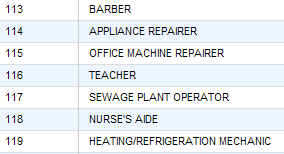
According to a newly released study from job site CareerCast.com —  teacher ranked #116 out of 200 of the best and worst jobs in the U.S. —  based on five criteria — environment, income, employment outlook, physical demands and stress.

Sewer plant operator came in a distant #117. 

image

The best and worst are displayed below … with the link to the full survey.

* * * * *

Top Jobs

Ken’s favorite: Philosopher … know any ?

image

* * * * *

Worst Jobs

Where’s toll collector?

image 

Full list:
http://online.wsj.com/public/resources/documents/st_BESTJOBS2010_20100105.html

Thanks to Coop for stringing the lead.

How many gallons of soda do YOU drink in a year? How much time in a car each day?

January 6, 2010

Some interesting stats from WHAT AMERICANS REALLY WANT by Dr. Frank I. Luntz

* * * * *

Americans say they average of 87 minutes a day behind the wheel. For car commuters, it’s an average of 100 minutes.

More than one-third of working Americans are awake by 6:00 a.m. and out the door by 7:00 a.m.  … for a commute to work that is an hour or longer.

More than 3 million Americans travel 50 miles or more one-way to work.

Less than 5 percent of the population takes public transportation to work, and only 12 percent carpool.

About 100 million people drive alone to work each day.

* * * * *

Americans drink an average of more than 50 gallons of soda per person per year.

Put another way, people drink more soda than coffee, milk, and
fruit drinks combined.

* * * * *

Three-quarters of Americans are overweight, meaning they weigh more than the recommended weight for their height … 25 years ago, 50% were overweight.

One-third are obese, meaning they weigh at least 20 percent more than their ideal weight … that’s doubled over the past 25 years. 

Bottom line: All-you-can-eat is no longer just an occasional trip to the buffet line — it’s now a way of life.

* * * * *

From: WHAT AMERICANS REALLY WANT. . . REALLY – The Truth About Our Hopes, Dreams, and Fears
by Dr. Frank I. Luntz

Shaking up the movie industry’s distribution mojo: Sony bypassing intermediaries

January 6, 2010

TakeAway:  Sony is taking the bull by the horns.  The movie industry has been wrestling with its distribution challenges for a few years but no effective solutions have surfaced. 

Now, Sony, with an eye on the future, is leveraging its suite of movie assets to create new channels of distribution for its movies.  Interesting story of product, place, and price optimization.

* * * * *

Excerpted from NYTimes, “Sony to Offer Film on Internet TV, Then DVD,” By Tim Arango, November 10, 2009

The latest experiment in Hollywood’s effort to find a way to compensate for the steep decline in profits from home entertainment … Sony will make its animated hit “Cloudy With a Chance of Meatballs” available to consumers directly through Internet-enabled televisions and Blu-ray players BEFORE the movie is released on DVD.

The move is significant because it represents the latest tinkering with the movie industry’s release windows, something Hollywood has long been reluctant to do out of fear of upsetting the profitability of DVD sales and angering its most important retailer, Wal-Mart. But with the decline in DVD sales, off as much as 25 percent at some studios, finding new ways to distribute movies has become a necessity.

The price of the film, $24.95, is high enough not to alienate retailers, Sony said … “It will make televisions more valuable, and that’s a good thing.”

Sony, the only Hollywood studio tethered to a major hardware manufacturer, is in a unique position to experiment with selling movies directly to consumers through television sets … The experiment is part of a search in Hollywood for ways to capitalize on the Internet’s potential for film distribution.

“The time when a majority of consumers have Internet-enabled TVs is a long way off,” said an analyst at Pali Capital. “But it’s moving the ball in the right direction” …

In addition to the industry ramifications, the experiment is important to Sony’s vision of its two pillars — hardware and content — to work together profitably …

Sony hopes later to entice other studios to make their films available to owners of Sony televisions, bypassing cable and satellite companies that offer their own video-on-demand services …

Mindful of the music industry’s contraction after the collapse of compact disc sales, Hollywood is frantically trying to develop new sources of home entertainment revenue …

Edit by TJS

* * * * *

Full Article
http://www.nytimes.com/2009/11/10/business/media/10sony.html?ref=media

* * * * *

Funding ObamaCare … taxes going up, up, up

January 6, 2010

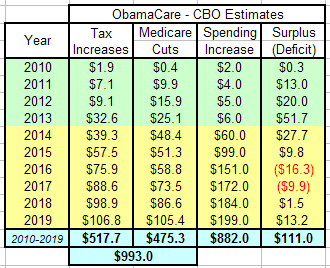
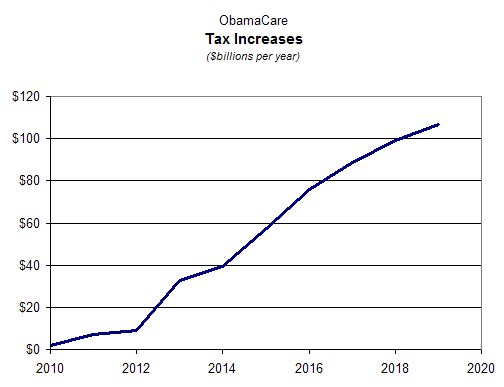
Based on the CBO scoring (before discovery of double-counting the Medicare savings):

Almost $1 trillion in additional government spending over 10 years … funded roughly half from Medicare cuts and half from tax increases … with the tax increases on a sorry trajectory.

Draw your own conclusions.

image

image

Uh-oh … Mayo Clinic to Medicare Seniors: "Sorry, cash only"

January 5, 2010

Ken’s Take: The Mayo & Cleveland Clinics are frequently cited as ObamaCare’s best practice models. Yesterday, the Mayo Clinic in Arizona stopped taking Medicare patients — unless they’re willing and able to pay CASH out of their own pockets.  Oops.

Why?

The Centers for Medicare and Medicaid Services cautioned that, under the proposed benefit cut, “providers for whom Medicare constitutes a substantive portion of their business could find it difficult to remain profitable and might end their participation in the program (possibly jeopardizing access to care for beneficiaries).”
http://www.investors.com/NewsAndAnalysis/Article.aspx?id=517004

So, Americans who have paid into the Medicare system for their entire working lives end up paying for health care out of their own pockets. Is that fair?

* * * * *

Excerpted from Bloomberg News: Mayo Clinic in Arizona to Stop Treating Some Medicare Patients , Dec. 31, 2009

The Mayo Clinic, praised by President Barack Obama as a national model for efficient health care, will stop accepting Medicare patients at one of its primary-care clinics in Arizona, saying the U.S. government pays too little.

More than 3,000 patients eligible for Medicare … will be forced to pay cash if they want to continue seeing their doctors at a Mayo family clinic in Glendale.

A Medicare patient who chooses to stay at Mayo’s Glendale clinic will pay about $1,500 a year for an annual physical and three other doctor visits, according to an October letter from the facility. Each patient also will be assessed a $250 annual administrative fee.

* * * * *

Obama has frequently cited the nonprofit Rochester, Minnesota-based Mayo Clinic and the Cleveland Clinic in Ohio for offering “the highest quality care at costs well below the national norm.”

Mayo’s move to drop Medicare patients may be copied by family doctors, some of whom have stopped accepting new patients from the program.

“Many physicians have said, ‘I simply cannot afford to keep taking care of Medicare patients … If you truly know your business costs and you are losing money, it doesn’t make sense to do more of it.”

Medicare Loss

The Mayo organization lost $840 million last year on Medicare. The program’s payments cover about 50 percent of the cost of treating elderly primary-care patients at the Glendale clinic where “Medicare payments no longer reflect the increasing cost of providing services for patients.”

* * * * * *

Nationwide, doctors made about 20 percent less for treating Medicare patients than they did caring for privately insured patients in 2007.

Medicare covered an estimated 45 million Americans at the end of 2008.

While 92 percent of U.S. family doctors participate in Medicare, only 73 percent of those are accepting new patients under the program .

There not enough new doctors becoming family doctors, internists and pediatricians who oversee patients’ primary care.

“Some primary care doctors don’t have to see Medicare patients because there is an unlimited demand for their services … When patients with private insurance can be treated at 50 percent to 100 percent higher fees … then Medicare does indeed look like a poor payer.”

Full article:
http://www.bloomberg.com/apps/news?pid=20601070&sid=aHoYSI84VdL0

The 5 things that Americans really want …

January 5, 2010

Excerpted from: WHAT AMERICANS REALLY WANT by Dr. Frank I. Luntz

* * * * *

According to Dr. Luntz, the five core attributes define what Americans really want.

1. More money.

Financial success has always been the highest priority for American men, but with the economic downturn it has leapt to the top among American women as well.

For millions of Americans approaching retirement, it’s less about more money and more about just getting back to where they once were.

For women, money is all about personal security, about having no fears and no worries of the financial kind.

Women measure success in life based on personal satisfaction and happiness — and the lack of economic anxiety leads to personal happiness.

For men, more money means more freedom, although that does manifest itself in the desire to buy more stuff. Men are much more likely than women to measure their success by their accumulation of material goods: house, car, technology, toys, the whole package.

For both men and women, money is more important today than at any time in a long time.

2. Fewer hassles.

Having fewer hassles is now the number two day-to-day priority of Americans.

Companies that sell products in shrink-wrapped hard plastic shells that are impossible to open don’t understand the importance of a hassle-free life.

Other examples are products that don’t perform like they do on television, services that sound much better in the advertisement than they are in reality, and
technologies that break or never work right in the first place.

3. More time.

Time used to be the highest priority for women — and for good reason.

From getting the kids up in the morning to paying the bills at night, women shoulder the majority of family responsibilities and household chores, even though the vast majority of women now work outside the home.

They have little time for themselves, and they crave it.

4. More choices.

There is an important distinction between choice and the right to choose.

Young people embrace as much choice as possible. Give them 15 choices of exercise equipment or 20 choices of coffee — the more the better.

Conversely, older people want the right to choose but don’t actually want to make the choice.  If you give them a choice of 20 different health-care plans, you’ve created a situation somewhere between confusion and chaos. To them, too many choices is no choice at all.

But for most Americans, limiting their choices is like denying life, liberty, and the pursuit of happiness.

If you sell the right to choose, or seem to expand people’s choices, you will find a lot of buyers.

5. No worries.

This can mean anything from “Yes, it will get done” to “I will take care of you.” It’s an expression of confidence that things will turn out right. 

* * * * *

From: WHAT AMERICANS REALLY WANT. . . REALLY – The Truth About Our Hopes, Dreams, and Fears
by Dr. Frank I. Luntz

Shoot the messenger !

January 5, 2010

Ken’s Take: I’m a big fan of Rasmussen Reports’ polls — in part because I like the answers, but more because of its track record for accuracy.

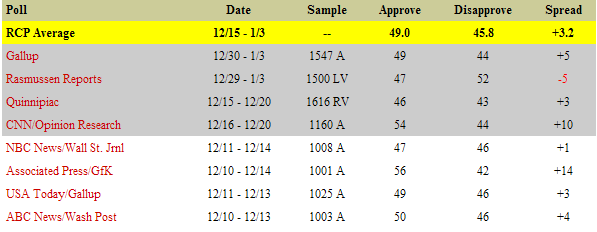
Since Rasmussen was first to report Pres Obama’s approval slide — and continues to be less favorable than the ABC, CBS, NBC, and CNN commissioned polls — the Rasmussen Reports are under attack.

Draw your own conclusion.

* * * * *

Excerpted from Politico: Low Obama favorables: Dems rip Rasmussen Reports, January 2, 2010

Democrats are turning their fire on Scott Rasmussen, the prolific independent pollster whose surveys on elections, President Obama’s popularity and a host of other issues are surfacing in the media with increasing frequency.

The pointed attacks reflect a hardening conventional wisdom among prominent liberal bloggers and many Democrats that Rasmussen Reports polls are, at best, the result of a flawed polling model and, at worst, designed to undermine Democratic politicians and the party’s national agenda. “His data looks like it all comes out of the RNC [Republican National Committee].”

While Scott Rasmussen, the firm’s president, contends that he has no ax to grind — his bio notes that he has been “an independent pollster for more than a decade” and “has never been a campaign pollster or consultant for candidates seeking office” — his opponents on the left insist he is the hand that feeds conservative talkers a daily trove of negative numbers that provides grist for attacks on Obama and the Democratic Party.

Nothing, however, sets off liberal teeth gnashing more than Rasmussen’s daily presidential tracking polls, which throughout the year have consistently placed Obama’s approval numbers around 5 percentage points lower than other polling outfits.

Ken’s Fact Check: The RCP Poll of Polls Data

image
http://www.realclearpolitics.com/epolls/other/president_obama_job_approval-1044.html

Democratic pollster Mark Mellman believes Rasmussen designs its polling questions to elicit negative responses about Obama and Democrats — a sentiment that is widely shared in the liberal blogosphere.

“I think they write their questions in a way that supports a conservative interpretation of the world … In general, they tend to be among the worst polls for Democrats, and they phrase questions in ways that elicit less support for the Democratic point of view.”

Rasmussen is quick to point out the accuracy of his surveys — noting how close his firm was to predicting the final outcome in this fall’s New Jersey governor’s race. (Rasmussen’s final survey in the race showed Republican Chris Christie edging out Gov. Jon Corzine 46 percent to 43 percent. Christie beat Corzine 48 percent to 45 percent on Election Day.)

Last year, the progressive website FiveThirtyEight.com’s pollster ratings, based on the 2008 presidential primaries, awarded Rasmussen the third-highest mark for its accuracy in predicting the outcome of the contests. And Rasmussen’s final poll of the 2008 general election — showing Obama defeating Arizona Sen. John McCain 52 percent to 46 percent — closely mirrored the election’s outcome.

Rasmussen, for his part, explained that his numbers are trending Republican simply because he is screening for only those voters most likely to head to the polls — a pool of respondents, he argues, that just so happens to bend more conservative this election cycle.

Polling all adults — a method used by Gallup, another polling firm that conducts a daily tracking poll of Obama — Rasmussen acknowledged, is “always going to yield a better result for Democrats.” But critics note that the practice of screening for only those voters regarded as most likely to head to the polls potentially weeds out younger and minority voters — who would be more likely to favor Democrats than Republicans.

Rasmussen, of course, is hardly the only pollster to come under fire this election cycle — just the one who attracts the most sustained criticism.

Last month, conservative radio host Rush Limbaugh accused the Gallup polling organization of “doing everything they can — they’re upping the sample to black Americans — to keep” Obama’s approval at 50 percent.

Full article:
http://dyn.politico.com/printstory.cfm?uuid=DCAD6DDB-18FE-70B2-A8986E439331DA11

Busted. Marketers’ grocery store tactics revealed

January 5, 2010

TakeAway:  As manufacturers and retailers strategize to squeeze pennies out of our now incredibly cost-conscious consumers, it appears the consumers are starting to catch on.

* * * * *

Excerpted from New Jersey Business, “Savvy marketing ploys can cost unwitting grocery shoppers plenty,” The Associated Press, November 06, 2009

If you ever leave the grocery store with a slight sense of bewilderment at what you’ve just bought, you are not alone.

Despite the utilitarian look of most grocers’ shelves, careful science goes into deciding how to display the thousands of items each store carries and how to make them appeal to consumers.

Marketers tug shoppers toward items they did not intend to buy … with package design, shelf placement, tie-ins and temporary price cuts …

Marketers have put more thought into grocery stores than any other type of store because they see an opportunity in the monotony of shopping for necessities …

For a bundle of 30 products that would cost an “impulsive” shopper $288 … research found a “savvy” shopper would pay just $166 at the same grocery store. In addition to guarding against marketing ploys, the savvy consumer tracked down coupons, used a store bonus card and chose the most economical sizes …

Here’s what to watch for next time you head out for groceries.

1. END OF THE AISLE: Marketers pay grocers dearly to put their wares on the end of each aisle shelves because products there can sell 30 percent more …

2. EYE-LEVEL, EYES OPEN: … Shoppers look straight ahead or, at most, from side to side, as they shop. So products on shelves at eye level often cost more than their lower-shelf siblings …

3. MORE CAN BE LESS: … One in four times a smaller version of a product was cheaper per serving …

4. D-I-Y CARROT STICKS: … convenience can be pricey.

5. DON’T PICK THEIR NUMBER: … Be wary of … the buy-five-for-$5 type. You usually don’t have to buy all five to get the promotional price …

6. THAT ONE LAST THING: The items in the display by the cash register are always marked up …

7. REMEMBER THE TRIED AND TRUE: … Buy store brands, which can be even more economical than shopping at warehouse clubs …

Edit by TJS

* * * * *

Full Article
http://www.nj.com/business/index.ssf/2009/11/savvy_marketing_ploys_can_cost.html

* * * * *

What’s an iPhone without AT&T? … a hot-selling iPod Touch.

January 4, 2010

Punch line: While Apple’s iPhone grabs headlines, the cheaper iPod touch keeps gaining devoted fans … thanks to strong functionality and, well, no dependency on AT&T.

Trend to watch: As my students know, I’m very critical of cell phone service — dead spots, crackling reception, dropped calls, slow upload / download speeds.  Wonder if iPod Touch (and Apple’s tablet to follow) will give a super-boost to WiFi coverage and obsolete cell phone technology.  Hmmm.

* * * * *

Business Week: iPod Touch’s Holiday Sales Spike Likely Beat the iPhone’s, December 30, 2009

Ever since Apple introduced the iPhone in the summer of 2007, it has been hailed as one of the most revolutionary products in tech history. By comparison, the iPod touch, which has all the iPhone’s features without the cell phone, has been downright publicity-starved.

But this holiday season, it seems the thinner, cheaper iPod touch may be Apple’s breakout hit …  iPod touch sales soared more than 100%, to 7.2 million, in the final quarter of 2009, while iPhone sales rose 53%, to 11.3 million.

Post-Christmas, the number of apps downloaded onto … iPod touches surpassed the iPhone. “It wasn’t just that the iPod touch barely squeaked by … It blew the doors off the iPhone—and overnight.”

The iPod touch can do pretty much anything an iPhone can do, and for a lot less money. It features the same slick multi-touch interface and can run almost all the 100,000-plus programs in Apple’s App store. The device has taken the portable gaming market by storm

The main difference is that the iPod touch does not work over cellular networks, so owners must be within striking distance of a Wi-Fi hotspot to go online or download apps. But Wi-Fi is available in most homes, offices, airports, and coffee joints, either for free or for a few bucks—but it costs nowhere near the monthly $100 of an AT&T contract.

This year, iPod touch sales may be getting an extra boost from the travails of AT&T, the exclusive carrier of the iPhone in the U.S.

Because of Ma Bell’s network problems, including frequent dropped calls and spotty Net access in cities such as New York and San Francisco, many consumers are opting to carry a new iPod touch along with their old cell phone rather than rely on an iPhone. Many users carry a BlackBerry  for email and making calls, and an  iPod touch for running apps and going online.

Some folks may soon be tempted by Apple’s much-rumored tablet device. Sources expect the tablet device to be roughly three times the size of an iPhone, making it well-suited for playing games, running apps, and reading e-books or online newspapers. The device may also rely on Wi-Fi, allowing Apple to further distance itself from AT&T’s service woes.

Full article:
http://www.businessweek.com/magazine/content/10_02/b4162022078079.htm

"The Lowering of Higher Education in America"

January 4, 2010

TakeAway: Colleges are filled with unserious students learning too little.

Excerpted from WSJ: On Campus, Unprepared, Dec. 22, 2009

It is widely recognized  that the gap between the earnings of high-school graduates and college graduates has become a chasm in recent decades.

So, governments around the world — from China and India to the Middle East — are trying to boost college attendance for their knowledge-hungry populations.

But in the U.S., many students are poorly prepared for college and end up taking remedial courses. And huge numbers fail to graduate.

A few skeptics think that aiming to increase the number of American college graduates is actually a fool’s errand. Most prominent among them is Charles Murray, who in “Real Education” (2008) argued that most young people are just not smart enough to go to college and should be encouraged to take other paths instead, especially vocational training.

Now comes Jackson Toby with “The Lowering of Higher Education in America,” a provocative variation on Mr. Murray’s theme.

Mr. Toby draws on social-science data as well as personal experience — he taught sociology at Rutgers University for 50 years before retiring a few years ago — to decry the intellectual conditions that prevail on the American campus:

  • The easy availability of financial aid to undergraduates who are unqualified for college-level coursework leads to low academic standards.
  • Few students are prepared to meet even the minimal demands of a real college education.
  • Lax college-admission standards give high schools little incentive to push their students harder.
  • Too many undergrads can’t write with minimal competence or understand basic cultural references.
  • Students often take silly, politicized courses, and feel entitled to inflated grades.
  • Most undergrads enjoy a steady diet of extracurricular hedonism while skating through their coursework.

Full article:
http://online.wsj.com/article/SB10001424052748703523504574604443236619168.html?mod=djemEditorialPage

Tempting the tax cheats … Stimulus bill says "come on down".

January 4, 2010

Another fine example of our government in action …

A report from the Treasury Department’s Inspector General for Tax Administration counts 56 tax provisions in the Stimulus bill with a projected cost of $325 billion. Of those 56, 20 are tax breaks for individuals and 36 are for businesses.

The problem, the Inspector General says, is the IRS can’t verify taxpayer eligibility “for the majority of Recovery Act tax benefits and credits.”

For individual taxpayers, 13 of the 20 benefits and credits can’t be verified; for businesses, it’s 26 of 36.

In other words, Treasury finds that the biggest chunk of the $325 billion in stimulus package tax breaks can’t be adequately tracked to protect against fraud.

IBD, How Corruption Stalks The Stimulus, 12/23/2009
http://www.investors.com/NewsAndAnalysis/Article.aspx?id=516173

About those New Year’s resolutions …

January 1, 2010

TakeAway: Odds are that you won’t keep your New Year’s resolutions, but it’s worth trying and there are some “tricks of the trade”.

* * * * *

WSJ: A Cheat Sheet for Keeping Resolutions, Dec. 29, 2009

If you are making a New Year’s resolution you would like to keep,  keep in mind that only about 19% of people who make them actually stick to their vows for two years.

But those discouraging statistics mask an important truth: The simple act of making a New Year’s resolution sharply improves your chances of accomplishing a positive change—by a factor of 10.

Among those people who make resolutions in a typical year, 46% keep them for at least six months.

* * * * * 

Successful resolution-keepers make specific, concrete action plans to change their daily behavior.  Here are the principles they follow:

Take one step at a time. Too many people “make large resolutions, such as losing 40 pounds by March, that are just too hard to accomplish.”    Most people do better if they break big goals into small steps. After 30 days, small changes become habit, adding up gradually to an overhaul.

Get a little help from your friends. Enlist like-minded friends to help. Make a five-minute phone call every day to a friend who has agreed to keep the same resolution.  That interaction with another person keeps it alive and keeps us sharing and listening.”

Change your environment. Another catalyst of change is to alter your surroundings to support your new behavior. Tracking your progress by recording or charting it also helps. 

Announce your intentions. Tell friends; publish  the intention on a blog; anything !

Figure out your attachment to bad habits.  Psychologists advise figuring out what your bad behaviors do for you and finding healthier substitutes. If you overeat to ease stress, for example, start practicing deep breathing or meditation.

Expect setbacks. People who fail at resolutions tend to criticize or blame themselves for slip-ups. In contrast, successful resolution-keepers brush off the inevitable setbacks and got quickly back on track.

Full article:
http://online.wsj.com/article/SB10001424052748704234304574625993885272978.html?mod=WSJ_hps_MIDDLEForthNews