Archive for April, 2010

Docs say ‘Shove it’ to ObamaCare …

April 30, 2010

Yes, the AMA supported ObamaCare, but … less than 15% of practicing docs belong to the AMA … and “90% of the AMA’s funding comes via a government sanctioned monopoly whereby the AMA sells the billing codes upon which the entire health care system relies”

Vested  interest?  You decide …

* * * * *

Excerpted from Forbes: Why Physicians Oppose The Health Care Reform Bill, 04.28.10

The medical establishment is not celebrating ObamaCare. In fact, the mood in exams rooms is downright morose.

A recently released poll of more than 2,000 physicians is alarming:

  • 79% of physicians are less optimistic about medicine since the passage of health care reform.
  • 53% indicate they will consider opting out of insurance plans with passage of the bill.
  • 66% indicate that they will consider opting out of all government-run programs.

Many physicians may ultimately be faced with the choice of opting out of government insurance programs or going out of business.

A significant number of physicians are realizing they cannot stay in business — let alone remain independent — if they continue to accept artificially low government reimbursement rates.

The same reform bill that will provide “care for all” may drive away more physician caregivers than attract previously uninsured patients.

What a predicament that would be. Health care without active physician participation is no health care at all.

* * * * *

How can physicians be so pessimistic ?

For one, the bill addresses none of the issues most consistently ranked by physicians as the most critical for lowering costs and improving access.

Tort reform, streamlining billing and payment, and fixing the flawed government formula for calculating physician reimbursement are given little, if any, serious attention.

Instead of fixing these issues, the government will be reducing physician reimbursement, just as the country is counting on even more physicians to be available.

* * * * *

What of the much-touted American Medical Association’s support for the bill?

Less than 15% of practicing physicians are AMA members, so any AMA support is more a reflection of the AMA’s financial interests than what physicians in this country truly want. This is a situation that proved opportunistic to proponents of the bill but could prove painful for America’s health care system.

The AMA, which counts less than 10% of its $300 million dollars in revenue from physician membership dues (the rest comes from a government sanctioned monopoly whereby the AMA sells the billing codes upon which the entire health care system relies) had little choice but to endorse the bill, lest the government retract its exclusive license on billing codes.

* * * * *

Full article:
http://www.forbes.com/2010/04/28/health-care-reform-physicians-opinions-contributors-daniel-palestrant_print.html

If you’re opposed to the illegal immigration law … then boycott Arizona (Tea) … huh ?

April 30, 2010

The problem: Other than its brand name, Arizona Tea has nothing to do with the state of Arizona … it’s brewed in New York. 

Ready  =>  shoot  => aim …

* * * * *

Excerpted from NY Daily News: Opponents of immigration law call for boycott of Arizona Iced Tea, April 28th 2010

Arizona’s new state law allows cops to demand citizenship papers from anyone they stop for a violation and think looks illegal.

Opponents of Arizona’s new anti-immigrant law are calling for a boycott of the state’s products – including the popular Arizona Iced Tea.

The problem: Arizona Iced Tea is actually brewed in New York.

Misguided tea fans vowed to switch to Lipton or Snapple:

  • “Dear Arizona: If you don’t change your immigration policy, I will have to stop drinking your enjoyable brand of iced tea” 
  • “It is the drink of fascists”.

Founded in Brooklyn in 1992, the firm was based in Queens before moving into a new $35 million headquarters in Nassau County last year.

Actual Arizona firms facing a boycott: Cold Stone Creamery, U-Haul and Best Western.

Full article:
 http://www.nydailynews.com/news/politics/2010/04/28/2010-04-28_ariz_law_leads_to_misfired_ire.html#ixzz0mTxCBHo1

Hey doc: your turn to bend over …

April 29, 2010

The gist of the below article: Primary care physicians are grossly underpaid compared with specialists, so there are fewer are them.  (No kidding ?)  

So, pay them more and there will be more of them. (It’s called an upward sloping supply curve !)

Yeah, yeah.

But, here’s what caught my eye: “A family physician or general internist averages about $160,000 a year; a specialist averages $267,000.”

BW focused on the $100k difference (which they multiplied by 35 to make it look, well, 35 times bigger).

My focus: the $267,000 level … just enough to target the specialists as rich enough to get hit by Obama’s soak-the-wealthy tax rate increases.

So, under ObamaCare, docs who are arguably the best get hit with reimbursement caps (that cut their earnings) and tax increases (that grabs more of what’s left).

Bend over doc.

* * * * *

Excerpted from Business Week: General Practitioners Need to Make More Money, April 26, 2010

In 1997, The Council on Graduate Medical Education, a little-known federal panel … suggested a cap on the overall number of medical residents as part of federal cost cuts. And so it was done.

Now, the Council is about to recommend an increase in the number of primary-care physicians—and pay them a whole lot more.

Primary-care doctors comprise 32% of the physician workforce. Factor out pediatricians and just over 23% of doctors deal with adults, and that number is shrinking.

A family physician or general internist averages about $160,000 a year; a specialist averages $267,000.

That means the general practitioner will earn about $3.5 million less over a lifetime.

The panel is calling for a 40% hike in the number of primary-care doctors — and a 40% income increase for those entering the field. That should get general practitioners to within 70% of the median income of specialty physicians.

* * * * *

Did you know ?

Medicare determines the baseline for doctors’ pay, and since most medical students elect to train in the non-primary-care jobs generating the majority of charges, procedure-oriented specialists end up the winners.

Medicare finances the system via direct subsidies to pay residents’ salaries and indirect payments to hospitals for tests and other duties fulfilled by residents.

Full article:
http://www.businessweek.com/magazine/content/10_18/b4176043937119.htm

EC says “not so fast” on internet sales …

April 29, 2010

TakeAway:  Who should have more control over where goods are distributed – manufacturers or retailers? 

Seems like the maker of the good (i.e., the manufacturer) should have the say over where its goods are made available for sale. 

Not so in Europe.  The European Commission is prepared to mandate retailer-favored distribution policies.

* * * * *

Excerpted from WSJ, “EU to Overhaul Online-Retail Rules,” By Peppi Kiviniemi, April 19, 2010

Heavy lobbying from luxury-goods companies has led the European Commission to water down proposals aimed at expanding online sales of goods in Europe …

The new rules … will protect luxury-goods manufacturers against damage to their image by allowing them to insist in many cases that online sales be restricted to retailers who have “bricks and mortar” stores … This would prevent online-only retailers like Amazon and Ebay from selling the goods directly.

Preventing consumers from buying clothes or cosmetics brands over the Internet from a company that has an “online-only” business model will limit consumer choice and lead to higher prices and less innovative goods, said Director General of the European Consumers Organisation BEUC. But famous names like LVMH and Estée Lauder have argued that an uncontrolled push online could damage their image, and that online entrepreneurs shouldn’t benefit from the brand recognition they have worked hard to build up …

With the Internet now the fastest-growing retail channel in Europe, the overhaul of the competition rules has been long expected by the industry. Previously, luxury-goods makers had full control over who could sell their goods and they were able to prevent most online sales.

Overall, the new EU-wide rules will open up online sales by ensuring that manufacturers cannot discriminate against online shops when setting up their distribution networks, the document shows.

Any qualitative conditions that manufacturers set on who is allowed to sell their products must apply equally to high-street and online sales. This means that shopkeepers who are allowed to sell branded goods on the high street can also set up a store inside eBay or elsewhere on the Web to sell the same products online, provided that their online presence meets the brand requirements for look, feel and pre- and after-sales services …

Edit by TJS

* * * * *

Full Article
http://online.wsj.com/article/SB10001424052748704671904575193993537322862.html?mod=WSJ_business_whatsNews

* * * * *

Snippet from the Goldman Sachs hearing …

April 28, 2010

Amid the blah-blah-blah. one question caught my attention:

Sen. Levin: “Which do you put first, the interests of your customers or the interests of your firm ?”

The GS guy stammered and gave a non-answer.

I wish he had answered either:

(a)  “Obviously, the interests of our customers because they are our business — so serving their interests is in the best interest of our firm.”

… or better yet, wish he had answered the question with a question …

(b) “Senator, when you vote, which do you put first, the interests of your constituents (the majority of whom are and were opposed to ObamaCare), or the interests of your party and President Obama ?”

The guy would have been charged with contempt of Congress, but it would have made for great theater …

In response to smart phones, LG says ‘keep it simple, stupid.’

April 28, 2010

Takeaway: It’s a classic strategic response: when the competition goes left, you go right.

As Apple, RIM, and Google race to make the smartest phones, LG hopes to connect with customers looking for simplicity and style.

Though smart phone usage has grown exponentially, these devices capture less than 20 percent of all US cell phone users.

LG believes there is tremendous opportunity in focusing on the larger portion of the overall market. LG’s strategy also reduces dollars required for R&D that can instead be redirected to design, branding, and…oh yeah, shareholders.

Will LG prove that less is more? Or, will the market develop to expected more and drop LG’s call?
 
* * * * *

Excerpt from Advertising Age, “Style Over Smarts: LG and Sprint Pitch Simpler Phones” by Andrew Hampp, April 8, 2010.

Even as Apple promises new features for the iPhone, the industry anticipates the iPhone’s arrival on Verizon and Palm retools its marketing strategy, LG and Sprint are starting a campaign aiming for the vast swath of consumers still choosing among simpler phones largely on the question of style.

The campaign and an accompanying MTV miniseries called “LG Fashion Touch” pair two LG phones being introduced April 19, the Lotus Elite and Rumor Touch, with Victoria Beckham and Eva Longoria Parker, respectively. The Lotus Elite is an edgier, more colorful flip phone that suits Ms. Beckham’s bombshell look, while the Lotus Elite is a more sleek, classic phone that complements Ms. Longoria Parker’s daily style.

The smartphone wars still don’t apply to a large group of women, said a VP of marketing and innovation at LG.

“Although there’s a large percentage of consumers going to smartphones, there’s still another segment who are saying, ‘I want phones that reflect my personal style’ without all the bells and whistles of a smartphone.”

Indeed, only 19.4% of U.S. mobile phone subscribers were using smartphones in the three months ended Feb. 10, compared with 80.6% using simpler devices, according to ComScore.
 
Edit by BHC
 
* * * * *
Full Article:
http://adage.com/madisonandvine/article?article_id=143184

Still more trouble for tanning salons …

April 27, 2010

These guys just can’t catch a break … now they get hit by studies that tanning can be as addictive as drugs.  Oh my.

* * * * *

Excerpted from Washington Post,  Study: Indoor tanning may be addictive,  April 20, 2010

Researchers reported in the Archives of Dermatology that as many as a third of young people who use indoor tanning facilities may be addicted to the behavior.

Among people who said they had used indoor tanning facilities in the past, 69 percent met  criteria for addiction.

Among those who scored positive for addiction, 78 percent said they had tried to cut down on the time spent tanning but couldn’t, and 78 percent said they felt guilty about using tanning beds or booths too much.

Further, 26 percent said that, when they wake up in the morning, they want to use a tanning bed or booth, and nearly one in four admitted that they had missed scheduled activities — social, occupational or recreational — because they decided to go to a tanning facility.

The findings are the latest to suggest that tanning, whether natural or indoors, activates the same parts of the brain triggered by drug dependence.

Full article:
http://voices.washingtonpost.com/checkup/2010/04/study_indoor_tanning_may_be_ad.html?wprss=checkup

Tax Facts: Hooray for married people.

April 27, 2010

Too bad they’re a diminishing breed …

* * * * *

Excerpted from IBD: New Tax Math: Single Moms + Big Brother, 04/23/2010

The news that the U.S. has become a two-class society — i.e., half of Americans pay federal income taxes and half don’t — has been bouncing around the media and shocked some Americans who had no knowledge of this appalling economic fact.

Married taxpayers pay 75% of all federal income taxes, whereas two-thirds of single parents who file as head of household pay no income tax at all.

In 2008, 40.6% of children born in the U.S. were born outside of marriage; that’s 1,720,000 children …  7% of those babies were born to girls under age 18 … over three-fourths were born to women over 20.

LBJ’s Great Society set up a  system whereby millions of people were taught they had an “entitlement” to pick the pockets of law-abiding, taxpaying families if they met two conditions: They didn’t work, and they were not married to someone who did work.

Now, about 40% of Americans receive federal government handouts of cash and valuable benefits …  20% of Americans get 75% of their income from the federal government and another 20% get 45% of their income from the government.

Obama’s stimulus law will add nearly $800 billion in welfare spending over the next decade.

That means $22,500 for every poor person in the U.S., which will cost over $10,000 for each family that pays federal income taxes.

Full articler:
http://www.investors.com/NewsAndAnalysis/Article.aspx?id=531278

An undercover look at a television show’s impact on a brand

April 27, 2010

Key Takeaway: With viewership that can reach in the tens of millions, popular television shows tend to be the golden child of advertising. Perhaps the only thing better than having a 30-second commercial is having an entire show focus on your product…right?

A study looked at how CBS’ hit show, Undercover Boss, has influenced three establishments. The research shows that while perceptions improved in the short-run, they ultimately drifted back towards the pre-show numbers.

It goes to show that while you can expect television to create buzz around your product, it cannot be the only tactic if trying to change your brand image.

* * * * *

Excerpted from Brandweek, “‘Undercover’ Boosts Brands?” April 23, 2010

Retail chains with negative reputations expecting big, long-lasting buzz boosts from appearances on CBS’ Undercover Boss better think again.

YouGov’s BrandIndex examined three establishments featured on the hit program to learn if the exposure persuaded consumers that these were places they’d consider working for.

7-ELEVEN
7-Eleven received the lowest reputation score in the Grocery Store sector, so the timing was ideal for the February 21 broadcast.
President and CEO Joseph DePinto’s disguised himself as a trainee on the night shift in a Long Island, N.Y., store, where one employee confides that he’d never recommend working at the chain because it’s a dead end job.

That out-of-the-blue upbeat finale moved the meter only slightly for 7-Eleven — from -23.1 on the night the show aired to a short-term gain of a couple of points. However, in the long run, the chain made it as high as -17.2, and is now tracking at -19.3, a decent amount above its -24.7 score from January 1

WHITE CASTLE
Dave Rife — great-grandson of the hamburger chain’s founder — was surrounded by relatives, expensive cars and a personal trainer when his turn to work undercover arrived on February 28.

After revealing his identity, he told an employee to start a wellness program. He also handed out two $5,000 checks: one to an aspiring cook as a scholarship, and another to a worker for a “leaders of tomorrow” program.
That resonated the most with consumers, who sent White Castle’s reputation score upwards from -11.4 to -5.9 in a matter of three weeks. The brand has since settled in at -9.8, just a few points higher than the January 1 score of -13.4.

HOOTERS
The Atlanta-based restaurant chain has had one of the most undesirable workplace perceptions in the dining sector, so the appearance of president and CEO Coby G. Brooks on Valentine’s Day couldn’t have come at a better time. The chain’s reputation low point of the year came on January 21, with -31.1, around the same time the owners who licensed the brand name for Las Vegas’ Hooters Hotel and Casino announced they had “substantial doubt about our ability to continue as a going concern.”

Hooters’ reputation score got a modest shot in the arm, as it climbed leading up to the February 14 airing, hitting -26.2. It then moved up to -23.7 in late March — the chain’s highest score since November 2009. However, Hooters has slid to -27.7 — and its very existence is shaky now that it has one month to find a buyer to resolve a legal brawl over Coby Brooks’ father’s estate.

Edit by JMZ

* * * * *

Full Article:
http://www.brandweek.com/bw/content_display/news-and-features/direct/e3icc341acc4f9c061e30d034bbbaf1c758

This is big: Florida puts ObamaCare "individual mandate" on Nov. ballot …

April 26, 2010

First, the news and a sample of how it’s being covered … below is my take on why it’s important.

In Florida, voters will decide this fall whether to ban health insurance mandates, including those required by the federal health care overhaul.

The Republican-controlled Florida Legislature voted on Thursday to place a constitutional amendment on the Nov. ballot that would ban any laws that compel someone to “participate in any health care system.”

Republican legislators said the amendment was needed to block an attack on freedom and individual rights by Congress.

Democrats said the debate echoed the battle over states’ rights when the federal government ordered school integration and said the amendment could not trump federal law.

Sixty percent of voters must approve the amendment in order for it take effect.

Excerpted from NYT: Florida: Health Overhaul on November Ballot, April 22, 2010
http://www.nytimes.com/2010/04/23/us/23brfs-HEALTHOVERHA_BRF.html

* * * * *

Ken’s Take: I think the pundits are missing the point on this one.

Whether the constitutional amendment passes or not is largely irrelevant.

An important part of the the Bush / Rove election strategy in 2000 was to get wedge issues on ballots — gay marriage bans. The intent: to draw social conservatives to the polls.

Well, ObamaCare is still opposed by a majority of the electorate — and, many in that majority are passionate about the issue.

So, if ObamaCare shows up on the November ballot, it’ll draw right-leaning voters.

Watch for more of these issues to make their way to the Nov. ballots.

Whether the specific proposals win or lose is irrelevant — it’s all about turnout.

ObamaCare and New Coke

April 26, 2010

Punchline: “Admitting a mistake is almost constitutionally impossible for today’s corporate chiefs, and even harder for politicians. Sometimes it’s best to admit your mistakes. Presidents, like CEOs, can pay a steep price for not admitting error.”

Note: My students will know that I’m conflicted on this one.  While I like the message and the implied recommendation, I may be the last living person who thinks that New Coke was a strategic coup — it got Coke plenty of heightened exposure, it strengthened ties with the Classic Coke buyer (when Classic was promptly re-introduced), it got Coke extra shelf facings (New Coke + Classic Coke), and it provided the flavor formula for Diet Coke (<= bet you didn’t know that).

* * * * *

Excerpted from WSJ:  ObamaCare and New Coke, April 24, 2010

This week marked the 25th anniversary of the introduction of “New Coke.”

New Coke was not just another product launch: It crossed over from product marketing into the social and political sphere.

New Coke was introduced by the company with high hopes: It was a drink that consumers in blind taste tests rated superior not only to Pepsi, but also to Coca-Cola.

Despite consumers’ immediate acceptance of the new beverage and an initial jump in sales, resistance began to form in small protests around the country. Sales began to lag.

The objection was not so much to the new product itself, but to the company’s hubris in removing the traditional Coca-Cola from the shelves to make way for the new.

* * * * *

There may be some lessons here regarding ObamaCare.

Just as most Americans were happy with the old Coke, 85% of Americans were happy with their own health-care plans at the time that ObamaCare was introduced.

In essence, those plans were taken away from them in the same way the old Coke was taken away.

And, as was the case with New Coke, opposition has continued to grow.

This is personal for the American people.

* * * * *

Faced with a successful launch but growing and vocal public resistance, the Coca-Cola Company’s leadership did the extraordinary.

Coke reversed paths and returned classic Coca-Cola to supermarket shelves just 77 days after the debut of New Coke.

Coke said: We were wrong, but at least we’re smart enough to listen to you.

People not only rejoiced, they rewarded the company with unprecedented gains in volume and market share.

* * * * *

Full article:
http://online.wsj.com/article/SB10001424052748703876404575200550394710626.html?mod=djemEditorialPage_h

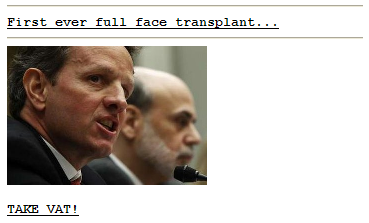
First ever face transplant …

April 26, 2010

Precisely as presented on the Drudge Report …

Gotta wonder:

(1) Geithner or Bernanke ?

(2) Worth the effort ?

image

image

http://www.drudgereport.com/

Reeling tanning salons take another direct hit …

April 23, 2010

Punchline: The European Union declares vacationing a right and subsidizes holidays for the underprivileged so that they can hit the beach … the tanning salon guys just can’t catch a break these days.

* * * * *

Excerpted from WSJ: Cash for Tanners, April 23, 2010 

The European Union’s “social tourism” project advocates subsidized holidays for the underprivileged, saying that visiting foreign countries is a “right,” and one that could soon be financed by EU taxpayers.

This gives a whole new meaning to the concept of “paid vacation.”

The EU last year launched a project to identify and promote measures to help the needy to go on holiday.

The project specifically targets the disabled, poor families, senior citizens and “youth,” a group that in geriatric Europe includes people up to 30 years of age.

Cash for tanners is also being touted as good economic policy.

At an EU meeting last week, Spanish Tourism Minister Miguel Sebastian said tourism “should be an asset all citizens can enjoy, in particular those with physical disabilities or financially disadvantaged.”

Full article:
http://online.wsj.com/article/SB10001424052748704448304575195820988457124.html?mod=WSJ_Opinion_AboveLEFTTop

Mr. President: my Toyota lost market value … how about writing off some of my auto loan ?

April 23, 2010

This one just won’t die … and it gets me riled every time its heart starts beating louder.

Why should people who bought houses they couldn’t afford have their bad behavior rewarded with loan forgiveness while their mortgage paying neighbor has to pay off the full amount they borrowed ?  It just doesn’t make sense.

Maybe they should cut mortgage principle balances across the board — good loans and bad loans.  Let real home “owners” (like me) feed at the trough, too.  Better yet, extend the program across all loans — say auto loans.  I bet many Toyota’s are underwater these days …

CNBC: Force Banks to Cut Mortgage Principal: Watchdog, 20 Apr 2010

The watchdog overseeing the $700 billion bank bailout said that the Obama administration should consider forcing lenders to make principal reductions for struggling homeowners who owe more than their home is worth.

Further, he  urged the administration to consider extending the amount of time unemployed homeowners are forgiven from making mortgage payments as the maximum six months now allowed may not be long enough.

Full article:
http://www.cnbc.com/id/36658764

Beating the promotion cycle

April 23, 2010

TakeAway:  Jos A Bank responded to the downturn the way many companies did – discount, discount, discount.

But Jos A Bank, unlike most companies, appears positioned to carry its short-term success into long-term profitability. 

Thanks to several operating decisions (maintaining control over most of its manufacturing and shipping, and exploiting the downturn real estate market to negotiate low rent leases), Jos A Banks is maintaining profitability while acquiring new consumers. 

Did Jos A Bank figure out how to successfully execute and beat the margin killing promotion cycle?

* * * * *

Excerpted from Washington Post, “The economic downturn suits menswear retailer Jos. A. Bank just fine,” By Ylan Q. Mui, April 19, 2010

… Jos. A. Bank began making headlines when — just days after the stock market plummeted to a 12-year-low — it offered to refund any suit purchase to customers who lost their jobs.

It rolled out aggressive promotions — such as buy one suit, get two for free — to lure new shoppers. The retailer revamped its Web site, opened new stores and started renting tuxedos. Last week, it announced it would open five pilot outlet stores that could become models for a new line of business.

Such moves have fueled an 11 percent increase in sales … during the last fiscal year and a 21 percent jump in profits … Wall Street valued the company at $1 billion this spring for the first time. Its stock price has more than doubled since last summer …

It seems an unlikely time for a rally. Retailers suffered massive losses as the financial crisis of 2008 froze consumers’ wallets and high unemployment rates stymied prospects for recovery …

Jos. A. Bank responded to the downturn with sharp pricing and inventive promotions … “They have a compelling price-value message with a good-quality product. . . . In this environment, that is what draws the consumer.”

But discounting can become a vicious cycle, and many retailers have struggled to wean shoppers off heavy promotions. Jos. A. Bank experimented with more traditional pricing during Father’s Day last year — typically one of its busiest holidays — and found sales dropped off. When it returned to aggressive promotions, customers came back. It has tested traditional pricing several times since with limited success.

Black said the company will continue discounting as long as necessary. Because it manufactures nearly all of its products, the retailer has greater flexibility to determine prices. The promotions have squeezed profit margins, but the company has made up part of the difference by saving on shipping and materials and negotiating some lower rents …

The retailer’s trademark suits have become increasingly important sales drivers, accounting for nearly 40 percent of sales last year compared to about 30 percent in 2008. Though Black said existing customers are purchasing less, the chain has enticed new shoppers away from competitors. Its customer file has grown 18 percent …

Meanwhile, Jos. A. Bank is testing several new concepts. Early this year, it began offering tuxedo rentals at some stores through a third-party distributor. The company is hoping the service will bring new customers through its doors, who could then be persuaded to purchase other clothing …

Edit by TJS

* * * * *

Full Article
http://www.washingtonpost.com/wp-dyn/content/article/2010/04/18/AR2010041802777.html?hpid=artslot

* * * * *


Wall Street : Back to the Future ?

April 22, 2010

Below is a quick take on the context of the Goldman bruhaha and financial regulatory reform. 

The “factors that moved Wall Street from the old model to the new” don’t get talked about much …

* * * * *

IBD: Goldman Case Marks Shift On Wall Street,  04/21/2010

Once upon a time, Wall Street’s leaders saw themselves as arbiters of capital, helping allocate society’s savings to productive uses.

By contrast, Wall Street’s major firms now see themselves as captains of “the market,” navigating it — for themselves and sometimes their clients — for maximum gain.

This is a distinction with a difference.

As arbiters of capital, Wall Street was paid to make judgments. It tutored investors on which stocks to buy, advised companies on which mergers and acquisitions to pursue. It decided which companies deserved capital through the sale (“underwriting”) of new stocks and bonds to investors. Wall Street made money through fees and commissions.

Now the prevailing model is different. Wall Street firms still give advice — and earn fees. But their main business is trading for their own accounts and creating trading opportunities for clients.

About 80% of Goldman’s $12.8 billion in Q1 revenues came from its trading and proprietary investment accounts. The rest represented underwriting, financial advice and management.

Greed and shortsightedness didn’t originate yesterday. Wall Street’s old model bred abuses. Brokers “churned” clients’ accounts to generate commissions. Investment bankers earned fees by rubber-stamping dubious mergers. Underwriters blessed poorly managed firms or companies with no real businesses (remember the dot-com bubble). And there were swindles.

Many factors moved Wall Street from the old model to the new:

  • the end of fixed commissions on trades, which squeezed revenues;
  • computer technology, which made rapid trading and exotic financial instruments possible;
  • the replacement of partnerships with publicly held firms. When partners were individually responsible for a firm’s losses and mistakes, they restrained excessive risk-taking.

These changes won’t be reversed. But if Wall Street can’t control itself, someone else will.

Full article:
http://www.investors.com/NewsAndAnalysis/Article.aspx?id=530938

Loose women cause Quakes … with a capital "Q"

April 22, 2010

I figure that if the Iranians can close in on a nuclear bomb, they must have a knack for science. 

Intuitively, it makes sense that a whole lot of shakin’ could cause some quakin’ …. but seems it would take an enormous number of women being simultaneously “loose” to cause a Quake.

Maybe religion and science should stay out of each other’s knickers…

CNN: Iran cleric says Promiscuous women cause earthquakes,April 21, 2010

Iran suffers regular earthquakes, including a devastating one that destroyed the ancient city of Bam in 2003, killing tens of thousands.

A leading Iranian hard-line cleric has said that women who dress provocatively and tempt people into promiscuity are to blame for earthquakes,

The prayer leader, Hojatoleslam Kazim Sadeghi, says women and girls who “don’t dress appropriately” spread “promiscuity in society.”

“When promiscuity spreads, earthquakes increase.”

Full article:
http://www.cnn.com/2010/WORLD/meast/04/20/iran.promiscuity.earthquakes/

It’s called "principle": Why tea partiers swayed by a dollar-a-day …

April 21, 2010

Punch line: Tea party supporters are not easily bought off with dollar-a-day tax credits — they resist an emerging culture of dependence.

* * * * *
Excerpted from Washington Examiner, Tea Partiers Fight Culture of Dependence, April 19, 2010

The Obama Democrats’ vast expansion of the size and scope of government — is really not just about economics. It is really a battle about culture, a battle between the culture of dependence and the culture of independence.

The Obama Democrats see a society in which ordinary people cannot fend for themselves, where they need to have their incomes supplemented, their health care insurance regulated and guaranteed, their relationships with their employers governed by union leaders. Highly educated mandarins can make better decisions for them than they can make themselves. That is the culture of dependence.

The tea partiers see things differently.

They’re not looking for lower taxes — half of tea party supporters, a New York Times survey found, think their taxes are fair. Nor are they financially secure — half say someone in their household may lose their job in the next year. Two-thirds say the recession has caused some hardship in their lives.

But they recognize, correctly, that the Obama Democrats are trying to permanently enlarge government and increase citizens’ dependence on it. They believe that this will destroy the culture of independence which has enabled Americans over the past two centuries to make this the most productive and prosperous — and the most charitably generous — nation in the world.

Seeing our political divisions as a battle between the culture of dependence and the culture of independence helps to make sense of the divisions seen in the 2008 election. Barack Obama carried voters with incomes under $50,000 and those with incomes over $200,000, and lost those with incomes in between. He won large margins from those who never graduated from high school and from those with graduate school degrees, and barely exceeded 50 percent among those in between.

The top-and-bottom Obama coalition was in effect a coalition of those dependent on government transfers and benefits and those in “the educated class,” who administer administer those transactions. They are the natural constituency for the culture of dependence.

The in-between people on the income and education ladders, it turns out, are a constituency for the culture of independence.

Tea party supporters are not in the mood to be bought off with $400 tax credits. They have a longer time horizon and can see where the Obama Democrats are trying to take us.

Full article:
http://www.realclearpolitics.com/articles/2010/04/19/tea_partiers_fight_culture_of_dependence.html

In this economy, “earned success.” is harder to come by …

April 21, 2010

Punchline: This economy makes job satisfaction a thing of the past … and in the future, will people be happy forking over their earnings to the government or will they find real satisfaction when holding their hands out to the government?

* * * * *
Excerpted from RCP: Under Obama, Reducing Choices for the Future, April 5, 2010

As Americans, we get such satisfaction when we believe the work we are doing — in workplaces and in community activities and voluntary associations — is serving interests broader than our own.

We’re making use of our talents, whatever they may be, to make a contribution to society.

It’s hard to get that kind of satisfaction in this kind of economy.

People say, “At least I’ve got a job.”

Not a satisfying job, not one that it makes full use of their talents and interests, not one that provides a sense of earned success.

Just a job, a source of income.

The kind of job in which you keep looking at the clock, counting the time before you can leave, counting the hours until the weekend comes.

The economy we enjoyed between 1983, when the Ronald Reagan tax cuts kicked in, and 2007, when the housing market collapsed, provided many more jobs in which people could gain such satisfaction.

You could make a living as a master carpenter, as an actor or sewing quilts because steady economic growth and low inflation meant expanded markets for custom goods.

You could do work you really wanted to do. You didn’t have to settle for a data-entry or bolt-attaching job.

The economy we have now doesn’t do that.

Full article:
http://www.realclearpolitics.com/articles/2010/04/05/under_obama_reducing_choices_for_the_future.html

Gillette’s retaliation may give Shick razor burn

April 21, 2010

Takeaway: For years, the makers of men’s razors have focused on improving their products’ engineering specs, namely by adding blades. Shick has finally broken this cycle of one-upmanship by focusing on the needs of their customers, which center around comfort.

However, in making this potentially breakthrough move, Shick has awakened a giant. P&G’s Gillette will be quick to follow with a relaunched Fusion razor aimed to address the same needs as Shick’s product.

Will Shick’s launch provide the company with a first-mover advantage in comfort positioning? Or, will Gillette’s brand recognition, enormous advertising support, and best-in-class distribution system leave Shick all cut up?

* * * * *
Excerpt from New York Times, “New Razors Place Focus on Comfort, Not Blade Count” by Andrew Adam Newman, April 18, 2010.

When Gillette introduced the first three-bladed razor in the United States in 1998, it struck some as absurd, and “Saturday Night Live” at the time pitched a 14-blade razor in a parody commercial. But blade escalation continued: Rival Schick introduced the four-bladed Quattro in 2003, and Gillette struck back with the five-bladed Fusion in 2005.

Schick is introducing a new razor, the Hydro, however, and this time it is not raising the blade ante. The new razor is available in both five- and three-blade versions, and advertising focuses less on blades than how a moisturizing gadget reduces irritation.

New television commercials show men getting an unexpected splash from a boxing glove or a soccer ball exploding like a water balloon, drenching the player.

“As you continue to add more blades, there are diminishing returns because more and more blades make a bigger cartridge and that makes it hard to shave in all the nooks and crannies on your face,” said a Schick brand manager. “So instead of more blades, we’re providing a more lubricious, smoother, more comfortable shave.”

The razor replaces the moisturizing strip on the razor’s head with a gel reservoir that exudes aloe and vitamin E.

“It’s by far the biggest launch we’ve ever done, our largest capital commitment for R.& D. and marketing, and by far the best technology we’ve ever come up with,” said a company representative.

Schick, which was bought by Energizer in 2003, is dwarfed in the razor category by Gillette, a Procter & Gamble brand. Gillette has 66 percent and Schick has 25 percent of the nondisposable razor segment. In the $781 million replacement cartridge segment, Gillette commands an 83 percent share, compared with 14 percent for Schick.

“In brand marketing, when you do something and it works, you keep doing it until it stops working, and that’s what it felt like was happening when companies went from one to three to five blades,” said marketing professor at New York University. “They added so many blades that they have unwanted effects, like more irritation. It was absurd, frankly, and it got to be a marketing gimmick.”

While razor makers tend to stress technological advances and performance, which can make razors seem more like racecars, the new Schick campaign focuses more on how it treats skin.

Schick says its internal research found that only 30 percent of men shaved five or more times a week. The company is publicizing a poll it commissioned which found, conveniently enough, that men who shave five or more times a week have sex twice as frequently as the stubbly, and that 82 percent of women prefer cleanly shaven men.

Gillette, meanwhile, will introduce a razor in June that, rather than add another blade, similarly promises to make shaving with five blades less irritating. The Fusion ProGlide, as its name makes clear, will not be an entirely new razor, but rather an extension of Fusion, a brand that Procter & Gamble reports grew faster than any other in its history, earning $1 billion within two years of its introduction.

“If you’re going to address comfort, the place to start is not by adding blades but rather to work on the engineering of the blades themselves,” said Stew Taub, associate director of male premium systems at Gillette.

The ProGlide makes seven comfort-related improvements to the Fusion, including using thinner blades with improved friction-reducing coating. The company also will introduce a preshave facial scrub that causes a warming sensation, as well as a postshave cooling lotion under the ProGlide label.

“Consumers vote with their purchases and have overwhelmingly said Fusion is best, and we’ve chosen to take it up a notch,” said a Gillette spokesman.

Mr. Jones said the innovations in the ProGlide had been in development for years. But some industry analysts think Gillette is rushing a comfort-driven product to market to steal Schick’s thunder.

“It looks like a fairly quick and defensive move on Gillette’s part,” a marketing professor at NYU said. “For me the big news is that Schick, after being almost an afterthought in the category for many years, has staked out some smart territory, and is acting like a real brand marketing company.”

Edit by BHC

* * * * *
Full Article:
http://www.nytimes.com/2010/04/19/business/media/19adco.html?ref=media


How to live in your home for free … and buy the things you’ve always wanted

April 20, 2010

Punchline:  Steve Martin has a dated comedy routine: how to get a million dollars tax-free.

First, get a million dollars.  Then, simply don’t pay any taxes.  If the Feds come knocking, say “I forgot”.

Here’s a contemporary twist: how to live in your home for free and buy the things you’ve always wanted.

First, stop making your mortgage payments.  Then, buy whatever you want until your cash runs outs.  When the repo man comes, say “I forgot”.

It used to be that American homeowners would pay their mortgage first, then the rest of their bills, and then spend whatever is left over.

My, how times have changed …

* * * * *

Excerpted from CNBC: Mortgage Defaults May Be Driving Consumer Spending, 12 Apr 2010

Recent studies show Americans are now far more likely to pay their other bills first before their mortgage (which is a big turnaround historically speaking.)

That means they pay off their credit cards, cable bills, car loans in place of their home loans.

Paul Jackson, publisher of Housingwire.com, wrote a fascinating article last week that describes a case study of someone who applied for the government’s Home Affordable Modification Program.

The person had an $1,880.00 monthly mortgage payment on which they’d defaulted, but said person’s monthly bank statement showed payments to a tanning salon, nail spa, liquor stores, DirecTV bill with premium charges, and $1,700.00 in retail purchases from The Gap, Old Navy, Home Depot, Sears, etc. 

Writes Jackson:  Even if you assume that just half of the current 7.4 million currently delinquent mortgages fit this sort of ’spending profile’ (that is, they are spending their mortgage) and you assume a $1,000 median monthly mortgage payment for most U.S. homeowners — you get a $3.7 billion boost per month to consumer spending. It’s certainly enough spending to matter in the overall scheme of things. 

Since it currently takes well over a year, in some cases nearly two years, to go from missing a payment to being chucked out of your home … it’s just another, innovative way of using your home as your ATM.

Full article:
http://www.cnbc.com/id/36422316

Thanks to SMH for feeding the lead

Here come the bumper stickers …

April 20, 2010

President Obama seems to have struck a nerve with unhappy taxpayers by mocking them: “They should be telling me thank you!”

The campaign bumper stickers have already started appearing.
 

image

image

image

How low can you go

April 20, 2010

TakeAway:  If it’s possible to lower price, Wal-mart usually leads the way. 

And it has done it, again.  Wal-Mart, seeking to firmly establish itself as a price leader, has cut prices. 

The move serves two purposes – block competition from other discount retailers and retain middle-class consumers, who are now feeling more financially stable and may consider upgrading to Kohl’s or Target.

Of course, Wal-Mart plans to preserve its margins by simply passing the cost of lower prices onto its suppliers.

* * * * *

Excerpted from WSJ, “Wal-Mart Bets On Reduction In Prices,” By Miguel Bustillo and Timothy Martin, April 9,2010

Wal-Mart is cutting prices on thousands of products in an aggressive campaign to reinforce its reputation as a discount leader, as the company seeks to reverse months of slowing U.S. sales.

The world’s largest retailer was a rare beneficiary of the economic slump, as bargain-hungry Americans … flocked to its supercenters from supermarkets and specialty clothing stores.

But Wal-Mart’s sales from U.S. stores open a year or more have edged lower recently, while other retailers have started to see an uptick in consumers’ discretionary spending. That suggests to some analysts that Wal-Mart is having trouble hanging on to middle-class shoppers.


Wal-Mart says that it isn’t so. Its executives attribute the chain’s slowing sales to a general decline in food and electronics prices …

The company says it believes that, despite growing consumer optimism, many Americans will continue to struggle in the months ahead. So, it is cutting prices this week on roughly 10,000 items, mostly food and other staples …

“We felt we needed to increase the intensity and excitement with our customer, especially the feeling that Wal-Mart has great deals.”

Wal-Mart is publicizing its price cuts with a barrage of placards in the aisles of its 3,700 U.S. stores and a media campaign describing how the company’s cost-cutting moves …

Wal-Mart expects to expand its price cuts with help from suppliers. The chain is encouraging them to reduce what they charge Wal-Mart in exchange for having it spotlight their products as part of its price “rollback” …

Retailing experts question how effective the strategy will be in lifting Wal-Mart’s sales, since consumers already regard the chain as a low-price leader.

Though the company may get a modest near-term sales boost, the cuts are more likely to intensify the loyalty of shoppers who came to Wal-Mart during the recession … “This will make customers say, ‘if I go back to Kohl’s and Kroger I may be missing deals at Wal-Mart.’ ”

Despite its sales slowdown, Wal-Mart has continued to post solid profits, in part due to widening margins. Some analysts believe that gives the retailer room to cut prices without sacrificing profit. Getting suppliers to share the costs of the price reductions would also mute the impact on its bottom line …

The price reductions could help Wal-Mart fend off a growing list of no-frills competitors, such as the U.S. branch of Germany’s Aldi discount grocery chain and variety stores such as Dollar General, which are nipping away at Wal-Mart’s less-affluent core customers.

Yet whether Wal-Mart is committed to pushing the envelope on pricing as it did in the days of its late founder or is merely hyping promotions as it pursues a more margin-driven strategy, is the question the industry is asking …

Edit by TJS

* * * * *

Full Article
http://online.wsj.com/article/SB20001424052702304198004575172271682347064.html#mod=todays_us_marketplace

* * * * *


Obama says that taxpayers should be saying thank you … huh ?

April 19, 2010

Obama mocked Tea Partiers, saying that they should be thanking him. 

President Barack Obama struck a hyperpartisan note Thursday, telling Democrats that he was “amused” by the Tax Day Tea Party rallies. 

Obama, addressing a Democratic National Committee (DNC) fundraiser in Miami, did little to endear himself to the Tea Party groups protesting around the country, saying:

 “”I’ve been a little amused over the past couple of days where people have been having these rallies about taxes …they should be saying thank you”  because of the tax cuts he has signed into law. 

‘You Would Think They’d Be Saying Thank You’, April 16, 2010
http://thehill.com/homenews/administration/92625-obama-amused-by-tea-party-rallies 

click for video:
http://tinyurl.com/y3a88zf
 

Oh really ?  

His rationale: he cut taxes for 95% of Americans. 

Give me a break, please. 

First, the tax break he was selectively talking about was a whopping dollar-a-day refundable tax credit that was part of the Stimulus package. 

Second, most of it went to the people who don’t pay income taxes anyway.  Those folks are already saying thank you … when they’re not saying “gimme, gimme, gimme” 

Third, the dollar-a-day program is more than offset by $670 Billion in enacted tax increases, about 1/2 of which hits folks reporting less than $200,000 in income … that works out to about $2,100 per citizen, and $4,200 per taxpayer collected by 16,000 additional IRS agents. 

According to a Ways and Means Committee staff analysis:

“The list of $670 billion in tax increases includes at least 14 violations of the President’s pledge not to raise taxes on Americans earning less than $200,000 for singles and $250,000 for married couples.”

This specific group of tax hikes totals $316 billion over 10 years.

http://www.house.gov/budget_republicans/press/2007/pr20100415whereisbudget.pdf

As RealClearPolitics opined:

President Obama just can’t help himself from playing the Comic-in-Chief and ridiculing his opponents.

It’s good for a laugh from the partisan crowd, sure, but it often comes across to average folks (and, of course, to the opposition) as petty and/or unpresidential.

That’s not … what the public might expect from a President who promised to rise above petty partisan politics.

http://realclearpolitics.blogs.time.com/2010/04/16/obama-may-not-be-so-amused-in-november/

Clash of the Titans: U.S. vs. G.S. … my bet’s on Goldman.

April 19, 2010

First, friends and family know that I’m no fan of investment banks.

My view: IBs are heavily populated with soulless folks who have strayed way too far the constructive role of efficiently raising capital for “producing” firms that make things and serve people … to a focus on simply making money via maneuvers that don’t advance the economy (e.g. 2nd and 3rd order derivatives).

Second, I took the bait on Friday and thought the SEC really had something on Goldman … that the crooks had gotten their come uppance.

Now, I’m not so sure. 

Admittedly, I’m heavily swayed by today’s WSJ editorial that reads in part:

The Securities and Exchange Commission’s complaint against Goldman Sachs is playing in the media as the Rosetta Stone that finally exposes the Wall Street perfidy and double-dealing behind the financial crisis. Our reaction is different: Is that all there is?

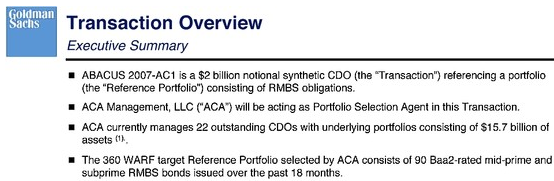
After 18 months of investigation, the best the government can come up with is an allegation that Goldman misled some of the world’s most sophisticated investors about a single 2007 “synthetic” collateralized debt obligation (CDO).

Far from being the smoking gun of the financial crisis, this case looks more like a water pistol.

WSJ, The SEC vs. Goldman, April 19, 2010
http://online.wsj.com/article/SB10001424052702303491304575188352960427106.html

Fundamentally, the “synthetic CDO” at issue did not hold mortgages, or even mortgage-backed securities.

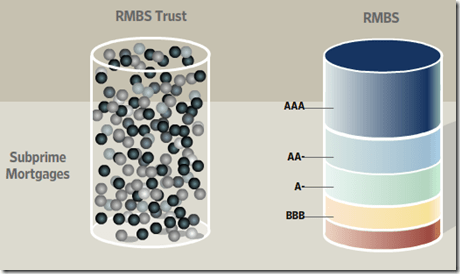
This is why it is called a “synthetic” CDO, which means it is a financial instrument that lets investors bet on the future value of certain mortgage-backed securities without actually owning them. (see pics and link below)

It was simply a mega-bet peddled to “whales” — sophisticated investors (mostly financial institutions with floors of MBAs and lawyers)    — a bet structured by an uber-bookie who took the other side of the bet.  A common practice among “players”. 

image

The main impact of the “action” was transferring a few billion dollars from the long-side housing gamblers (the financial institutions and other fat cats)  to the bookie (Paulson & Company).

Since the market crashed — i.e. the “favorite” lost the game — the whales (e.g. the Royal Bank of Scotland)  lost big — especially since they were betting with borrowed money.

My take: This wasn’t numbers being run on the city streets of Baltimore … it was big guys vs. big guys … who cares if they all lose? 

This didn’t cause the housing bubble or its bust … and Goldman will walk on the rap. 

* * * * *

Anatomy of a CDO

Wall Street Journal has an interesting depiction of how a synthetic CDO is put together.

Click either of the pics to go to WSJ’s interactive description — cool, but complicated.

image

image

Pay your taxes, fool? … Didn't you know that — according to Harry Reid — “Paying taxes is strictly voluntary”

April 19, 2010

“Paying taxes is strictly voluntary” … so says Harry Reid

Don’t you feel silly for sending in a check yesterday ?

It makes me shiver to think that this guy is the second most powerful person in the country (after Nancy Pelosi)

This is worth watching …

image
http://www.youtube.com/watch?v=R7mRSI8yWwg

Pay your taxes, fool? … Didn’t you know that — according to Harry Reid — “Paying taxes is strictly voluntary”

April 19, 2010

“Paying taxes is strictly voluntary” … so says Harry Reid

Don’t you feel silly for sending in a check yesterday ?

It makes me shiver to think that this guy is the second most powerful person in the country (after Nancy Pelosi)

This is worth watching …

image
http://www.youtube.com/watch?v=R7mRSI8yWwg

Wallet’s are opening … for consumers and advertisers.

April 19, 2010

TakeAway:  Whew.   Consumers are spending again. But this sigh of relief is not heard in the halls of the big CPGs. 

The latest recession provided private-label brands with the momentum needed to overcome consumers’ quality perceptions and induce trial. 

The result: consumers liked or were at least satisfied with the PL products. 

Now that the economy is recovering and consumers have the dough to go back to the brand-name staple goods, companies are hoping that a long-held theory – more advertising will increase market share – will ensure that consumers trade-up for their staple goods.

* * * * *

Excerpted from WSJ, “Consumer-Goods Makers Pour Out Ads,” By Ellen Byron, April 12, 2010

As wary Americans start to crack open their wallets, household-goods makers like Procter & Gamble, Colgate-Palmolive, Kimberly-Clark and Clorox are cranking up their advertising, hoping to coax consumers farther out of their shells.

Amid signs of an improving economy, recent survey data show consumers are more willing to splurge by eating out or buying new shoes, but the same doesn’t necessarily hold for everyday household goods.

“In consumer staples, you saw consumers trade down” to cheaper products due to the recession, and they were “quite satisfied,” says chief executive of Consumer Edge Research.

To lure them back to premium products—and prices—brand-name manufacturers are churning out “new and improved” goods ranging from more-absorbent diapers, to specialized toothpastes to closer-shaving razors. The strategy relies on advertising to get the word out.

That’s one reason the industry’s ad spending is expected to grow in 2010. So far such spending has been running well ahead of 2009 levels, with year-to-year increases for household products of 15% in January and 11% in February …

P&G, the world’s biggest ad spender, plans a 20% increase in “consumer impressions,” or instances when consumers see its ads … and it will introduce 30% more “significant” innovations in products this year, which its CEO describes as the most in his 30-year career at the company …

The big-name marketers face the challenge of overcoming consumers’s newfound thrift. While U.S. sales of household staples have posted middling gains overall, sales of cheaper private label, or store-branded, goods, have risen more sharply.

In the four weeks ended March 20, overall U.S. sales of household and personal products increased 0.2% from a year earlier, compared with a 5.4% gain in private-label sales …

The new spending will test a long-held theory: that boosting a brand’s share of advertising beyond its market share will raise that market share. Among major household products, market share stayed the same or rose 64% of the time over the past 16 quarters when a company’s advertising reach exceeded its market share by 50% or more …

Some experts say winning over consumers will require not just advertising, but a new approach: emphasizing value.

“For many years, any hint of price was a no-no. It was all about generating emotional connections,” says chief brand strategist at consulting firm Portnoy Group:”Now you’re going to have to work harder to convince me that I’m getting much more value by trading up.. You need to show me that I’m getting more for my money, and it’s not frivolous.”

Edit by TJS

* * * * *

Full Article
http://online.wsj.com/article/SB10001424052702304703104575174042139131092.html#mod=todays_us_marketplace

* * * * *


Indonesia begs reconsideration as a top emerging market

April 16, 2010

TakeAway:  The unfortunate truth about emerging markets is that companies cannot make market entry decisions based only on traditional variables such as consumer wealth and spending. 

A country’s operating environment (i.e., the political environment) is a key decision making variable and one that often causes companies to turn away from otherwise appealing markets. 

The good news for Indonesia is that companies are forgiving and are willing to reconsider markets that they previously declined to enter. 

Indonesia’s improved political environment and booming consumer spending will likely put the country back on the radar screens of many large companies.

* * * * *

Excerpted from WSJ, “Brands Bet on Indonesia as Spending Booms,” By Patrick Barta, April 8, 2010

International companies are betting Indonesia will become Asia’s next big consumer market after China and India—in part because of booming jungle outposts like this one.

Here in Samarinda, a coal-mining center on the far eastern edge of Borneo, the population has more than tripled since 2000, and incomes are rising rapidly. Ford has added its first dealership and Honda motorcycle salesmen say they can’t get motorbikes fast enough to keep up with demand.

Variations of that pattern are being repeated across this vast nation … Ford dealers are adding a new showroom nearly every six weeks … CVC Partners agreed to pay more than $770 million for a controlling stake in one of country’s largest retailers, PT Matahari Department Store, which plans to add 150 new outlets …

H.J. Heinz said that Indonesia played a major role in pushing Asia sales, including chili sauces, up 41% last year. It also recently predicted a 23% increase in packaged food spending in Indonesia between 2009 and 2011—a faster rate of growth than India and China, which were expected to grow 20% and 14%, respectively.

With 240 million people, the world’s fourth-largest population behind China, India and the U.S., Indonesia has long promised to be one of the world’s biggest consumer markets. But it has lagged behind other developing nations because of political instability and disappointing growth after the Asian financial crisis of 1997-1998.

That has started to change in the past several years … with a democratically elected government and surging sales of commodities such as coal, natural gas and palm oil to China.

Last year, Indonesia posted the second-highest personal spending growth in Asia, behind China. Private consumption climbed 5.1% compared with 0.4% growth in Asia excluding China …

Unilever’s Indonesian arm, which sells soaps, ice cream and other consumer goods, said in March that 2009 sales shot up 17%—well above previous years and among the fastest rates in the world for Unilever …

Indonesia’s resurgence as a consumer market is the latest evidence that developing Asia, which for years relied primarily on exports for growth, is becoming more self-reliant as it develops a bigger middle class and its own domestic demand.

Indonesia still rates poorly in international indexes measuring corruption and ease of doing business, and many foreign companies remain wary. Income levels are low compared with other emerging markets, with GDP per capita of just $4,000, less than half the level of Brazil—though more than India.

The country also isn’t industrializing as rapidly as China and other emerging markets, which could limit its growth in future years … Even so, “it’s a very strong market” for consumer-spending gains

Powering the rebound, analysts say, is surprising strength in once-ignored second-tier cities, which in some cases are posting growth rates approaching 10% a year, on par with China …

These areas are also benefiting from political reforms after the fall of former dictator Suharto in the late 1990s aimed at decentralizing the country. Such “regional autonomy” reforms, which return more tax revenue to local governments and give them more authority …

Edit by TJS

* * * * *

Full Article
http://online.wsj.com/article/SB20001424052702303591204575169704072987766.html#mod=todays_us_marketplace

* * * * *


The Federal budget … precisely explained in 98 seconds.

April 16, 2010

A former colleague of mine at McKinsey used to to classify people into two groups: simplifiers and complicators.

In most situations, simplifiers are effective … complicators are ineffectual and annoying.

Complicators cannot distinguish between the pertinent and the irrelevant.

Simplifiers know what’s essential and what’s extraneous.  They have the ability to cut to the core of issues and communicate in clear, simple terms.

Here’s an example …

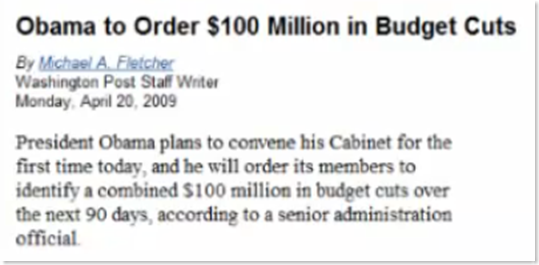
In this short video that’s been viraling, a college student explains the Federal budget and puts President Obama’s proposed budget cuts in context.

It’s a quick tutorial on the Federal budget … and a nice example of communicating effectively by simplifying.

Click pic or link below to view video

image

http://www.wimp.com/budgetcuts/

Thanks to JNH for feeding the lead.

News Flash: Nearly half of US households escape fed income tax … psst, I told you so (July 31, 2008)

April 15, 2010

Last week, there was a flurry of news activity over a report that nearly half of all U.S. households will pay no federal income taxes for 2009.

It was treated as new news.  Geez.

Homa Files were all over this as far back as July 31, 2008. 

For all the wonky facts & a complete analysis see:
Under Obama, Tax Payers Will be a Minority !
https://kenhoma.wordpress.com/2008/10/28/under-obama-tax-payers-will-be-a-minority/

Note: This is the Homa Files post with all-time record for most hits.

 I hate to be an “I told you so” (yeah, right) … but hears the AP report … almost 2 years later.

As President Obama likesto say “Elections have consequences”.

* * * * *

Excerpted from AP: Nearly half of US households escape fed income tax, April 9, 2010

The federal income tax is the government’s largest source of revenue, raising more than $900 billion — or a little less than half of all government receipts .

So, Tax Day is a dreaded deadline for millions, but for nearly half of U.S. households it’s simply somebody else’s problem.

About 47 percent will pay no federal income taxes at all for 2009 … up from 38% in 2007.

Either their incomes were too low, or they qualified for enough credits, deductions and exemptions to eliminate their liability.

In recent years, credits for low- and middle-income families have grown so much that a family of four making as much as $50,000 will owe no federal income tax.

Tax cuts enacted in the past decade have been generous to wealthy taxpayers making them a target for President Barack Obama and Democrats in Congress.

Less noticed were tax cuts for low- and middle-income families, which were expanded when Obama signed the massive economic recovery package last year.

The result is a tax system that exempts almost half the country from paying for programs that benefit everyone, including national defense, public safety, infrastructure and education. It is a system in which the top 10 percent of earners paid about 73 percent of the income taxes collected by the federal government.

The bottom 40 percent, on average, make a profit from the federal income tax … the government sends them a payment. Not just a refund of of excess withholding — so-called “refundable credits”.

“We have almost 50 percent of families who are getting something for nothing.”

Some of the blame goes to former President George Bush.  In 2008, he signed a law providing most families with rebate checks of $300 to $1,200.

Last year, Obama signed the economic recovery law that expanded some tax credits and created others.

Obama’s Making Work Pay credit provides as much as $800 to couples and $400 to individuals. The expanded child tax credit provides $1,000 for each child under 17. The Earned Income Tax Credit provides up to $5,657 to low-income families with at least three children.

There are also tax credits for college expenses, buying a new home and upgrading an existing home with energy-efficient doors, windows, furnaces and other appliances.

Many of the credits are refundable, meaning if the credits exceed the amount of income taxes owed, the taxpayer gets a payment from the government for the difference.

Obama has pushed tax cuts for low- and middle-income families and tax increases for the wealthy, arguing that wealthier taxpayers fared well in the past decade, so it’s time to pay up. The nation’s wealthiest taxpayers did get big tax breaks under Bush, with the top marginal tax rate reduced from 39.6 percent to 35 percent, and the second-highest rate reduced from 36 percent to 33 percent.

But income tax rates were lowered at every income level. The changes made it relatively easy for families of four making $50,000 to eliminate their income tax liability.

Here’s how they do it, according to Deloitte Tax:

The family was entitled to a standard deduction of $11,400 and four personal exemptions of $3,650 apiece, leaving a taxable income of $24,000. The federal income tax on $24,000 is $2,769.

With two children younger than 17, the family qualified for two $1,000 child tax credits. Its Making Work Pay credit was $800 because the parents were married filing jointly.

The $2,800 in credits exceeds the $2,769 in taxes, so the family makes a $31 profit from the federal income tax. That ought to take the sting out of April 15.

Full article:
http://finance.yahoo.com/news/Nearly-half-of-US-households-apf-1105567323.html?x=0&.v=1

* * * * *

Why it matters 

The Tax Foundation — a nonpartisan tax research group – has repeatedly warned that 

“While some may applaud the fact that millions of low- and middle-income families pay no income taxes, there is a threat to the fabric of our democracy when so many Americans are not only disconnected from the costs of government but are net consumers of government benefits.

The conditions are ripe for social conflict if these voters begin to demand more government benefits because they know others will bear the costs.” 

 http://www.taxfoundation.org/research/show/1111.html

Bummer:Waxman melts …

April 15, 2010

I’d cleared my calendar next Wednesday to watch Henry Waxman and his fellow Congressional nitwits grill a blue-ribbon group of uber-CEO’s on FASB rules and how they apply to the increased costs that companies will incur under Obama’s cost-saving healthcare plan. (Yeah, you read that right.)

I wanted to see Waxman order the CEOs to release fraudulent financial statements and “book” some of the pie-in-the-sky cost savings that ObamaCare promises to deliver …

The hearings would have made great theater …

* * * * **

Excerpted from Washington Examiner: Waxman cancels Obamacare CEO hearing, 04/14/10

Chairman Henry Waxman, D-Calif., has cancelled the April 21 subcommittee hearing in which CEOs were to testify about Obamacare.

Waxman had called the hearing in reaction to public statements by several companies — including Verizon, AT&T, and John Deere, among others — that Obamacare would cost them hundreds of millions or even billions of dollars because it laid a new tax on their retiree health benefit payments.

Ever since the passage of the Medicare Prescription Drug benefit, the payments had been subsidized, tax-free, as a way of preventing these companies from dropping enrollees onto the Medicare rolls, where they would cost the government far more.

When Obamacare changed the tax rules, it was quite clear that this would result in huge losses, but President Obama and Democrats had failed to heed warnings to this effect in the run up to Obamacare’s passage last month.

The CEOs, required by law to be honest about earnings projections, re-stated their bottom lines in reaction to Obamacare’s passage, earning the ire of Waxman and other Democrats.

Hearings on this matter would likely have proved an embarrassment to the Democrats and helped drag out discussion of Obamacare’s unexpected ill effects.

Full article:
http://www.washingtonexaminer.com/opinion/blogs/beltway-confidential/Waxman-cancels-health-care-CEO-hearing-90853384.html#ixzz0l7OIE29c

LVHM’s luxury house of brands expands to include hotels

April 15, 2010

TakeAway:   LVMH made an interesting business decision when it decided that opening hotels was the best option to continue its corporate growth. 

Yes, it said that there were no good acquisition targets left in its core business area. 

Yes, it observed that other high-end brands had opened hotels. 

But, the hospitality business is very different from the luxury consumer goods business. 

Although hotels may be a good way for LVMH to expand its presence in the luxury market and provide a new point of sale for its luxury goods, this strategy could require LVMH to devote enormous marketing funds to gain customers in the already-crowded luxury hotel market and could backfire if the hotel experience does not meet customers’ expectations of the LVMH brand.

* * * * *

Excerpted from WSJ, “LVMH Extends Posh Label To New Luxury Resorts,” By Christina Passariello, April 9, 2010

… LVHM, the world’s largest luxury-goods company, said Thursday it will develop resorts using the name of its Bordeaux winery, Cheval Blanc. 

LVMH tested the concept with a first location that opened in the French ski resort Courchevel in 2006. Two more hotels are scheduled to join the chain by 2012 in Oman and Egypt …

The project is “a natural extension of activities in luxury hospitality with Cheval Blanc,” LVMH said in a statement.

Like many top hotel operators, LVMH is limiting its exposure to the volatile hotel industry. It won’t own the real estate or finance construction, but will instead run the resorts under management contract, a similar model to other high-end chains such as The Ritz-Carlton …


The move shows how LVMH is trying to grow without resorting to costly acquisitions. Two years ago, the company pushed the boundaries of its luxury-goods universe to include yachts when it bought Dutch ship builder Royal Van Lent. A few years earlier, LVMH developed a new high-end rum, 10 Cane, instead of buying an existing brand.

LVMH grew throughout the 1990s and until 2001 thanks to expensive acquisitions. But many purchases … haven’t turned into major successes. Now, as the industry leader, there are few targets for LVMH that would have a significant impact on its growth.

LVMH’s hotels will be a showcase for many of its brands. The Cheval Blanc in Courchevel has a Givenchy spa, and visitors can buy its Louis Vuitton and Dior goods in the hotel.

Luxury brands have moved into the hotel business in recent years, looking for new ways to increase their presence …

Edit by TJS

* * * * *

Full Article
http://online.wsj.com/article/SB20001424052702304198004575171680599417158.html#mod=todays_us_marketplace

* * * * *


Panic in Washington: Congress might get a dose of its own ObamaCare medicine … oops

April 14, 2010

Punchline:  More proof that Congress is populated by morons …

A report from the Congressional Research Service found that — because of imprecise language and a possible drafting error in the ObamaCare bill — senators, representatives, and their staffers may end up having their ‘Cadillac’ coverage replaced by everyman’s ObamaCare.

A provision in the bill inadvertently bars members of Congress and congressional staff from taking part in the current federal health employee plan. 

Watch for a legislative fix … via the 51 vote reconciliation process, of course.

* * * * * 

Excerpted from NY Times: Baffled by Health Plan? So Are Some Lawmakers, April 12, 2010

The new health care law will affect almost every American in some way. And, perhaps fittingly if unintentionally, no one may be more affected than members of Congress themselves.

The Congressional Research Service says the law may have significant unintended consequences for the “personal health insurance coverage” of senators, representatives and their staff members.

For example, it says, the law may “remove members of Congress and Congressional staff” from their current coverage, in the Federal Employees Health Benefits Program.

The confusion raises the inevitable question: If they did not know exactly what they were doing to themselves, did lawmakers who wrote and passed the bill fully grasp the details of how it would influence the lives of other Americans?

Representative Jason Chaffetz, Republican of Utah, said lawmakers were in the same boat as many Americans, trying to figure out what the new law meant for them. “If members of Congress cannot explain how it’s going to work for them and their staff, how will they explain it to the rest of America?”

Full article:
http://www.nytimes.com/2010/04/13/us/politics/13health.html?hp

I slept better last nite knowing that Canada is de-nuking.

April 14, 2010

I never have trusted the Canadians … I figure that if you’re willing to toss off your hockey gloves and wail on an opponent at mid-rink, then you’re probaably willing to lob nukes at a neighboring country.

So, I was pleased to hear of Obama’s nuclear coup — getting Canada to scale back its nuclear ambitions.

According to USA Today, in the marquee deal of  Obama’s Nuclear Security Summit,  Canada agreed to a plan to send spent nuclear fuel back to the U.S.
http://content.usatoday.com/communities/theoval/post/2010/04/obama-strikes-nuke-deals-with-mexico-canada-others/1

Let me make sure I understand, we still don’t have agreement in the US where to stash our nuclear waste (not in my backyard, please), but now we’re going to take Canada’s radioactive garbage … and that’s a good deal that will make us safer ?

BTW: Canada doesn’t do nuke weapons.  According to Wikipedia — the Homa Files ultimate reference source — Canada is listed as a nation with the capability (infrastructure, material and experts) to quickly make nuclear weapons … but hasn’t and has never intended to do so.

* * * * *

Is it just me, or does the Nuclear Summit seem like US gun control on steroids?  The good guys agree to restraints … so that the only deadly strike capability rests in the hands of rogue states and terrorists.  I must be missing something …

Japanese food companies look to spice up sales overseas

April 14, 2010

Takeaway: When you’re bored with the game at home, take your show on the road.

This strategy has worked well for Japanese companies for decades. However, foreign markets typically expect high tech products from Japan.

Recently, Japanese food companies have focused their efforts outward as their domestic consumer market stagnates.

As is expected in Japan, these companies face relatively high labor costs, and limited agricultural resources, so will this strategy bring home the bacon, or be put out to pasture?
 

* * * * *

Excerpt from New York Times, “Japanese Food Companies Seek Growth Abroad” by Miki Tanikawa, April 2, 2010.

As birth rates and the consumer market shrink at home, food companies in Japan are increasing the pace of their overseas expansions and trying to improve promotion of their brands.

Analysts say that increasing sales abroad is crucial for manufacturers. To do so, the companies are combining, undertaking joint ventures, cutting production costs and creating strategies for new markets.

“The domestic market is shrinking, deflation is cutting into sales and the sense of crisis is looming stronger and stronger,” said a senior economist at Norinchukin Research Institute in Tokyo.

The sector’s strategy has been twofold. First, Japanese companies have been infiltrating the health food and condiment categories overseas with soy-based products like tofu in countries where few domestic companies can compete.

Second, Japanese producers capitalize on cute Asian-themed characters like koalas and pandas and apply technology to make amusingly shaped treats to attract snack-happy consumers.

The Japanese confectioner Ezaki Glico says its Sofyl yogurts and Yakult fermented-milk drinks contain bacteria that aid digestion, now draws 25.7 percent of its 293 billion yen in annual revenue from overseas units, thanks to 38,000 “Yakult women” who sell the products door to door in Asia and Latin America.

The company says it sells 6.5 billion units of Yakult and Sofyl a year outside Japan. “We want our product to be available virtually everywhere, like Coca-Cola, and make a contribution to the health of people around the world,” said the director for the international department.

Ajinomoto, a leading Japanese food company, with about 1.2 trillion yen in annual revenue, has increased its overseas sales ratio to 31.8 percent, from 22.8 percent, in eight years.

In terms of expansion, Japan’s Asian neighbors offer the biggest opportunities. Countries like Thailand already embrace a Japanese food subculture, and in China, growing numbers of upwardly mobile workers are increasingly inclined to purchase prepared foods and snacks.

The international survey firm Euromonitor says that the Lotte Group, a company in Tokyo that sells products in more than 70 countries, is the leading Asian-owned confectioner, with a 10.3 percent market share. The company, maker of Koala’s March — chocolate-filled koala-shaped cookies — ranks fourth in terms of sales among global companies in the Asian sector excluding Japan — ahead of Nestlé but behind Mars, Perfetti Van Melle and Cadbury.

Despite quality concerns raised by the recent recalls by Toyota Motor, a scandal caused by the sale of expired dairy products and eggs at Fujiya confectionery in 2007 and the Snow Brand food-poisoning fiasco in 2000, Japanese food manufacturers express pride in the country’s technological expertise.

In fact, the sales and marketing strengths of Western food companies far outweigh those of the Japanese. Kraft, for example, has gross sales of $50 billion a year, nearly 10 times as much as Lotte, which grossed about $5 billion in sales in its 2008 financial year.

Analysts and management consultants said that the struggle of the Japanese food companies to keep up with their Western rivals in overseas territories sounded familiar: Japanese companies that have higher-quality products are still sometimes hampered by weak marketing and brand strategies.
 

Managing director in Tokyo for the Boston Consulting Group, said: “Japanese firms may say, ‘We have superior products.’ That alone won’t do. You need sales and personnel who understand the trends of the local market, developers who will take the local taste into account and marketers who can explain the product to the locals on their terms.”

“You need the whole package in order to win,” he said.

Edit by BHC

* * * * *

Full Article:

http://www.nytimes.com/2010/04/03/business/global/03food.html?pagewanted=2&ref=business


TAXES: The triumphant return of the marriage penalty … on steroids this time.

April 13, 2010

Here’s probably the quirkiest part of the selective expiration of the Bush tax cuts that Obama has baked into his budget …

Obama repeatedly promised that individuals earning less than $200,000 — and families earning less than $250,000 wouldn’t see their taxes go up by as much as a dime.

Think about that for a second …

Let’s pretend there’s an unmarried couple (boyfriend and girlfriend, or any other combination) with each individual earning $200,000.

As individuals, if Obama keeps his pledge,  they incur no additional income taxes in 2011 when parts of the Bush tax cuts are allowed to expire, and no additional “payroll taxes” in 2013 when the ObamaCare surcharge goes into effect.

But, if the couple is married and files jointly, they’d have $400,000 of family income and officially be reclassified as “rich people” … uh-oh !

By my count, their marriage penalty would be over $23,000.

Their “base” income taxes would go from $102,285 to $118,340 —  an increase in their effective tax rate from just over 25% to 30%.

                        image

                        image 

Plus, they’d be slapped with the 3.8% payroll tax on all income over $200,000.  That tacks on another $7.600.

That makes their total income tax bill $125,940 — 23% higher than if they were unmarried and filing as individuals.

Now, that’s a marriage penalty !

Rasmussen: Majority of Americans trust GOP more on Health Care …

April 13, 2010

Punchline: Voters now trust Republicans more than Democrats on nine out of 10 key issues regularly tracked by Rasmussen Reports

* * * * *

Excerpted from Rasmussen: 53% Now Trust Republicans More Than Democrats on Health Care, Saturday, April 03, 2010

Following the passage of the health care bill, 53% now say they trust Republicans on the issue of health care. Thirty-seven percent (37%) place their trust in Democrats.

A month earlier, the two parties were essentially even on the health care issue.

* * * * *

Which party do you trust more on the following issues?

image
http://www.rasmussenreports.com/public_content/politics/mood_of_america/trust_on_issues

Used to be "enhanced water" … repositioned as "hangover cure" … now you're talking !

April 13, 2010

TakeAway:  Vitaminwater is prepared to put age-old Markstrat advice …you can bend perceptions but, ultimately, if the product does not deliver, the consumer backlash will be extreme … to the test. 

Cleverly listening to its consumers, Vitaminwater is leveraging a common use of the product – a hangover cure – for its latest advertising push.  But the lack of hard proof behind this claim has brought the ads under scrutiny from the FTC and others.  It will be interesting to watch this new usage occasion for Vitaminwater playout.

* * * * *

Excerpted from WSJ, “Vitaminwater Tries Winking,” By Valerie Bauerlein, April 5, 2010

The new ad campaign for Coca-Cola’s Vitaminwater hints at a use for enhanced waters and sports drinks that is part of conventional wisdom among many college students and young professionals: hangover relief.

The ads debuted during the NCAA March Madness basketball tournament, and are part of Coke’s effort to revitalize the brand … After a decade of fast growth, Vitaminwater’s sales volume slipped 22% last year as price-conscious consumers traded down …

One of the new spots … asserts that Vitaminwater’s purple “Revive” flavor has B vitamins and potassium, and will help rehydrate you after “apparently epic nights.”

Vitaminwater’s head of marketing says that the ad never says the young man has been drinking … “He’s just had a big night … You can take away from that what you wish” …

In these ads, Vitaminwater is tapping into the idea that it’s good to replenish fluids and nutrients, no matter the reason for losing them.

Mass retailers sometimes display enhanced waters or sports drinks beside hand sanitizers and thermometers during cold and flu season. Convenience stores regularly ring up bottles of sports drinks alongside cases of beer.

Alcohol researcher John Brick says there is some science behind the idea that drinks like Vitaminwater improve hangover symptoms

Some sugars help metabolize alcohol, and ingredients such as potassium and electrolytes help re-establish healthy body function …

The FTC, in at least three cases, has brought complaints against companies touting unproven hangover cures in ads …

A spokeswoman for Gatorade, which dominates the sports-drink niche, says Gatorade doesn’t advertise itself as a cure for ailments, even in a tongue-in-cheek way. “We are focused on athletes and fueling athletic performance only,” …

Edit by TJS

* * * * *

Full Article
http://online.wsj.com/article/SB10001424052702303450704575160280077022428.html

* * * * *


Glub-glub … O’s back under water again.

April 12, 2010

Pres. Obama had a small bounce from the enactment of ObamaCare, but it was very short lived.

Now, Gallup — which leans slightly left — has a plurality of Americans disapproving of the job he’s doing as president — 48% disapproving to 45% approving.

image

http://www.gallup.com/poll/113980/Gallup-Daily-Obama-Job-Approval.aspx

* * * * *

Similarly, the Real Clear Politics “poll-of-polls” has the President upside-down by 1.2 points — 47.3% disapproving, 46.1% disapproving.

image
http://www.realclearpolitics.com/epolls/other/president_obama_job_approval-1044.html

* * * * *

And according to Pollster.com’s poll-of-polls,  Obama’s approval rating among Independents is 9.2 points under water — 39.8% to 49%

image

The Jobs Picture Still Looks Bleak

April 12, 2010

Punchline: Many outsourced jobs will never return, and median income will likely continue to fall. But, the jobs of well-educated Americans, although hardly immune to foreign outsourcing and technological displacement, have been less vulnerable to these trends than the jobs of Americans with fewer years of education.

* * * * *

Excerpted from WSJ: The Jobs Picture Still Looks Bleak, April 12, 2010

The U.S. economy added 162,000 jobs in March. That sounds impressive until you look more closely.

  • At least a third of them were temporary government hires to take the census—better than no job but hardly worth writing home about.
  • The 112,000 real new jobs were fewer than the 150,000 needed to keep up with the growth of the U.S. population.

It’s far better than it was—we’re not hemorrhaging jobs as we did in 2008 and 2009—but the bleeding hasn’t stopped.

  • The economy has shed 8.4 million jobs and failed to create another 2.7 million required by an ever-larger pool of potential workers. That leaves us more than 11 million jobs behind.
  • The number is worse if you include everyone working part-time who’d rather it be full-time, those working full-time at fewer hours, and people who are overqualified for the jobs they’re in.

This means even if we enjoy a vigorous recovery that produces, say, 300,000 net new jobs a month, we could be looking at five to eight years before catching up to where we were before the recession began.

* * * * * 

Outlays from the federal stimulus have already passed their peak, and the Federal Reserve won’t keep interest rates near zero for very long.

And even households whose incomes have returned are likely to be residing in houses whose values haven’t—which means they can’t turn their homes into cash machines as they did before the recession.

Consumers have been shedding their debts like mad—often simply by defaulting on loans — but, their remaining burdens are still heavy. Debt averages $43,874 per American, or about 122% of annual disposable income.

Most Americans’ biggest asset is their homes. The “wealth effect” of the rising stock market is felt mainly by the richest 10%, whose net worth is largely stocks and bonds.

* * * * *

What’s likely to slow the jobs recovery most, however, is the indubitable reality that many of the jobs that have been lost will never return.

The Recession has accelerated a structural shift in the economy that had been slowly building for years.

Companies have used the downturn to aggressively trim payrolls, making cuts they’ve been reluctant to make before.

  • Outsourcing abroad has increased dramatically.
  • Companies have also cut costs by substituting more computerized equipment for labor.

These cost-cutting moves have allowed many companies to show profits notwithstanding relatively poor sales.

Those who have lost their jobs to foreign outsourcing or labor-replacing technologies are unlikely ever to get them back. And they have little hope of finding new jobs that pay as well.

This shift also helps explain why …

  • The unemployment rate for Americans with college degrees is now only 5%
  • It is 10.5% for those with only a high-school degree, and …
  • 15.6% for Americans with less than a high-school diploma.

The jobs of well-educated Americans, although hardly immune to foreign outsourcing and technological displacement, have been less vulnerable to these trends than the jobs of Americans with fewer years of education.

Full article:
http://online.wsj.com/article/SB10001424052702304222504575173780671015468.html

Mavericky Brand Building 101

April 12, 2010

Takeaway: Many folks make fun of her, but does Sarah Palin know more about brand building than we MBAs do?

In a matter of months, and against all odds, Palin built herself into a multi-million dollar national brand with droves of loyal followers. How many classically-trained marketing whizzes can boast the same?

Palin may not be able to see Russia from her house, but marketers take note, she is likely to understand many Americans better than we do. This begs the question: What can we learn from Palin?
 
* * * * *

Excerpt from New York Times, “How Sarah Palin Became a Brand” by David Carr, April 4, 2010.

When Sarah Palin made her debut as the host of “Real American Stories” on Fox News, she described several triumphs of regular people over insurmountable odds, but she missed an obvious one: her own.

After her failed bid for the vice presidency, she was more or less told to head back to Alaska to serve out her term as governor.

Instead, she quit her day job and proceeded to become a one-woman national media empire, with the ratings and lucre to show for it.

With its tales of uplift and pluck, “Real American Stories” trades in the kind of easy sentimentality that provokes eye rolls among those of us who work in media while quickening the pulse and patriotic ardor of almost everyone else. At the beginning of the show, Ms. Palin promised that it would “reaffirm our pioneering spirit and unmatched generosity, here and around the world.”

“It’s not the kind of thing that’s going to excite you guys on the East Coast, but everyone else is dying to hear stories like these,” said one of her representatives.

Beyond her Tea Party theatrics, Palin has tunneled her own route into the public consciousness and gone into the Sarah Palin Across America business. And what a business it is.

She was paid a $1.25 million retainer by HarperCollins. Her book, “Going Rogue,” has sold 2.2 million copies, according to its publisher, and she has another tentatively scheduled for this fall.

She now has an actual television career, including appearances as a pundit on Fox News, her gig as the host of “Real American Stories” four times a year, and a coming eight-part series on TLC called “Sarah Palin’s Alaska,” which will cost, according to some media reports, $1 million an episode.

Other people have crossed the border from politics to media to very good effect — George Stephanopoulos, Patrick Buchanan and Chris Matthews, to name a few — but the transition was far more gradual. Ms. Palin turned on a dime and was a ratings sensation from the word go: her first paid appearance, as a commentator on “The O’Reilly Factor” on Jan. 12, was good for an extra million viewers.

Her appeal doesn’t stop at the red states. When Ms. Palin stopped by to chat with Oprah Winfrey — not exactly friendly territory — the show achieved its biggest ratings in two years.

Ms. Palin didn’t go on the show to run for president as much as to become the next Oprah. And it seems to be working. So what are the rest of us missing?

Back in September 2008, when she was unveiled in St. Paul during the Republican convention, a longtime political reporter told me that her appeal would burn off over time. I wondered about that. I’m from Minnesota, which is sometimes considered the southernmost tip of Alaska, and her way of speaking in credulous golly-gee may have been off-putting to some, but there is a kind of authenticity there that no image handler could conjure.

In Ms. Palin’s America, everyone’s got bootstraps; they just need to have the gumption to find them. And her version is full of plain old folks spending a lot of time overcoming a great deal, including a government that she posits usually intends to do them harm.

She’s also imported the political trick of coming from the outside and ruling from the center. When she sets down the ear piece and leaves the studio lights, even the way she says the word “media” in her speeches — “MEE-dee-uh” — makes it sound like something yucky and foul, a swamp to be avoided at all costs. Unless, of course, you are promoting a show, a book or a cause.

Many observers thought her unwillingness to serve out her term would be fatal to her ambitions, but the fact that governance did not suit her — she resigned as governor back in July — has become a kind of credential.

Ms. Palin still gets a session in the media spanking machine every time she does anything, but the disapproval seems to further cement the support of her loyalists. Ms. Palin may or may not be qualified to represent America around the world, but she certainly represents vast swaths of the American public and has a lucrative new career to show for it.

If we don’t see why, then maybe we deserve the “lamestream media” label she likes to give us.
Edit by BHC
 
* * * * *
Full Article:
http://www.nytimes.com/2010/04/05/business/media/05carr.html?ref=media
* * * * *

TAXES: Funding ObamaCare with a 3.8% non-payroll payroll tax … here’s the impact on your wallet

April 9, 2010

In a prior post, we walked through the impact if Obama selectively lets the parts of the Bush tax cuts expire in 2011 — those parts that effect individuals earning more than $200,000 and couples earning more than $250,000.

In a nutshell, here’s what we concluded …

  • The tax rate on capital gains will go up 5% … and the tax rate on dividends will go up at least 5% (to the capital gains tax rate) and maybe all the way up to ordinary income tax rates.
  • For ordinary income, the effective (not marginal) tax rate increase on ordinary income will be about 1/2% for each $100,000 of taxable income (i.e. ordinary income plus dividends and capital gains) over $200,000.

For example, assume a couple has $200,000 in taxable ordinary income and $100,000 in dividends and capital gains, giving them total taxable income of $300,000.   Their tax hit will be about $6,000 — $5,000 from the increase in dividend and capital gains tax rates (5% X $100,000) and $1,000 from the increase in the effective rate on ordinary income ($300,000 minus $200,000 = $100,000 => 1/2% rate increase times $200,000 = $1,000).  In rough numbers, their income taxes would go from $67,000 to $73,000 — an increase of almost 9% — and their effective tax rate would go from 21% to over 24%.

But, that’s only part of the story.

Remember that the original Senate bill funded roughly 1/2 of ObamaCare from MediCare cuts and roughly 1/2 from an excise tax on employer provided Cadillac health insurance plans — a plan originally teed up by Obama.  When the unions marched on the White House and reminded the President who got him elected, Obama recalibrated upward the threshold defining a Cadillac plan, delayed the implementation of that tax until 2018, and replaced the lost tax revenue with a supplemental 3.8% payroll tax on AGI (Adjusted Gross Income — which includes ordinary income plus dividends and capital gains) over $200,000 — starting in 2013

Technical note:  The base Medicare tax rate is currently applied as a payroll tax on so-called earned income.  Employees pay 1.45% and employers are required to match the 1.45% — for a total of 2.9%.  Under ObamaCare, for “unearned income” — mostly dividends and capital gains — there is no employer per se, so the taxpayer is charged the full 2.9% base … plus, a supplemental .9% was added on for good measure — raising the total to 3.8%

So, comparing 2013 to the current tax rates

  • The tax rate on capital gains will go up 5% … and the tax rate on dividends will go up at least 5% (to the capital gains tax rate) and maybe all the way up to ordinary income tax rates.
  • For ordinary income, the effective (not marginal) tax rate increase on ordinary income will be about 1/2% for each $100,000 of taxable income (i.e. ordinary income plus dividends and capital gains) over $200,000.
  • There is a 3.8% “payroll tax” on all AGI over $200,000 — that includes ordinary income plus dividends and capital gains.

Let’s rework our example …

Again, assume a couple has $200,000 in taxable ordinary income and $100,000 in dividends and capital gains, giving them total taxable income of $300,000.

Their tax hit (versus 2009) will be about $9,800 …

  • $5,000 from the increase in dividend and capital gains tax rates (5% X $100,000)
  • $1,000 from the increase in the effective rate on ordinary income ($300,000 minus $200,000 = $100,000 => 1/2% rate increase times $200,000 = $1,000).
  • $3,800 in additional “payroll taxes” ($300,000 minus $200,000 = $100,000 times 3.8% = $3,800

In rough numbers, their income taxes would go from $67,000 to $76,800 — an increase of almost 15% — and their effective tax rate would go from 21% to over 25.5%.

Keep in mind, that this is just Federal income taxes.  Add on another 5% to 10% for state and local income taxes … then draw your own conclusions re: fairness and effect on the economy. …

* * * * *

Here’s a handy tool for estimating effective tax rates now, and prospectively in 2013.

image


* * * * *

Next up: The triumphant return of the marriage penalty

>> Current Posts

It’s not a fine, it’s not a tax … it’s a "different tax status" … just like being married

April 9, 2010

Remember those 16,000 new IRS agents who will be policing implementation of ObamaCare ?

Well, turns out that they won’t be collecting fines or taxes … they’ll just be reclassifying non-compliers into “alternative tax statuses”.  Whew.

Who comes up with this stuff ?

Here’s a minute of spin worth watching …

Memo to Playboy: Even a bunny knows when to stop …

April 9, 2010

TakeAway:  Playboy’s loyal collectors have followed the brand for decades and some have even dedicated entire wings of their houses to Playboy paraphernalia.

So, you know something has gone really wrong when these loyalists complain about Playboy’s latest category extensions. 

Though it is better to get consumers to switch within a brand franchise, it appears that Playboy has gone beyond the loyalists perceptions of fit.  Maybe Playboy executives need to step back and reacquaint themselves with the loyalists associations to and beliefs about the brand.   

* * * * *

Excerpted from WSJ, “As Playboy Bunny Logo Multiplies, Collectors Are Barely Interested in It,” By Russell Adams, April 5, 2010

Over the past nine months, Playboy has turned its bunny loose, slapping its famous logo on a tanning spray, a disposable lighter, a mattress, a couch and a line of drinks designed to boost the libido.

The new Playboy paraphernalia should be welcome news for Ken Ritchie, who has a wing on his house precisely to hold stuff like this.

Ken has spent most of his adult life collecting and selling Playboy merchandise. For about a decade, he was spending $3,000 a month on paraphernalia … But Mr. Ritchie turns up his nose at what Playboy is selling now.

“These are a lot of silly things that have no connection with Playboy,” Mr. Ritchie says. “How many guys do you think are going to go out and buy navel rings because they’ve been licensed by Playboy? It’s not a must-have item.”

Playboy launched more than a magazine when it put Marilyn Monroe on its inaugural issue in 1953. It created a brand that came to represent a rebel ethos … Over the years Playboy Enterprises has capitalized on it by attaching its logo to nightclubs, cuff links and other trinkets.

As advertising has drained from its magazine, Playboy has come to rely more heavily on its licensing efforts. That’s rankled some core fans, highlighting the delicate task facing Playboy and other struggling magazine companies: how to capitalize on their brands without diminishing their value in the eyes of the people who cherish—and in some cases profit from—them most …

Playboy has been licensing its brand on an array of seemingly random products for decades … However Playboy has sought to usher the brand up-market during the last 20 years … canceled licensing contracts with makers of items such as fuzzy dice and air fresheners and instead targeted high-end apparel and accessories for women.

Playboy’s new CEO … is shifting gears, making expansion of licensing a priority. “I think we might have been a bit more conservative about category expansion previously” …

The CEO acknowledges that it is difficult to expand the high-margin licensing business and please hard-core collectors at the same time. The ubiquity that fuels strong sales is precisely what turns off collectors …

Still, the CEO says Playboy takes pains to determine whether new products will sully its media properties or other products. “So far, we can’t point to an example of a product we’ve licensed that we regret,” …

In February, Playboy reached a deal to outsource its licensing business in Asia, where Playboy-branded apparel has become especially popular among young women.

That doesn’t sit well with male collectors … they are reluctant to put on a Playboy shirt given the growing popularity of Playboy apparel among women. “Now it’s almost too feminine to wear something like that,” …

Edit by TJS

* * * * *

Full Article
http://online.wsj.com/article/SB10001424052748703447104575118051700987106.html

* * * * *


TAXES: What if you're in the minority — folks paying income taxes — and Obama let's the Bush tax cuts expire ?

April 8, 2010

OK, what’s the effect if Obama lets the Bush tax cuts expire? Big hurt or little hurt ?

Here’s a first cut …

* * * * *

Base Case

Assume a married couple earning a combined $250,000 in taxable income.  Their tax liability based the 2009 tax rate schedule would be $60,320 an effective tax rate of 24%

image

Literally reverting back to the pre-Bush 2000 tax rate schedule, they’d owe $73,048 — a 29% effective tax rate — and a 21% increase over the current tax rates.

image

That’s a big hurt … and probably an unlikely worst case scenario.

* * * * *

Likely Obama Plan

Remember that Obama has often said “not a dime more in taxes for families making less than $250,000″ … and sometimes said the same for individuals making less than $200,000.

In fact, according to the Tax Foundation, the plan outlined in the Obama administration’s budget is to allow:

  • The top tax rate to revert from 35% to 39.6%. 
  • The 33% tax rate to revert to 2001 law (rate of 36%) but the income threshold where that bracket starts will shift up to $250,000 in taxable income (couples) and $200,000 for singles
  • The rate on long-term capital gains to revert to 2001 law (rate of 20%) but only for couples with over $250,000 in AGI the year the gain is realized ($200K threshold for singles)
  • The rate on dividends to be hiked to long-term capital gains rates, i.e. up to 20%, but below ordinary income tax rates.

    Excerpted from Tax Foundation: Fate of Bush Tax Cuts Uncertain As Expiration Approaches, March 25, 2010   http://www.taxfoundation.org/research/show/26062.html

* * * * *

If the Tax Foundation is right, here’s what the brackets would look like for married couples per the Obama budget:

image

If Obama keeps his word on this one, our illustrative couple earning $250,000 won’t pay higher income taxes.

What about their friends who earn more and have more wealth to spread around ?

Well, a couple earning $500,000 would have their tax liability go from $137,500 (an effective tax rate of about 27.5%) —  to $150,000 (an effective tax rate of about 30%) — roughly a 9% increase in their taxes paid.

Draw your own conclusion whether that’s a lot or a little …

Note: This is only the increase due to the tax brackets shift if the Bush tax cuts are allowed to expire … it does not consider:

  • The impact of the likely increase increase in the capital gains tax rate (from 15% to 20%), or the increase in the dividends tax rate (from 15% to either 20% or the ordinary income tax rate)
  •  … or the triumphant return of the marriage penalty (on steroids this time)
  •  … or the 3.8% payroll tax surcharge on AGI over $200,000 (including dividends and capital gains)  to be added in 2013 to pay for ObamaCare. 

I’ll cover capital gains and dividends below … and  the marriage penalty and ObamaCare payroll tax surcharge in subsequent posts.

* * * * *

Estimating your tax hit

Here are some back-of-the-envelope ways to ballpark how much more you’ll be paying in income taxes in 2011 …

If your taxable income (AGI minus deductions) is less than $200,000 (individuals) or $250,000 (couples) — and if Obama keeps his campaign pledge — then your income taxes won’t go up.

If taxable income is over the thresholds …

The tax rate on capital gains will go up 5% … and the tax rate on dividends will go up at least 5% (to the capital gains tax rate) and maybe all the way up to ordinary income tax rates.

For ordinary income, the effective (not marginal) tax rate increase on ordinary income will be about 1/2% for each $100,000 of taxable income (i.e. ordinary income plus dividends and capital gains) over $200,000.

For example, assume a couple has $200,000 in taxable ordinary income and $100,000 in dividends and capital gains, giving them total taxable income of $300,000.   Their tax hit will be about $6,000 — $5,000 from the increase in dividend and capital gains tax rates (5% X $100,000) and $1,000 from the increase in the effective rate on ordinary income ($300,000 minus $200,000 = $100,000 => 1/2% rate increase times $200,000 = $1,000).  In rough numbers, their income taxes would go from $67,000 to $73,000 — an increase of almost 9% — and their effective tax rate would go from 21% to over 24%.

* * * * *

Here’s a handy chart for eyeballing 2011 effective ordinary income tax rates at a range of taxable income levels. 

Technical note: Remember to separate out capital gains and dividends from taxable ordinary income — since they get a 5% hit. But, use total taxable income (ordinary income plues dividends and capital gains ) to estimate the increase in the ordinarary income effective tax rate.

In a subsequent post, I’ll incorporate the ObamaCare 3.8% payroll tax on AGI over $200,000 to be added in 2013 and look at the return of the uber-marriage penalty.

image

* * * * *

Next up: The payroll tax surcharge …  add 3.8% for all income over $200,000

TAXES: What if you’re in the minority — folks paying income taxes — and Obama let’s the Bush tax cuts expire ?

April 8, 2010

OK, what’s the effect if Obama lets the Bush tax cuts expire? Big hurt or little hurt ?

Here’s a first cut …

* * * * *

Base Case

Assume a married couple earning a combined $250,000 in taxable income.  Their tax liability based the 2009 tax rate schedule would be $60,320 an effective tax rate of 24%

image

Literally reverting back to the pre-Bush 2000 tax rate schedule, they’d owe $73,048 — a 29% effective tax rate — and a 21% increase over the current tax rates.

image

That’s a big hurt … and probably an unlikely worst case scenario.

* * * * *

Likely Obama Plan

Remember that Obama has often said “not a dime more in taxes for families making less than $250,000″ … and sometimes said the same for individuals making less than $200,000.

In fact, according to the Tax Foundation, the plan outlined in the Obama administration’s budget is to allow:

  • The top tax rate to revert from 35% to 39.6%. 
  • The 33% tax rate to revert to 2001 law (rate of 36%) but the income threshold where that bracket starts will shift up to $250,000 in taxable income (couples) and $200,000 for singles
  • The rate on long-term capital gains to revert to 2001 law (rate of 20%) but only for couples with over $250,000 in AGI the year the gain is realized ($200K threshold for singles)
  • The rate on dividends to be hiked to long-term capital gains rates, i.e. up to 20%, but below ordinary income tax rates.

    Excerpted from Tax Foundation: Fate of Bush Tax Cuts Uncertain As Expiration Approaches, March 25, 2010   http://www.taxfoundation.org/research/show/26062.html

* * * * *

If the Tax Foundation is right, here’s what the brackets would look like for married couples per the Obama budget:

image

If Obama keeps his word on this one, our illustrative couple earning $250,000 won’t pay higher income taxes.

What about their friends who earn more and have more wealth to spread around ?

Well, a couple earning $500,000 would have their tax liability go from $137,500 (an effective tax rate of about 27.5%) —  to $150,000 (an effective tax rate of about 30%) — roughly a 9% increase in their taxes paid.

Draw your own conclusion whether that’s a lot or a little …

Note: This is only the increase due to the tax brackets shift if the Bush tax cuts are allowed to expire … it does not consider:

  • The impact of the likely increase increase in the capital gains tax rate (from 15% to 20%), or the increase in the dividends tax rate (from 15% to either 20% or the ordinary income tax rate)
  •  … or the triumphant return of the marriage penalty (on steroids this time)
  •  … or the 3.8% payroll tax surcharge on AGI over $200,000 (including dividends and capital gains)  to be added in 2013 to pay for ObamaCare. 

I’ll cover capital gains and dividends below … and  the marriage penalty and ObamaCare payroll tax surcharge in subsequent posts.

* * * * *

Estimating your tax hit

Here are some back-of-the-envelope ways to ballpark how much more you’ll be paying in income taxes in 2011 …

If your taxable income (AGI minus deductions) is less than $200,000 (individuals) or $250,000 (couples) — and if Obama keeps his campaign pledge — then your income taxes won’t go up.

If taxable income is over the thresholds …

The tax rate on capital gains will go up 5% … and the tax rate on dividends will go up at least 5% (to the capital gains tax rate) and maybe all the way up to ordinary income tax rates.

For ordinary income, the effective (not marginal) tax rate increase on ordinary income will be about 1/2% for each $100,000 of taxable income (i.e. ordinary income plus dividends and capital gains) over $200,000.

For example, assume a couple has $200,000 in taxable ordinary income and $100,000 in dividends and capital gains, giving them total taxable income of $300,000.   Their tax hit will be about $6,000 — $5,000 from the increase in dividend and capital gains tax rates (5% X $100,000) and $1,000 from the increase in the effective rate on ordinary income ($300,000 minus $200,000 = $100,000 => 1/2% rate increase times $200,000 = $1,000).  In rough numbers, their income taxes would go from $67,000 to $73,000 — an increase of almost 9% — and their effective tax rate would go from 21% to over 24%.

* * * * *

Here’s a handy chart for eyeballing 2011 effective ordinary income tax rates at a range of taxable income levels. 

Technical note: Remember to separate out capital gains and dividends from taxable ordinary income — since they get a 5% hit. But, use total taxable income (ordinary income plues dividends and capital gains ) to estimate the increase in the ordinarary income effective tax rate.

In a subsequent post, I’ll incorporate the ObamaCare 3.8% payroll tax on AGI over $200,000 to be added in 2013 and look at the return of the uber-marriage penalty.

image

* * * * *

Next up: The payroll tax surcharge …  add 3.8% for all income over $200,000

Government gridlock … you ain’t seen nothing yet.

April 8, 2010

This may be obvious to the rest of the world, but it’s a new revelation to me … there’s no chance of anything material been passed out of Congress for quite awhile.

Why ? It centers on the Dems blatant use the 51-vote reconciliation process on ObamaCare to bypass the super-majority that’s traditional in the Senate.

Here’s a common scenario: The House passes a bill.  Then, the Senate passes a related, but different bill — the differences can be big or little — that doesn’t matter.

Under traditional rules, the two bills get consolidated by a conference committee and then is submitted to a majority vote in the House and a super-majority vote in the Senate.

Under reconciliation rules, the Senate’s super-majority is bypassed and 51 votes carries the day.

So what ?

Bottom line, the initial Senate bill — passed by a super-majority — is meaningless since it can be altered in the conference committee and passed back for a 51-vote reconciliation.

The only way that the minority party in the Senate has any residual clout is if it fillibusters initial bills so they don’t go to conference and reconciliation … or, if the Senate passes a House bill without changes — that wouldn’t be subject to conference and reconciliation. The latter has long odds for any material legislation.

So, expect GOPers to fillibuster just about everything.  Until the November elections, that is. 

Conceivably, the GOP will win back a majority in the Senate — but no way it gets to a super-majority.

So, the tables may get turned, with Dems fillbustering to stop the GOP from reconciling.

Follow all of that ?

The good news, in my opinion, is the likelihood of complete gridlock … for as far as the eye can see. 

1 million government census workers ???

April 8, 2010

Last Friday’s jobs report included 48,000 temporary census workers … less than anticipated given the plan to eventually hire 1 million temporary gov’t workers to service the census.

Prompted a great question from wife Kathy: “Why does it take 1 million people 6 months to count 300 million other people?

Think about it … that’s 300 counted citizens per hired temporary census worker … or each census worker counting about 2 people per day spread over the 6-months’ data collection period.

This, from the same government that’s going to eliminate waste from our healthcare system …  yeah, right.

Encore – Those %#@! Bush Tax Cuts

April 7, 2010

This brief was originally posted July 23, 2008. 

Since expiration of the Bush tax cuts is looming soon, I thought they’re worth another look — just as background 

In subsequent posts, I’ll deal with the likely implications of letting the cuts expire … 

* * * * *

Summary: We’ve all heard the  rants about the cuts in the top bracket rate, capital gains rate, dividend taxes, and estate taxes.

But, when was the last time that your heard a candidate (on either side) or a pundit (O’Reilly included) mention the new 10% bracket, larger and refundable child and earned income credits, negative income taxes, elimination of the marriage tax penalty, or expanded college benefits?

* * * * *

The income tax cuts of 2001 and 2003 are shorthanded by the press and political candidates as “Bush’s tax breaks for the wealthy — who didn’t even want them”, and are blamed for an accelerating polarization of wealth distribution (i.e. rich get richer, poor stay poor).

Warren Buffet says his secretary pays more taxes than he does (really?). McCain says he’ll stay the course. Obama says that he’ll roll back the tax cuts if he’s elected and redistribute them to the “folks who need them the most”.

All of the rhetoric got me thinking.  Somewhat embarrassed, I realized that I didn’t know exactly what was in the Bush tax plan.  (Quick Test: take out a sheet of paper and jot down the tax breaks enacted as part of the Bush plan)

Prompted by curiosity (and a modicum of selfish interest) I did some digging.  Here’s what I found, along with my “take”:

The top marginal income tax rate  was cut from 39.5% to 35% (applied to Taxable Income >$350,000)
– the 36% marginal rate was cut to 33%  (TI > $161,000)
– the 31% marginal rate was cut to 28%  (TI> $77,000)
– the 28% marginal rate was cut to 25%  (TI > $32,000)
…  a clear benefit to the top half of income earners; with the biggest benefit to the highest earners

Capital gains and dividend tax rates were reduced to 15% for high-earners, zero for low earners … more of a benefit to high-earners, but 1/3 of households own stock and more than 1/4 of returns (including many retirees) report dividend income … turned out to be a windfall for hedge funds and private equity via the “carried interest” loophole (more on that in a subsequent post)

A low-income 10% tax rate bracket was introduced … benefit to many low-earners previously in the 15% bracket

Child Care Credit and Earned Income Tax Credit were increased and made refundable … resulting in zero or negative tax due balances for millions of people (note: “refundable” means that any negative tax due is paid to the citizen — a very important policy shift)

Income limits were eliminated on personal exemptions and itemized deductions … the former helps low earners most — since it’s a higher proportion of income; the latter benefits higher earners most — since they are the ones who itemize deductions. (Note: roughly 2/3’s of tax filers take the standard deduction)

Marriage penalty was neutralized … benefits middle-earning couples most

College education benefits were liberalized, e.g. 529 plans, student loan interest deduction, tax-free employer paid tuition … benefits mid- and high-earners most (since their family members disproportionately attend college)

Estate taxes were reduced and to be phased out… only impacts wealthy folks with estates that are big enough to be subject to “death taxes”


* * * * *

Details re: “Bush Tax Plan” – 2001 and 2003

Officially, the first round of Bush tax cuts were codified in the “Economic Growth and Tax Relief Reconciliation Act of 2001” which was approved by the Congressional conference committee on May 25, 2001; signed into law shortly thereafter; but phased in over a several year period.  The key provisions of the law (as reported in the conference committee’s report):
Introduce a 10-percent rate bracket… reducing the rate from 15% to 10% for the first $6,000 of taxable income for single individuals ($7,000 for 2008 and thereafter), $10,000 of taxable income for heads of households, and $12,000 for married couples filing joint returns ($14,000 for 2008 and thereafter).

Reduce individual income tax rates  … from 28 percent, 31percent, 36 percent, and 39.6 percent are phased-down over six years to 25 percent, 28 percent, 33 percent, and 35 percent, effective after June 30, 2001.
click table to make it bigger

Phase-out of Itemized Deductions and Restrictions on Personal Exemptions … by eliminating all limitation on itemized deductions and any restrictions on personal exemptions for all taxpayers by one-third in taxable years beginning in 2006 and 2007, and by two-thirds in taxable years beginning in 2008 and 2009, and by 100% for taxable years beginning after December 31, 2009.

Increase and Expand the Child Tax Credit… Increasing the child tax credit to $1,000, phased-in over ten years. and by making the child credit — subject to certain income limitations — non-taxable and refundable (i.e. payable to the person if the net tax liability is zero),

Provide relief from the “marriage penalty” … by increasing the basic standard deduction for a married couple filing a joint return; by increasing the size of the 15-percent regular income tax rate bracket for a married couple filing a joint return to twice the size of the corresponding rate bracket for an unmarried individual filing a single return.; and by increasing limits on the Earned Income Tax Credit.

Provide Education Benefits… by increasing the annual limit on contributions to education IRAs to $2,000; by expanding the reach of 529 tuition programs; by extending the non-taxibility of employer paid tuition; and by raising income phase out levels for deductability of student loan interest.

Phase-out and Repeal of Estate and Generation-Skipping Transfer Taxes:

* * * * *

In 2003, a second round of tax changes was enacted in the “JOBS AND GROWTH TAX RELIEF RECONCILIATION ACT OF 2003” which:

Accelerated the phase in of the 10% bracket, the reduction in other bracket rates, the child care tax credit, and marriage penalty relief.

Provide reductions in taxes on capital gains and dividends … reducing the 10- and 20-percent rates on capital gains on assets held more than one year to five ( zero, in 2008 ) and 15 percent, respectively. and providing that dividends received by an individual shareholder from domestic and qualified foreign corporations generally are taxed at the same rates that apply to capital gains.

* * * * *

Source Reports
http://www.jct.gov/x-50-01.pdf
http://www.house.gov/jct//x-54-03.pdf

* * * * *

Next up: What if Obama let’s the Bush tax cuts expire ?  You may be surprised …